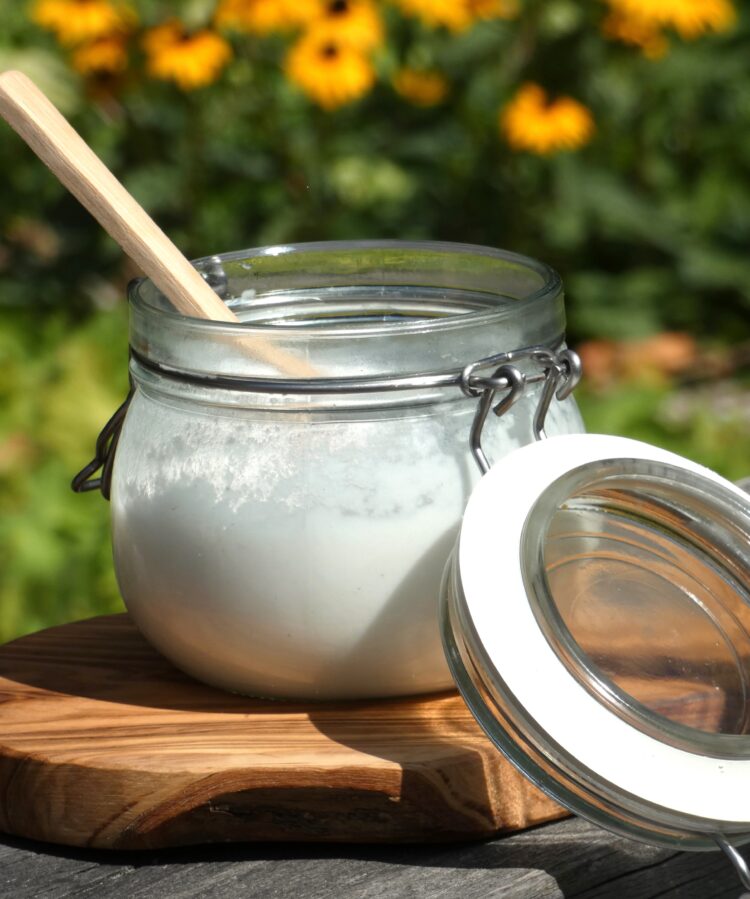
A plant-based coconut yogurt fermented with probiotics, with no added sugar, a creamy texture and a refreshing tang.
By the spoonful, the texture is smooth and creamy: the coconut stays mild, with the refreshing tang of a well-chilled dessert. Allow 24 hours of fermentation in a warm place, then about 6 hours in the refrigerator. With a carefully measured dose of probiotics, this homemade coconut yogurt makes 3 small jars rich in live cultures, with no added sugar. Allow about 30 hours in total and roughly 220 kcal per small jar. Find this recipe among my keto breakfasts.
What is coconut yogurt?
A fermented preparation made with full-fat coconut milk, or a block of creamed coconut diluted with water, inoculated with probiotics. The word yogurt refers to the fermentation: the base remains plant-based, and its body comes from the coconut fat. The base must first be completely smooth, especially when using a block, then cooled to below 45 °C before adding the powdered probiotics, totaling 4 to 8 billion bacteria.
These cultures start the fermentation and gently develop acidity over 24 hours in a warm place. Refrigeration improves the texture: the cold firms up the coconut fats for a creamier consistency. The recipe makes 3 small jars, portioned into tightly sealed jars, preferably glass, or into the jars of a yogurt maker.
How the preparation works
The recipe follows the steps of home fermentation: heat, cool, inoculate, leave to ferment, then chill until firm. Its distinctive feature is the use of powdered probiotics as a starter culture, an accessible solution for a dairy-free version with consistent results. Two bases lead to the same result, either full-fat coconut milk, which is already liquid, or a diluted block of creamed coconut; the goal remains a creamy texture, a clean coconut flavor and a hint of tanginess. With no added sugar, it can suit a low-carb diet depending on the product and toppings.
The main ingredients
Full-fat coconut milk, 400 ml, provides body, flavor and structure; a full-fat version gives a better consistency after chilling than a heavily diluted coconut drink. Alternatively, a block of creamed coconut, 200 g with 200 to 400 ml of water, provides concentrated coconut flesh and fat: less water for a denser base, more water for a thinner yogurt, with the mixture perfectly smooth before inoculation.
The probiotics, totaling 4 to 8 billion bacteria, trigger fermentation and develop acidity; if using capsules, open them and use only the powder, distributing it evenly throughout the lukewarm base. Agar-agar, 1 to 2 teaspoons and optional, can help the yogurt set but must be incorporated before the cultures, as it requires appropriate heating to activate. Water is only needed with the block of creamed coconut, to adjust the fluidity, but judge the texture mainly after chilling.
Fermentation, hygiene and serving
The key moment is adding the probiotics: the base must have cooled to below 45 °C, and a thermometer provides assurance that touch alone cannot guarantee. Leave to ferment for 24 hours in a warm place, in a yogurt maker or in a jar kept somewhere warm. After fermentation, the coconut takes on a tangy note; the texture may seem runny, but the refrigerator finishes the setting process in about 6 hours. With a block of creamed coconut, slight graininess or a little watery separation is not necessarily a problem: stir, leave to rest in the refrigerator, then judge the thickness once the yogurt is thoroughly chilled.

Hygiene requires care: the container, spoon, saucepan and jars must be very clean, as reheating is no substitute for cleanliness. Excessive or fluctuating heat undermines fermentation, which is why a yogurt maker is useful. In the refrigerator, the jars will keep for just under a week if everything has gone well, using a clean spoon each time you take some, though food safety is not guaranteed: discard any moldy, discolored or rancid-smelling batch without tasting it. Serve cold and plain, adding a few berries, hemp seeds or unsweetened cacao nibs just before serving. In France, full-fat coconut milk and blocks of creamed coconut, sometimes sold under the name “ creamed coconut ”, can be found in the international food aisle, Asian grocery stores or organic food shops; do not heat the yogurt after fermentation, to preserve the live bacteria.
You can find more dishes of this kind among my low-carb recipes.
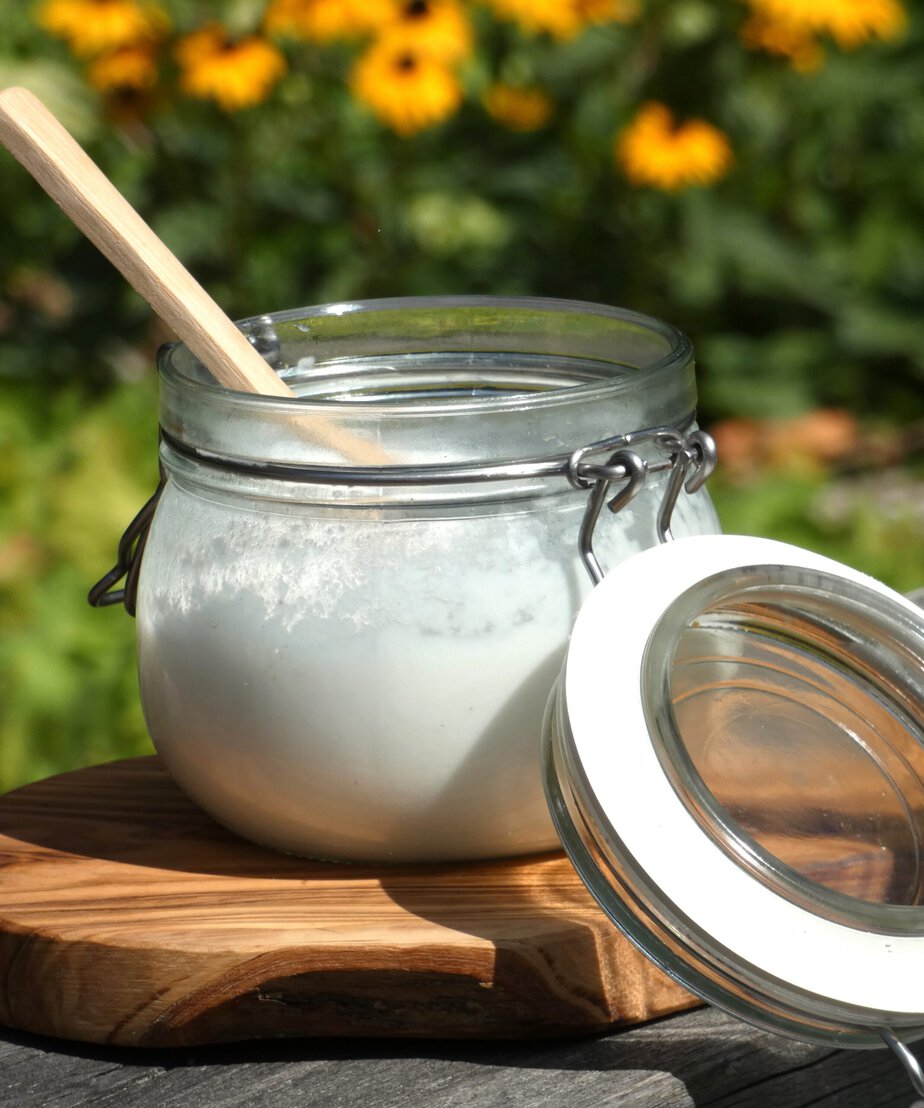
Homemade Coconut Yogurt
Ingredients
- 200 g creamed coconut block
- 200 to 400 ml water or 400 ml of full-fat coconut milk
- 4 to 8 billion probiotic bacteria
Optional
- 1 to 2 teaspoons agar-agar
Instructions
Using a creamed coconut block
- Mix the creamed coconut block with hot water, or with cooler water and then heat everything in a small saucepan. The creamed coconut block must be fully blended with the water to produce a smooth, uniform milk.200 g creamed coconut block, 200 to 400 ml water, 1 to 2 teaspoons agar-agar
Using coconut milk
- Heat the milk in a small saucepan.
Using either a creamed coconut block or coconut milk
- Let the base cool to no more than 45 degrees Celsius, preferably a little cooler as a precaution.
- Add the probiotic powder. If using capsules, open them first! Do not use the capsules themselves (the shells).4 to 8 billion probiotic bacteria
- Mix the milk and probiotics thoroughly. Pour into a jar that can be tightly sealed, preferably a glass one.
- Alternatively, pour into the yogurt maker/divide among the yogurt maker’s jars, then follow the instructions for your model.
- If using a jar with a rubber seal, leave it in a warm place for 24 hours. In summer, place it behind a sunny window. In winter, place it near the boiler or on a heated floor. Shake gently from time to time.
- Open the jar carefully: it is under pressure! To do this, for example, place your hand on the lid and first let a little air escape while pressing down against it. Point the opening away from you.
- Stir briefly and leave in the refrigerator for a few hours. The yogurt is then ready to eat.
- To make the yogurt thinner or thicker, wait until it has cooled, as it will firm up a little more as it cools.
- Use a clean spoon to scoop out the yogurt. The yogurt will keep in the refrigerator for just under a week.