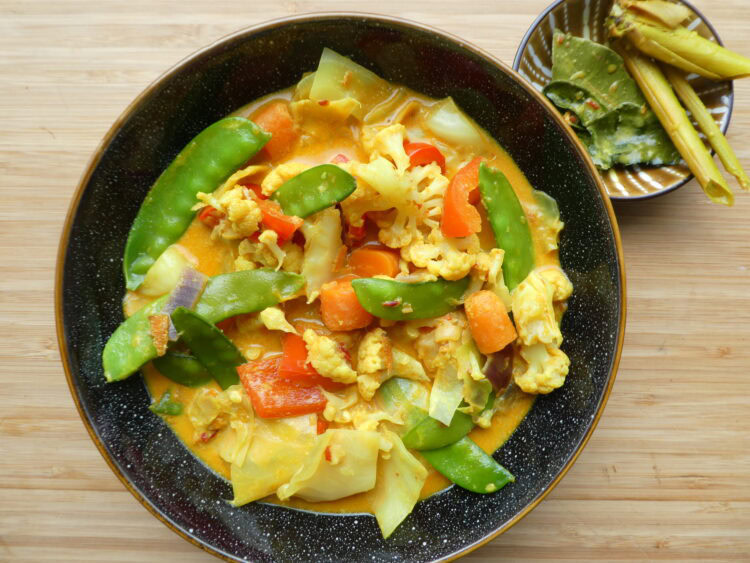
An Indonesian vegetable stew in a coconut milk broth, scented with galangal, turmeric and makrut lime.
Coconut milk coats the vegetables with a light, creamy texture, enlivened by resinous galangal, golden turmeric, punchy ginger, lemongrass and makrut lime. Trassi and fish sauce give the broth a salty, briny flavor, while the vegetables stay tender without falling apart. This fragrant stew takes around 30 minutes to cook and stays low in carbohydrates, with 9 g of net carbs per serving. Find this recipe among my keto main dishes.
What is sayur lodeh?
In everyday Indonesian cooking, sayur lodeh is a vegetable stew served in a generous coconut milk broth. Its ingredients vary with the market, the season and your mood, but the idea remains the same: chunky vegetables, plenty of sauce, fresh aromatics and a gentle coconut sweetness that brings everything together.
The dish is built on a boemboe, a pounded aromatic paste combining garlic with ginger, galangal and fresh turmeric, sometimes with a little chili. Makrut lime leaves, daun salam leaves and pieces of lemongrass infuse the sauce with flavor; count them so you can remove them before serving. Coconut milk and a little solid coconut cream, known as santen, give it a velvety texture, while trassi and fish sauce supply salt and umami.
An easy-to-adapt family dish
Sayur lodeh is one of those family recipes served in a large dish in the center of the table, with a ladle. A deep wok or sauté pan holds the aromatics, coconut broth and vegetables; if your frying pan is too shallow, it is best to finish simmering in a large pot.
This version combines cauliflower, white cabbage, carrot, bell pepper and snow peas, cut into evenly sized pieces for uniform cooking. The flavor comes from trassi, fish sauce, fresh galangal and makrut lime leaves, balancing sweetness, citrus, warmth and briny depth. Trassi, a fermented shrimp paste, and fish sauce mean this dish is not vegetarian.
The main ingredients
The vegetables weigh 600 g in total. The cauliflower, 150 g, provides bulk and structure, and its florets soak up the coconut sauce well; the white cabbage, 125 g, adds a subtle sweetness and tender texture. The carrot, 125 g, brings color to the dish and mellows the broth; you can leave it out for a lower-carb version. The bell pepper, 100 g, retains a fruity note, and the snow peas, 100 g, are added later to keep them green and firm.
The red onion forms a sweet base once sautéed, while two garlic cloves strengthen the boemboe. Fresh ginger adds a distinct warmth, galangal brings woody, citrusy notes, and turmeric contributes a golden color and earthy flavor; half a red chili adds heat without masking the coconut. For seasoning, a 5 mm piece of block trassi or 0.5 tablespoon of the powdered version is enough, and half a teaspoon of sugar-free fish sauce adds a subtle saltiness.
The liquid base totals 750 ml, made from a can of coconut milk topped up with 350 ml of stock, for a thin sauce. A small cube of santen, around 2 tablespoons, enhances the velvety texture, and coconut oil is used to sauté the aromatics. Cumin seeds, coriander seeds and candlenuts are optional; the latter must be toasted and then cooked, as they are toxic when raw. Trassi, fish sauce and stock already add plenty of salt, so taste before adding more.
Cooking tips and serving
There should be plenty of sauce, with a consistency close to a coconut milk broth. Cut the vegetables into bite-sized pieces: the firmer ones, white cabbage, carrot and cauliflower, need around 10 minutes, then the bell pepper and snow peas cook for another 5 minutes. Gentle heat keeps the coconut emulsion stable and prevents the vegetables from becoming too soft.
Serve sayur lodeh in a large dish with a ladle, so you can scoop up the sauce and vegetables together. The 9 g of net carbs per serving applies to the dish alone; cauliflower rice soaks up the broth nicely while keeping the meal low in carbohydrates. Cool quickly before refrigerating in an airtight container, then reheat gently while stirring, as coconut milk sets when cold and becomes fluid again when warmed. You can freeze it, though the vegetables will be softer afterward.
You can find other dishes like this among my low-carb recipes.
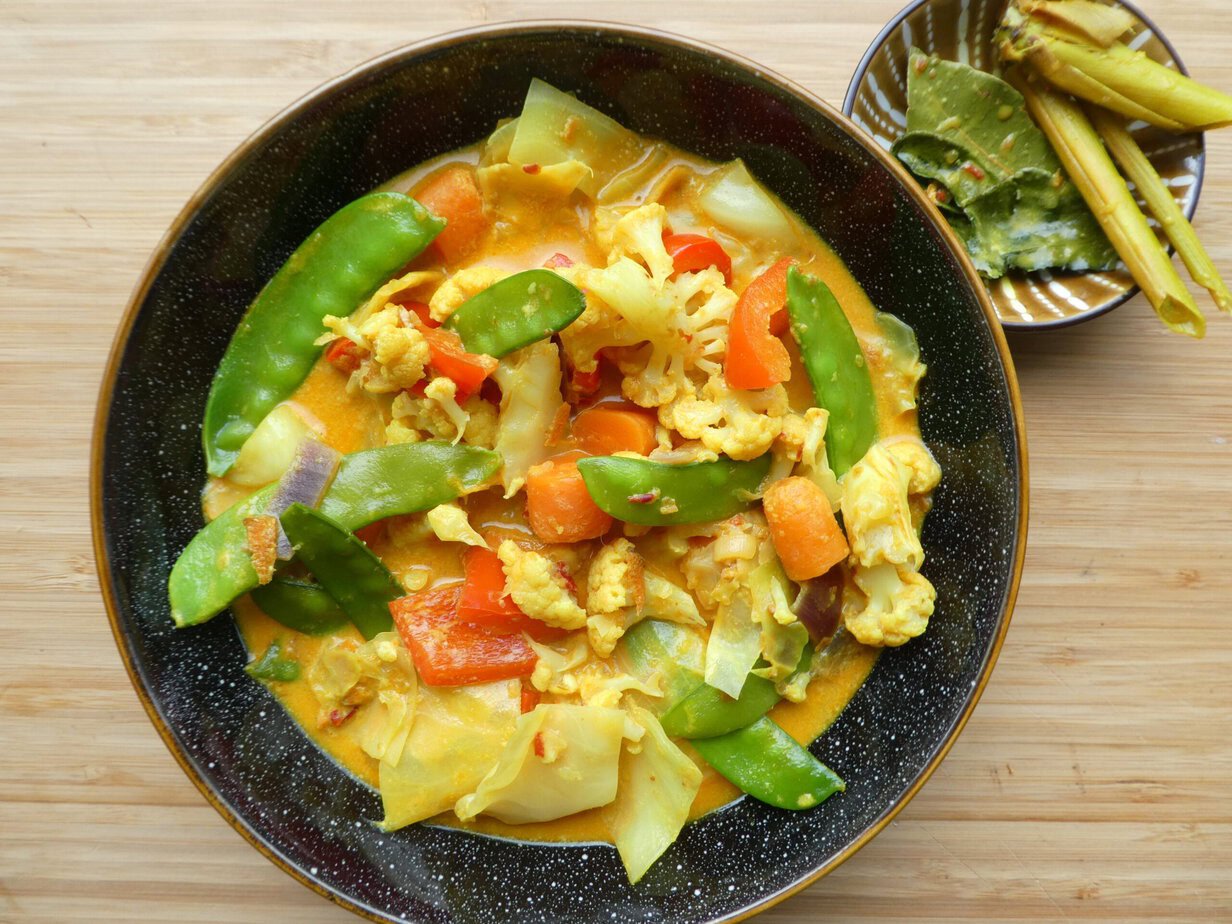
Sayur lodeh
Ingredients
- 150 g cauliflower
- 125 g white cabbage
- 125 g carrot
- 100 g bell pepper
- 100 g snow peas
Sauce
- 1 red onion
- 2 cloves garlic
- 0.5 cm trassi shrimp paste or 0.5 tablespoon of trassi powder
- 0.5 teaspoon fish sauce sugar-free
- a small piece ginger fresh
- a small piece galangal fresh
- a small piece turmeric fresh
- 1 or 2 makrut lime leaves (djeroek poeroet)
- 1 or 2 Indonesian bay leaves (daun salaam)
- 1 or 2 stalks fresh lemongrass
- 750 ml liquid 1 can of coconut milk + 350 ml of stock
- About 2 tablespoons coconut cream in a block (a small cube)
- 1 tablespoon coconut oil for cooking
Optional
- 0.5 to 1 red chili pepper (chili or Spanish pepper)
- 1 teaspoon cumin seeds ground or whole
- 2 teaspoons coriander seeds ground or whole
- 3 candlenuts cook thoroughly, as they are toxic when raw!
Instructions
- For the boemboe spice paste, chop or grate the garlic, red chili pepper, ginger, galangal and turmeric. You can also do this in a small food processor. Then, if desired, pound further in a mortar.2 cloves garlic, 0.5 to 1 red chili pepper (chili or Spanish pepper), a small piece ginger, a small piece galangal, a small piece turmeric
- If using candlenuts, crush them in a mortar. Toast them in a hot pan without oil. If using whole cumin and coriander seeds, toast them briefly with the nuts at the end.3 candlenuts, 1 teaspoon cumin seeds, 2 teaspoons coriander seeds
- Add oil to the pan. Cut the onion into half-rings and sauté until translucent.1 tablespoon coconut oil, 1 red onion
- Add the boemboe spice paste and trassi. If using ground cumin and coriander seeds, add them at this stage too.0.5 cm trassi shrimp paste
- Add the coconut milk, creamed coconut, stock and fish sauce.750 ml liquid, About 2 tablespoons coconut cream, 0.5 teaspoon fish sauce
- Add the creamed coconut, makrut lime leaves and bay leaves. Bruise the lemongrass or cut it into large pieces and add it. Keep track of how many leaves and pieces of lemongrass you add, as you will need to fish them out later.1 or 2 makrut lime leaves (djeroek poeroet), 1 or 2 Indonesian bay leaves (daun salaam), 1 or 2 stalks fresh lemongrass
- Cut the white cabbage into large pieces, cut the carrot into bite-sized pieces and separate the cauliflower into bite-sized florets. Add them.125 g white cabbage, 125 g carrot, 150 g cauliflower
- If using a high-sided wok, you can cook everything in the same pan. If using a shallow frying pan, transfer everything to a large pot.
- Cook for 10 minutes. Wash and cut the vegetables that need less cooking time. Add the chopped bell pepper and snow peas. Cook for about 5 more minutes.100 g bell pepper, 100 g snow peas
- Bring to the table in a large serving dish. Let everyone help themselves.