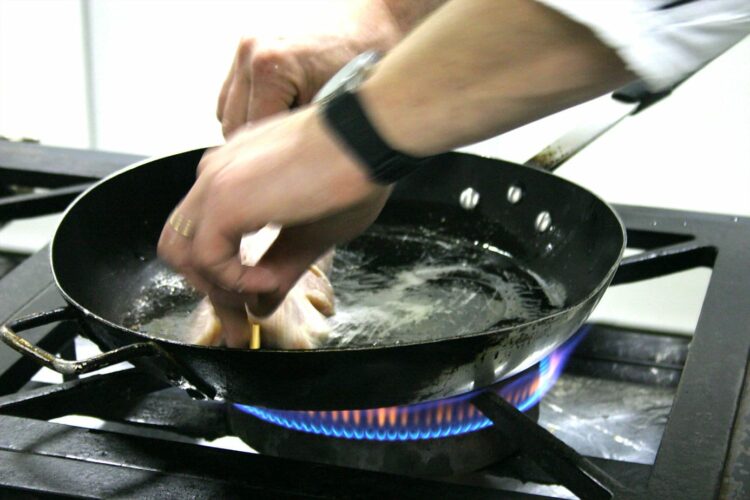
What is a wok?
The wok is a deep pot with a rounded bottom, shaped like a spherical cap. This utensil is common in China, popular in the eastern and southern regions, throughout Southeast Asia, as well as in other parts of the world.
A flagship element of Chinese, Thai, and Japanese cooking, and really of Asian cuisine in the broadest sense: the wok is the essential utensil to have in your kitchen! However, when the time comes to buy a wok, it can be difficult to choose one based on your needs. The aim of this article is to explain the different kinds of wok, their advantages and disadvantages, so that you can make a choice under the best possible conditions.
Why cook with a wok?
Because it’s amazing! The shape of the utensil makes it the perfect versatile tool that won’t mess up your whole kitchen every time you use it. On top of that, it generally heats up very well, which allows for a one-of-a-kind searing of food that is typical of many Asian dishes. And if the wok is wide enough, fried eggs or a nice steak come out beautifully in it.
How much does a wok cost?
It depends greatly on the material used to make it, so for that I’ll point you to the rest of the article. That said, for a good entry-level wok you can expect to pay between €30 and €50 if you don’t want any material that turns toxic at high temperatures.
What materials are used in a wok?
Woks can be classified according to the materials used to build them; we distinguish 10:
- Carbon steel
- Cast iron
- Enameled cast iron
- Aluminum
- Anodized aluminum
- Stainless steel
- Iron
- Non-stick coating
- Ceramic
- Copper
How to choose the right wok?
It’s very important to clearly define your personal needs and your kitchen environment: Will you be cooking Asian food often? How much space and what type of cooktop do you have? What is your budget? Normally, the information in this article should let you quickly compare your criteria with the characteristics of a potential wok!
Which material for a wok?
1. Carbon steel wok
A wok can be made from a single sheet of high-quality carbon steel, hammered entirely by hand into the shape of a wok. This type of wok is the most traditional of all. It is very durable thanks to the absence of joints. However, the handles are welded on. In general, Chinese chefs prefer these lightweight woks over the others. Your chicken wok or vegetable wok will have an authentic taste (I’ll point you to the rest of my site for some good recipes)


The disadvantages of a carbon steel wok
The only downside of such a carbon steel wok is the upkeep. You have to “season” it from time to time and clean it carefully. Every time you put it away, you have to heat it so that the moisture disappears completely and the wok doesn’t rust. However, if seasoning and intensive hand-washing don’t suit you, carbon steel woks are also available with a non-stick coating.
Non-stick carbon steel wok
Non-stick coated carbon steel is the wok material that has gained a lot of popularity nowadays. Carbon steel is a lightweight material, and it also provides efficient, even heat distribution. For this reason, cooks want to have such a wok. But given the difficult maintenance, non-stick coated carbon steel woks are the most preferable.


2. Cast iron wok
You’ll find cast iron woks in every traditional Asian kitchen. Cast iron is ideal for heating up quickly and distributing heat evenly. This ultimately translates into an excellent stir-fry. That’s the main reason chefs love cast iron as a wok material.


The market offers many pre-seasoned cast iron woks. Among them, the uno casa wok is one of the most popular. This Cantonese-style wok is very durable and extremely cheap when you look at the materials used.
The disadvantages of a cast iron wok
They’re not very rust-resistant and need to be “seasoned” often. The maintenance required is therefore very high. However, enameled cast iron doesn’t require seasoning or much upkeep, yet offers the same cooking quality as cast iron. I’ll tell you about it right now.
3. Enameled cast iron wok
When a special substance is applied to the surface of cast iron, it’s called enameled cast iron. The enamel prevents the cast iron from rusting. What’s more, you won’t need to season it. Cleaning enameled cast iron is child’s play, and it’s a far better option than pure cast iron. Some cast iron woks also contain substances that aren’t very good for your health, whereas enameled cast iron will, in effect, be a safer wok material.


The enameled cast iron wok above is a very popular model. This wok requires little maintenance and doesn’t need seasoning. The included lid makes this wok a versatile cooking tool; you can use it to make red pork, for example.
The disadvantages of an enameled cast iron wok
All these advantages come at a price: indeed, it’s one of the most expensive types of wok.
4. Aluminum wok
Aluminum woks are very common kitchen utensils in Asian households. Indeed, aluminum is the ideal wok material for making stir-fries, since this metal has a better and, above all, faster heat-distribution capacity than others; so over low heat, your ingredients will cook evenly. Aluminum is also cheap and requires less maintenance. The aluminum wok is corrosion-resistant and therefore very durable, on top of being lightweight.
The disadvantages of an aluminum wok
Its heat-retention capacity isn’t good, so if you take the wok off the heat, it will cool down very quickly. But the main issue is safety…. Basically, you can’t cook acidic foods in an aluminum wok because they react with the metal, and since many stir-fried dishes include an acidic wok sauce (General Tso’s chicken, for example), you unfortunately have to avoid this material for a wok at all costs. With one exception:
5. Hard-anodized aluminum wok
By immersing aluminum in a chemical bath and applying an electric current, you produce what is called anodized aluminum. Roughly speaking, an oxide layer hardens the aluminum and makes it rustproof. It’s like a 2.0 version of classic aluminum.
This aluminum 2.0 is also the safest wok material:
- It’s one of the most robust and non-reactive metals at high temperatures. Anodized woks don’t react with acidic foods and therefore keep your food healthy.
- It’s an excellent heat conductor, preventing hot spots and ensuring even heat distribution.
- It usually comes with a natural non-stick coating that improves the user experience.
- Premium hard-anodized woks are also oven- and dishwasher-safe.
- It’s very lightweight


This hard-anodized aluminum wok, despite the price, is the most worthwhile investment for beginners if you plan to dedicate yourself to Asian cooking for a while.
The disadvantages of an anodized aluminum wok
The anodized aluminum wok offers a non-stick coating. However, it’s not a 100% non-stick surface, so some foods can stick and that can make the cleaning process difficult.
6. Stainless steel wok
Stainless steel is the most modern wok material of all. Stainless steel woks are found in many commercial kitchens and modern households. Stainless steel is more durable because it resists rust and scratches. Stainless steel is also considered one of the safest wok materials, one that won’t release any bad substances at high temperatures.
The stainless steel wok is durable, elegant, and versatile, and it supports many cooking styles, including stir-frying, deep-frying, steaming, boiling, and so on. All of this is possible thanks to its flexibility in the face of changes in heat intensity and temperature. Stainless steel woks are also oven- and dishwasher-safe, which makes it the best wok material for a hassle-free modern kitchen.


This generic steel wok is the best stainless steel wok for beginners on the market; it even includes a frying rack that lets you make delicious shrimp fritters very easily. This wok is also an induction wok, so for people with induction cooktops, it’s perfect!
The disadvantages of the stainless steel wok
Stainless steel woks are expensive and don’t give you the authentic wok-cooking experience that cast iron or carbon steel does. But apart from that, it’s all advantages.
7. Iron wok
Iron woks are also one of the “primitive” types of wok found very commonly in the markets of Asian countries. These are commonly used in countries such as India, Pakistan, Bangladesh, China, Korea, and many others.
The best advantage of iron woks is that they are 100% safe for your health. Iron woks are often pre-seasoned.
The disadvantages of an iron wok
It’s not a very durable material and is prone to rust. You’re better off turning to modern alternatives, since they aren’t good long-term investments.
8. Wok with a non-stick coating
These days, you’ll find a non-stick pan in every kitchen. Non-stick woks are made from materials such as carbon steel, cast iron, stainless steel, ceramic, aluminum, and so on, with a non-stick coating. Teflon is a popular non-stick substance used for the coating.
Woks with a non-stick coating improve the cooking experience by making it very easy, hassle-free, to cook food. It’s more commonly used to eliminate the excessive use of oil and fat.
The disadvantages of a wok with a non-stick coating
Teflon releases toxic fumes at high temperatures. Non-stick pans are also very prone to scratching. Even a single scratch can ruin your wok pan and make it unhealthy. To be avoided.
9. Ceramic wok
The ceramic wok is a staple kitchen utensil in today’s modern kitchens. When you search online for a ceramic wok, you’ll find a wide range of colors and designs, each more varied than the last.
Ceramic woks are excellent for everyday use because they resist scratching, peeling, or coating wear. Ceramic woks are also very easy to clean and are dishwasher- and oven-safe as well. They also work on all types of stovetops, except induction.
The disadvantages of a ceramic wok
These woks don’t have any traditional touch and are also very fragile.
10. Copper wok
Copper woks are the most high-end woks of all. They’re really pleasing to look at, very good at heat distribution, and available with both flat and round bottoms. Woks made solely from natural copper are the safest to choose. Copper woks usually come with a non-stick coating, but tinned coatings are healthy and non-reactive, so no worries.
The disadvantages of a copper wok
This type of wok material is costly and must be washed by hand only. On top of that, you should only use wooden spatulas/spoons to handle them, since they are extremely sensitive to heat.