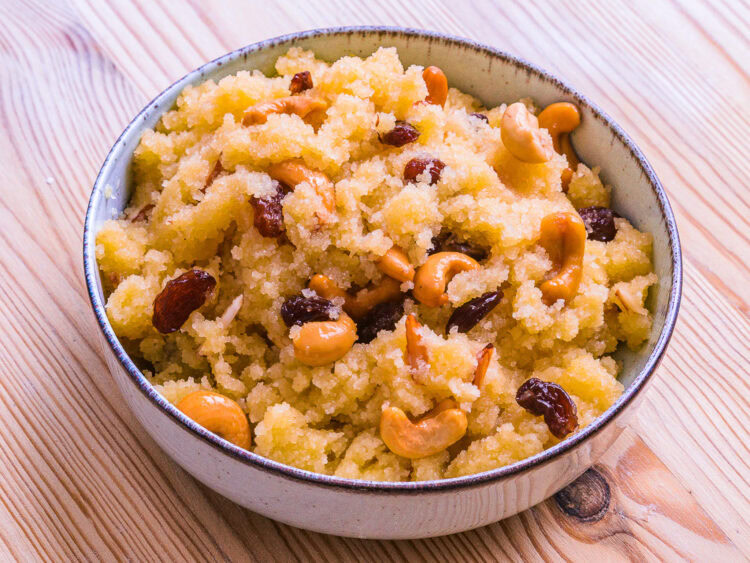
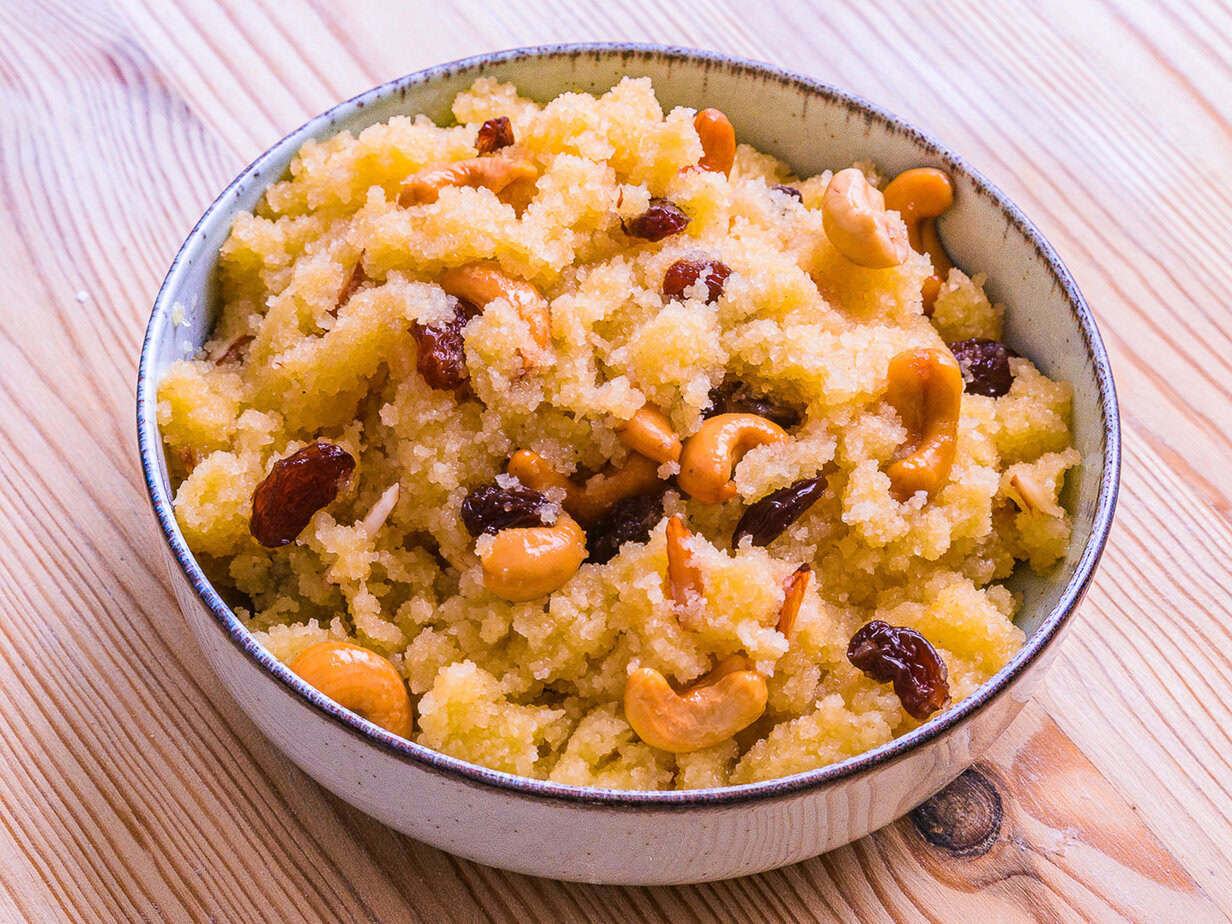
An Indian sweet made with fine semolina toasted in ghee, sweetened, scented with cardamom and garnished with cashews, almonds and raisins.
Some evenings call for a warm dessert that fills the whole house with its aroma. In the pan, the semolina slowly turns golden in the ghee, taking on a toasted hazelnut aroma, almost like a biscuit.
Hot water makes it swell with a sizzle, the cardamom goes in, and plump raisins nestle among the crunchy cashews. Eaten by the spoonful while still warm, the halwa is soft, glossy and meltingly tender, and the bowl empties much faster than expected.
What is semolina halwa ?
Semolina halwa is an Indian dessert made with fine semolina toasted in ghee, then cooked with hot water and sweetened. Cardamom lends its fragrance, while cashews, almonds and raisins fried in ghee provide the garnish. Its soft texture recalls a semolina pudding, with a much more pronounced toasted flavor. In Maharashtra and Gujarat, it is called sheera.
The word halwa comes from the Arabic hulw, meaning “ sweet ”. In Hindi, sooji means wheat semolina : sooji ka halwa therefore simply means “ semolina halwa ”.
From Arab confections to Indian kitchens
The earliest halwas were Middle Eastern confections made from dates and milk, or sugar syrup cooked with honey, almonds and sesame seeds. A 13th century Arabic cookbook, the Kitab al-Tabikh, already describes several varieties, flavored with cardamom or rose water.
The dessert reached India through trade and via Persia during the Delhi Sultanate. In the 16th century, the Ain-i-Akbari lists it among the dishes served to the Mughal emperor Akbar on days when he did not eat meat.
Halwa then developed into a broad family of sweets based on grains, vegetables or nuts and dried fruit. In the South, rava kesari is a semolina halwa colored with saffron ; in the North, gajar halwa, made with grated carrots slowly cooked in milk, is the dessert of winter celebrations.
Semolina halwa remains the most common. Families prepare it for an afternoon snack or breakfast, and it often serves as prasad, an offering shared after prayer. During Navratri, on the day of Ashtami pooja, it is served with poori, small fried breads made from the same dough as chapati, and spiced black chickpeas, a cousin of chana masala.
The main ingredients in semolina halwa
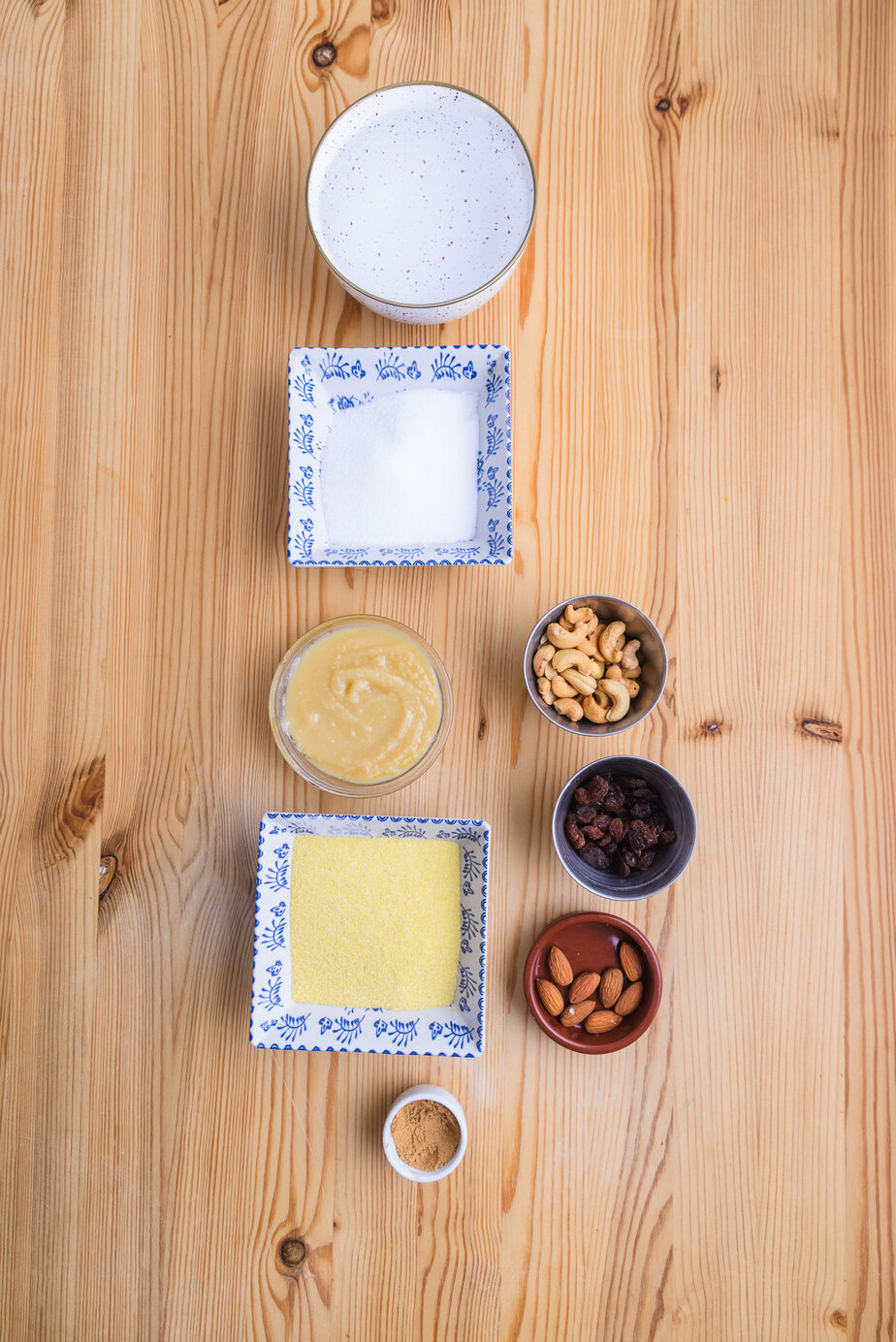
Fine semolina forms the base, and the finer the grain, the softer the halwa. Ghee, a clarified butter, is used to toast the semolina, carry the aromas and give the dessert its glossy finish. It stands up well to heat, whereas regular unsalted butter, with its water and milk solids, burns more quickly. The traditional recipe uses equal quantities of semolina, ghee and sugar{NB}; this version uses less ghee, and adding two tablespoons at the end of cooking makes for a richer halwa.
Water determines the texture : a little less water produces a grainier halwa to eat on its own, while more makes a very soft halwa, just as it is enjoyed with poori. Some of the water can be replaced with whole milk for a creamier result. The sugar only goes in once the water has been absorbed.
The garnish does the rest. The cashews turn golden in the ghee, the sliced almonds add delicate slivers, and the raisins swell until juicy. Half cooks with the semolina, while the other half is set aside and added back at the end. Cardamom gives the halwa its fragrance ; rose water can replace it, bringing the same floral note found in rose syrup.
Technique tips for great semolina halwa
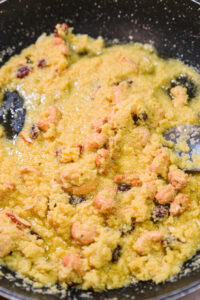
It all comes down to toasting : in a heavy-bottomed pan over low to medium heat, toast the semolina for 12 to 15 minutes, stirring constantly, until fragrant and the ghee begins to separate. Too brown, and it turns bitter ; too pale, and the halwa lacks flavor and becomes sticky. The water should be very hot but not boiling, and it splatters vigorously on contact with the semolina : pour it in all at once, carefully, then stir immediately. A successful halwa pulls away from the sides of the pan, stays soft and has a gentle sheen of ghee.
Ingredients
- 160 g fine semolina
- 100 g ghee
- 175 g sugar
- 600 ml water
- 45 g cashews, halved
- 8 almonds, thinly sliced
- 2 tablespoons raisins
- 0.5 teaspoon ground cardamom
Instructions
Préparation
- Heat the ghee in a heavy-bottomed pan.
- Fry the cashews until golden.
- Add the almonds and raisins.
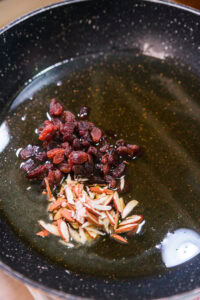
- Continue cooking until the raisins plump up.
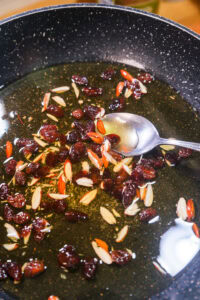
- Set aside half the nuts and raisins for garnish.
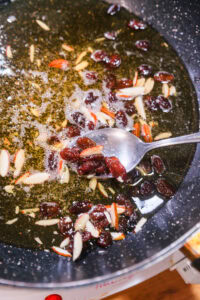
- Lower the heat.
- Add the semolina.
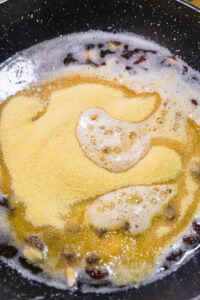
- Toast over low to medium heat, stirring constantly, for 12 to 15 minutes, until golden and fragrant and the ghee begins to separate.
- Meanwhile, heat the water until very hot, without bringing it to a boil.
- Pour the hot water over the semolina all at once, taking care as the mixture tends to splatter.
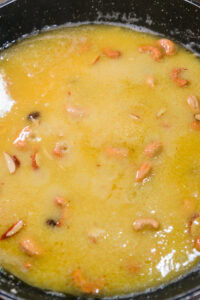
- Stir immediately to prevent lumps.
- Cover and cook for a few minutes, until the water is completely absorbed.
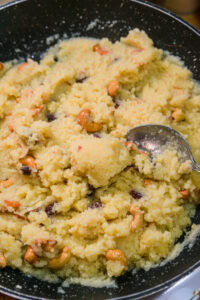
- Add the sugar and cardamom.
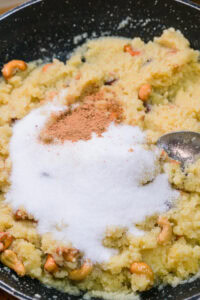
- Stir: the halwa will become runny again.
- Cover and cook until the sugar has dissolved and the halwa pulls away from the sides of the pan.
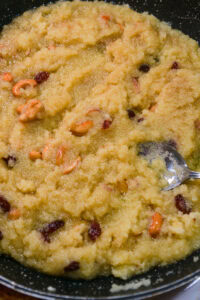
- Stir in the reserved nuts and raisins.
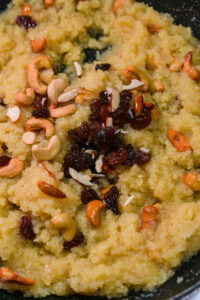
- Serve hot or warm.