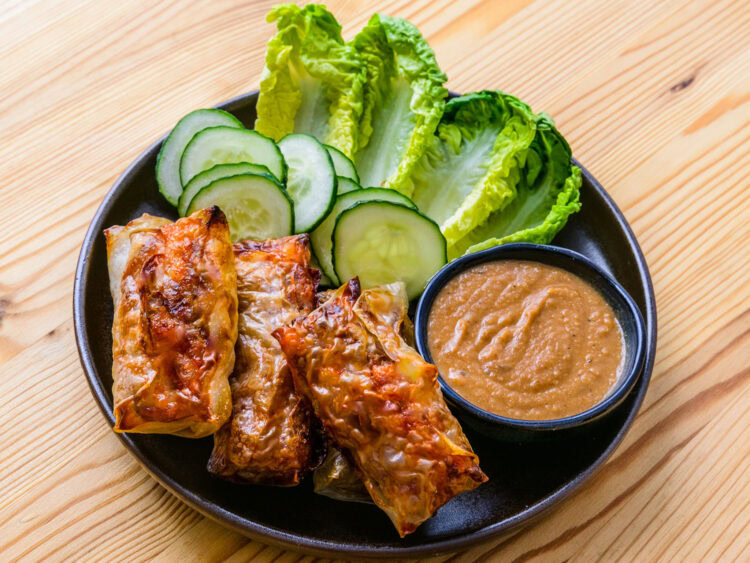
A rice paper roll filled with shrimp and pork, grilled over charcoal and served with a thick peanut-tamarind sauce.
Smoke curls up from a brazier on the street corner, and the smell of grilled rice paper stops you in your tracks. A piping-hot roll is lifted from the skewer, wrapped in a lettuce leaf with Thai basil and cucumber, then dipped into a thick peanut-tamarind sauce. The shell crackles between your teeth, while the shrimp-and-pork filling stays tender inside.
That’s chả lụi from Lagi, the kind of snack you eat standing up, with your fingers, and start recommending after the very first bite.
What is chả lụi?
Chả lụi is a rice paper roll stuffed with pounded small freshwater shrimp and well-marbled pork, colored with annatto oil and grilled over charcoal until the wrapper blisters and turns crisp and brittle.
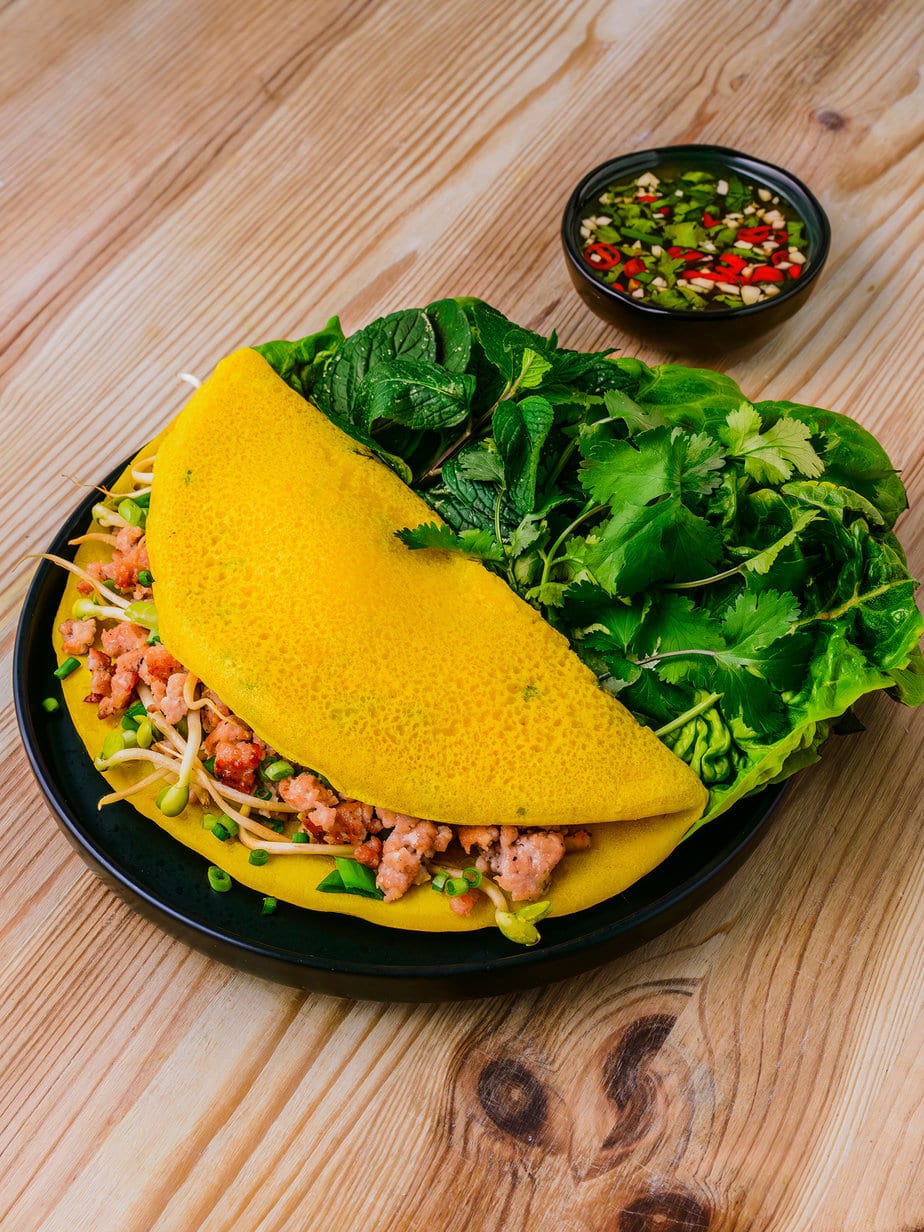
It is neither a Vietnamese fried spring roll nor a sausage. It is often confused with chả lụa, the steamed pork sausage, or with Huế’s nem lụi, molded around lemongrass stalks, but Lagi chả lụi is a dish in its own right, charcoal-grilled and inseparable from its platter of herbs and sticky sauce.
In the coastal speech of Vietnam’s south-central region, the word lụi means “to skewer” or “to pierce,” and the name describes the gesture.
Vendors thread several tightly packed little rice paper bundles onto a bamboo or iron skewer, then turn them together above the coals. This shared axis keeps the rolls aligned, seals the seams, and makes it possible to flip a whole row in one motion.
Born in Lagi, on the coast of Bình Thuận
Chả lụi is a fairly recent addition to Vietnamese cuisine. According to local accounts, it was born in Lagi, a coastal town in Bình Thuận province, in the late 1990s or early 2000s. It is credited to a street vendor named Mrs. Căn, often called Bà Canh, who worked in the Phước Lộc neighborhood.
The idea answered the demands of street food: something affordable, easy to take away, filling, and fragrant enough to stop passersby in front of a charcoal brazier.
Bình Thuận is a land of dried fish and fish sauce, and that local character shapes the dish’s seasoning from start to finish. The filling draws its savoriness from local fish sauce rather than salt, while annatto oil gives the rolls their golden-red sheen.
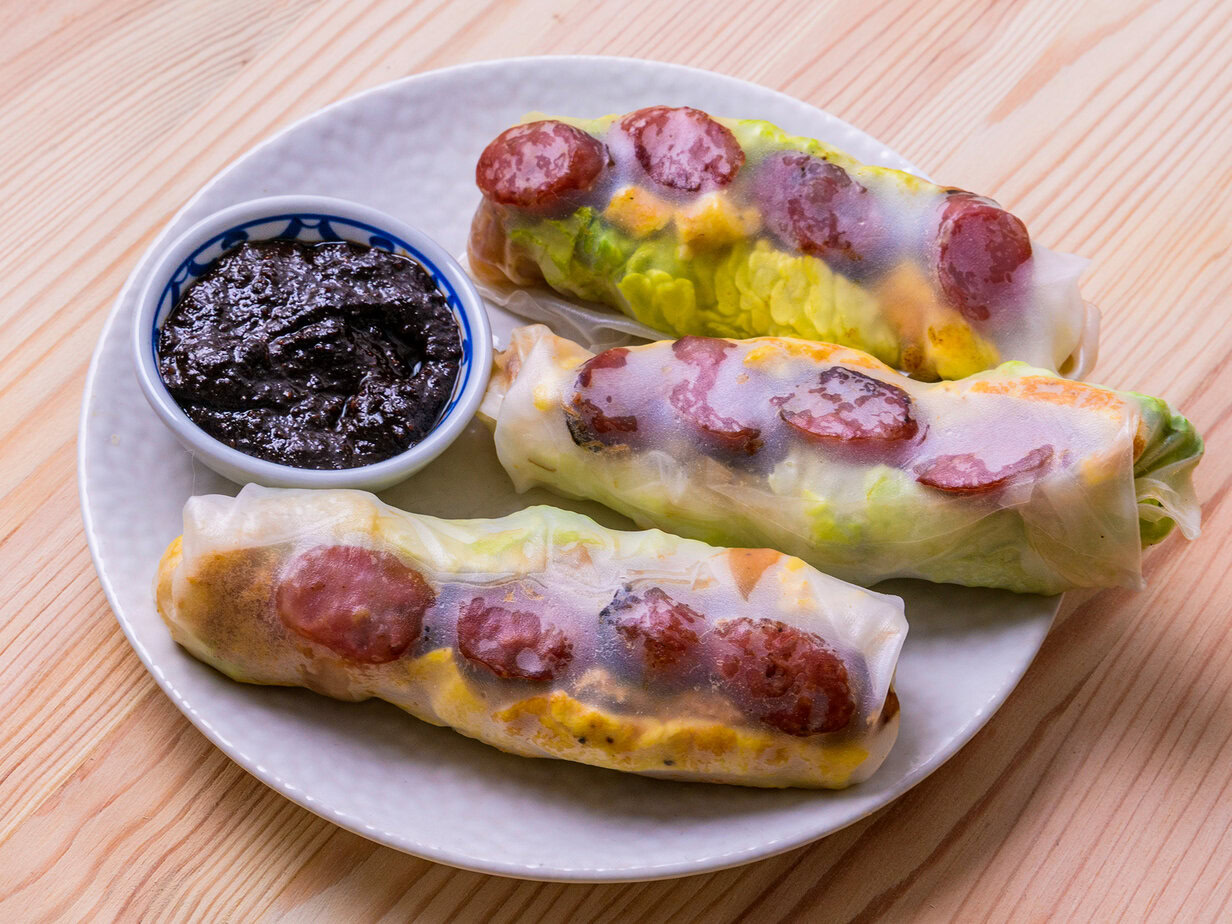
From Lagi, the snack spread to Biên Hòa, Vũng Tàu, Huế, and Ho Chi Minh City. In the city, the rolls are often larger or served alongside other grilled specialties, but Quán Bà Canh remains a touchstone for the old style: small, tightly wrapped rolls with a thin crust and the unmistakable scent of the embers.
Key ingredients in chả lụi
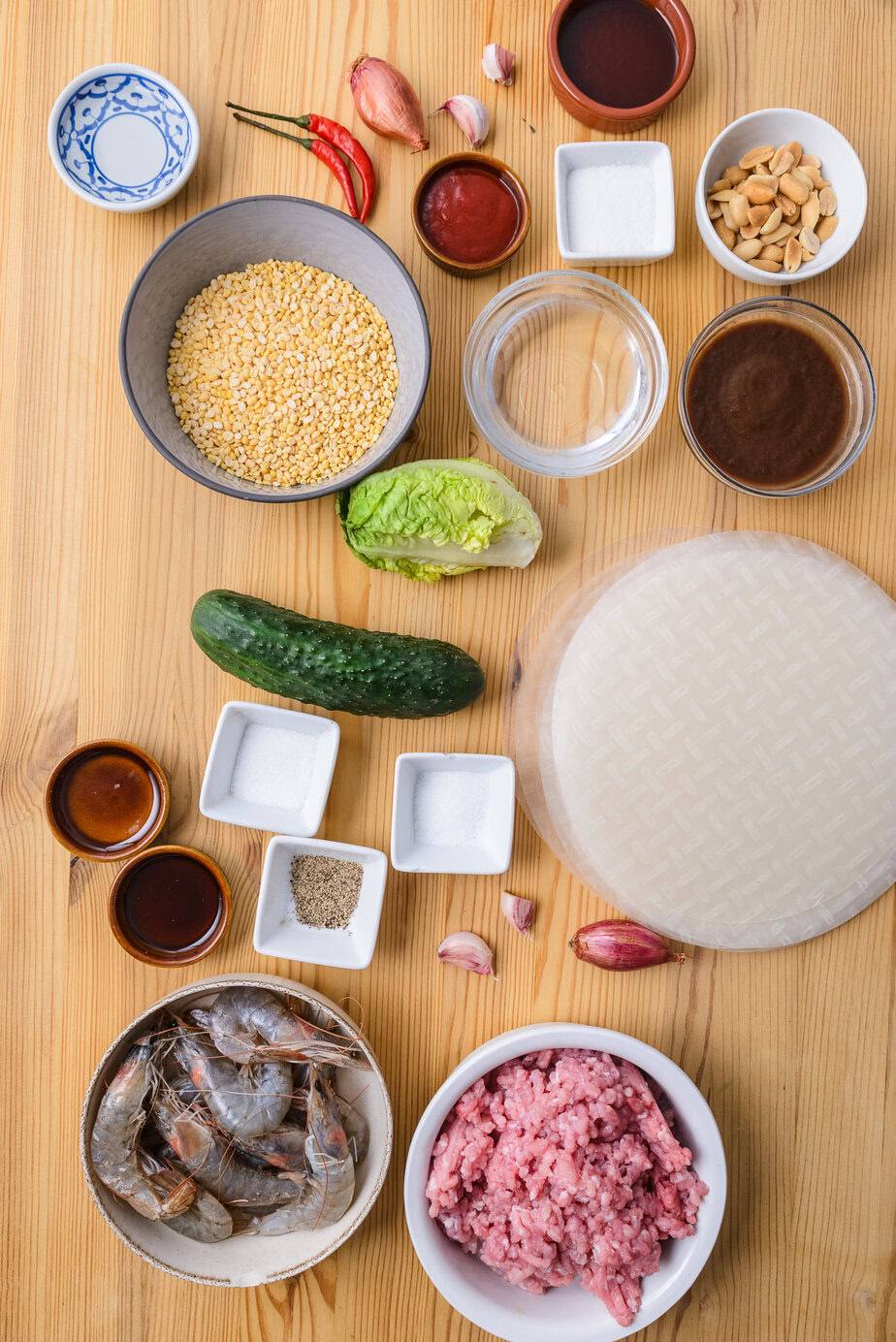
The filling is built around two proteins and a wrapper. Once pounded, the small freshwater shrimp, tôm đất or tôm chỉ, release sticky proteins that bind the mixture and give it elasticity, with a gentle flavor that lacks the pronounced brininess of sea shrimp.
Well-marbled pork belly or shoulder provides the fat that melts during cooking, keeps the center juicy, and helps the rice paper crisp up. The wrapper itself must stand up to light moistening, tight folding, and intense heat: when handled properly, it blisters and becomes almost glassy.
Most of the seasoning comes from fish sauce, which brings both saltiness and umami in place of salt. Annatto oil, dầu điều, colors both the filling and the wrapper a deep golden red and helps the rice paper withstand the heat of the coals. Minced shallot and garlic form the aromatic base, fresh chili and pepper are used with restraint, and a little sugar rounds out the fish sauce. A pinch of MSG is optional.
The sauce is what sets it apart from other Vietnamese rolls. It is cooked rather than mixed raw: fish sauce and sugar are reduced to a syrup, peeled tomato adds body, tamarind brings a rounded tang, and sautéed shallot and garlic add fragrance.
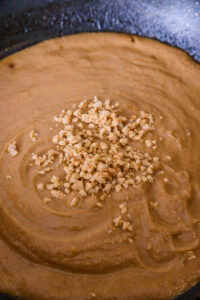
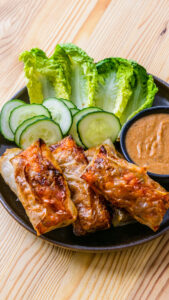
Crushed roasted peanuts are added at the end so they keep their crunch. At the table, lettuce acts as a wrapper, herbs bring freshness, and green mango or starfruit cuts through the richness with bright acidity.
Signs of authenticity and pitfalls to avoid
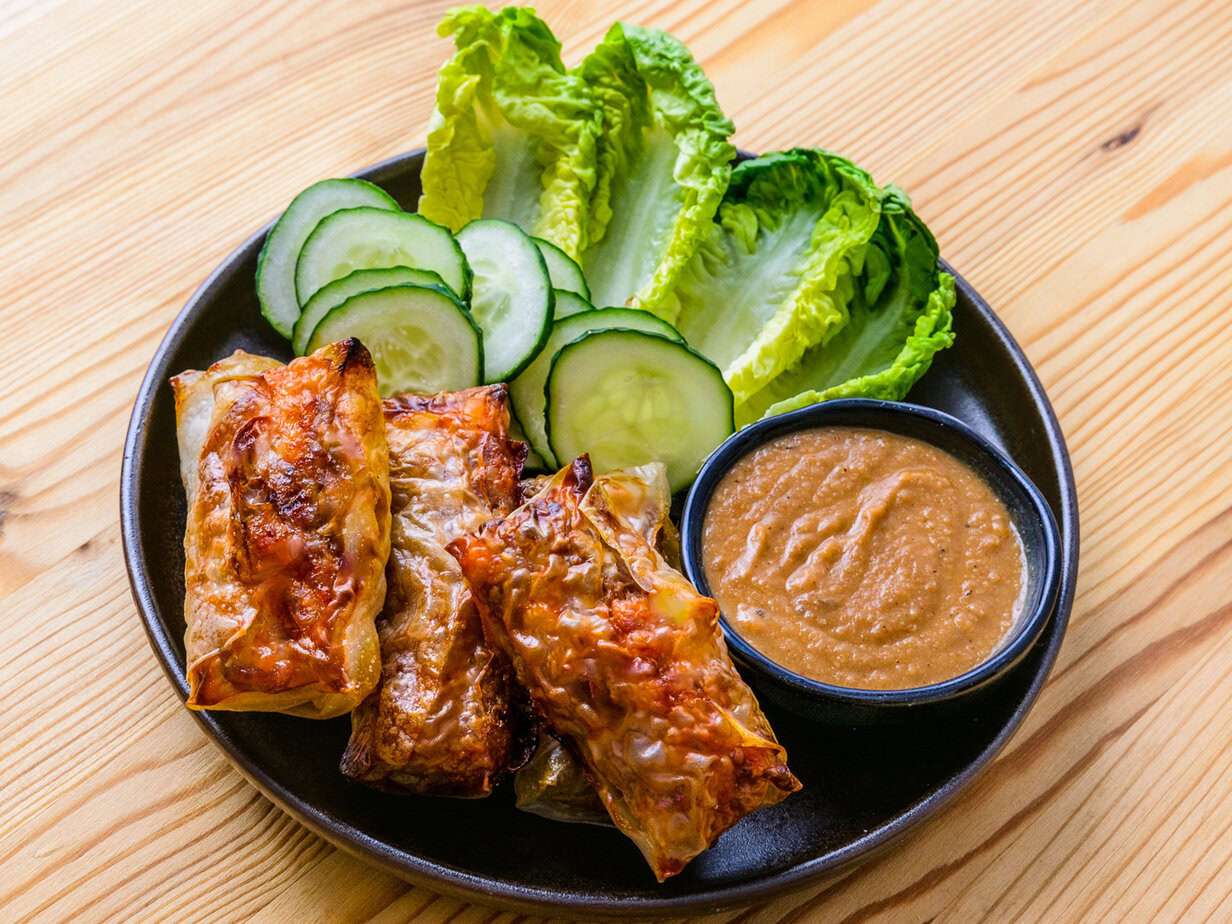
True Lagi-style chả lụi is defined by its charcoal-grilled rice paper shell, not a fried one, and by its thick, cooked sauce of tomato, tamarind, and peanuts, not a bowl of thin, raw dipping sauce.
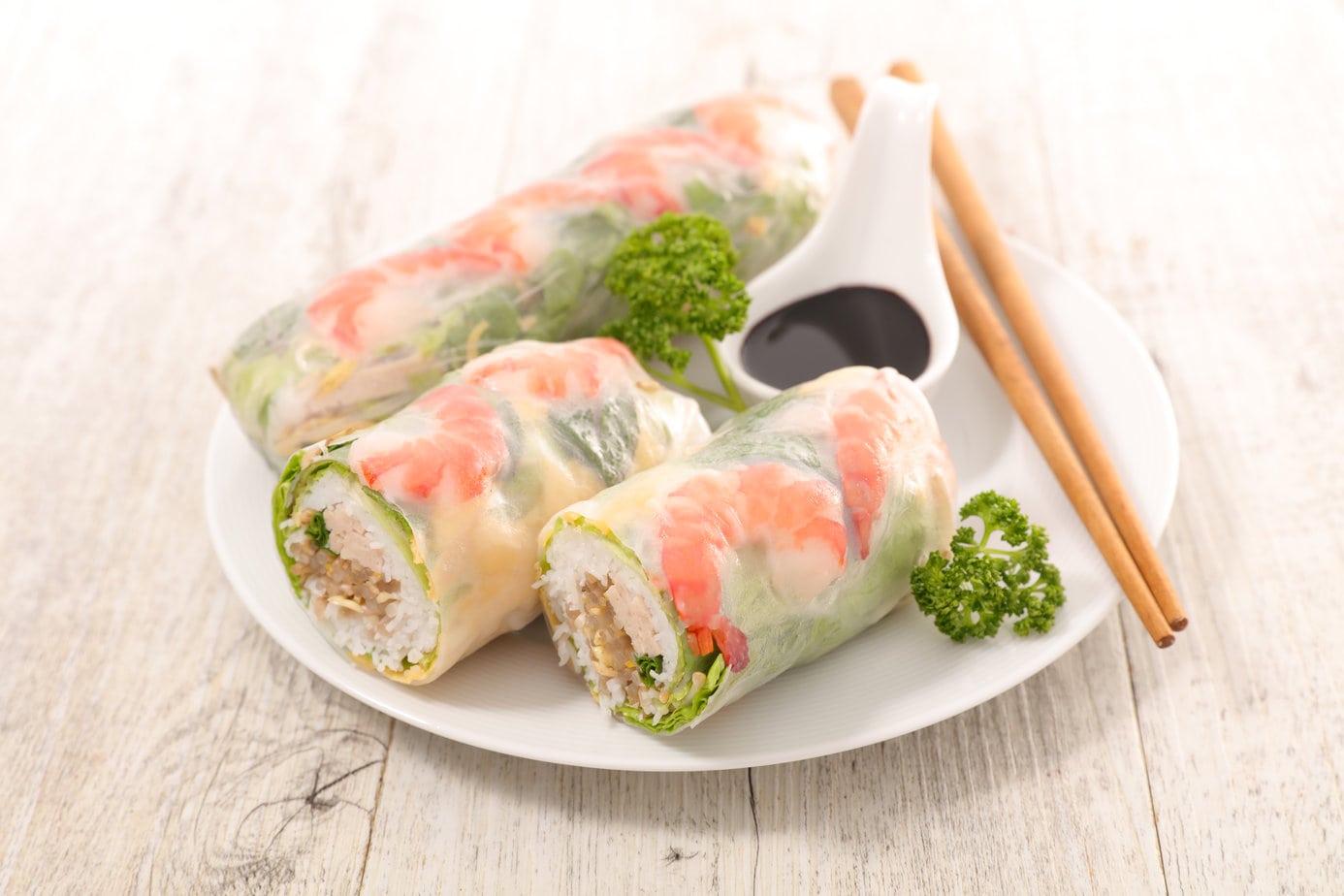
Beware of confusion: a finely emulsified paste mixed with ice water and then steamed in banana leaves is chả lụa; meat molded around lemongrass stalks is Huế’s nem lụi.
The air fryer or the oven can stand in, but neither blisters the rice paper quite as well or creates the same smoky aroma as pork fat dripping onto hot coals. The gold standard is still Lagi, at places like Quán Bà Canh, where the rolls remain small, tightly wrapped, and perfumed by the embers.
Ingredients
For the filling
- 200 g shrimp
- 400 g pork ground
- 100 g mung beans hulled
- 1 shallot chopped
- 1.5 cloves garlic chopped
- 0.5 tablespoon sugar
- 0.5 teaspoon pepper ground
- 0.5 teaspoon MSG
- 1 tablespoon annatto oil
- 0.5 tablespoon fish sauce
For the sauce
- 30 g tamarind
- 100 ml water
- 20 ml water if needed
- 1 shallot chopped
- 1.5 cloves garlic chopped
- 2 chilies chopped
- 30 g peanuts roasted
- 1.5 tablespoons annatto oil
- 3 tablespoons sugar
- 3 tablespoons fish sauce
- 3 tablespoons ketchup
- 1 tablespoon chili sauce
For assembly and serving
- 200 g rice paper wrappers
- lettuce
- cucumber
- Thai basil
- Vietnamese balm
- green mango tangy
- water for moistening the rice paper wrappers
- 0.33 teaspoon salt for cooking the mung beans
Instructions
Prepare the ingredients
- Soak the mung beans overnight, then cook them with the salt until the water has evaporated. Remove from the heat as soon as they are tender.100 g mung beans, 0.33 teaspoon salt
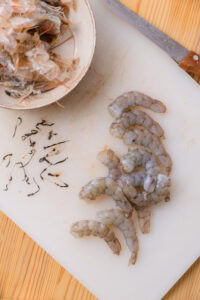
- Rinse, peel, and devein the shrimp, removing the heads and back vein, then blend finely.200 g shrimp
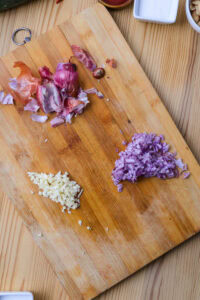
- Peel and finely chop the shallots and garlic, keeping the portions for the filling and sauce separate.1 shallot, 1.5 cloves garlic, 1 shallot, 1.5 cloves garlic
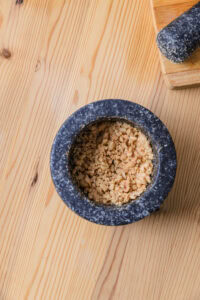
- Finely crush the roasted peanuts.30 g peanuts
- Rinse and drain the herbs and vegetables.lettuce, cucumber, Thai basil, Vietnamese balm, green mango
Make the filling
- Combine the blended shrimp, ground pork, shallot, garlic, and all the filling seasonings in a large bowl, then mix thoroughly.400 g pork, 0.5 tablespoon sugar, 0.5 teaspoon pepper, 0.5 teaspoon MSG, 1 tablespoon annatto oil, 0.5 tablespoon fish sauce
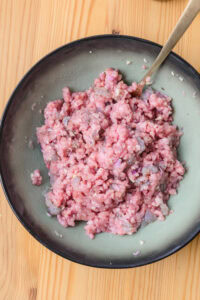
- Let the filling marinate in the refrigerator for 30 minutes.
Make the sauce
- Heat a pan over medium heat, add the annatto oil, then sauté the shallot and garlic for the sauce until fragrant.1.5 tablespoons annatto oil
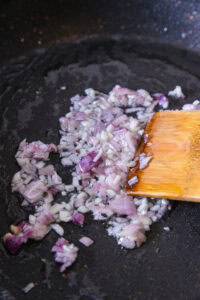
- Add the water and tamarind, reduce the heat to medium, and cook until the tamarind softens.30 g tamarind, 100 ml water
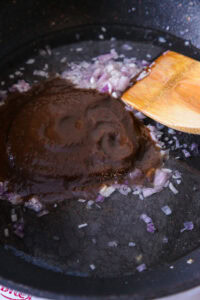
- Add the sugar, fish sauce, ketchup, and chili sauce. Stir well, then remove from the heat and discard the tamarind seeds.3 tablespoons sugar, 3 tablespoons fish sauce, 3 tablespoons ketchup, 1 tablespoon chili sauce
- Transfer the cooked mung beans and sauce to a blender and blend until smooth, adding a little water if the sauce is too thick.20 ml water
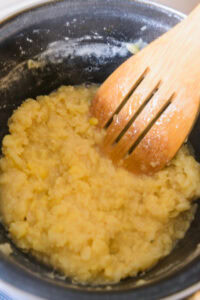
- Return the sauce to the heat and bring it to a boil. Add the crushed peanuts and stir until well combined.
Roll and bake
- Lay out a rice paper wrapper and lightly moisten it. Place a portion of filling in the center, fold in the ends, then roll into a slightly flattened roll. Repeat until all the filling is used.200 g rice paper wrappers, water
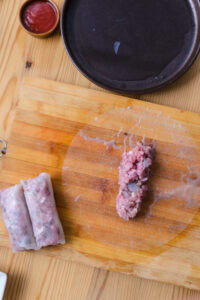
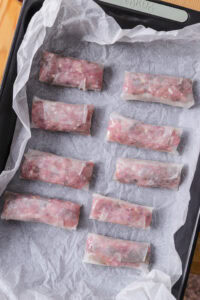
- Preheat the oven to 180 °C for 15 minutes. Arrange the rolls on a baking sheet and bake for 7 minutes. Turn them over and bake for 7 more minutes, until golden and crisp.
Serve
- Serve the chả lụi with the herbs and vegetables, with the tamarind sauce on the side for dipping.
Notes
- To save time, soak the mung beans the day before and prepare the sauce while the filling is marinating.
- Add up to 20 ml water as needed to achieve a thick, spoon-coating consistency; the sauce will thicken as it cools.
- Baking time may vary depending on thickness: watch the color and add 2 more minutes at a time if needed.