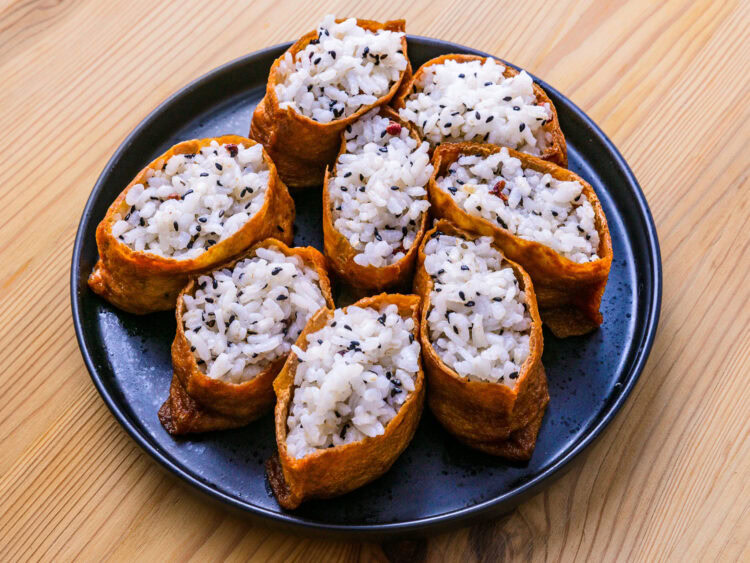
Fried tofu pouches filled with vinegared rice: a sweet-savory street sushi with roots in Inari shrines.
The tofu pouches gleam with a glaze of soy sauce and mirin, then open to reveal warm, vinegar-scented shari. Authentic inarizushi is an understated dish with real depth and a lingering finish: sweet, salty, and delicately tangy, it is less about spectacle than balance.
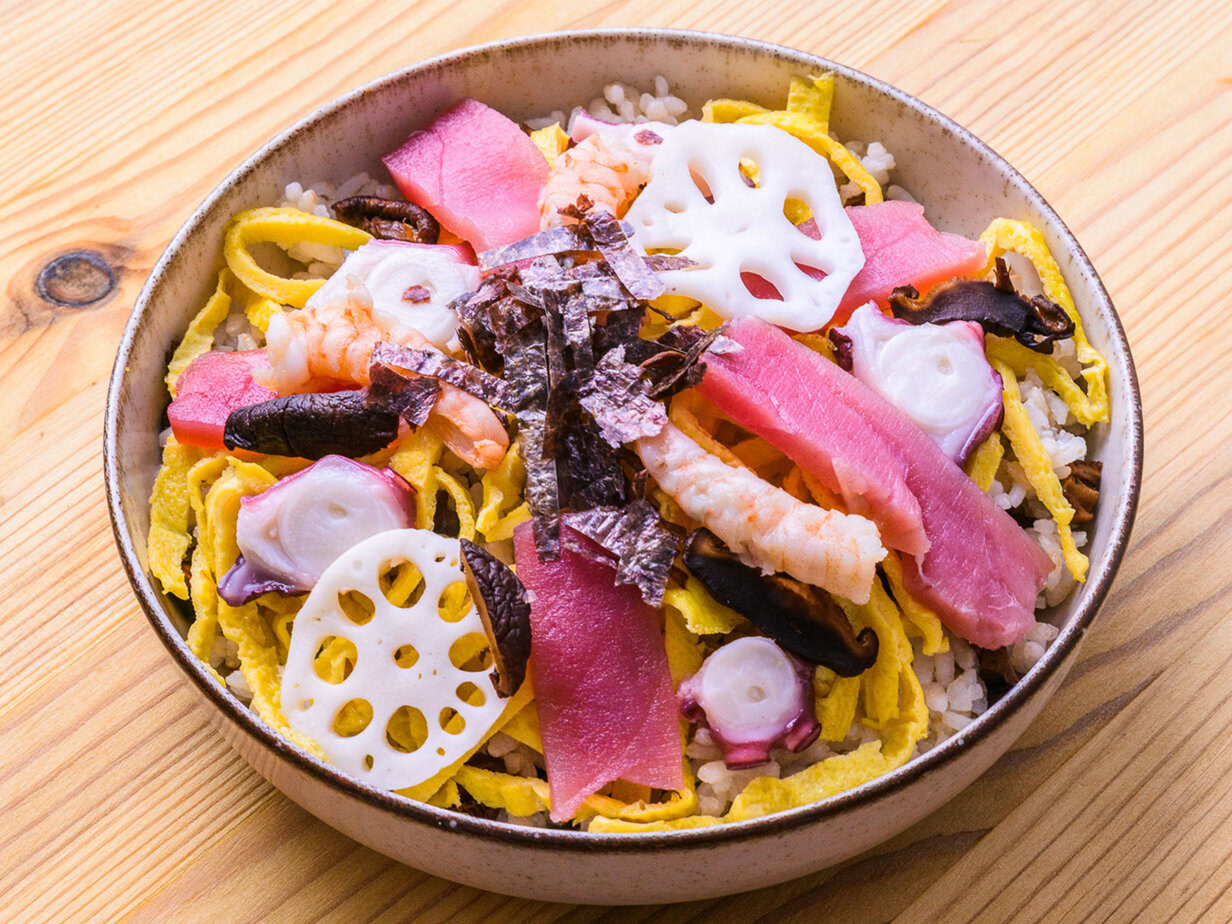
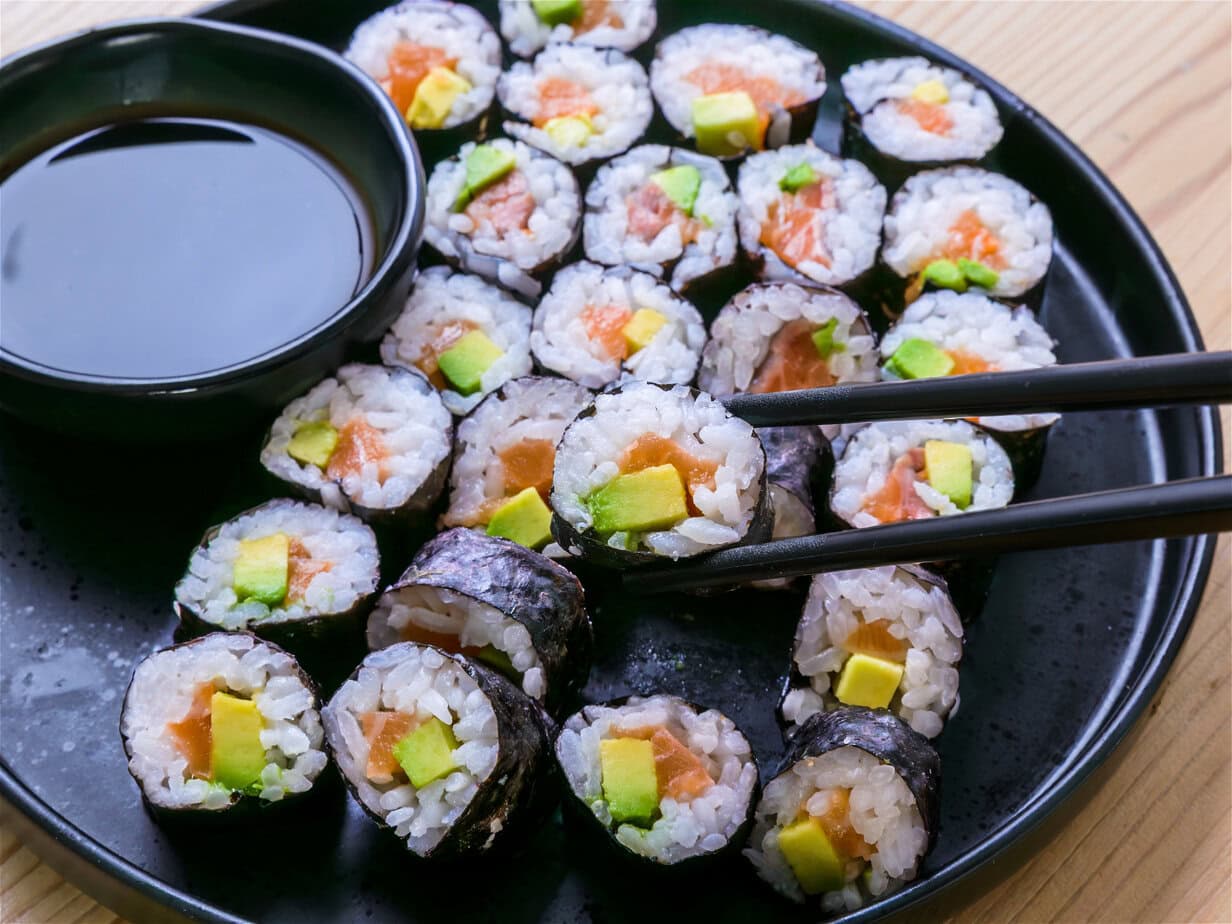
For anyone who thinks “real sushi” must contain raw fish, as in better-known styles such as temaki or maki sushi, this street-born bite, closely tied to shrine culture, offers another way to understand sushi. Its authenticity lies in the rice, the careful simmering, and the simple filling.
What is inarizushi?
Inarizushi is vinegared sushi rice, or shari, tucked into a seasoned fried tofu pouch called aburaage. It is a minimalist style of sushi, and it is fully cooked. It can easily be made vegan with a kombu-based dashi instead of a broth made with dried bonito.
Its name comes from Inari Ōkami, the Shinto deity of rice, fertility, and prosperity. According to folklore, kitsune, Inari’s fox messengers, are fond of fried tofu, helping turn this practical food into an edible offering.
The dish goes by several affectionate names. O-inari-san carries the respectful nuance of an honorific title; kitsune-zushi means “fox sushi”; age-zushi means “fried sushi”; and shinoda-zushi refers to the legend of the fox of Shinoda Forest.
The preparation is simple but exacting. The aburaage is blanched to remove residual frying oil, opened into pouches, then simmered in nijiru, a reduced cooking liquid made with dashi, soy sauce, sugar, and mirin. As the pouches cool in this glaze, the flavors soak deep into the tofu.
From Edo merchants to Inari shrines
Inarizushi took shape during the Edo period. Its roots are often traced to the Nagoya area, in the former Owari domain, before it spread to Edo, Kyoto, and Osaka.
By the 19th century, it was already part of everyday urban life. Kitagawa Morisada’s Morisada Mankō is a vast compilation of Edo-period culture and daily life. Compiled over nearly thirty years and published around 1837, the work describes an urban food culture in which sweet-savory inari was prized because it was portable, practical, tasty, and inexpensive.
Street vendors, known as furi-uri, carried boxes or baskets filled with aburaage pouches stuffed with vinegared rice through crowded streets. The dish joined the ranks of quick, inexpensive street meals, alongside soba and udon.
A serving cost roughly the modern equivalent of 480 yen, an accessible price for artisans, city workers, merchants, and samurai who had come from the provinces and were stationed in Edo.
In Edo, a vendor named Jyukkendana Jiroko became known for supplementing, or even replacing, the rice with okara, the soybean pulp left over from tofu making. It was an economical, filling solution, and one that suited the Edo spirit of avoiding waste.
The dish spread as people moved. Under sankin-kōtai, daimyō and their samurai retinues were required to live alternately in Edo and in their provincial domains, bringing tastes and techniques back home with them.
This circulation transformed a regional urban specialty into a national classic. By the end of the Edo period, sales had gradually shifted toward specialized shops. There, inarizushi appeared alongside nigirizushi as a sweeter, softer option. Its connection to shrines endured, especially during festivals such as Hatsu-uma in February. People eat inarizushi while praying for good harvests, protection from misfortune, and prosperity in business.
Tawara in the east, triangle in the west
Two classic shapes reveal two regional tastes. In Kantō, around Tokyo, inarizushi usually takes the tawara shape: rectangular or bundled like a small bale, reminiscent of rice-straw bales.
Darker koikuchi soy sauce gives the pouch a brown color and a more pronounced sweet-salty flavor. The rice is often left plain, sometimes dotted with sesame or lotus root, to maintain a clear contrast between the dark tofu and the shari.
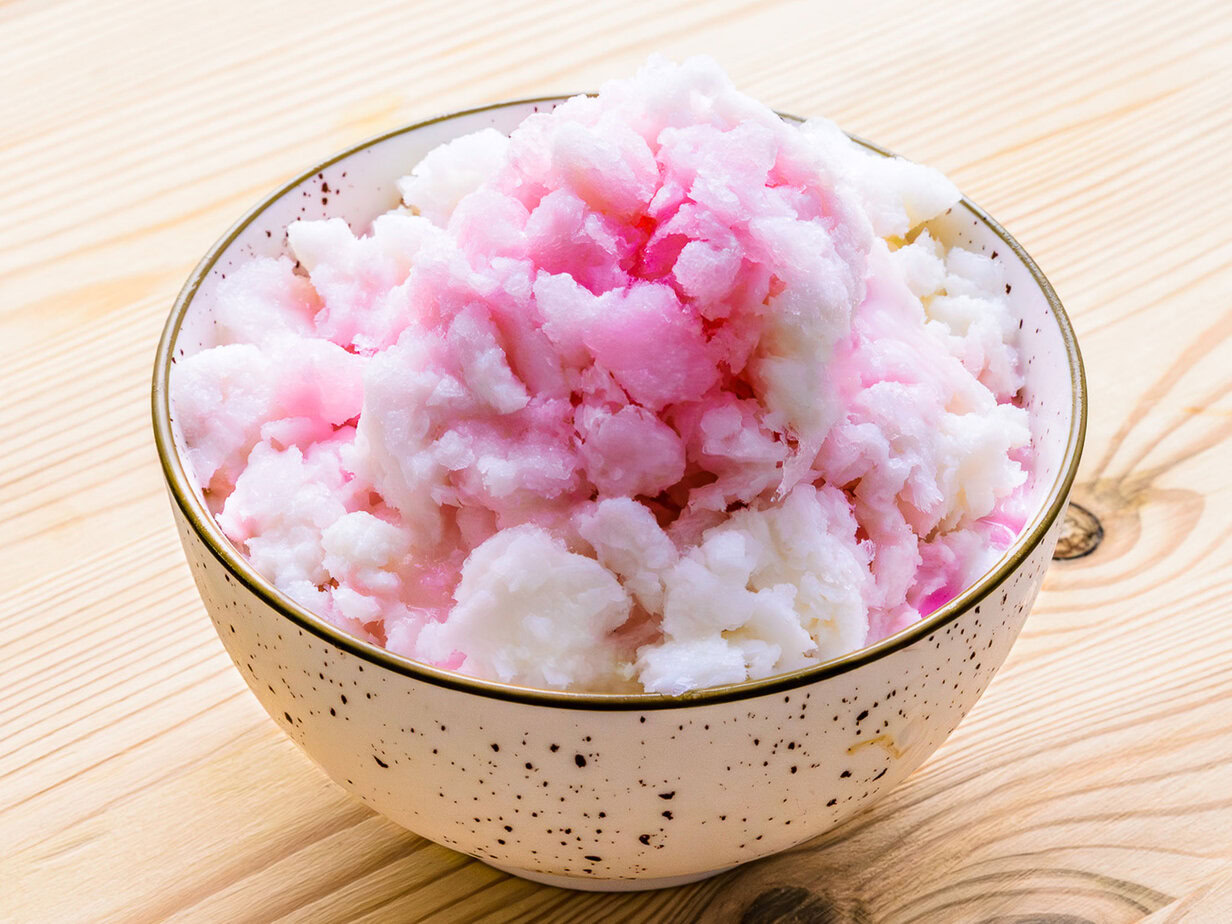
In Edo-style inarizushi, akazu also played an important role: this red vinegar made from sake lees brings rounded umami and an amber hue.
In Kansai, around Kyoto and Osaka, the pouch is often triangular. This shape is usually said to evoke fox ears or the silhouette of Mount Inari. Usukuchi soy sauce and a clear dashi preserve the tofu’s pale golden color and delicate savoriness. The rice may be prepared gomoku-style: mixed with simmered shiitake mushrooms, burdock, carrot, mitsuba, shungiku, or other greens; lotus root also appears in some variations.
Historic establishments such as Izuju in Kyoto illustrate this Kansai approach. In Tokyo, Otsuna offers a variation in which the pouch is turned inside out and scented with yuzu. Elsewhere, local versions take an elongated shape in Saitama or are wrapped in Nankan-age in Kumamoto. In Tsuwano, they become darker thanks to brown sugar; in Ibaraki, soba even replaces the rice.
Main ingredients in inarizushi
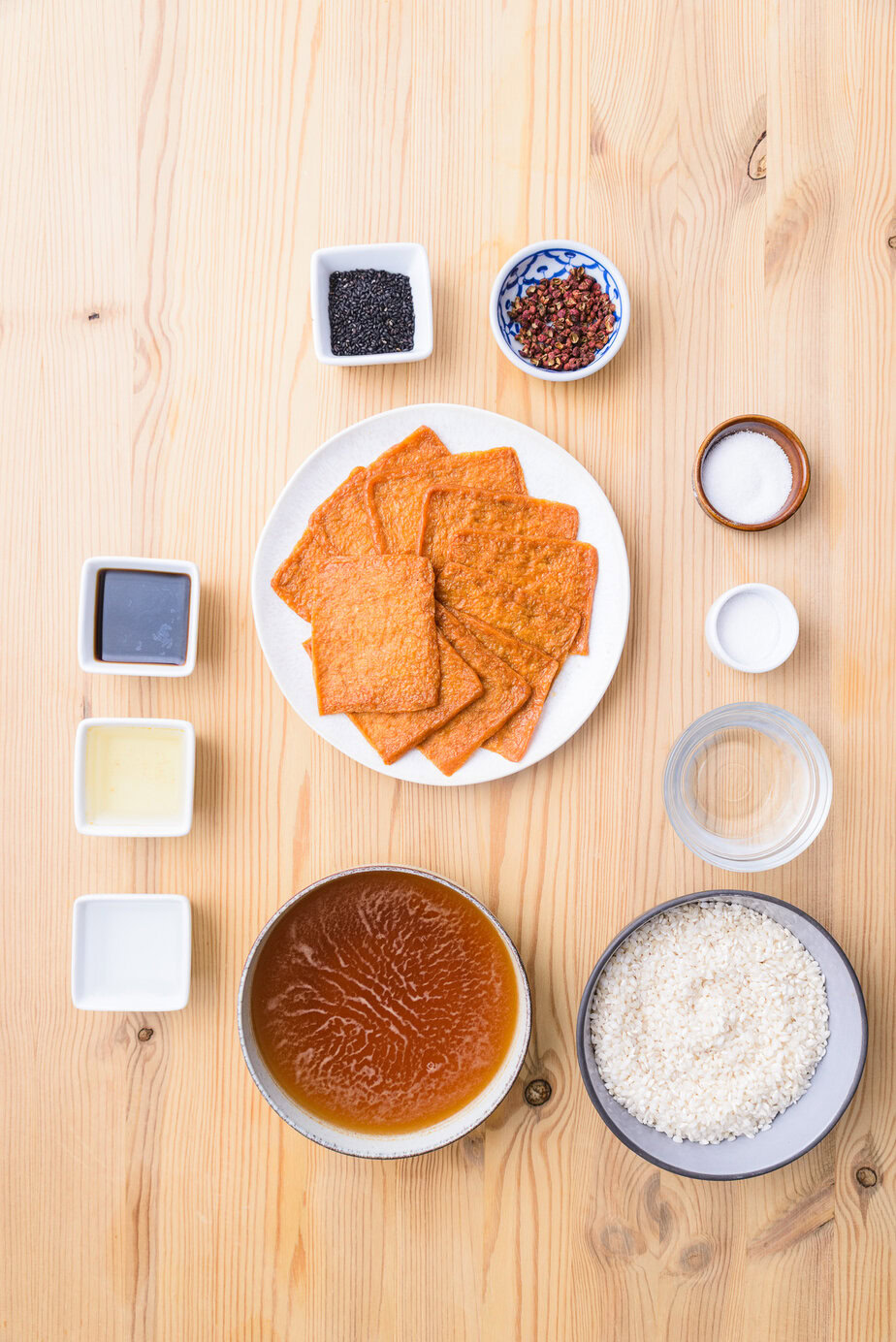
- Aburaage: aburaage forms the pouch and acts like a sponge; blanching it removes excess frying oil and allows the nijiru to penetrate evenly.
- Dashi: kombu and katsuobushi form the dish’s umami backbone; dashi made with kombu alone makes it vegan.
- Soy sauce: koikuchi deepens the color and saltiness in Kantō-style inarizushi; usukuchi preserves the delicacy prized in Kansai.
- Sugar: it balances the soy sauce and vinegar; unrefined sugar can add rounder, more caramelized notes.
- Mirin or sake: mirin, the classic ingredient in nijiru, adds gloss and rounded sweetness; some recipes also add sake, or use it as the preferred alcohol, to enhance aroma and depth.
- Japanese short-grain uruchimai: uruchimai is the heart of the dish: it has a supple, slightly sticky texture and a subtle natural sweetness.
- Vinegar: akazu adds mellow depth, while komezu gives a clean, lively finish.
- Optional additions: shiitake mushrooms, burdock, carrots, mitsuba, shungiku, and other greens are especially common in Kansai gomoku versions; sesame or lotus root can also accent simpler variations, particularly in the Kantō style.
- Yuzu: it adds a bright aromatic note that cuts through the sweetness.
- Salt: it lifts the sushizu and keeps the sweetness, saltiness, and acidity in balance.
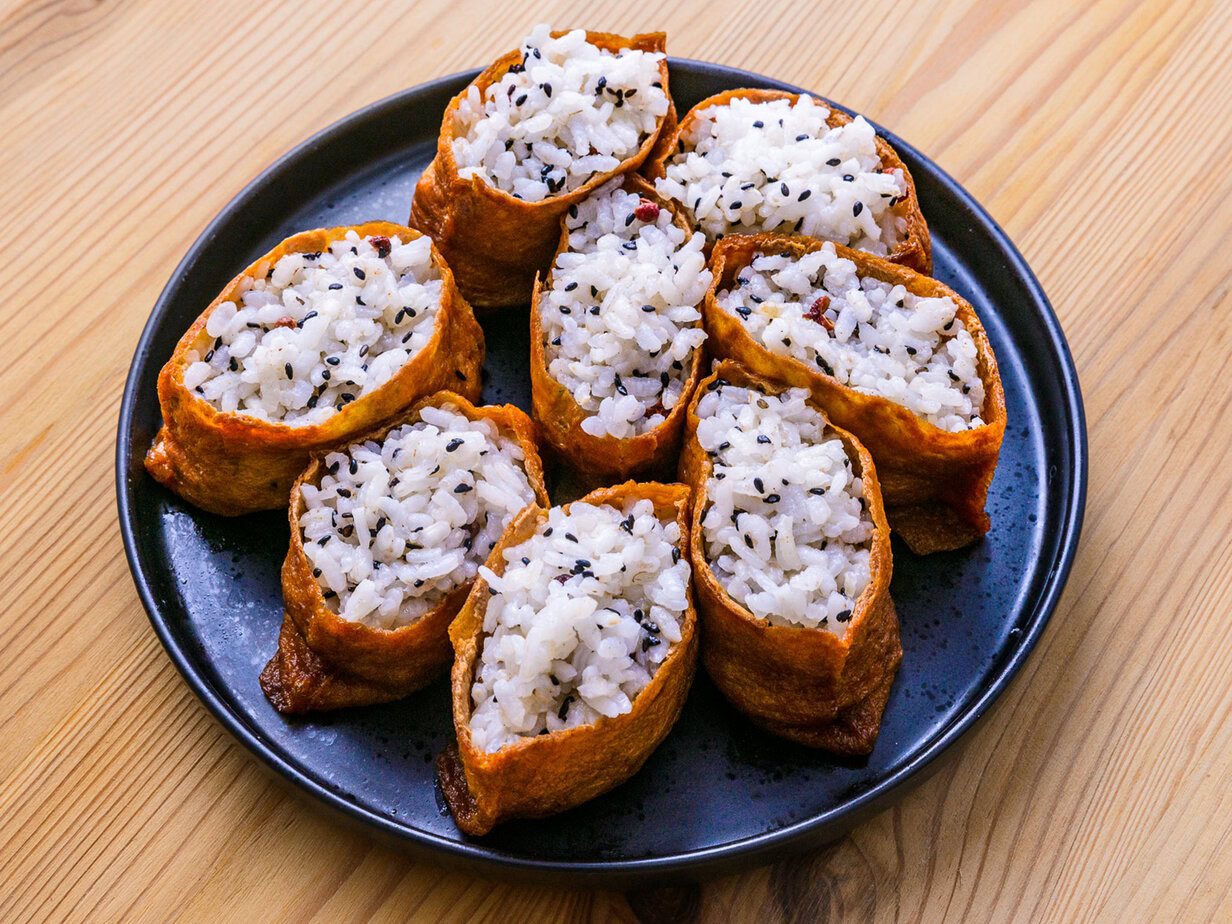
Ingredients
Aburaage Pockets
- 10 sheets aburaage fried tofu
Seasoning for the Aburaage Pockets
- 210 ml dashi
- 1 tablespoon sake
- 2 tablespoons light soy sauce
- 2 tablespoons mirin
- 1 tablespoon sugar
- 1 teaspoon salt
Vinegared Rice
- 300 g Japanese rice dry weight
- 3 tablespoons rice vinegar
- 2 tablespoons sugar
- 1 teaspoon salt
- sesame seeds to taste
- sanshō peppercorns or Sichuan peppercorns, to taste
Accompaniments
- pickled ginger pickled in plum vinegar, to taste
- shibazuke Japanese pickles, to taste
Instructions
Prepare the Aburaage Pockets
- Roll a chopstick (or another blunt-edged object) over the aburaage sheets to break down the fibers and make them easier to open.10 sheets aburaage
- Blanch the aburaage sheets in plenty of boiling water for 1 to 2 minutes to remove excess oil, then drain.
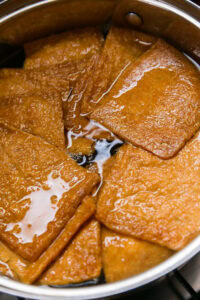
- Rinse the aburaage sheets in water to cool, then press them firmly by hand to remove the excess water.
- Cut the aburaage sheets in half and gently open them into pockets.
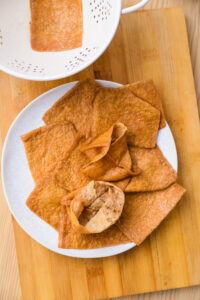
Cook the Aburaage Pockets
- Arrange the aburaage pockets in a radial pattern in a saucepan, leaving the center empty.
- Pour the dashi, sake, soy sauce, mirin, sugar, and salt into the center of the saucepan. Place a drop lid or a piece of parchment paper directly on top to keep the pockets in place.210 ml dashi, 1 tablespoon sake, 2 tablespoons light soy sauce, 2 tablespoons mirin, 1 tablespoon sugar, 1 teaspoon salt
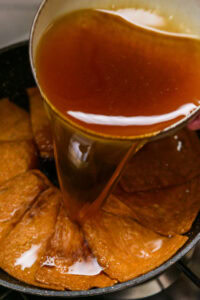
- Simmer over medium-low heat for about 20 minutes, pressing down on the drop lid from time to time to distribute the liquid evenly. Adjust the seasoning if needed.
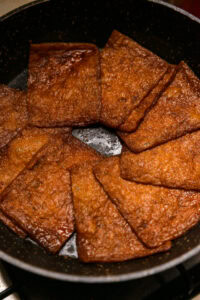
- When only a little liquid remains, turn off the heat and let the aburaage cool in the saucepan for a few hours so it can absorb the seasoning.
Prepare the Vinegared Rice
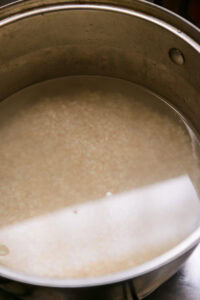
- Cook the Japanese rice with slightly less water than usual.300 g Japanese rice
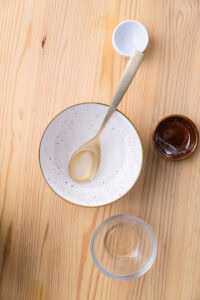
- Mix the rice vinegar, sugar, and salt to make the sushi vinegar, then pour it over the hot rice.3 tablespoons rice vinegar, 2 tablespoons sugar, 1 teaspoon salt
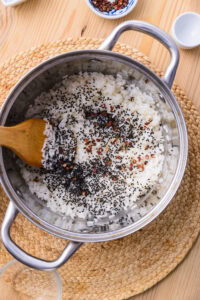
- Gently fold the rice with a slicing motion using a spatula, then add the sesame seeds and sanshō peppercorns.sesame seeds, sanshō peppercorns
Assemble the Inari Sushi
- Shape the vinegared rice into small oval portions.
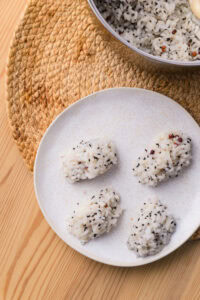
- Fill the aburaage pockets with the portions of vinegared rice.
- Serve with pickled ginger and shibazuke, to taste.pickled ginger, shibazuke
Notes
- For a lighter texture, drain and press the aburaage well after blanching.
- Letting the pockets cool in their cooking liquid helps them absorb the seasoning more deeply.