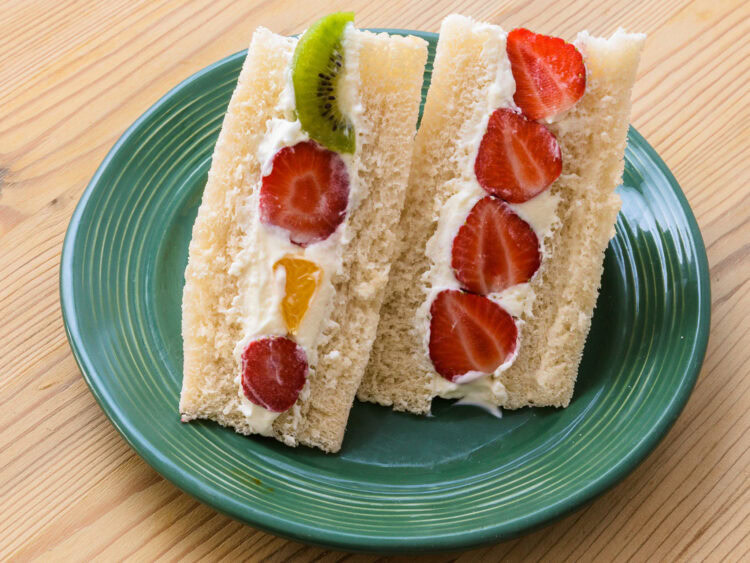
An ultra-soft Japanese fruit sando filled with fresh fruit and stabilized whipped cream for a clean, irresistible slice.
Pillowy shokupan gives way to well-chilled cream and carefully cut fruit; with each bite, everything yields with the tenderness of cake rather than the chew of bread.
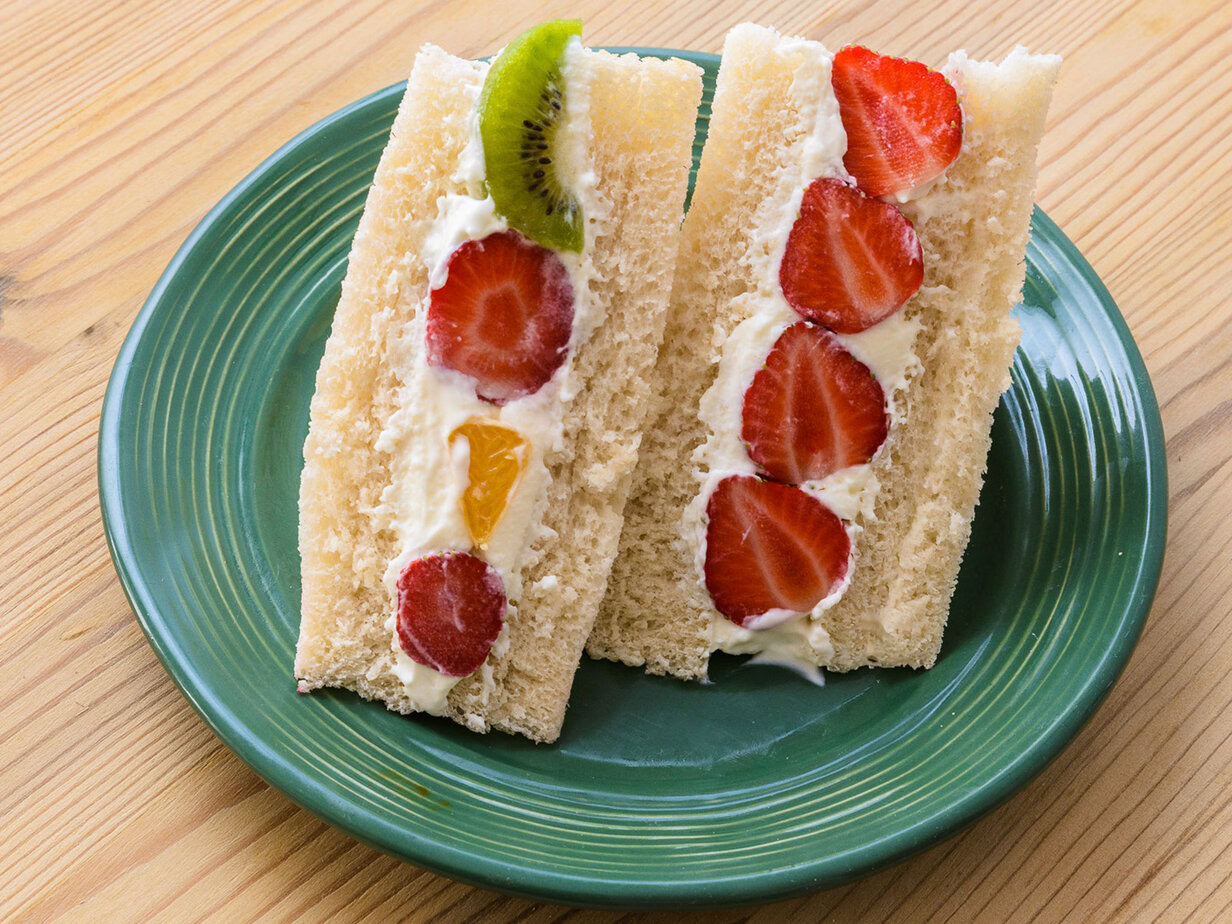
Cut it on the diagonal and the cross-section is revealed: a green kiwi set in the center like a medallion, flanked by pineapple and papaya in the classic arrangement, while strawberry, sometimes paired with melon, completes the traditional palette.
Japanese fruit sando is elegant, understated, and remarkably precise. It celebrates perfectly ripe fruit, supported by Western baking and cream techniques adapted in Japan, without ever letting sugar take over.
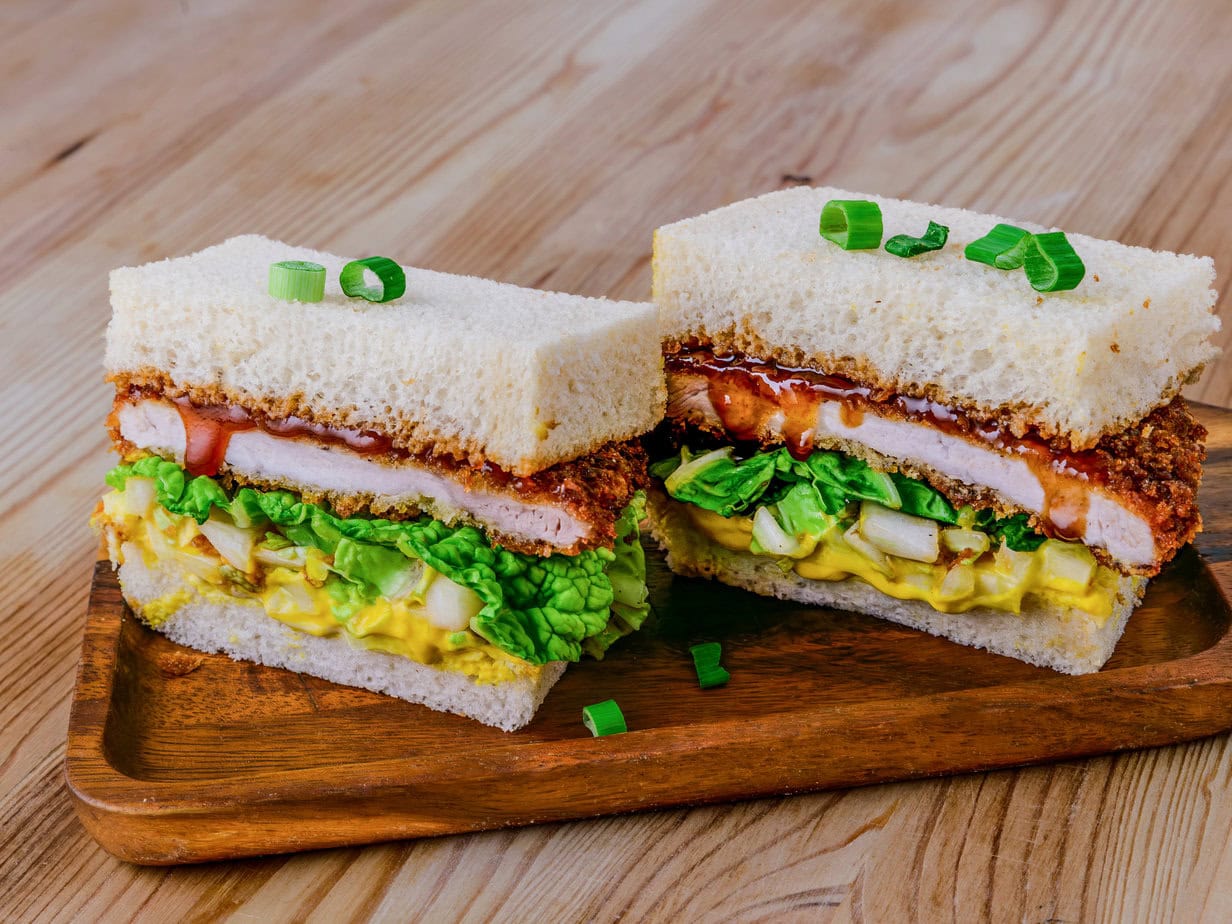
The same care in cutting and assembly appears on the savory side in the katsu sando and the tamago sando.
What is fruit sando?
Fruit sando, or フルーツサンド, takes its name from sando, the Japanese abbreviation for “sandwich” (big revelation, right?). Its basic structure is easy to describe, but demanding to execute well. Two crustless slices of shokupan enclose lightly sweetened stabilized cream and premium fresh fruit.
This very soft Japanese sandwich bread is often made in the spirit of enriched milk bread. The fruit is arranged so that, once cut, it forms a decorative cross-section called moedan.
The bread and cream are there to serve the fruit. Their neutral, pale, tender texture lets its colors and fragrance shine. In a well-made sando, the crumb, cream, and fruit yield together, without spilling out, dragging, or resisting the bite.
The balance depends on a fresh, even texture, with just enough sugar to let the fragrance of strawberry, the bright acidity of kiwi, and the aroma of melon come through.
From Tokyo fruit merchants to Kyoto parlors
Fruit sando emerged from the meeting of Meiji- and Taishō-era Westernization with Japan’s older culture of exceptional fruit. Western bread was adapted locally as shokupan: an enriched, highly hydrated, extremely soft loaf well suited to a country where rice dominates and tender textures are especially prized.
The same logic can also be found in Japanese curry or omurice. Fruit, meanwhile, remained a prestige product, cultivated for symmetry, fragrance, sweetness, and visual perfection, often given as a gift rather than eaten every day.
The exact place where it first appeared is hard to pin down, but the strongest leads point to the fruit parlors of Tokyo and Kyoto. These were elegant salons run by major fruit houses, where exceptional produce could be served in parfaits, tarts, and sandwiches while retaining its luxurious status.
In Tokyo, the trail first leads to the Sembikiya family, fruit merchants established in Nihonbashi since 1834. Their salon tradition is often linked to the opening of Japan’s first true fruit parlor at the end of the Meiji era, generally dated to 1894.
Some accounts even mention prototypes combining bread and fruit as early as 1868. Sembikiya’s classic mixed sando is made with strawberry, mango, kiwi, papaya, and pineapple, with melon appearing in broader versions of the fruit parlor tradition.
Its staying power comes from cleanly cut fruit, cream that is “not too sweet,” and a presentation designed to create a neat, easy-to-read slice.
Other Tokyo institutions helped define the style. Takano, whose Shinjuku fruit parlor opened in 1926, offered fruit sandos on its very first menu, while Nishimura, founded as an upscale fruit shop in Shibuya in 1910 and developed into a parlor from 1936 onward, became famous for its generous strawberry versions.
In Kyoto, another lineage is often cited. Yaoiso, a fruit merchant founded in 1869, did not open its salon until 1972, but today this house embodies one of the clearest expressions of the local aesthetic: seasonal, generous, and precise.
These sandos rely on fruit in “large pieces” so that every bite contains some. The seasonal fig sando, or ichijiku, is offered only for a very brief period, underscoring the importance Kyoto places on the exact moment of ripeness.
Whether linked to Tokyo’s commercial modernity or Kyoto’s refined seasonality, fruit sando was born among fruit professionals, not bakers. Its purpose has always been to showcase agricultural excellence with restraint and a keen sense of presentation.
Main ingredients in fruit sando
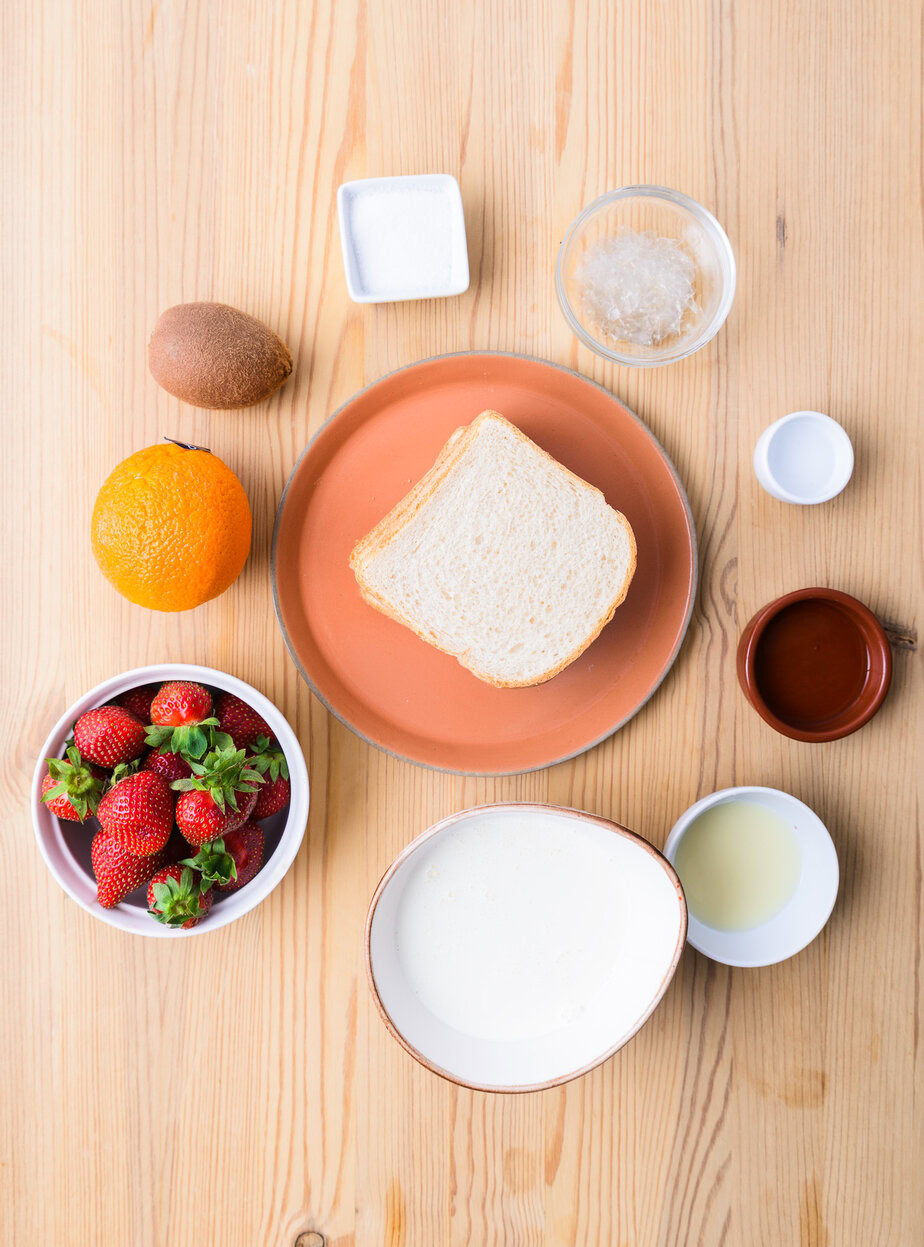
Shokupan : the foundation of the sando, used crustless, with a supple crumb that supports the cream and fruit. Its enriched, highly hydrated crumb stays tender when chilled and resists moisture better than classic white sandwich bread.
High-fat cream : professional recipes use a very rich cream, around 45 % fat, to bind the fruit and provide the cool roundness that makes the sando feel almost cake-like.
Stabilizer : strained yogurt (mizukiri yōguruto), mascarpone, or a carefully measured touch of gelatin keeps the cream from weeping. Yogurt also adds a gentle lactic brightness that helps balance acidic fruits such as kiwi and pineapple.
Granulated sugar : used sparingly, it rounds out the cream without masking the fruit’s natural sweetness.
Thin layer of butter or mascarpone : an almost invisible fat barrier limits moisture transfer into the bread while the sando chills.
Premium fruit : strawberry brings fragrance and a sweet-tart note. Kiwi adds acidity and the crunch of its tiny seeds, while pineapple provides a fibrous, lively bite. Papaya softens the brighter notes, melon adds its distinctive aroma, and fig, in season, brings delicacy and a sense of place.
Diplomat cream : some historical versions or parlor styles combine whipped cream and pastry cream for a richer, slightly golden profile, linked to the influence of early Western-inspired pastries.
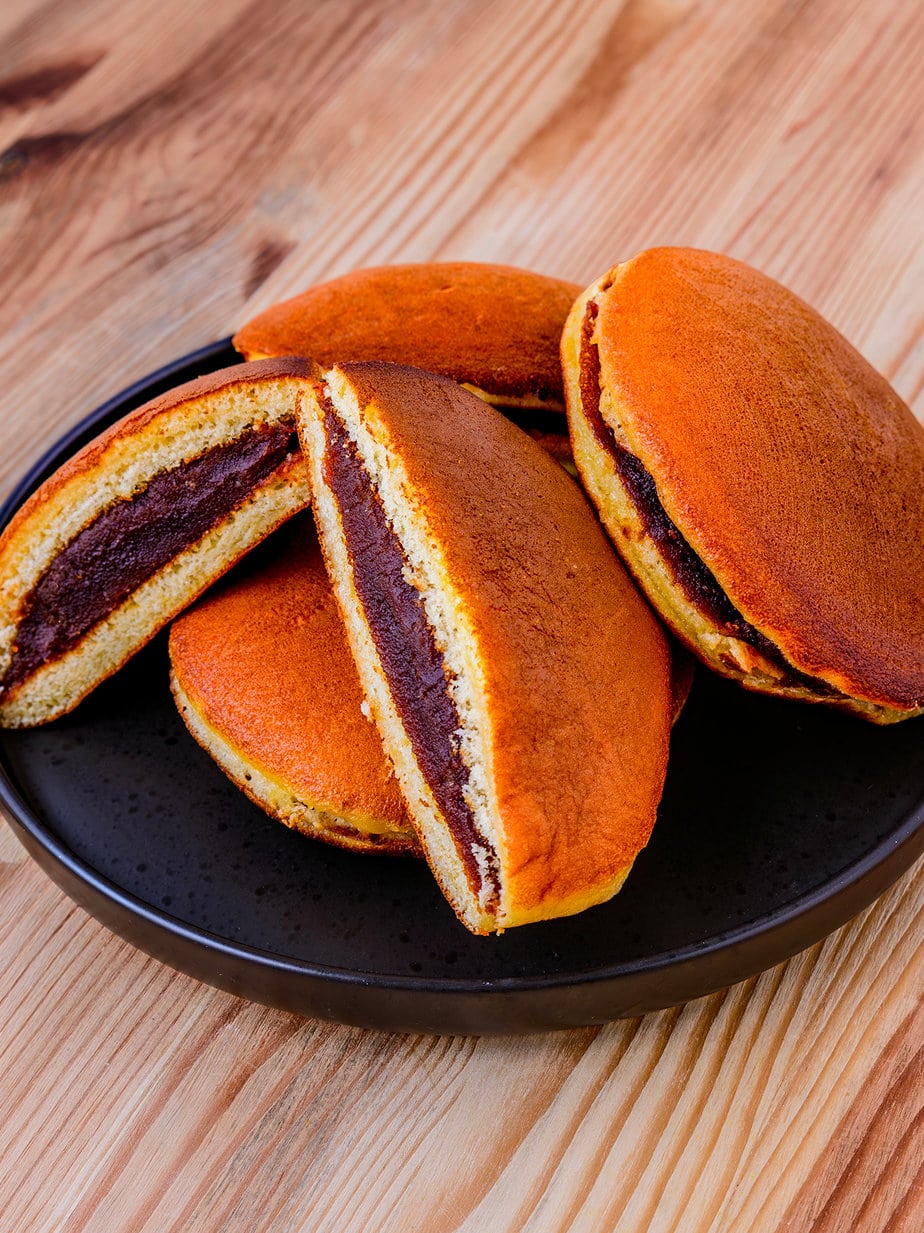
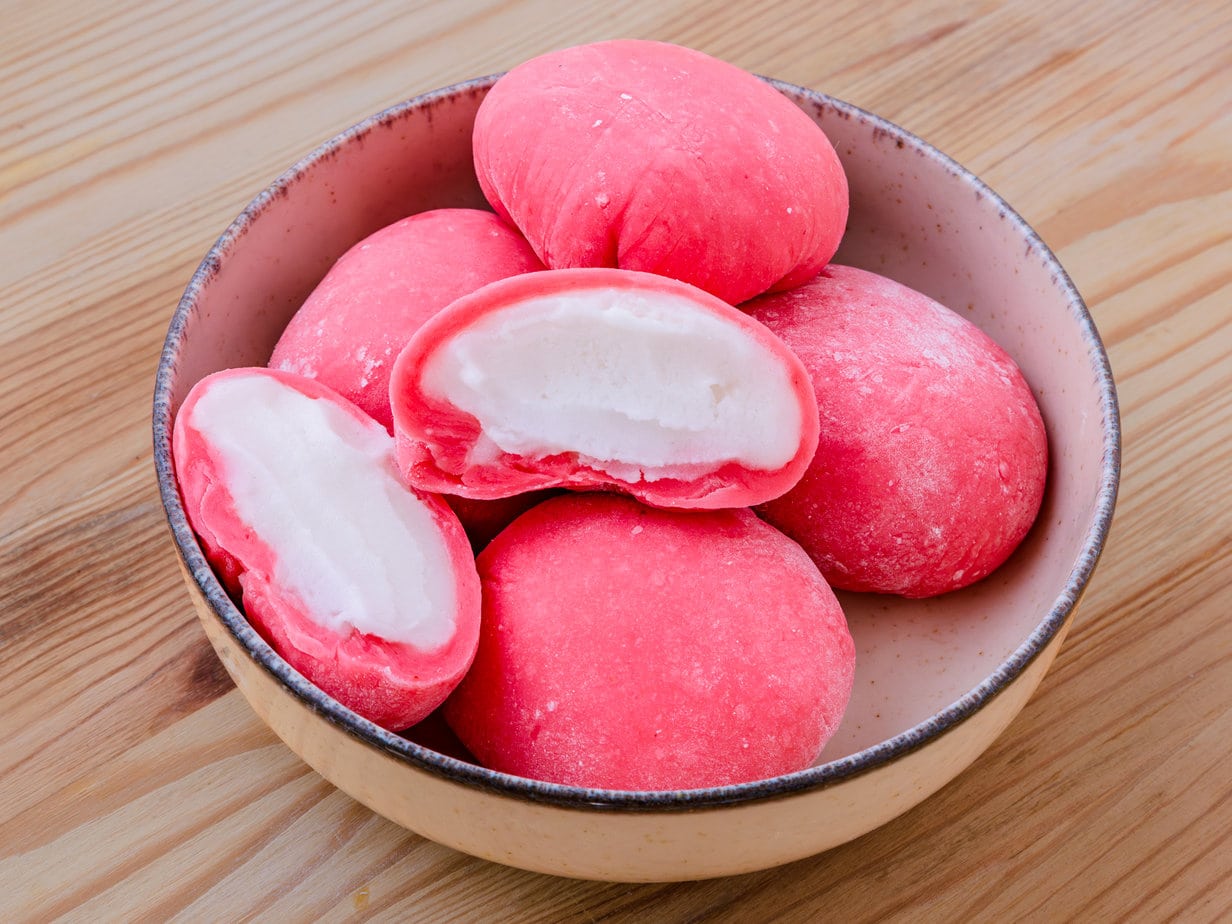
Within the world of Japanese sweets, fruit sando stands apart from dorayaki, mochi, mitarashi dango, or mochi ice cream because fresh fruit takes center stage. Where preparations such as black sesame paste or taro paste offer a dense sweetness, fruit sando aims for clean freshness and a light texture.
Signs of authenticity and pitfalls to avoid
An authentic fruit sando is recognized first by its texture. The bread, cream, and fruit should yield together, closer to a cream-filled sponge cake than a classic sandwich. If the cream squeezes out the sides when you bite in, the bread may be too resistant, the cream may lack structure, or the fruit may have been cut too unevenly.
The quality of the fruit is decisive. The pieces should be ripe but firm, cut into stable shapes, and carefully patted dry. Watery, thawed, or overripe fruit releases juice into the cream and bread, turning softness into collapse. Likewise, canned whipped cream or unstabilized whipped cream tends to weep, soaking the crumb and dulling the clean dairy flavor.
Temperature matters as much as composition. A sando should be served well chilled, never frozen. Time in the refrigerator firms the fat and helps the stabilizers hold everything in place, while preserving the softness of the shokupan. Freezing forms ice crystals that damage the fruit’s texture and can break the cream emulsion.
Ingredients
Base
- 4 thick slices soft white sandwich bread
- strawberries as needed, hulled (cut a few if necessary)
- 1 kiwi peeled and cut into pieces
- 1 orange peeled and cut into pieces
Stabilized Whipped Cream
- 150 g heavy cream well chilled
- 15 g granulated sugar
- 25 g sweetened condensed milk
- 1 g rum
- 1 g powdered gelatin
- 5 g water
Instructions
Preparing the Fruit
- Bloom the powdered gelatin in the water.1 g powdered gelatin, 5 g water
- Have a very sharp knife ready.
- Hull the strawberries.strawberries
- Peel the kiwi and orange, then cut them into pieces that will fit neatly in the sandwich.1 kiwi, 1 orange
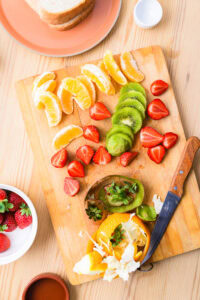
Stabilized Whipped Cream
- Pour the well-chilled heavy cream into a mixing bowl, add the sugar, then whip until softly whipped (about 80% whipped).150 g heavy cream, 15 g granulated sugar
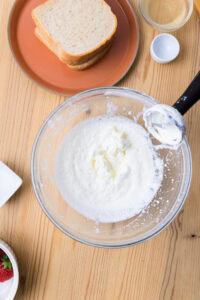
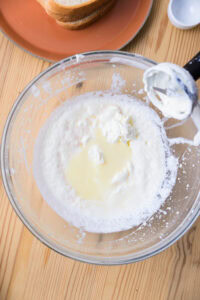
- Microwave the bloomed gelatin for about 10 seconds, just until liquefied.

- Add the melted gelatin, rum, and sweetened condensed milk to the whipped cream, then whip again until the cream holds firm peaks.25 g sweetened condensed milk, 1 g rum
Assembling the Sandwiches (Strawberry Version)
- Spread a thin layer of cream over one slice of sandwich bread. Arrange the strawberries in a straight line down the center (3 to 4, depending on their size), then cover generously with cream until the fruit is completely hidden. Spread a little cream on a second slice of bread and close the sandwich.4 thick slices soft white sandwich bread

- Wrap the sandwich tightly in plastic wrap, then draw a line on the wrap with a marker in the direction of the strawberry row to use as a cutting guide.
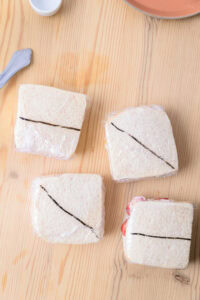
Assembling the Sandwiches (Mixed Fruit Version)
- Spread a thin layer of cream over one slice of bread. Arrange the kiwi, orange, and strawberry pieces on top, then cover generously with cream. Spread a little cream on a second slice of bread and close the sandwich.
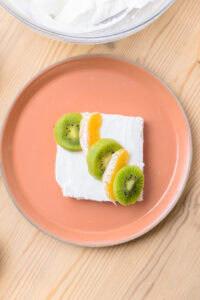
- Wrap tightly in plastic wrap without drawing a line; this sandwich will be cut diagonally.
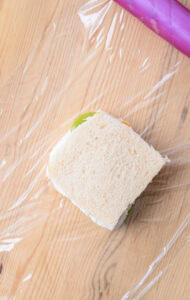
Resting
- Refrigerate the sandwiches overnight to firm up the cream and make clean slicing easier.
Cutting
- For the strawberry sandwiches: briefly warm the knife blade with hot water or a flame, then slice through the plastic wrap along the marked line without pressing down, using gentle back-and-forth motions. Wipe or rinse the blade between cuts, trim the ends, remove the wrap and crusts if desired, then cut again into neat cubes.
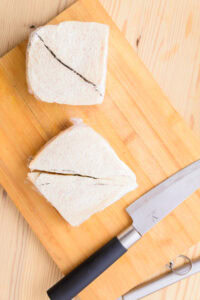
- For the fruit sandwiches: cut diagonally with a clean, very sharp knife. Remove the crusts if desired, depending on the presentation you want, and clean the blade between cuts.
Notes
- Adding gelatin gently stabilizes the cream, helping it hold around the fruit and making the sandwiches easier to slice cleanly after refrigeration.
- For the neatest cuts, use a hot, clean, very sharp knife and avoid crushing the sandwich. It’s better to saw gently than to press down.