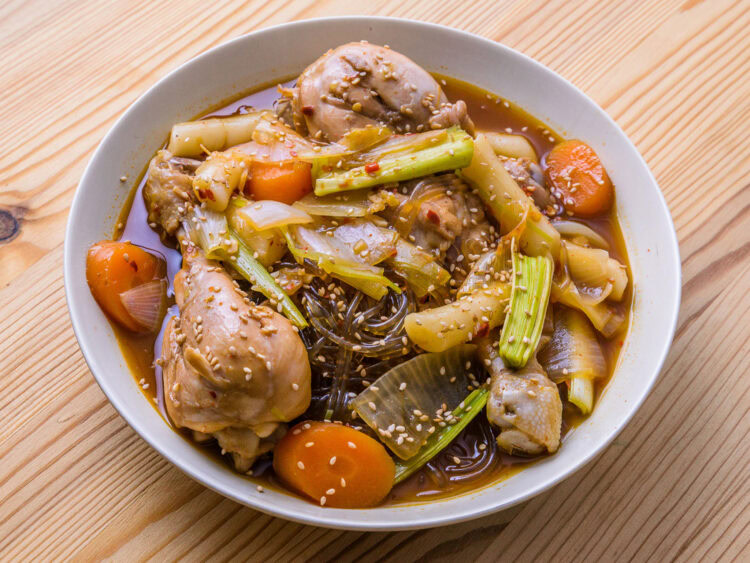
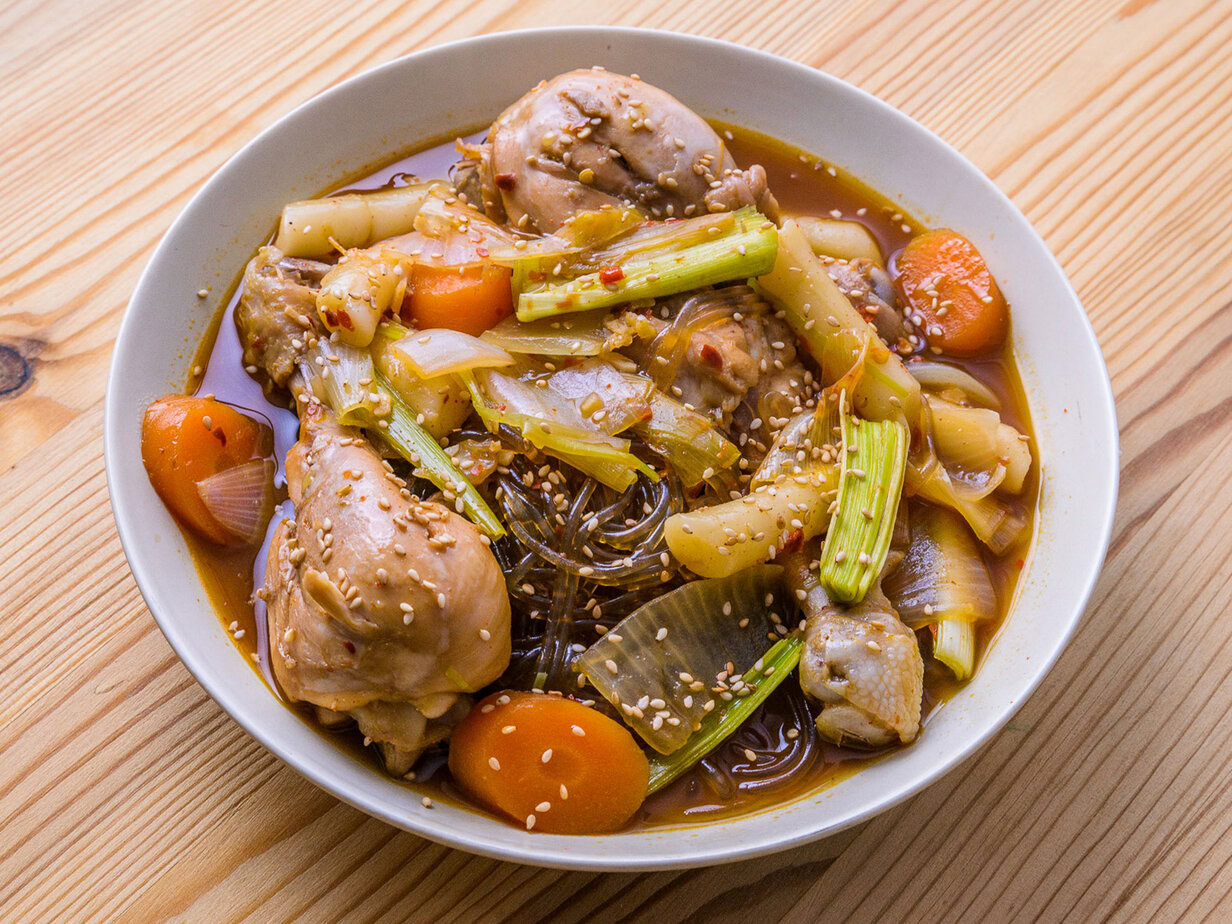
A Korean braised chicken dish seasoned with gochugaru, simmered with potatoes, carrots, and rice cakes, and served in the center of the table.
The pot lands in the center of the table, red with gochugaru, and the steam carries garlic and scallions through the room. The chicken has braised on the bone until it slips away effortlessly, while the potatoes break down at the edges and drink up the spicy broth.
Everyone helps themselves straight from the pot: a piece of chicken, a rice cake, a ladleful of sauce. It seems almost too simple to impress, until that first bold, spicy bite.
What is dakdoritang ?
Dakdoritang is a Korean braised chicken dish: spicy, deeply savory, and made with a whole chicken cut on the bone. The broth relies on gochugaru rather than a thick chili paste: the flakes turn the liquid a vivid red and give it a clean, direct heat.
Soy sauce brings salt and umami, rice wine tames any strong poultry aromas, and a touch of sugar rounds everything out. Large chunks of potato release enough starch to thicken the broth, while carrots and onions add a gentle sweetness. The dish holds a special place in Korea’s culture of shared meals.
Its name is still debated. Since 1992, the National Institute of the Korean Language has favored dak-bokkeum-tang and regards dakdoritang as a hybrid combining the Korean dak (chicken), the Japanese tori, and the Sino-Korean tang (soup).
Others argue for a purely Korean origin, with dori derived from a verb meaning “to cut into pieces,” and everyday usage has never let go of doritang.
From clear broths to the modern red braise
The red version of the dish is more recent than it looks. Before chili took center stage, Korean chicken braises were clear and peppery, built on soy sauce or fermented seafood brine. Older collections describe chicken sautéed in sesame oil and then simmered with scallions, salt, and black pepper, without any red chili.
The word doritang emerges more clearly in the 1920s, referring to a young chicken cut up and seasoned with shrimp brine. Red chili did not enter this family of recipes until 1946, with a dak-bokkeum that included it for the first time.
The dish took on its modern identity in the 1970s. Postwar industrialization and the rise of poultry farming made chicken more abundant and affordable, and city dwellers wanted a single dish that was spicy, budget-friendly, and hearty enough to feed several people. The braising technique remained ; the color, the heat, and the custom of sharing the pot did the rest.
The key ingredients in dakdoritang
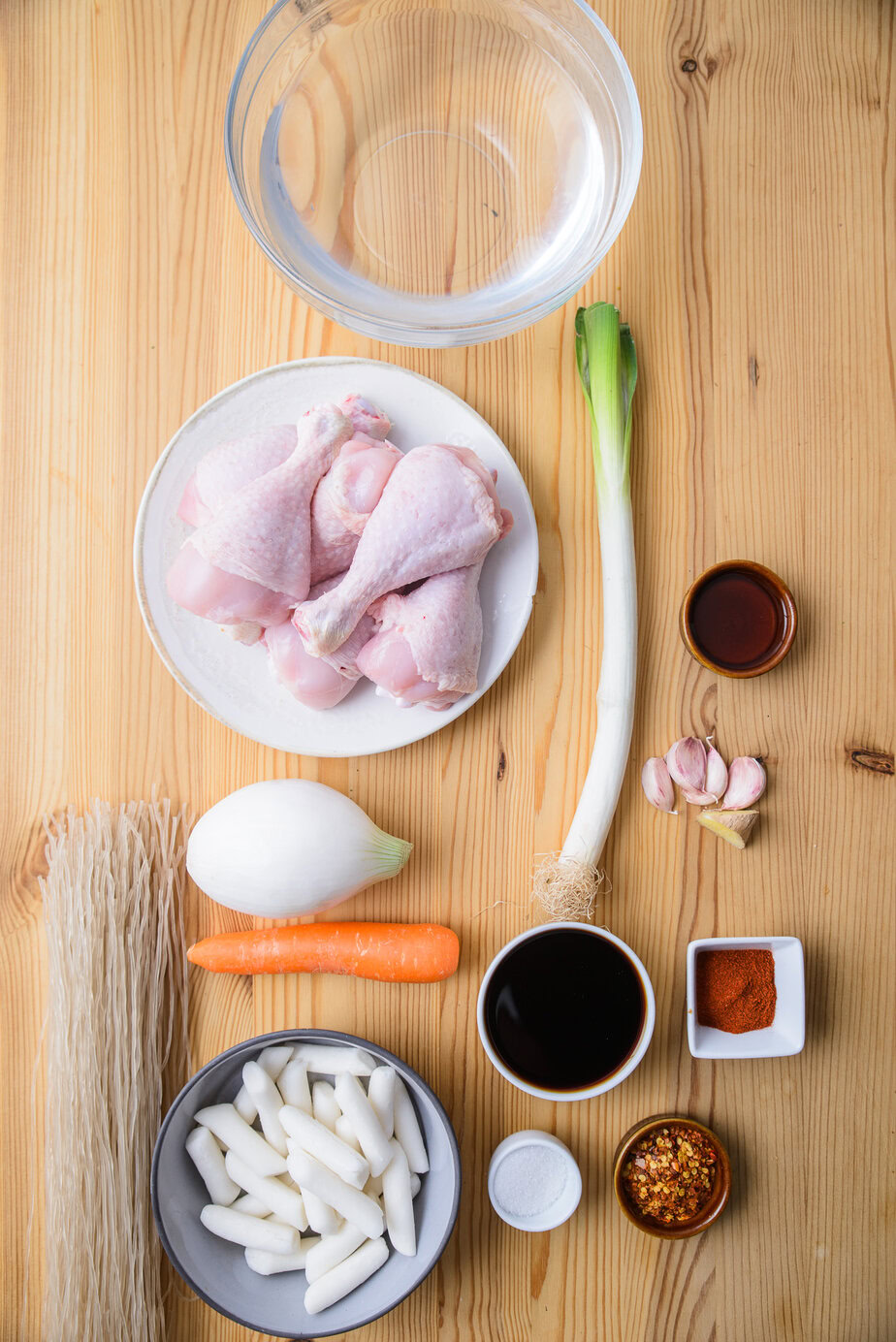
A whole chicken (or at least bone-in thighs) forms the base of the dish. The cut bones release marrow and collagen, while the skin’s fat emulsifies into the broth, giving it a texture boneless meat simply cannot match.
Gochugaru is the main source of both color and heat: four to six tablespoons is common, enough to tint the broth and give it a kick without making it heavy.
Soy sauce brings salt and depth, rice wine tames any strong poultry aromas and helps the aromatics bloom. Potatoes, rich in starch and cut into large chunks, thicken the broth without falling apart. Carrots and onions, cut into thick wedges, hold their shape while releasing their natural sweetness.
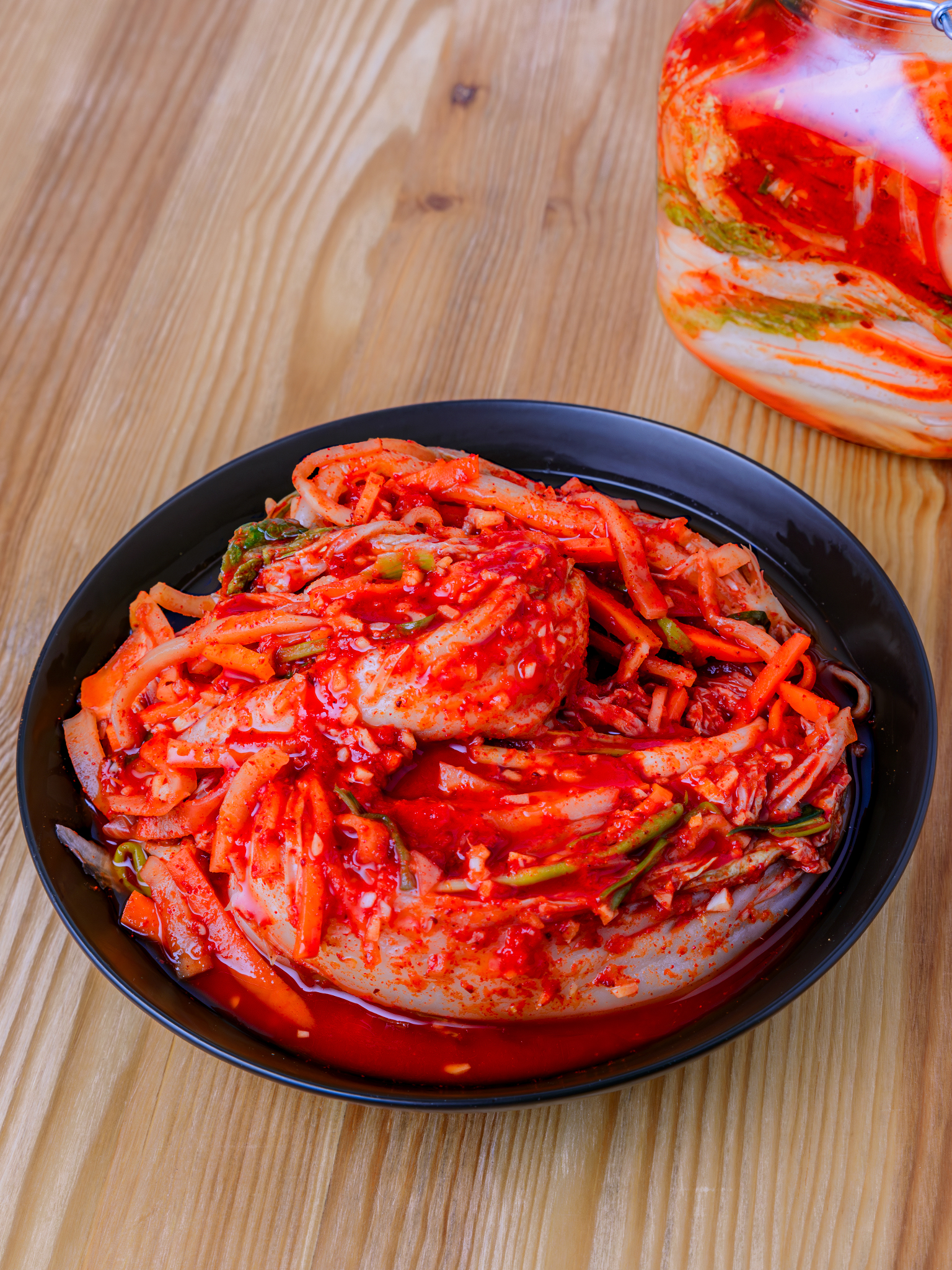
Garlic and scallions go in at the end, so their bright notes stay fresh in the steam. A touch of sugar, added early, balances the chili and soy sauce. For extra depth, a little doenjang, a touch of gochujang, or some well-aged kimchi works beautifully, as long as it stays in the background.
Ingredients
- 750 g chicken drumsticks
- 1 stalk Korean leek or young leek
- 1 onion
- 0.5 carrot
- 150 g dangmyeon
- 150 g tteokbokki rice cakes
- 3 Cheongyang chilies optional
Instructions
Preparation
- Soak the dangmyeon for 30 minutes beforehand.150 g dangmyeon
- Rinse the tteokbokki rice cakes briefly in water.150 g tteokbokki rice cakes
- Cut the carrot into bite-size pieces.0.5 carrot
- Cut the onion into bite-size pieces.1 onion
- Cut the Korean leek into 5 cm lengths, then halve each piece lengthwise.1 stalk Korean leek
Cooking
- Score the thickest parts of the chicken so the sauce can penetrate well.750 g chicken drumsticks
- Place the chicken in boiling water and blanch for 5 to 10 minutes, until the outside turns white.
- Rinse the blanched chicken to remove any congealed blood and small bone fragments.
- Place the chicken in a pot. Add the carrot, water, and sugar first, then bring to a boil.700 ml water, 2.5 tablespoons sugar
- Add the soy sauce, mirin, garlic, and ginger, then bring back to a boil.120 ml soy sauce, 2 tablespoons mirin, 1.5 tablespoons garlic, 0.5 teaspoon ginger
- Cover and cook over medium heat for 10 minutes.
- Once the carrot is tender, add the coarse and fine gochugaru, the onion, the white part of the Korean leek, and the rice cakes, then cook for 5 minutes.3 tablespoons gochugaru, 1 tablespoon gochugaru
- Once the gochugaru has bloomed and the broth has reduced, add the dangmyeon and the green part of the Korean leek, then cook for about 5 minutes, until the noodles are tender.
- Sprinkle with sesame seeds and serve.sesame seeds
Notes
- Adding the sugar first helps the sweetness penetrate the ingredients more effectively.
- Measure the soy sauce carefully, as too much can quickly make the dish taste overpowering.
- If your fine gochugaru is made from Cheongyang peppers, you can omit the Cheongyang chilies.
- If using Cheongyang chilies, add them at the same time as the dangmyeon, along with the green part of the Korean leek.
- Add the green part of the Korean leek at the end to preserve its color.
- If the broth reduces too much, add a little water.