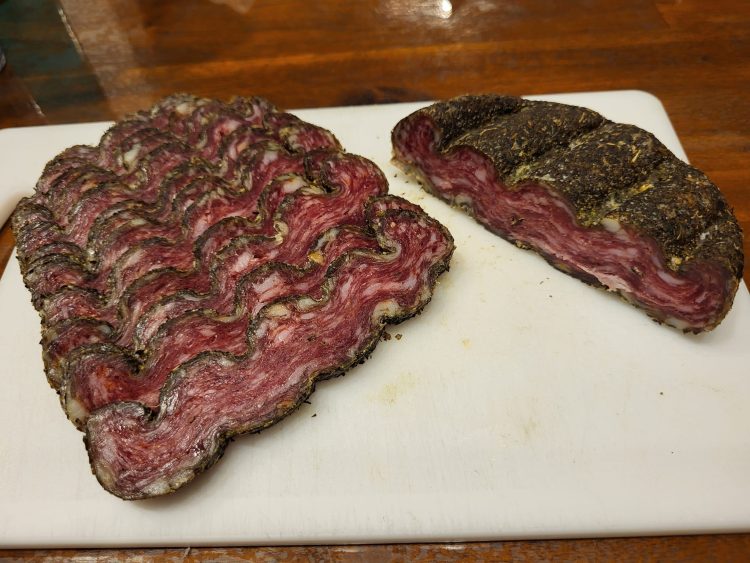
A disc-shaped Basque dry sausage with no casing, one of the simplest kinds of homemade charcuterie to make
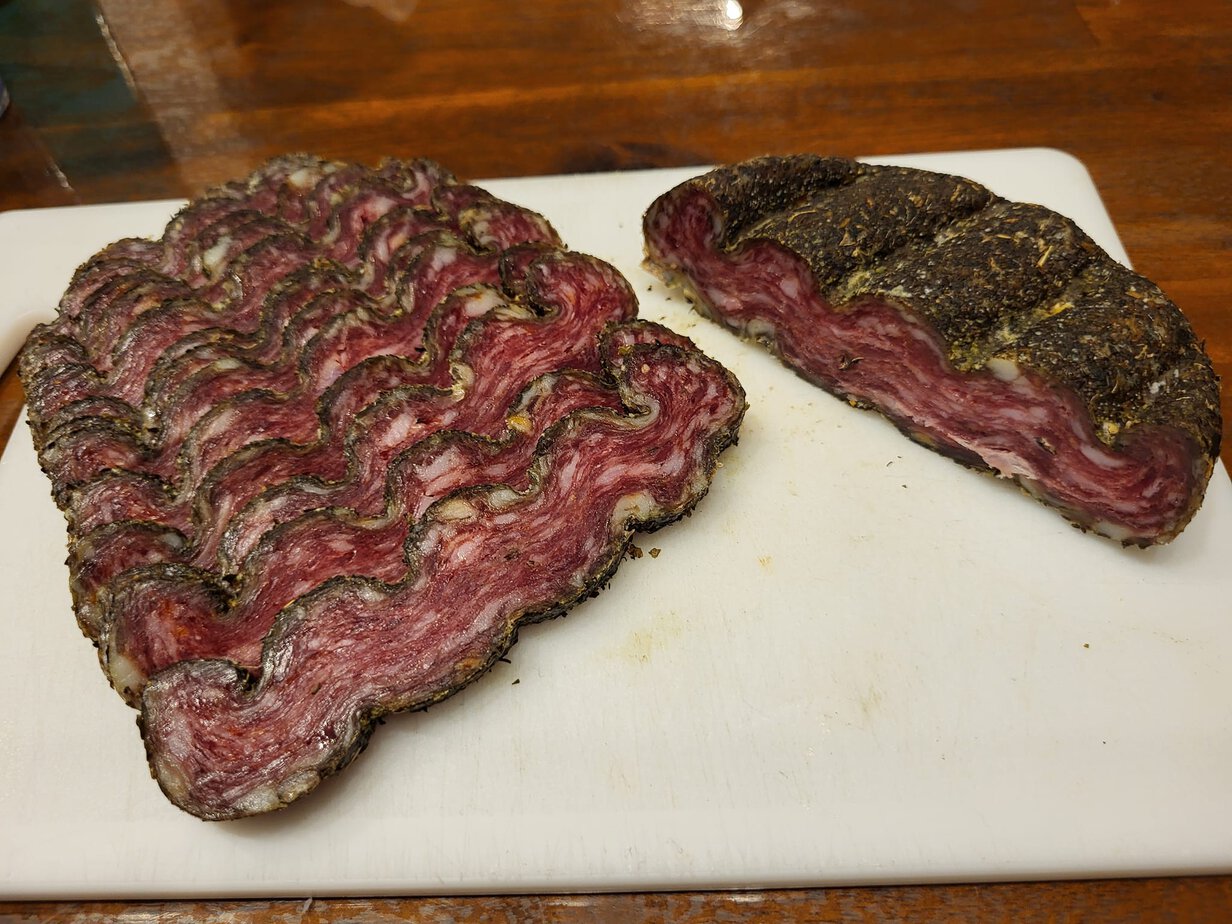
Sliced on a board, the béret basque is instantly recognizable by its Camembert-like shape. This casing-free sausage, flavored with pepper and Espelette pepper, can easily be made at home. If you enjoy traditional homemade charcuterie, here are the secrets to making it, plus a little patience while it dries.
What Is a Béret Basque?
The béret basque is a dry-cured sausage with no casing, pressed into a disc like a Camembert. Its name and shape are a nod to the famous headwear of the Basque Country.
With no casing to protect it, the meat dries exposed on a rack, so it has to be packed firmly to force out the air.
Born in 2003 in Saint-Jean-le-Vieux
The Mayté company created the béret basque in 2003 in Saint-Jean-le-Vieux, in Lower Navarre, and it quickly became a classic of Basque artisanal charcuterie. The original, flavored with pepper or Espelette pepper, is made from 100% Basque pork.
It quickly found itself at the center of what was dubbed “the sausage war.” An industrial competitor, the Loste company, launched a similar product, the “Pavé basque,” with Basque cultural references but non-local pork. “Why not call their sausage the ‘Pavé de la Haute-Loire’?” asks Éric Mayté.
The Mayté company defended its creation and, more broadly, the authenticity of Basque products. The dispute highlighted the lack of legal protection for the “Basque Country” brand. For connoisseurs, the flavor and quality of the meat make all the difference.
The Main Ingredients of a Béret Basque
The meat mixture combines pork shoulder and pork belly. It is seasoned with salt, gray and black pepper, quatre épices, coriander, nutmeg, a little sugar, garlic powder and Espelette pepper.
Use non-iodized salt, which is essential for homemade charcuterie: iodine can interfere with the fermentation of the meat, and therefore with its flavor and texture.
The Bactoferm Mold 600 and Sax-01 cultures, available from specialist suppliers such as Testek, improve the microbial flora and reduce the risk of oxidation. They add an extra layer of safety but are still optional: I’ll say it again, only use them if you already have them on hand or if you don’t feel confident with the recipe.
Technical Pointers
Homemade béret basque is learned as a method, with its own tricks and adjustments for a flavorful, high-quality result.
Set the bérets on a rack in a well-ventilated refrigerator. Turn them regularly, especially during the first few days, to ensure even drying.
A ventilated wine fridge, at 14°C and 74% humidity, is an excellent alternative.
Pack the bérets firmly and avoid a rack with too wide a mesh: the meat sags, air gets trapped inside and the drying suffers. Also keep the humidity steady to prevent premature oxidation or an unbalanced microbial flora.
Keep an eye on weight loss: the goal is a water loss of 45 to 50%. A 200 g raw béret should weigh about 100 g once dried. Below that threshold, the flavor will be less intense and the sausage will not keep as well.
This recipe follows the traditional method, without curing salt: the amounts of salt, temperatures and times given are what preserve the meat and must be followed to the letter, with impeccable hygiene; anyone who prefers an extra margin of safety can replace part of the salt with 0.6% nitrite curing salt, measured according to the manufacturer’s instructions.
A recipe contributed by cé-line
Ingredients
- 700 g pork shoulder
- 300 g pork belly
- 35 g salt
- 1 g gray pepper
- 2 g black pepper
- 4 g four-spice blend
- 1 g cilantro leaf
- 0.5 g nutmeg
- 2 g granulated sugar
- 1 g garlic powder
- 2 g Espelette pepper
Instructions
Grinding the Meat
- Run the pork shoulder and pork belly through a meat grinder fitted with an 8 mm plate.700 g pork shoulder, 300 g pork belly
Mixing the Ingredients
- In a large bowl or a stand mixer fitted with the paddle attachment, mix the ground meat with all the seasonings (salt, spices, cilantro, nutmeg, sugar, garlic, and Espelette pepper).35 g salt, 1 g gray pepper, 2 g black pepper, 4 g four-spice blend, 1 g cilantro leaf, 0.5 g nutmeg, 2 g granulated sugar, 1 g garlic powder, 2 g Espelette pepper
- Mix thoroughly until evenly combined.
Resting the Mixture
- Let the mixture rest in the refrigerator for at least 12 hours. This step is essential to let the flavors develop and to make shaping easier.
Shaping the Berets
- Divide the mixture into 350 g portions.
- Shape the mixture into disks about 3/4 cm thick, similar to a "Camembert". Feel free to use a ring mold with a plunger, because you need to pack the meat tightly to press out the air
Setting Up for Drying
- Arrange the berets on racks, spacing them well apart so they don't touch. Don't overdo it, but air needs to circulate. Also, the mesh of the racks shouldn't be too open, so the meat is well supported (remember, there's no casing, and even if you pack it firmly, the meat can sag and let air in)
- The goal is to allow even, flawless drying.
- Drying target: Target water loss: about 50%. Example: a beret weighing 200 g raw should weigh 100 g once dried. The right balance between flavor and shelf life lies between 45 and 50% water loss. Below that threshold, the flavor is less intense and the shelf life is shorter.
Drying in the Fridge
- Place the rack holding your berets at the bottom of your refrigerator, ideally a well-ventilated one. Let them dry for 4 weeks, turning them regularly, especially during the first few days.
Wine Fridge Option
- A wine fridge can also be used as an alternative to the refrigerator, as long as it is well ventilated. Make sure the temperature stays at 14°C and the humidity at 74% for optimal drying.
Notes
Try different levels of drying to suit your taste, but for the best dried meat or dry sausage flavor, aim for 50% water loss.