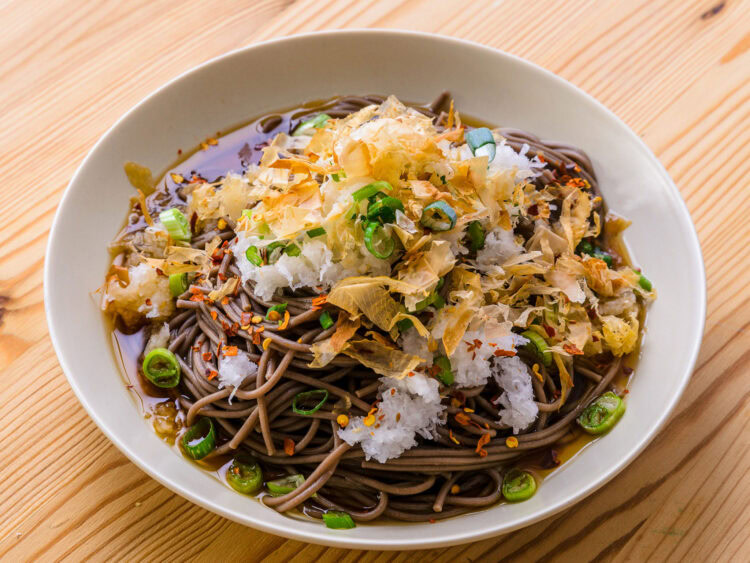
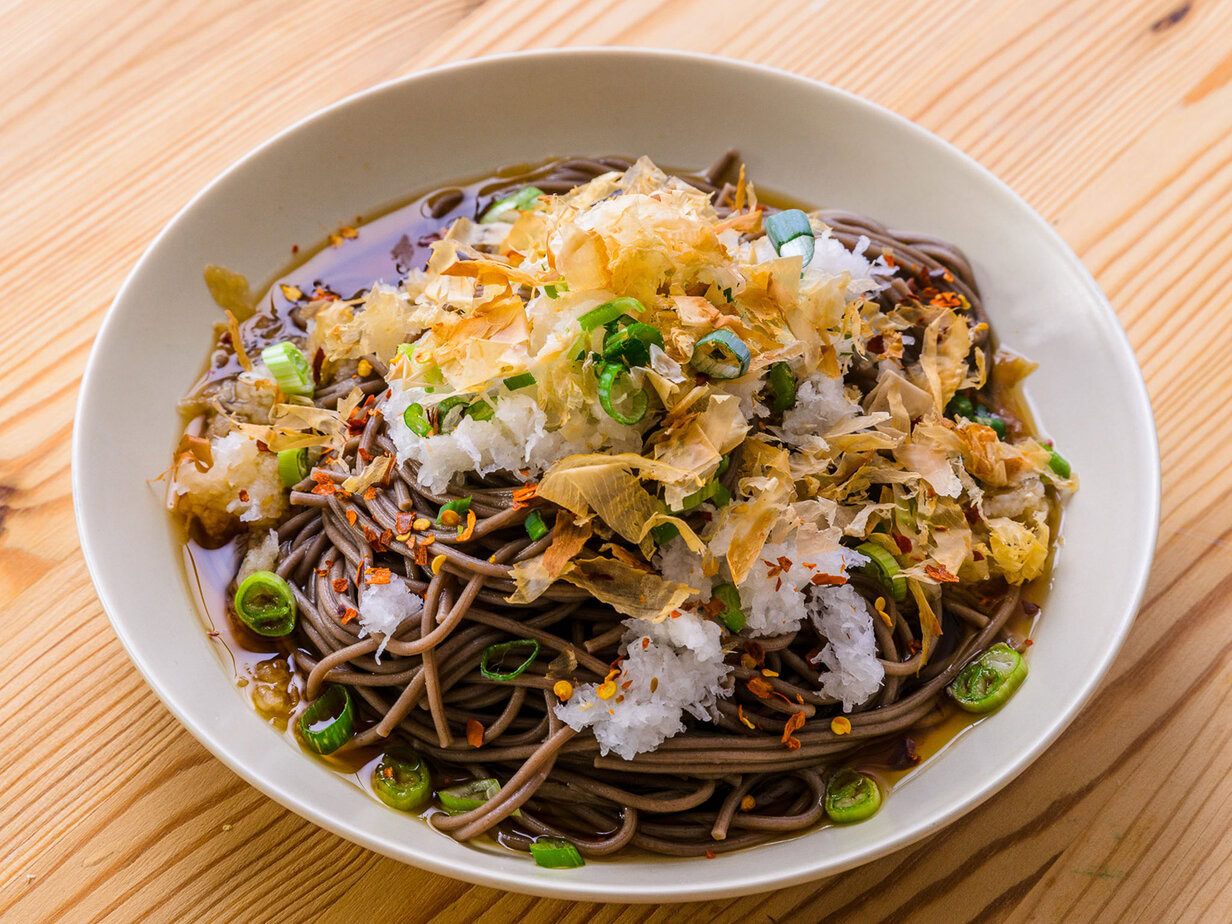
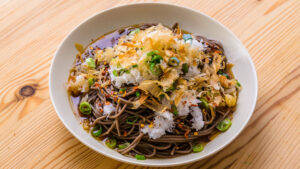
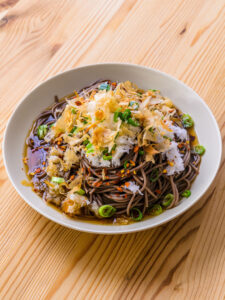
Fukui’s cold buckwheat noodles topped with a generous mound of pungent grated daikon and chilled tsuyu made with kombu and bonito dashi.
When it’s muggy and the meal needs to be quick, a bowl of cold noodles solves the problem in minutes. Oroshi soba is as direct as it gets: firm buckwheat noodles, a snowy mound of grated daikon, and cold tsuyu poured over at the table.
The radish’s heat hits at once, brief and almost peppery, then fades, leaving the noodles’ nutty grain flavor behind. The bonito flakes are still moving when the bowl arrives. In Fukui, they eat it this way all year round, even in the snow, and nobody adds wasabi.
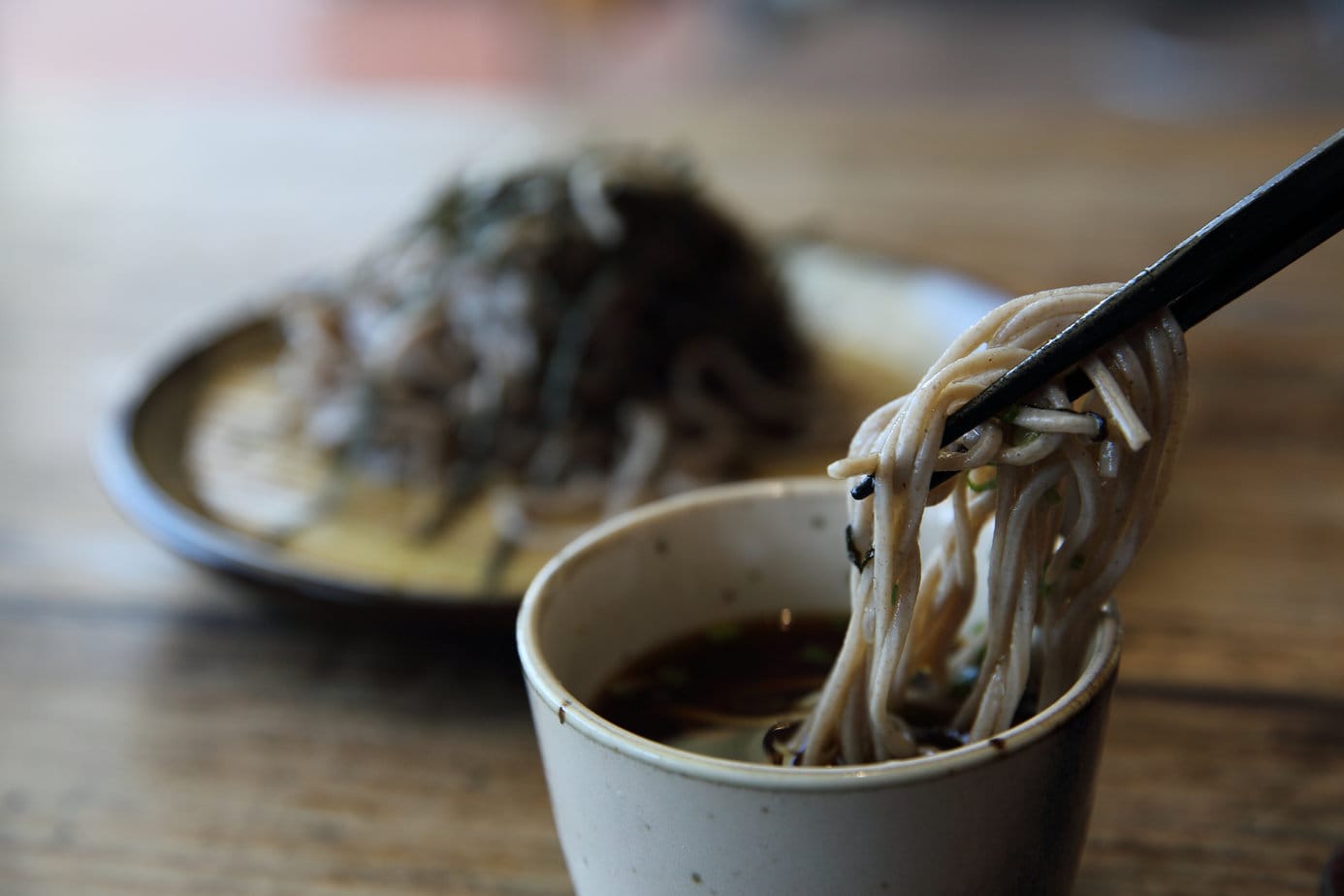
What is oroshi soba?
Oroshi soba is a bowl of cold buckwheat noodles topped with grated daikon and dressed with a concentrated tsuyu made from kombu and dried-fish dashi, seasoned with soy sauce, mirin, and a little sugar.
The garnishes are simple: katsuobushi and thinly sliced scallion. Fukui’s noodles are dark and speckled, made from whole-grain hikigurumi flour that gives them a deeper grain aroma than the pale Edo-style soba served as zaru soba. When grated, daikon releases isothiocyanates, a clean, fleeting heat closer to horseradish than chili.
“Oroshi” means “grated,” hence the mound of radish that defines the bowl. “Echizen” refers to the former province that became Fukui Prefecture, and more precisely to Fuchu, now the city of Echizen, where the dish took its current form.
From survival crop to the emperor’s bowl
Buckwheat first came to Fukui as a survival crop. Between 1471 and 1473, the warlord Asakura Takakage encouraged its cultivation around Ichijodani: it ripens in 75 days, grows on poor soil, and feeds the population when rice is scarce. It was not yet made into noodles. Instead, it was eaten as sobagaki, a dense kneaded paste, or as dumplings.
The turning point came in 1601, when Honda Tomimasa became lord of Fuchu. He brought in Kaneko Gonzaemon, a soba craftsman from Fushimi near Kyoto, who introduced sobakiri: dough rolled out and cut into thin strands.
Local accounts say the castle physician recommended adding grated radish, which at the time was thought to help digest starches. The pairing lasted for a simpler reason: cold buckwheat, the radish’s sharp bite, and a full-flavored broth simply work together.
The current name dates back to 1947. During an October visit to Fukui, Emperor Shōwa is said to have asked for a second bowl, then described it in Tokyo as “that truly delicious Echizen soba.”
The region adopted the phrase and officially enshrined “Echizen Oroshi Soba.” In a prefecture known for heavy snowfall, the bowl is served cold even in winter, at gatherings, temple festivals, and family meals, as a marker of local taste within Japanese cuisine.
The key ingredients in oroshi soba
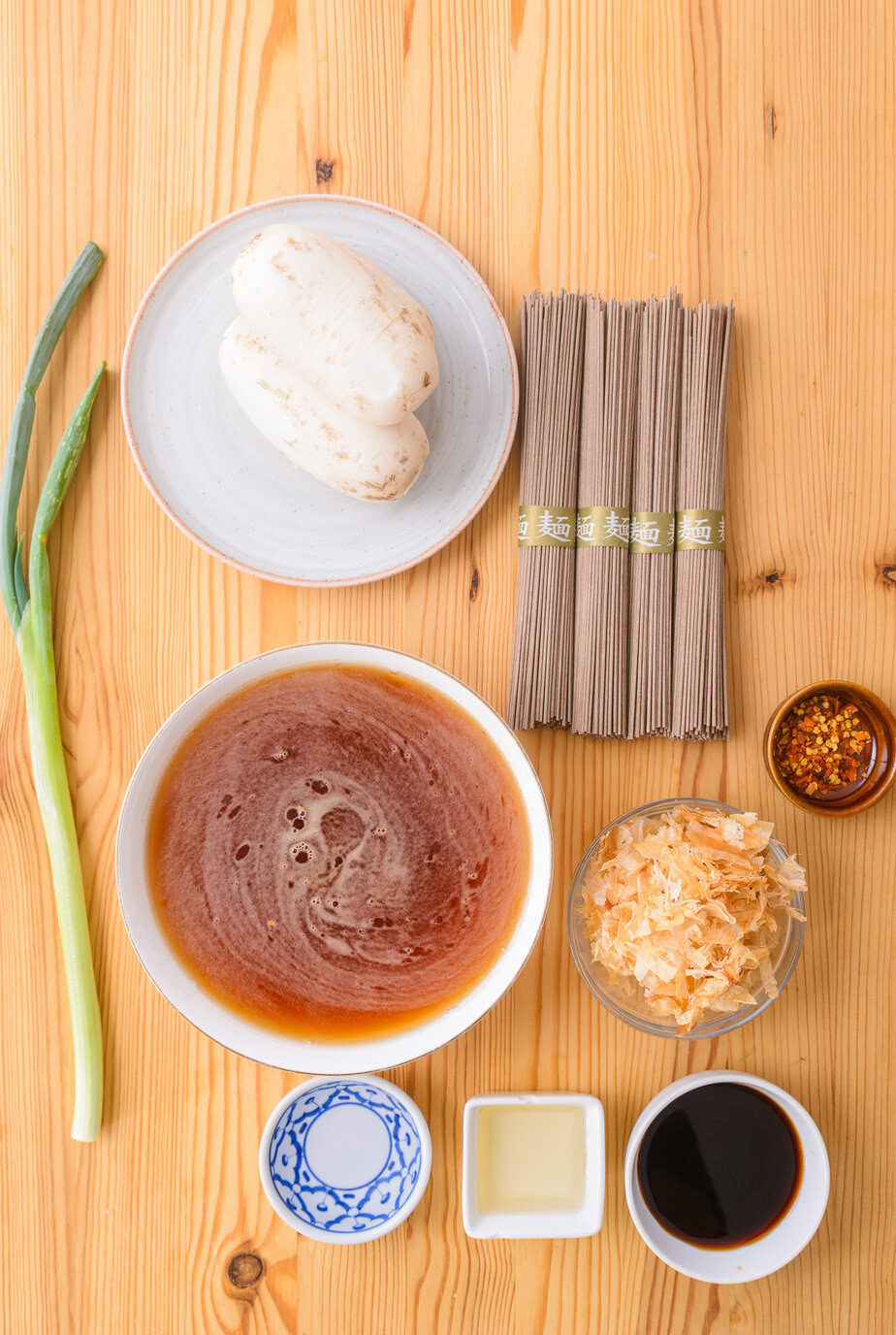
It all starts with the noodles. Hikigurumi flour is a whole-grain grind that often retains the grain’s black hull, milled slowly on stone to preserve its aroma. The best comes from zairaishu, Fukui’s heirloom varieties, which yield less than modern cultivars but offer far more fragrance. The noodles are dark, slightly rough-edged, and, when served cold, retain the firm koshi prized in soba.
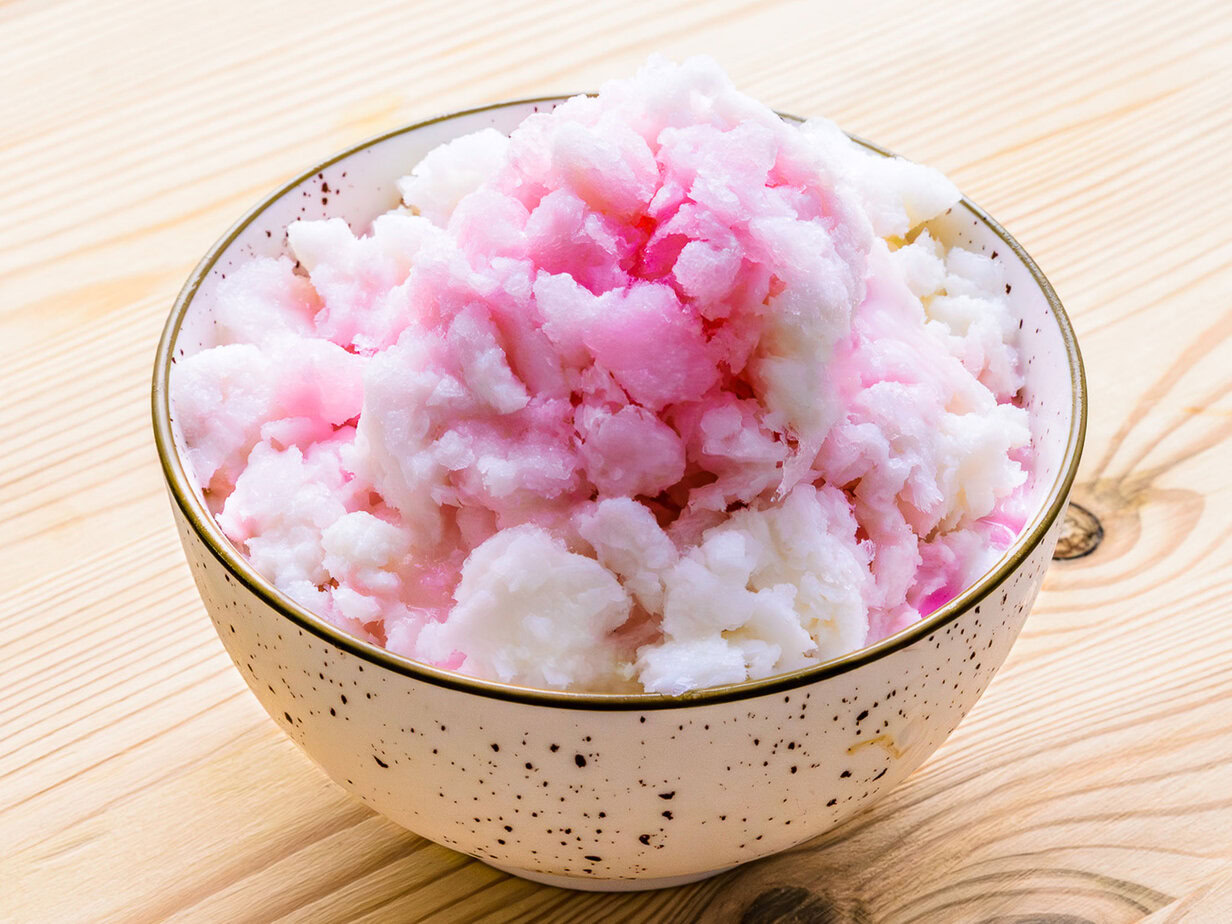
The daikon brings the heat, not the decoration. Karami daikon, small and dense, is the ideal radish. If you can’t find it, use the last 4 or 5 centimeters of a regular Aokubi daikon, unpeeled: that’s where the pungent compounds are most concentrated. Finely grated, it also releases plenty of juice, which thins and lightens the broth.
The tsuyu must be robust enough to stand up to that extra liquid. The kombu lays down the dashi’s mineral base; bonito, mackerel, or sardine flakes add smoke and sea notes.
Soy sauce, mirin, and a little sugar make up the kaeshi, then the broth is chilled. To finish, scallion brightens the bowl and katsuobushi reinforces the broth’s umami.
Hallmarks of authenticity and pitfalls to avoid
A good bowl reveals itself in a few details: dark, speckled noodles, genuinely pungent radish, and a broth concentrated enough to hold up without tasting watered down.
The most common style is bukkake, with tsuyu poured directly over the chilled noodles at the table, but some shops mix the radish into the broth, while others keep only its squeezed juice, shiborijiru. Outside the Fukui style are wasabi, too much chili powder, tempura, raw egg, and overly elaborate garnishes. Here, the point is contrast, not decoration.
Ingredients
- 4 servings of soba noodles
- 400 g of daikon (Japanese white radish) for grating
- 650 ml of dashi
- 1.5 tablespoons of sake
- 1.5 tablespoons of mirin
- 3 tablespoons of light soy sauce level
- 20 g of scallions thinly sliced
- 8 g of katsuobushi
- shichimi (Japanese seven-spice blend) or chili flakes to taste, optional
Instructions
Broth
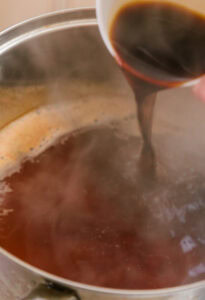
- Bring the dashi to a boil.650 ml of dashi
- Add the sake, soy sauce, and mirin, then return to a boil.1.5 tablespoons of sake, 3 tablespoons of light soy sauce, 1.5 tablespoons of mirin
Noodles and daikon
- Grate the daikon finely for more heat.400 g of daikon (Japanese white radish)
- Cook the soba noodles in a large pot of boiling water.4 servings of soba noodles
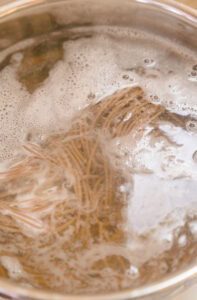
- Drain the noodles.
- Rinse the noodles under cold water, rubbing gently to remove the starch.
- Drain well.
Assembly
- Divide the noodles among serving bowls.
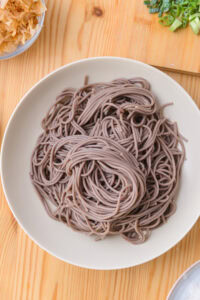
- Spoon over the broth and grated daikon.
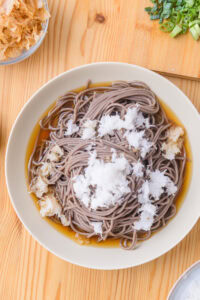
- Top with scallions and katsuobushi.20 g of scallions, 8 g of katsuobushi
- Finish with shichimi or chili flakes, if desired.shichimi (Japanese seven-spice blend) or chili flakes
Three serving options
- Stir the grated daikon into the broth, then pour it over the noodles.
- Serve the grated daikon and broth separately.
- Squeeze the juice from the grated daikon into the broth, then pour it over.
Notes
- Grate the daikon very finely for a sharper, spicier result, or more coarsely for a milder flavor.
- After rinsing, drain the soba thoroughly so the broth doesn’t become diluted.
- Adjust the broth to taste with the light soy sauce, and add the shichimi just before serving.