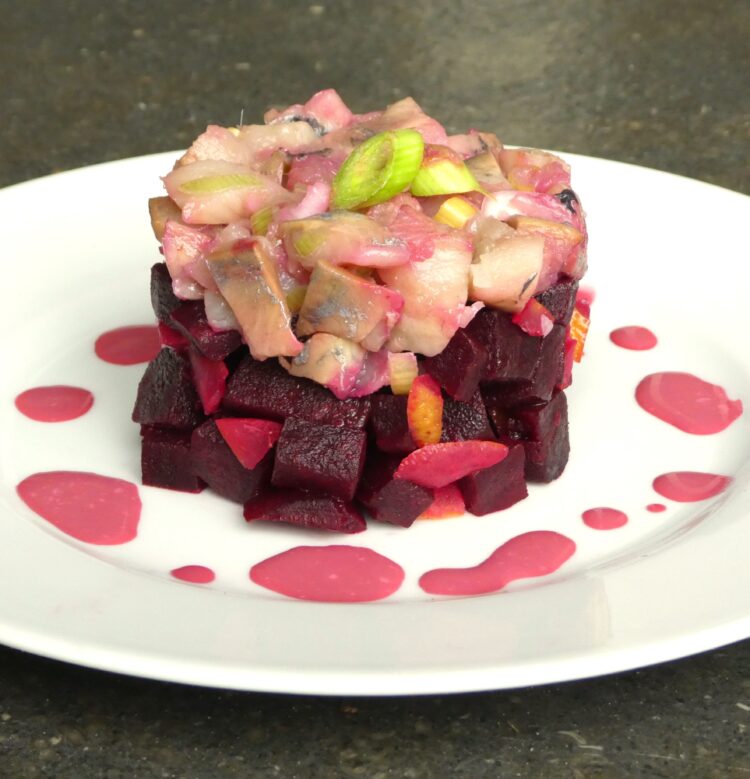
A cold starter shaped in a ring mould: beetroot marinated in soy sauce and balsamic vinegar, young herring and spring onion.
Deep red, citrus notes, briny flesh: this herring tartare is a fresh, salty and gently tangy bite. The beetroot, marinated the day before in a soy-balsamic mixture, forms a tender, glossy base, while the young herring retains its bite on top. This cold starter serves one and should be served well chilled with a few drops of sauce thickened with mayonnaise. This recipe is part of my keto dishes.
What is herring tartare?
Here, the word tartare refers to a cold preparation, cut into small, even pieces, carefully seasoned and often shaped in a ring mould for a neat finish. The layers remain distinct: on the bottom, diced, marinated cooked beetroot; on top, lightly salted young herring mixed with thin half-moons of spring onion. You find the same attention to cutting and seasoning in a Thai tartare.
The herring brings briny notes, saltiness and a firm yet tender texture, while the beetroot adds its earthy sweetness, deep colour and a measured acidity from the marinade. Salt-preserved lemon, very finely chopped, adds fragrance without overpowering, and the spring onion provides a fresh crunch. The sauce is not mixed into the layers; it is made with the reserved marinade, thickened with a teaspoon of mayonnaise.

The origins and spirit of herring tartare
Fish tartare is one of those cold starters where the cutting matters as much as the seasoning. The technique seems simple, but it calls for precision: clean cuts, carefully balanced saltiness and a ring-mould presentation that holds the layers together without crushing them. For another approach to raw fish, the principles of sashimi also rely on freshness and precise cutting.
The herring-beetroot pairing recalls combinations found in Northern European cuisines and at French tables, with the salted fish balancing the sweetness of the beetroot. Balsamic vinegar rounds out the acidity, while soy sauce or tamari brings umami. The distinctive touch in this version comes from the salt-preserved lemon and the reserved marinade, served as a sauce around the tartare.
The main ingredients
For one serving, use one lightly salted young herring, ready to eat and unsmoked, for a clean saltiness and a tender bite. Remove the tail, check the flesh for bones with your fingertips, then cut into even pieces. Allow 80 g of cooked beetroot for the base, diced and patted dry so it absorbs the marinade without diluting it; plain vacuum-packed cooked beetroot works well, provided it is not already seasoned.
The salt-preserved lemon, 20 g very finely chopped, provides the citrusy, salty note. The soy sauce or tamari, 1 tablespoon, brings salt and umami to the marinade; for a gluten-free version, check the label. The balsamic vinegar, 1 tablespoon, adds a gentle acidity and deepens the colour.
The mayonnaise, 1 teaspoon, binds the marinade into a fluid sauce to spoon around the tartare; a Japanese mayonnaise gives a creamier texture. Half a spring onion brings freshness and crunch, with thin half-moons mixed into the herring and two whole rings for garnish. No added salt is needed; if you opt for tamari, choose a well-balanced tamari sauce.
Technique tips and serving
Success starts the day before: cut the beetroot into small dice, pat dry and refrigerate with the soy sauce and balsamic vinegar. These 24 hours of resting infuse the vegetable with flavour and colour the liquid that will become the sauce, while the soy sauce enhances the umami flavour, subtle but essential. When plating, drain the beetroot, reserving the marinade, mix the dice with the preserved lemon, then combine the herring and onion separately. Shape in a ring mould in two gently compacted layers, with the lemon beetroot on the bottom and the herring with onion on top, then slowly lift off the ring.
Make the sauce by mixing the mayonnaise into the reserved marinade until fluid and glossy, then add it in drops just before serving to keep the tartare intact. Serve cold, without leaving it to stand at room temperature. A green salad or a few cucumber ribbons complement the starter without making it heavy; for the same briny, tangy character, a wakame salad or fish kinilaw also works well. Allow 6 g of net carbs per serving, with the beetroot and balsamic vinegar contributing to that total.
For more low-carb ideas, browse all my keto recipes.
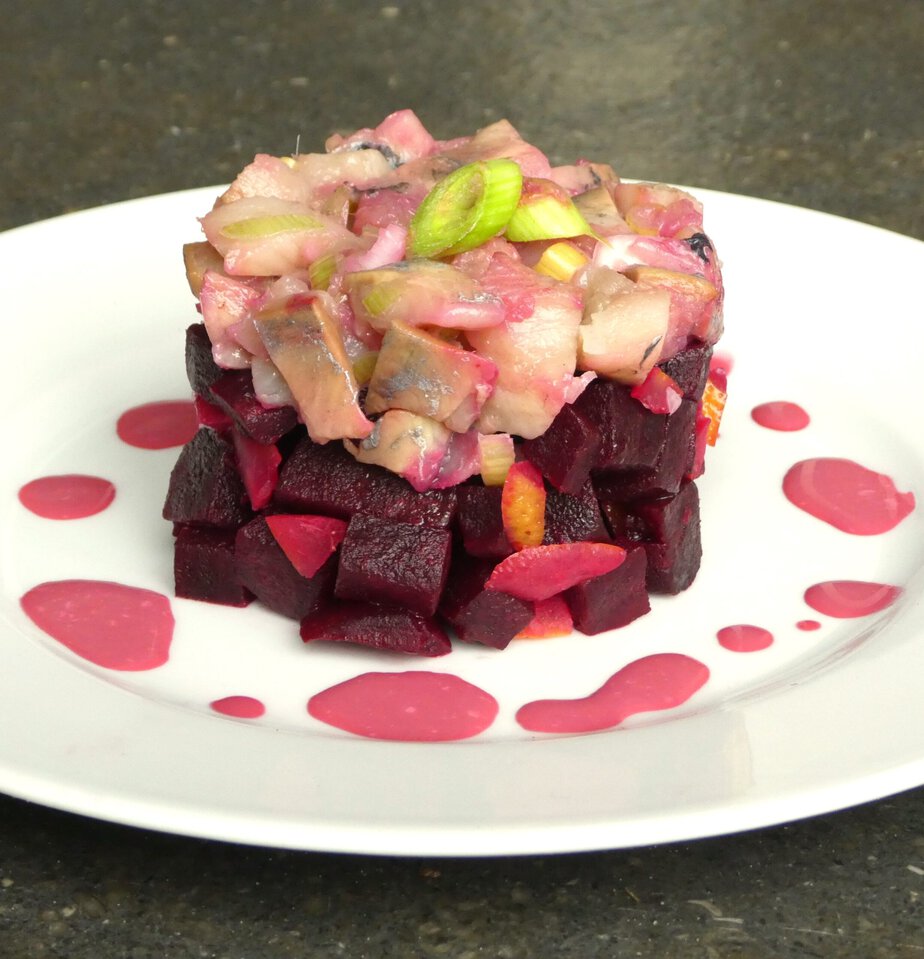
Herring Tartare
Ingredients
- 1 lightly salted new-season herring
- 80 g beetroot cooked
- 20 g preserved lemon
- 1 tablespoon soy sauce or tamari
- 1 tablespoon balsamic vinegar
- 1 teaspoon mayonnaise
- 0.5 spring onion
Instructions
- Cut the beetroot into small pieces and pat dry. Place in a container with the soy sauce and balsamic vinegar and refrigerate to marinate.80 g beetroot, 1 tablespoon soy sauce or tamari, 1 tablespoon balsamic vinegar
- Remove the herring’s tail and feel with your fingers to check that no bones are sticking out. Cut the herring into pieces.1 lightly salted new-season herring
- Cut the spring onion into thin half-rings and mix with the herring. Cut two neat whole rings for garnish.0.5 spring onion
- Cut the lemon into very small pieces and gently pat dry.20 g preserved lemon
- Drain the beetroot, collecting the marinade in a container to use as a sauce later. Mix the beetroot pieces with the lemon.
- Stir the mayonnaise into the marinade.1 teaspoon mayonnaise
- Assemble on the plate. First place the beetroot in the plating ring and press down. Then spread the herring on top and press down.
- Carefully lift off the ring. If necessary, press down gently on the tartare as you lift, but not too hard, or the little tower will collapse. Garnish with the reserved spring onion.
- Just before serving, dot the sauce around the little tower.