


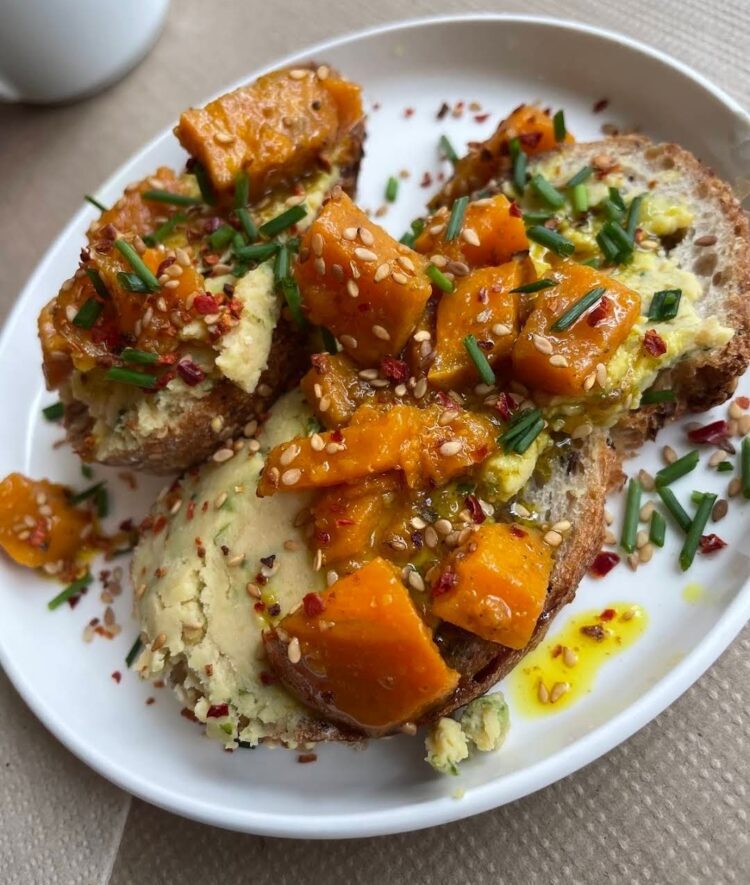
Air-fried butternut squash cubes, golden at the edges and meltingly tender in the middle, ready in about 20 minutes.
One look inside the basket tells you everything. The edges have turned a deep caramel brown, the rest has stayed a rich orange, and the smell of toasted thyme already fills the kitchen.
Air fryer butternut squash is all about contrast: a sweet crust with a little bite, and a center so soft it collapses like mash. You spear one cube to test for doneness, then a second, and by the time the dish reaches the table, it’s already missing a few pieces.
What is air fryer butternut squash?
Butternut squash is a winter squash with dense, sweet orange flesh and a gently nutty flavor. Once cubed, oiled, and seasoned, it goes into the air fryer and comes out as if it had been roasted in the oven, in half the time. Forced convection dries the surface while the center cooks, creating caramelized edges without drying out the flesh. It’s the same principle as sweet potato fries, but with a squash that is more delicate and contains more moisture.
The name comes from English: butternut squash, a reference to its buttery texture and nutty aroma. In French, it is sometimes called doubeurre, a literal translation that never really caught on. Botanically, it’s a Cucurbita moschata, closely related to pumpkin and other moschata squashes.
An American squash from the 1940s
Butternut is not an old heirloom squash. It was developed in the 1940s by Charles Leggett, a grower from Stow, Massachusetts, who wanted a winter squash with dense flesh, few seeds, and skin that was easy to remove. It quickly became a staple in American markets, then made its way to Europe.
In France, it first found its place in soups and gratins, two preparations that mute its best qualities. Roasted, butternut concentrates its sugars instead of diluting them, and suddenly it feels like much more than a dutiful winter vegetable. The oven could do that too, of course, but it took 45 minutes and a full sheet pan.
The air fryer changes the equation. A portion for four fits in one basket, the cooking time drops below 20 minutes, and you can get it going while the rest of the meal comes together. Roasted butternut pairs well with meat or fish, slips nicely into a warm grain salad, or gets eaten straight from the dish with a fork while you clear the table.
Main ingredients for air fryer butternut squash
A medium squash weighing 900 g to 1.1 kg yields the 600 g of flesh you need. Choose one that feels heavy for its size, with matte skin and a dry stem. The solid neck peels easily with a vegetable peeler; the bulbous base, much less so. Cut the squash in half and scoop out the seeds first, then peel it on a stable work surface.
Two tablespoons of olive oil are enough for 600 g of cubes. The oil is not there to fry; it carries heat to the surface and helps the spices adhere. Sweet paprika adds color and a light smoky note, while dried thyme holds up far better during cooking than fresh thyme, which burns.
Salt and pepper should stay restrained: half a teaspoon and a pinch. Butternut is already naturally sweet and doesn’t need much else. For a version with honey or maple syrup, add the sweetener only in the last few minutes: if you add it at the start, it will blacken before the squash is done and stick to the bottom of the basket.
Technical tips for perfect butternut squash
Everything comes down to size and moisture. Uniform 2 cm cubes caramelize at the edges just as the centers turn tender, and they should be patted dry with paper towels before oiling. As long as surface moisture is still evaporating, the temperature stays around 100 °C and browning won’t begin.
Preheat for 3 minutes at 190 °C, spread the cubes in a loose single layer in a 5- to 6-liter basket, and cook in two batches rather than crowding them if your basket is smaller.
Keep the temperature at 190 °C or below; butternut is rich in sugars that brown quickly, and the surface will blacken before the center has time to soften. Remove the cubes when several edges are deep golden and the tip of a knife slips through the center with just a little resistance, then serve right away.
Ingredients
Butternut Squash
- 600 g butternut squash peeled and seeded (about 1 medium squash weighing 900 g to 1,1 kg before preparation)
- 2 tablespoons olive oil
Seasoning
- 1 teaspoon sweet paprika
- 1 teaspoon dried thyme
- 0.5 teaspoon salt
- 1 pinch pepper
Instructions
Preparation
- Peel the squash, halve it lengthwise, remove the seeds and stringy fibers, then cut the flesh into even 2 cm cubes.600 g butternut squash
- Pat the cubes thoroughly dry with paper towels, then place them in a large bowl.
- Add the olive oil, paprika, thyme, salt, and pepper, then toss until the cubes are evenly coated.2 tablespoons olive oil, 1 teaspoon sweet paprika, 1 teaspoon dried thyme, 0.5 teaspoon salt, 1 pinch pepper
Air Fryer
- Preheat the air fryer to 190 °C for 3 minutes.
- Arrange the cubes in the basket in a single, fairly loose layer.
- Cook at 190 °C for 16 to 20 minutes, shaking the basket after 8 minutes and tossing again around 14 minutes. Start checking for doneness at 16 minutes and continue cooking in 2-minute increments if needed, until several edges are golden brown and the tip of a knife slides through the center with slight resistance.
Serving
- Serve immediately.
Notes
- Cut the squash into even 2 cm cubes: consistency matters more than exact size, otherwise some pieces will burn while others stay undercooked.
- Dry the cubes thoroughly after cutting: as long as moisture is still evaporating, the surface stays around 100 °C and caramelization cannot begin.
- Preheat for 3 minutes at 190 °C to keep the cubes from “sweating” at the start and steaming in their own moisture.
- Cook in a single, fairly loose layer (ideally a 5–6 L basket for 600 g). If your basket is smaller, cook in two batches rather than overcrowding it.
- Two tosses are enough (8 min and 14 min): opening the fryer too often lowers the temperature and slows browning.
- Doneness cue: golden-brown edges and a knife that slides through with slight resistance. Too tender, and the texture starts heading toward mash.
- Sweet version (honey/maple syrup): add the sweetener only during the last few minutes so it does not burn or stick.
- Storage: up to 2 h at room temperature; 3 days in the refrigerator in an airtight container once cooled; 2 months in the freezer (freeze flat first).
- Reheating: 4–6 min at 180 °C from the fridge, shaking halfway through; 8–10 min at 180 °C from frozen, shaking after 5 min, then checking every 2 min.


Mon mari a été bluffé par les bords bien caramélisés et le cœur fondant, il m’a même demandé d’en refaire dès la semaine prochaine 🙂