


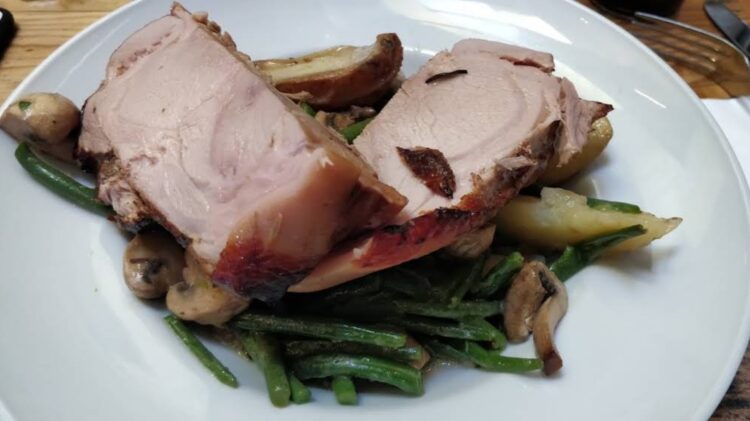
An 800 g pork roast coated in mustard, seared at 200 °C, then gently cooked at 160 °C in the air fryer, with the vegetables and broth in the same basket.
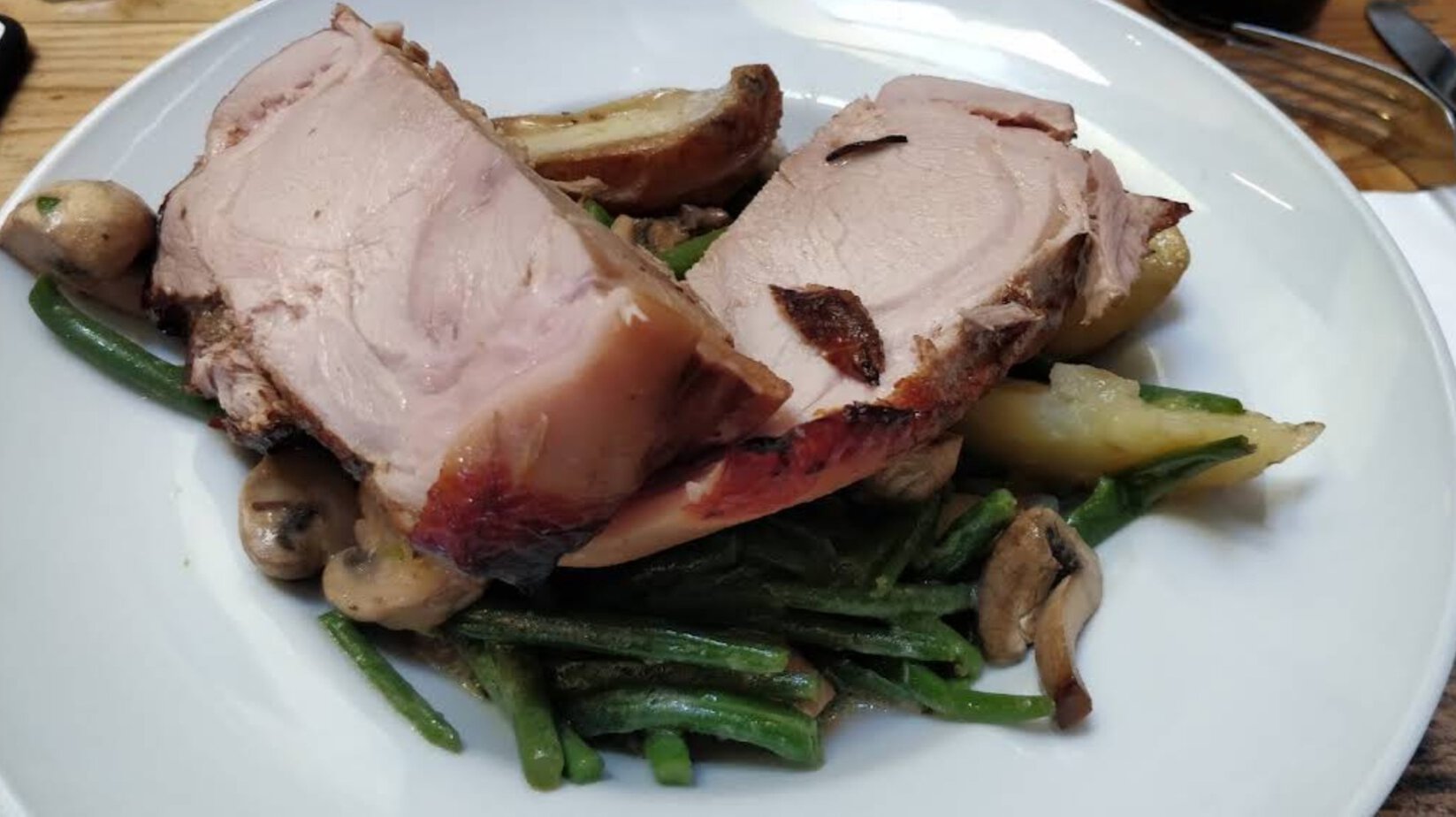
Open the basket and the aroma of toasted mustard and garlic reaches you before the dish does. The crust is brown, matte, almost lacquered, and the blade slips through without resistance.
At the center, the meat stays pale and juicy, and the juices bead on the board with the first slice. You might think this sort of roast belongs to a big Sunday oven and hours of cooking. In fact, it fits neatly into an air fryer basket, with the vegetables cooking all around it.
What Is Air Fryer Pork Roast?
A pork roast is a compact cut, often tied into a neat cylinder, seasoned on the outside and roasted until golden on the surface and just cooked at the center. An air fryer is not actually a fryer: it is a small convection oven whose fan quickly dries the surface and speeds up browning. This circulating heat works very well on a whole roast, provided it has enough room in the basket.
The mustard does the rest. Mixed with olive oil, thyme, and garlic, it clings to the meat, seasons the surface, and forms an even crust that slows the drying of the outer few millimeters. The real guide to doneness is not the timer but the internal temperature: here, 65 °C measured at the center of the roast.
The Sunday Roast, in a Basket
Pork roast is part of the classic French Sunday meal: a whole roast brought to the table with its vegetables and juices. The air fryer version keeps that spirit while changing the setup. No large oven to heat, a basket that comes up to temperature in five minutes, and an 800 g roast that feeds four.
The seasoning base, meanwhile, barely changes from one kitchen to another: mustard, oil, thyme or herbes de Provence, garlic, salt, and freshly ground pepper. The splash of broth poured into the drawer is another familiar habit. It keeps the drippings from burning and creates the juices that accompany the slices.
The time savings are more modest than people claim. With a large piece of meat, the total cooking time comes close to that of a conventional oven. What really changes is the five-minute preheating time and the quality of the crust.
The Main Ingredients for Air Fryer Pork Roast
The cut determines the final result. Pork neck, with its marbling, stays tender because its fat melts during cooking: it is the safest choice for the air fryer. Loin, much leaner, cooks more quickly and dries out faster, so it is better taken to 63 °C rather than 65 °C. If the roast is not already tied, tie it yourself: a regular shape cooks evenly, while a piece that tapers or frays on one side will leave you with a dry end by the time the center is just cooked.
The mustard, olive oil, dried thyme, chopped garlic, salt, and pepper are mixed in a bowl before being spread over the entire surface of the roast. One tablespoon of oil is plenty. Excess oil and rendered pork fat are the two most common causes of smoke in the air fryer, as with Chinese crispy pork.
The 10 cl of vegetable broth serve two purposes. They keep the drippings from burning at the bottom of the drawer and add a little humidity to limit drying. The 300 g of carrots and zucchini cook around the meat in the same basket, cut into large chunks; season them separately, otherwise they will absorb the salt meant for the roast.
Two-Stage Cooking
The first 10 minutes at 200 °C are just for browning. The crust forms, the exterior colors, then the temperature is lowered to 160 °C for 40 minutes, gentle enough for the center to rise slowly without drying out the outside. Cooking at 180 °C from start to finish gives you a roast that is nicely browned on the outside but dry through the outer centimeter.
Preheating matters for the same reason. A roast placed in a cold basket spends its first few minutes warming up instead of searing, and the crust never really forms. Do not cram the roast into a basket that is too small, either: the hot air needs to circulate all around it, otherwise the side pressed against the wall will steam rather than roast and stay pale. If the roast touches the sides, reduce the weight or move to a larger basket, and consult the air fryer cooking chart for everything else.
The only truly reliable guide is the internal temperature. At 63 °C, the meat will be pink and pearly at the center; 65 °C is the compromise chosen here; and 68 to 70 °C gives you meat that is well done but still tender if the cut is good. During the resting time, the temperature will rise by another 2 to 3 °C, so take the roast out slightly below your target. The 10 minutes of resting under a loose sheet of aluminum foil are non-negotiable: slice it straight out of the basket and the juices will run onto the plate.
Troubleshooting and Storage
The two most common issues can be fixed as you go: if the roast is still pale at the end of the suggested cooking time, give it 3 to 4 more minutes at 170 °C; if it is browning too quickly, cover it loosely with foil and finish it at 150 °C. Slice against the grain: 8 to 10 mm slices for pork neck, 6 to 8 mm for loin.
It will keep for 3 days in the refrigerator in an airtight container once completely cooled, or 2 months in the freezer with parchment paper between the slices. To reheat without drying it out, allow 8 to 10 minutes at 120 °C with a few drops of water in the basket, or 3 to 4 minutes at 160 °C under foil if the slices are already cut.
Ingredients
- 800 g pork roast
- 2 tablespoons mustard
- 1 tablespoon olive oil
- 1 teaspoon dried thyme
- 2 cloves garlic chopped
- salt
- freshly ground black pepper
Vegetables
- 300 g vegetables (carrots and zucchini) cut into large chunks
- 10 cl vegetable broth
Instructions
Preparation
- Remove the roast from the refrigerator 30 minutes before cooking.800 g pork roast
- Pat the roast dry with paper towels.
- In a bowl, mix the mustard, olive oil, thyme, chopped garlic, salt, and pepper.2 tablespoons mustard, 1 tablespoon olive oil, 1 teaspoon dried thyme, 2 cloves garlic, salt, freshly ground black pepper
- Coat the roast generously all over with the mixture.
Air Fryer Cooking
- Preheat the air fryer to 200 °C for 5 minutes.
- Place the roast in the basket, making sure it does not touch the sides.
- Sear for 10 minutes at 200 °C to form a golden crust.
- Reduce the temperature to 160 °C, then continue cooking for 40 minutes, turning the roast halfway through.
- Arrange the vegetables around the roast for the last 15 minutes, then pour in the broth.300 g vegetables (carrots and zucchini), 10 cl vegetable broth
- Check that the center of the roast reaches 65 °C, measuring in the thickest part.
Finishing
- Let the roast rest for 10 minutes under a sheet of aluminum foil.
- Slice against the grain and serve with the vegetables and pan juices.


Made this pork roast in the air fryer about 4 times now, and the two-stage cooking with the mustard crust gives me juicy slices and perfect veggies every single time 😊