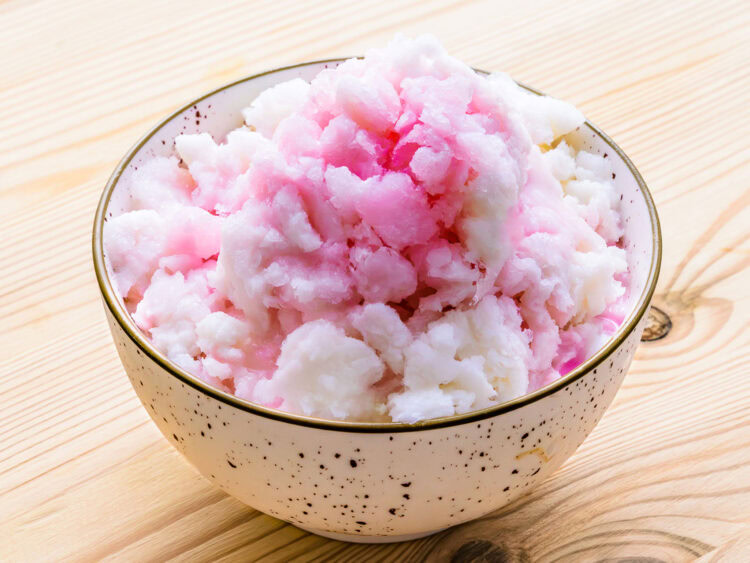
Shaved into delicate ribbons and drizzled with matcha, kuromitsu, or seasonal fruit syrup, kakigori is one of Japan’s most refreshing desserts.
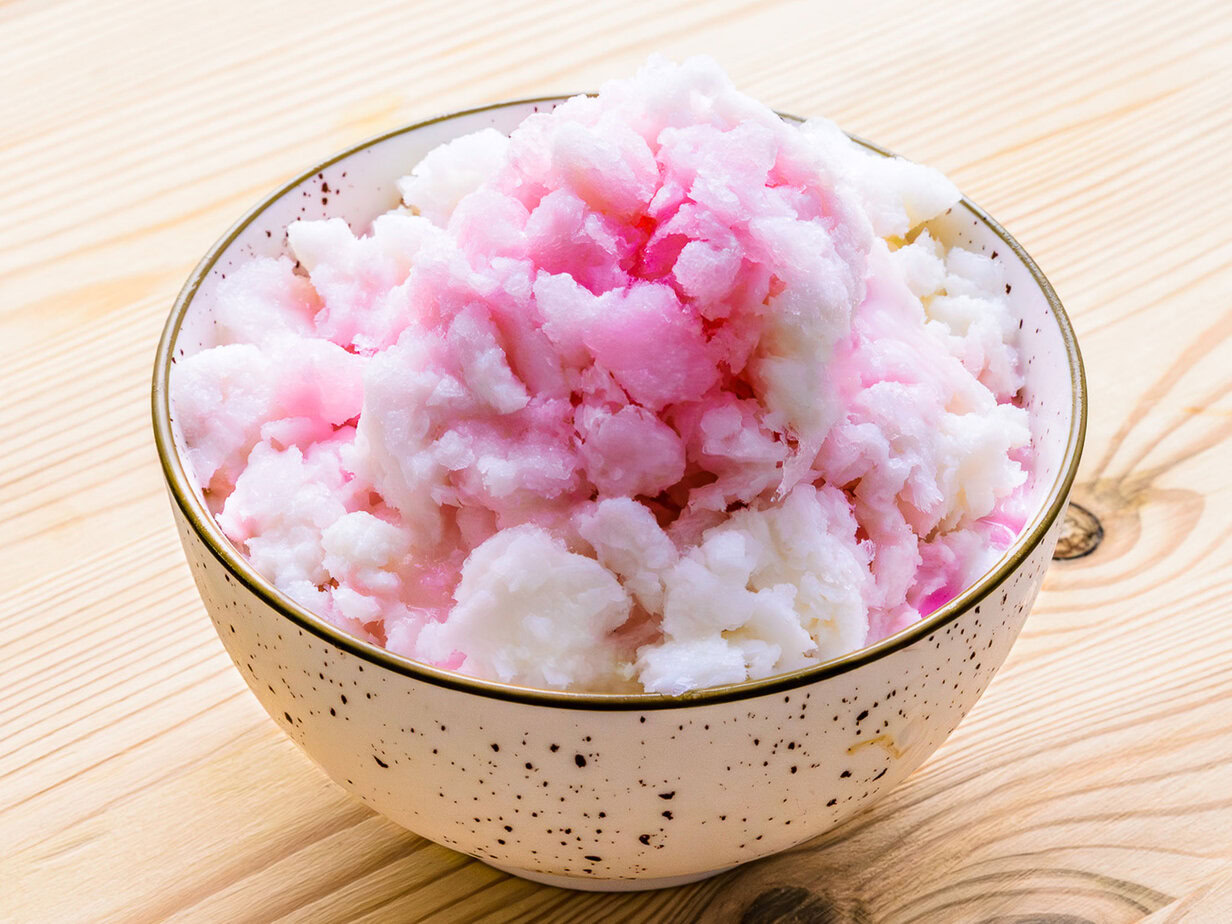
A snowy mound, almost trembling, catches the syrup like a fine rain: the ribbons of ice drink in its color before it even reaches the bottom of the bowl.
In the heavy heat of a Japanese summer, kakigori brings a clean, instant chill without the sometimes harsh crunch of crushed ice. Its fuwafuwa texture, light and fluffy, barely gives way under the spoon and melts as soon as it touches the tongue.
In a snow cone, syrup trickles between chunks of crushed ice. In kakigori, the extra-fine ice holds the liquid more evenly, allowing the flavors to spread through the entire serving. Authenticity, then, lies less in the flavor you choose than in the quality of the ice and the precision of the shave.
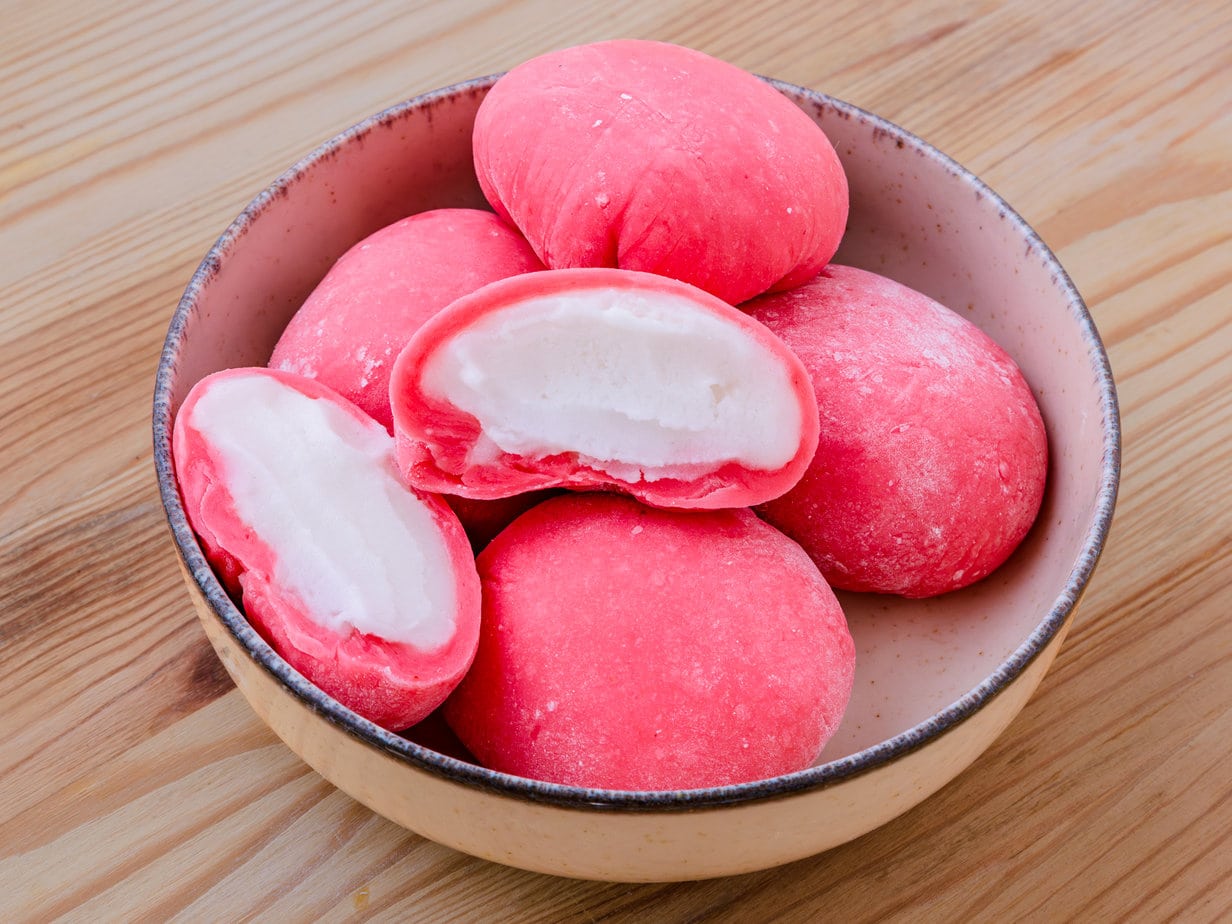
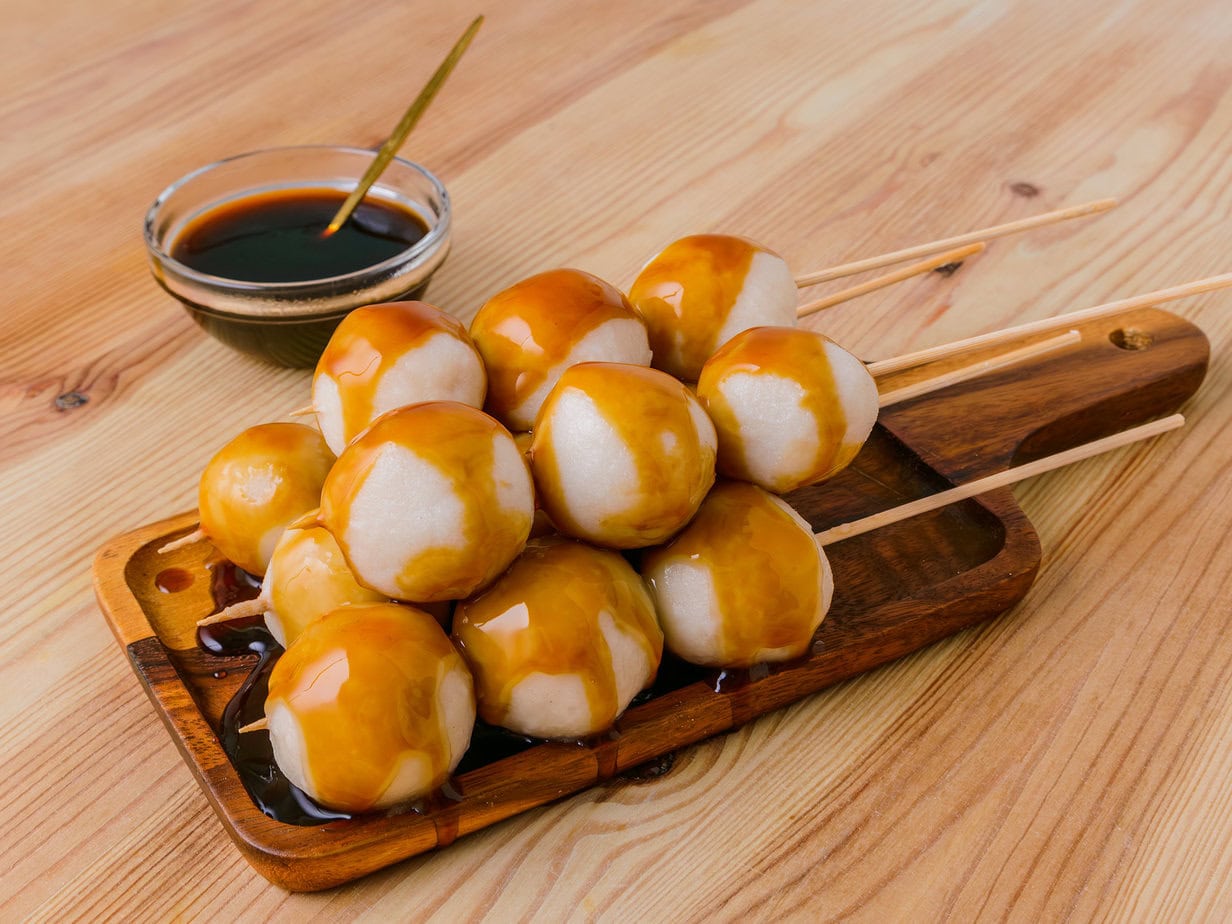
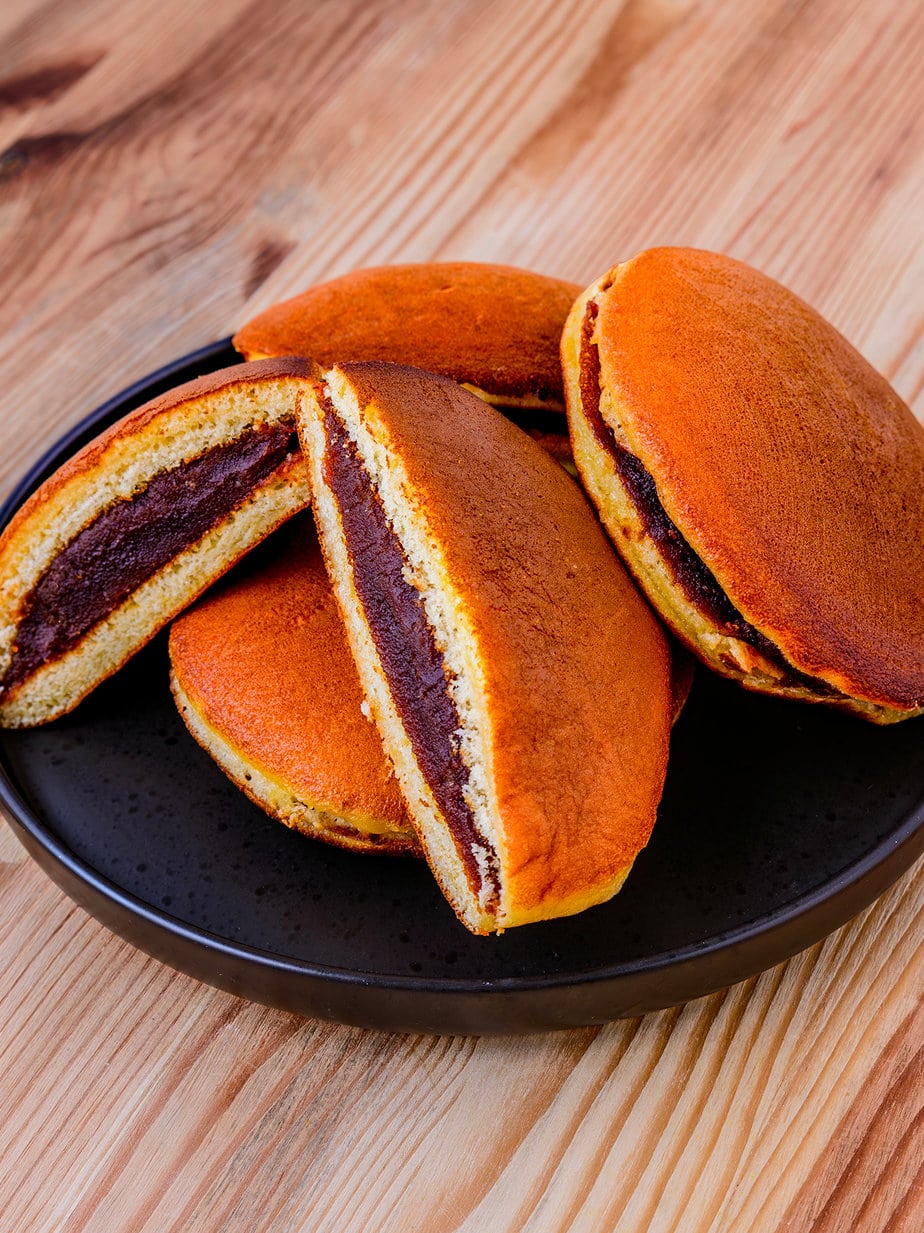
In the same world of Japanese sweets, this attention to texture can be found in mochi ice cream, easy mochi, dorayaki, and mitarashi dango, where softness matters just as much as flavor.
What is kakigori?
Kakigōri literally means “shaved ice.” The name sounds simple, but it refers to a precise technique. At the heart of the preparation is a dense block of very pure ice, ideally tennen-gori, natural ice made from spring water, or junpyō, purified artificial ice.
This block is not crushed. It is shaved into very fine ribbons with a specialized machine fitted with an adjustable flat blade, often fine-tuned throughout service.
Before shaving, the ice must be tempered. If it comes straight from the freezer and is still too cold, it shatters into dry, brittle grains. After ten to twenty minutes of resting, when the surface turns glossy, it generally reaches a temperature between −4 and −1 °C.
It then becomes supple enough to shave into fine ribbons. In traditional machines, the block, fixed on an axis, rotates against the blade while the bowl is moved or gently turned beneath the falling ribbons. The ice builds up naturally, without being packed down, forming a light mound ready to absorb matcha, kuromitsu, fruit purées, azuki, shiratama, or condensed milk.
This is where kakigori clearly stands apart from other frozen desserts. A snow cone is built on crushed, crunchy ice; Korean bingsu is often made with a milk-based ice.
Hawaiian shave ice, whose history is linked to Japanese workers who settled in Hawaii, is often packed by hand to hold generous layers of syrup. Japanese kakigori, however, is never packed down: its lightness is its signature.
From himuro to summer matsuri
Japan’s fascination with summer ice dates back to the himuro, the ice chambers mentioned as early as the 8th century. In Nara, Himuro Jinja Shrine preserves this ritual connection. Every May 1, during Kenpyōsai, ice artisans and refrigeration professionals still offer large blocks or columns of ice embedded with seasonal flowers and fish, praying for prosperity in the summer ahead.
In the 11th century, Sei Shōnagon recorded in The Pillow Book one of the earliest gourmet descriptions of finely shaved ice, served with amazura, a plant-based syrup, in gold or silver bowls. Long before refined sugar became common, this syrup came from vines and climbing plants. Recent research has identified Parthenocissus tricuspidata and Gynostemma pentaphyllum as likely botanical sources.
Kakigori began to spread more widely in the Meiji era. After costly imports of ice marketed as “Boston Ice,” Kahe Nakagawa established a domestic supply chain around “Hakodate Ice,” harvested from the frozen lakes of Hokkaidō and shipped south. In 1869 or 1872, depending on the source, he opened a shop in Yokohama’s Bashamichi district.
In 1887, Hanzaburō Murakami patented a mechanical ice-shaving machine, a decisive step in popularizing the technique. Kakigori then left aristocratic circles and entered the world of matsuri. The blue-and-white banner marked with the red kanji 氷, first a guarantee of hygiene and later a seasonal landmark, made it instantly recognizable.
For enthusiasts, the pinnacle remains tennen-gori. In Nikkō, home to three of Japan’s last five natural ice producers, spring water is channeled into shallow pools.
There, it freezes slowly with the fluctuations of winter temperatures. Gases and impurities escape, layers form day after day, and the blocks, cut into slabs about 15 cm thick, are stored under sawdust until summer. In the bowl, this density produces finer ribbons, slower melting, and a gentler cold.
Main ingredients of kakigori
Kakigori depends first and foremost on water, so quality is essential. The purer and denser the ice, the more easily the blade can cut it into fine ribbons that melt slowly while holding the syrup. Tempering provides the necessary suppleness: without it, the ice breaks; with it, it shaves into even ribbons.
Homemade syrups should be fluid enough to soak into the ice without crushing it. Matcha mitsu is generally made with matcha worked into a concentrated paste, sugar, and hot, but not boiling, water.
Kuromitsu, made with brown sugar, brings caramel-like depth. Seasonal fruit purées add acidity and fragrance. Azuki, whether tsubu-an or koshi-an, adds roundness and body; shiratama dango bring an elastic chew; condensed milk softens the tea’s astringency and ties the layers together.
In some modern versions, black sesame paste or taro paste can play the same role as a rich, dense topping.
Iconic regional variations
In Kyoto, Uji Kintoki depends on a precise balance: a vivid matcha syrup, prepared with water that is hot but not boiling, seeps into the ice before reaching the tsubu-an and shiratama. Its authenticity comes from the right proportions, balancing vegetal bitterness, sweetness, and the roundness of condensed milk.
In Kagoshima, Shirokuma is a more generous version. This milk-based preparation, which appeared at Tenmonkan Mujaki from the 1930s onward, combines sweetened condensed milk syrup, colorful fruits — mandarin segments, peach, pineapple, and cherries — raisins, and sweet beans. Seen from above, the arrangement resembles a polar bear’s face.
In Ise, in Mie Prefecture, Akafuku Gori places its toppings at the center of the ice. Beneath the matcha syrup, Akafuku-inspired fillings are specially prepared to stay tender despite the cold. They appear only when the spoon cuts through the ice and reveals the filling inside.
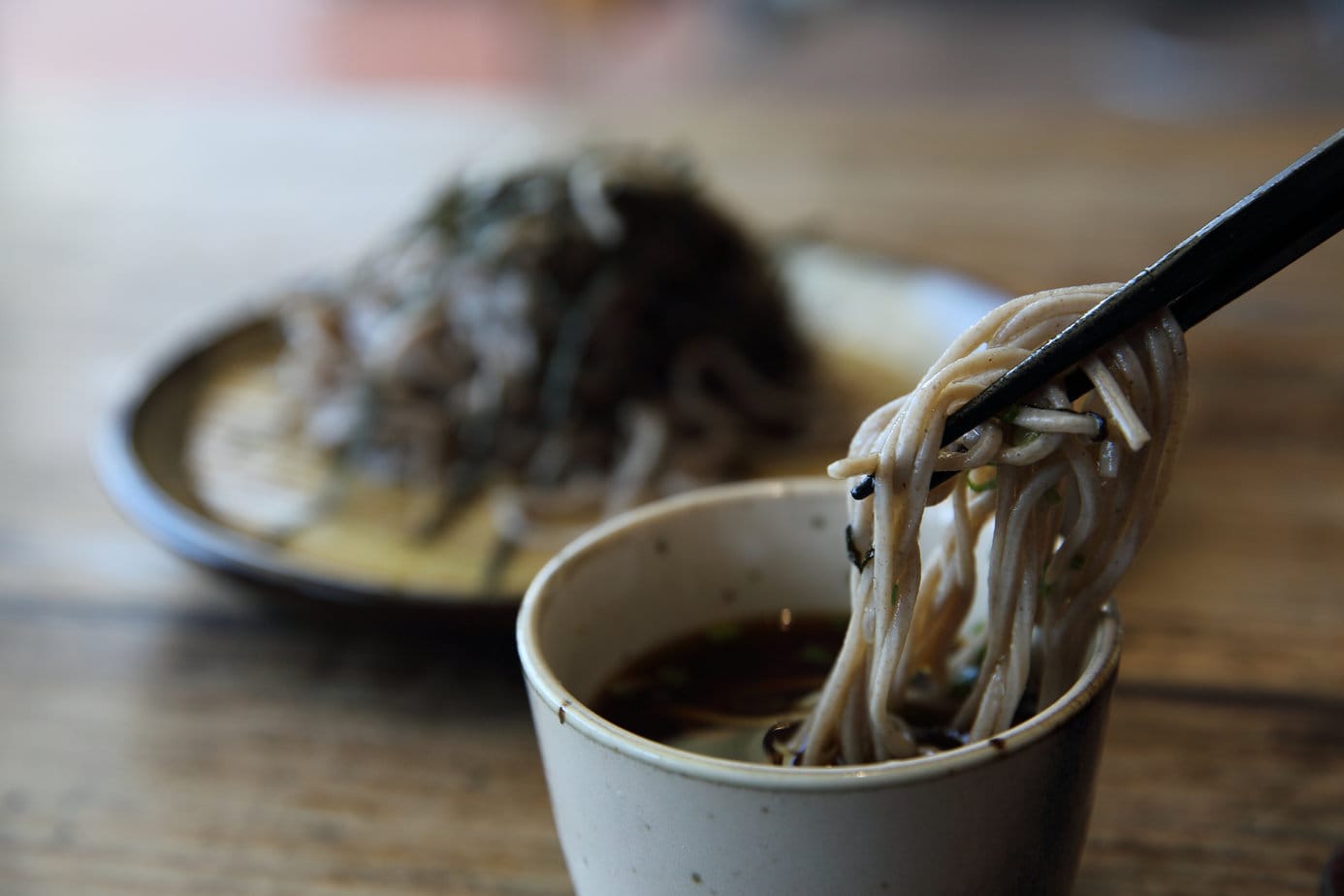
At the end of a Japanese meal, kakigori can follow savory dishes such as miso soup, gyoza, okonomiyaki, Japanese curry, katsu curry, or chilled zaru soba.
Ingredients
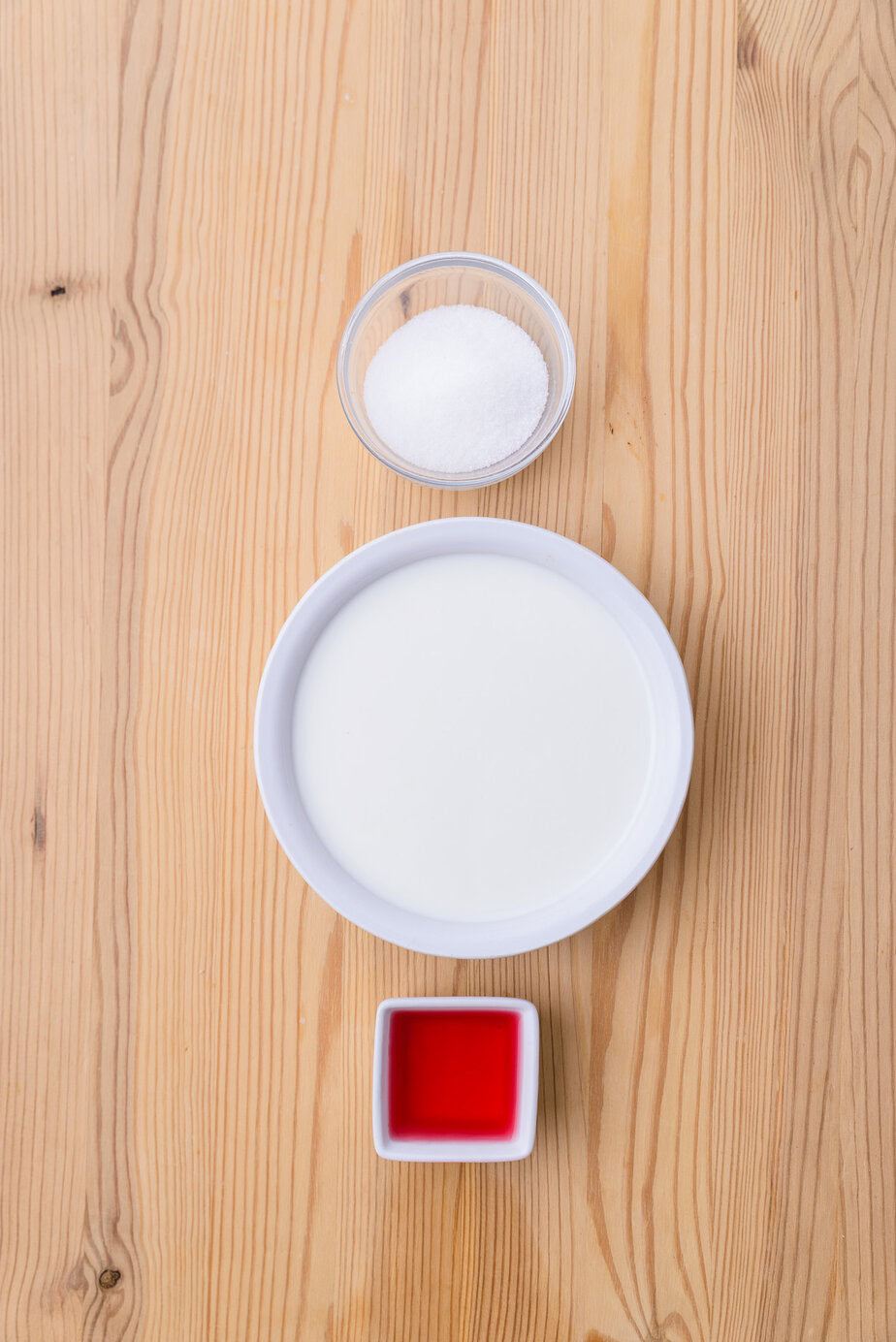
- 100 ml milk to heat with the sugar
- 300 ml milk to add afterwards
- 4 tablespoons sugar
- syrup of choice chilled, as needed
Instructions
Preparation
- Combine the milk to be heated and the sugar in a heatproof bowl.100 ml milk, 4 tablespoons sugar
- Heat for 1 minute at 500 W.
- Stir until the sugar is completely dissolved.
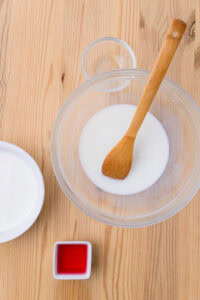
- Add the remaining milk.300 ml milk
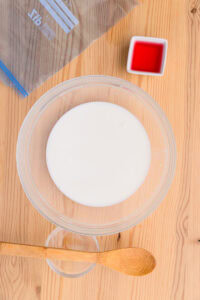
- Pour the mixture into a resealable freezer bag, seal it carefully, then flatten it into a thin layer.
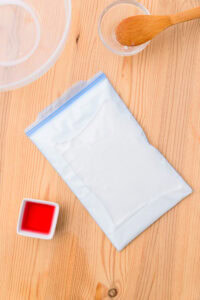
- Lay the bag flat in the freezer and freeze for about 5 hours, until the mixture is set but still crumbly.
- Place the serving bowl in the freezer and the syrup in the refrigerator so both are well chilled.
- Remove the bag from the freezer, break up the ice through the bag with your hands, then crush any harder pieces with a rolling pin (or a bottle).
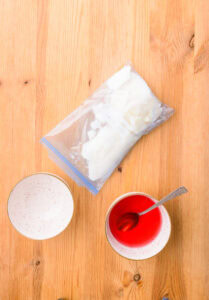
- Massage the bag until the ice has a fine, light texture.
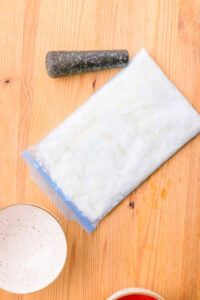
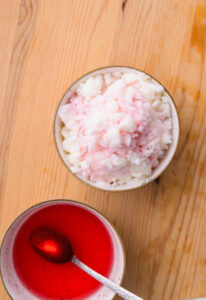
- Transfer the ice to the chilled bowl, shape it without packing it down, then quickly spoon the syrup over the top, distributing it little by little.
Notes
- This version won’t be as finely shaved as machine-made kakigōri; it doesn’t pass over a blade.
- The sugar helps keep the ice softer and easier to crumble.
- Freeze the bag nice and flat to make breaking up and massaging the ice easier.
- Work quickly after massaging the ice: it melts fast.
- A well-chilled bowl and cold syrup are essential for preserving the texture.
- Do not add too much syrup, or the ice will become heavy.