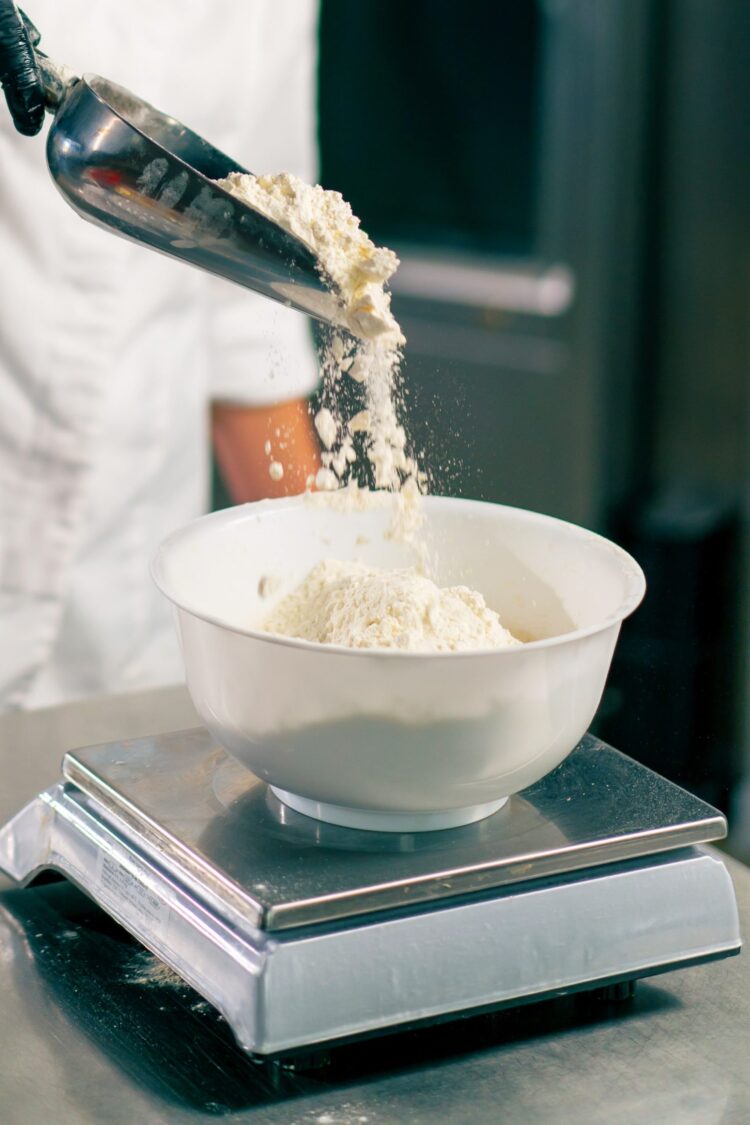
A wheat-flour cake recipe can take an extra 20 g of flour without anyone noticing. The same mistake in a gluten-free blend produces a sandy crumb or a center that stays wet. In France, we already weigh flour, so that is not the problem: it lies in everything we still measure in packets, spoonfuls and “three egg whites”.
What gluten used to forgive
Gluten is an elastic network. It forms on its own as soon as wheat flour meets water, traps air, and tolerates imprecision. A little too much water, an extra minute of kneading, a slightly oversized egg: the dough absorbs it all and still holds together.
A gluten-free blend has no such network. Its structure comes from elsewhere: starch that gelatinizes during baking, a binder that mimics elasticity (gum, psyllium), and eggs and fat for the rest. Each of these components has a narrow working range, and none can make up for an error in another.
That is why just 10 g of water can make or break a gluten-free genoise. Too runny, and the batter can no longer trap air, so the cake collapses as it cools. Too dry, and it bakes into a sponge. In our gluten-free chocolate genoise, the difference between the two comes down to a tablespoon.
In France, we weigh the flour and guess the rest
The American crusade against measuring cups does not really concern us. French kitchens have always weighed their flour, so that issue is settled. The blind spot lies elsewhere: in everything the recipe does not express in grams.
A packet, a level teaspoon, a pinch, three egg whites. These quantities go unnoticed because they are small, yet they are precisely the ones that determine texture in gluten-free baking. This is the starting point for all the other gluten-free baking habits.
Weighing them just once is enough to reveal the uncertainty. An egg white weighs 30 to 40 g, depending on the egg size. A level teaspoon of xanthan gum weighs 2.5 to 3 g, depending on how finely it is milled and how tightly it is packed. A tablespoon of finely powdered psyllium weighs considerably more than the same spoonful of whole husks.
Half a packet of baking powder, divided by eye, is 4 to 7 g from a full 11 g packet. And a cup of flour in an American recipe ranges from 120 to 150 g, depending on how you fill it. None of these differences shows in the bowl; all of them show when you slice.
Egg whites are the most common example. French pastry-making follows a convention: one egg white equals 30 g. Your eggs, however, come from a carton marked L, and each white weighs close to 40 g. Three whites listed as 90 g actually weigh 115 g, the egg-white-to-sugar ratio in a meringue shifts from 1:2 to 1:1.6, and beads of syrup form on its surface.
The same logic applies to macarons: the shell depends on the ratio of egg whites, ground almonds and powdered sugar, not on a number of eggs. And in a vegan meringue made with potato protein, where the binder is not even an egg white, the margin is narrower still.
Two grams of gum or psyllium: what difference does it make?
Xanthan gum is used at around 0.5% of the flour weight for a cake, and two to four times that for bread dough. For 250 g of flour blend, a cake therefore needs around 1.2 g. Add 2 g because the spoon was heaped, and you have tripled the amount.
The effects are immediately noticeable: an elastic crumb, a sticky mouthfeel, a cake that stays wet in the center. In the other direction, too little gum produces a bake that splits when sliced and pieces that crumble on the plate.
Psyllium is even more sensitive because it swells. Allow about 5 g per 250 g of flour: an extra 2 g means nearly 40% more water locked into the dough, and a no-knead baguette that retains a wet center even at the end of baking. Form matters as much as quantity, since fine powder and whole husks do not have the same density. A recipe written in spoonfuls no longer holds up as soon as you switch packets, and that also applies to sandwich bread.
Removing the binder does not remove the constraint; it shifts it to the flour ratios. Our gum-free, tapioca-free blend and our gum-free genoise rely entirely on a starch-to-flour ratio that leaves no room for guesswork.
Two scales are better than one
A standard kitchen scale displays whole grams and goes up to 5 kg. It has two limitations that nobody reads about in the manual. A minimum load, often 2 to 5 g, below which it displays zero or an unreliable reading. And rounding, which means that “3 g” on the screen covers anything from 2.5 to 3.4 g.
So it cannot weigh 1.2 g of gum. That is the only argument that matters for a second scale: a pocket model that measures to the nearest tenth of a gram, with a capacity of 200 to 500 g, costing less than a decent baking pan. The large one for flours, sugars and liquids. The small one for gums, psyllium, leavening agents, salt and flavorings.
Check it from time to time; these little scales drift. A €2 coin weighs 8.50 g and a €1 coin weighs 7.50 g: if the screen says otherwise, recalibrate before trusting a measurement to the nearest tenth.
The rest is convenience. One mixing bowl on the platform, tare between each ingredient, nothing to wash. Weigh liquids too: oil does not weigh 1 g per milliliter, and neither does plant-based milk.
Weigh once, keep the note forever
Two gluten-free blends, each weighing 200 g, do not absorb the same amount of water. How finely they are milled, the proportion of starch, the absorption capacity of each flour, the moisture in a packet opened three weeks ago: everything plays a part. The scale gives you an identical starting point, not an identical result.
That is why the habit that really changes things is taking notes. When a batch turns out just right, write the exact hydration and the brand of flour blend on the recipe card. That number is what will let you reproduce it next time.
If you are converting an American recipe, do not look for a universal conversion chart. Fill the cup with your own blend as you normally would, put it on the scale once, and write the weight on the packet with a marker. The 30 g difference between a packed cup and a cup filled by spooning in flour is exactly what you are trying to eliminate.
A scale does not make a recipe better; it makes it repeatable. In gluten-free baking, that is the whole difference between a good cake and a good cake you know how to make again.
Guide developed with chef Rommel Reyes. Find his work on Instagram, his Substack newsletter and his YouTube channel.