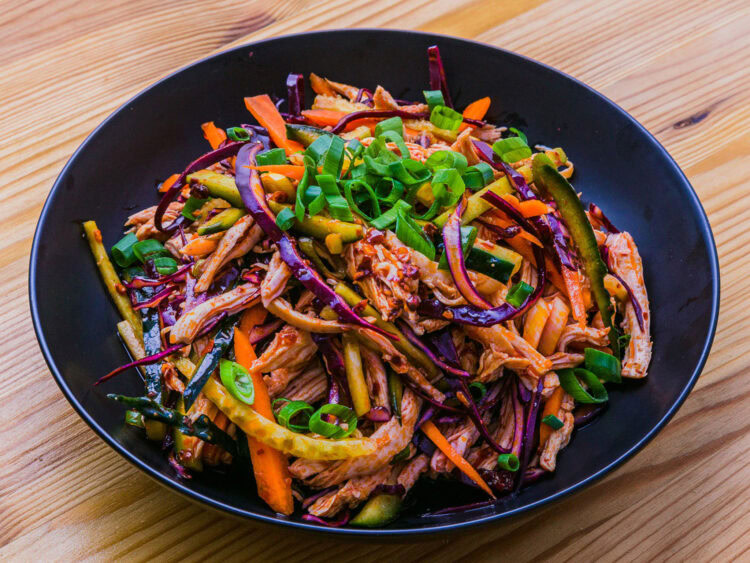
Ultra-tender shredded chicken, topped with crisp vegetables and dressed in a lightly sweet soy-vinegar sauce fragrant with sesame.
The chicken is poached until just cooked through, then cooled, often in its own broth. It is then pounded with a stick to loosen the fibers and help them soak up the sauce.
A drizzle of bright red Sichuan chili oil blends with toasted sesame paste, while the má la from Sichuan pepper brings its gentle numbing tingle. Served cold on a bed of cucumber, the dish is bright, juicy, and deeply aromatic.
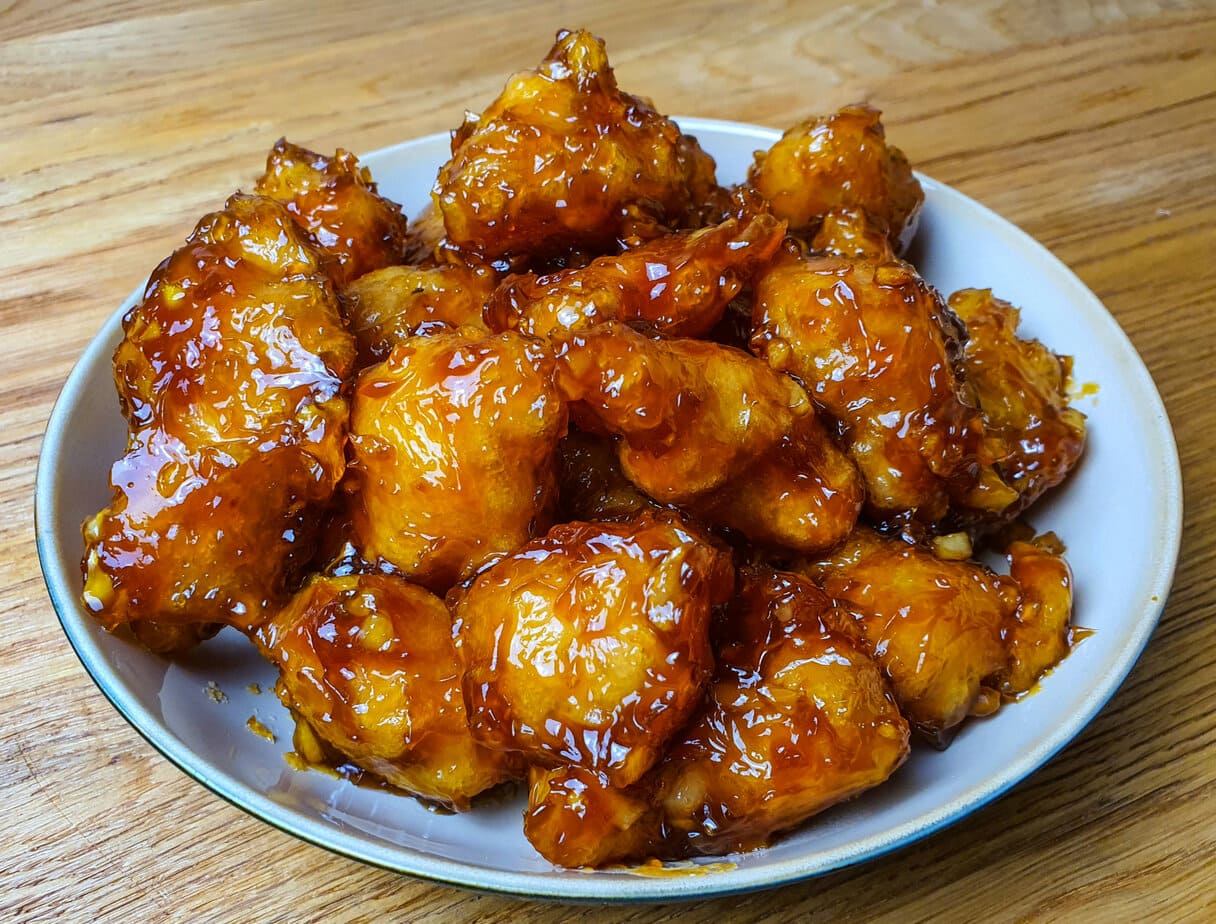
It has virtually nothing to do with the Westernized versions of sauced fried chicken made with sweet, spicy mayonnaise. Here, “ bang bang ” primarily refers to the stick used to tenderize the meat. It showcases the hallmarks of Chinese cuisine for a truly delicious bite.
What is bang bang chicken?
“ Bang bang ” refers to the stick (棒), rather than simply being an onomatopoeia. The most common explanation links the name to this tool, while the repetition reflects a common pattern in Chinese and emphasizes the repeated motion.
In broad terms, it is a cold appetizer. The chicken is gently poached, or sometimes steamed, until just cooked through; 74 °C at the center is a useful reference point. It is then often cooled in its broth. Once thoroughly chilled, the chicken is pounded with a stick and shredded by hand into fine strands, or jī sī, as in some chicken noodle dishes.
The pounding loosens the connective tissue around the muscle fibers without slicing them cleanly. This uneven surface holds sauce better and lets the seasoning penetrate more effectively. Unlike a clean knife cut, or fine shredding with a fork, this method helps the chicken mingle with the sauce and gives it a tender, juicy bite.
Flavor-wise, two main reference profiles coexist. Hongyou, or “ red oil ”, highlights the vivid heat of chili. Guài wèi refers to a more complex Sichuan profile, where salty, sweet, sour, spicy, numbing, toasted, and umami notes stay in balance. And that, my friends, is seriously addictive.
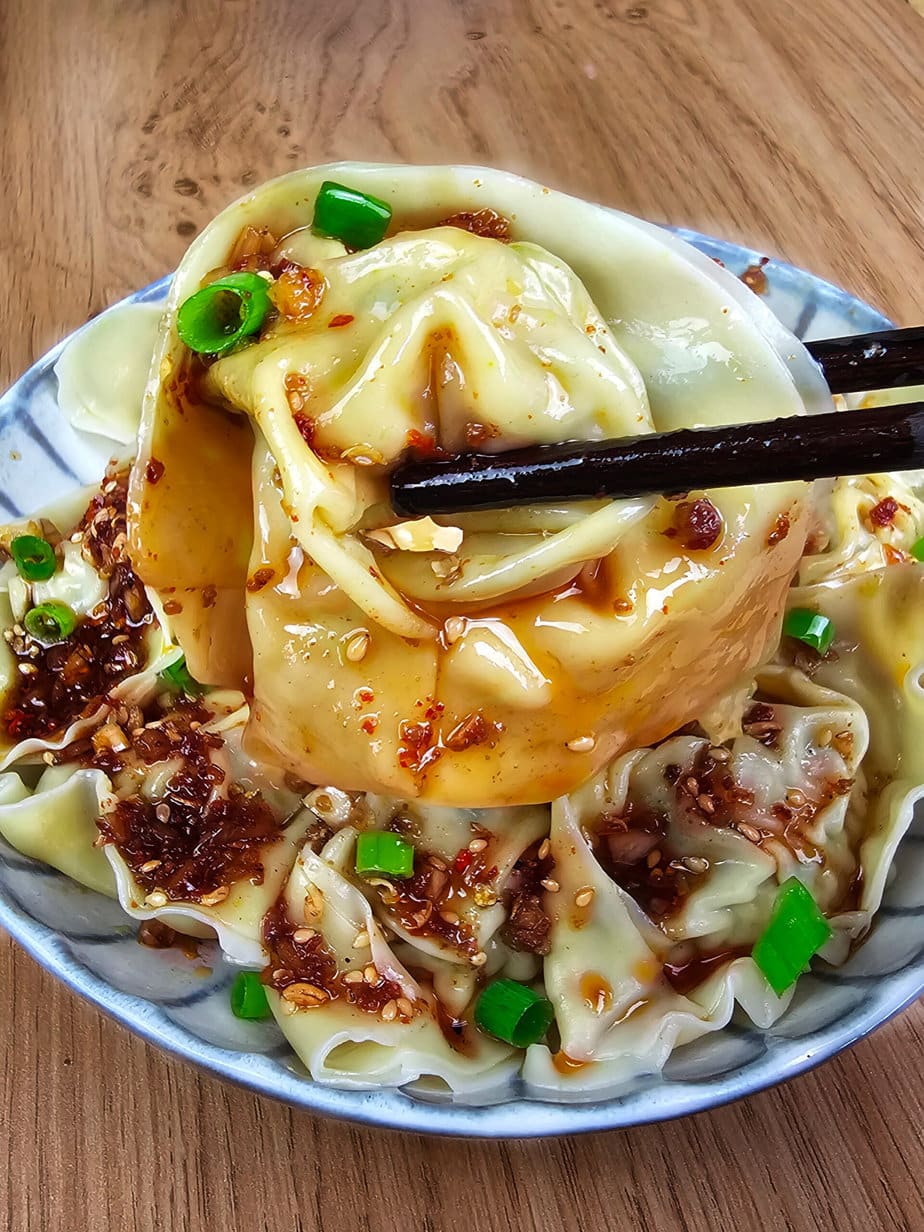
Thinned sesame paste adds body, while the chili oil gives the dish its lift. In some traditions and publications, bang bang chicken is closely related to “ strange flavor ” chicken, though the two categories do not always overlap exactly. They nevertheless belong to the same flavor family as mapo tofu or dan dan noodles.
The origins of Bang Bang Chicken
The dish is generally associated with Han Yang Ba, a small locality in Leshan Prefecture, where it is said to have taken shape in the early 20th century. In a street-food economy where chicken remained a luxury, vendors poached a bird, pounded it, shredded it, and sold it by the portion.
Porters carrying bamboo shoulder poles through the hilly streets of Chongqing and Leshan could stop, buy a small portion of seasoned shredded chicken, and then set off again without exceeding the day’s budget.
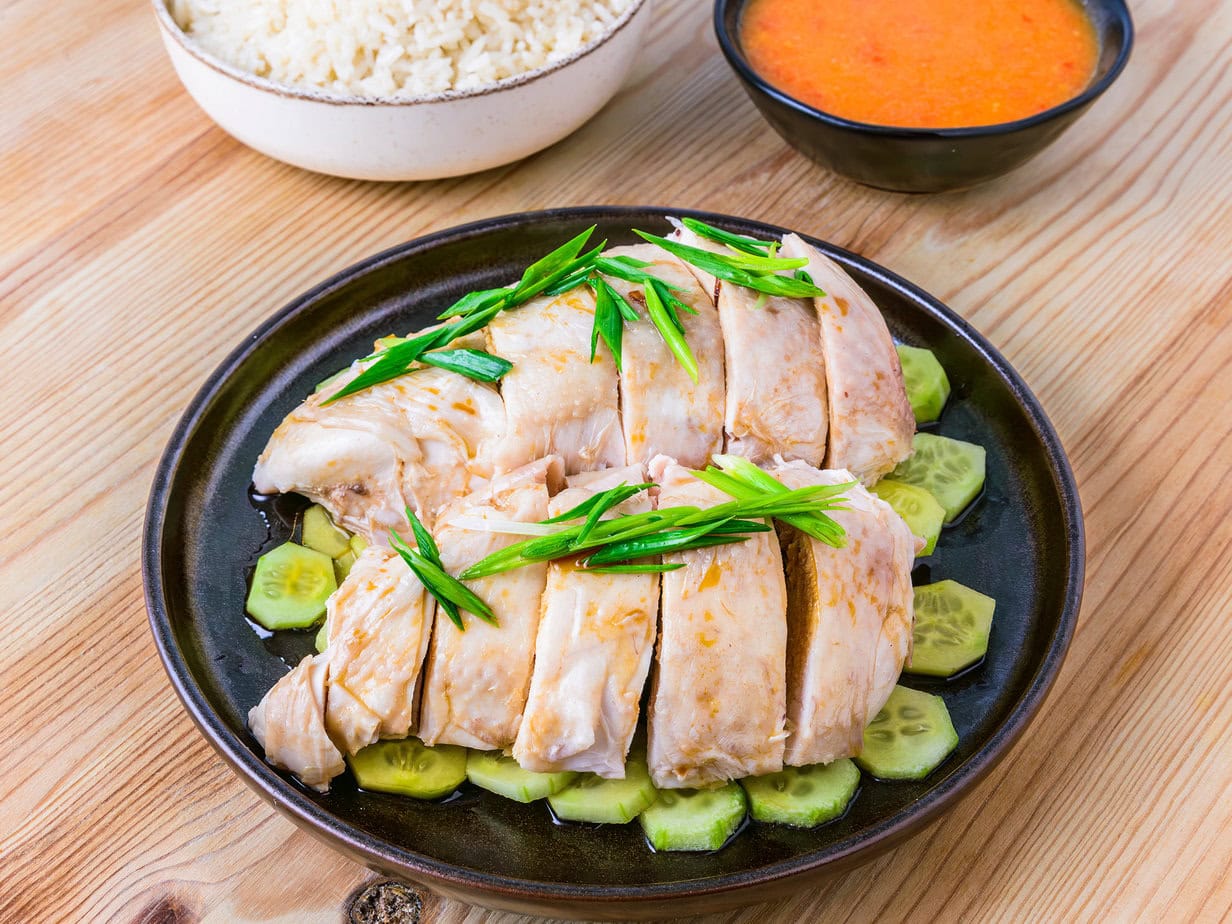
The name comes from the tool: bàng, the wooden stick used to tenderize the cooked meat. The repetition in “ bang bang ” emphasizes this repeated action.
The Qimin Yaoshu already documents a technique that involved beating meat to compact and preserve it, particularly in relation to an ancient dish called Baifu. This agricultural and culinary treatise was compiled under the Northern Wei between 533 and 544. The merchants of Han Yang Ba reversed the principle: they pounded the chicken not to dry it, but to loosen the fibers of the poached meat and help the sauce penetrate better.
Local free-range chicken breeds were known for being more flavorful. Studies on indigenous Chinese breeds often note finer fibers, a more tender texture, and higher levels of IMP, a nucleotide linked to umami, than in industrial broiler chickens.
Since poaching adds very little aroma of its own, the chicken’s natural flavor carries the dish, whether the sauce is hongyou or guài wèi. Fast-growing industrial chickens more often have a watery texture and a milder flavor, which means the sauce tends to dominate.
Main ingredients for Bang Bang Chicken
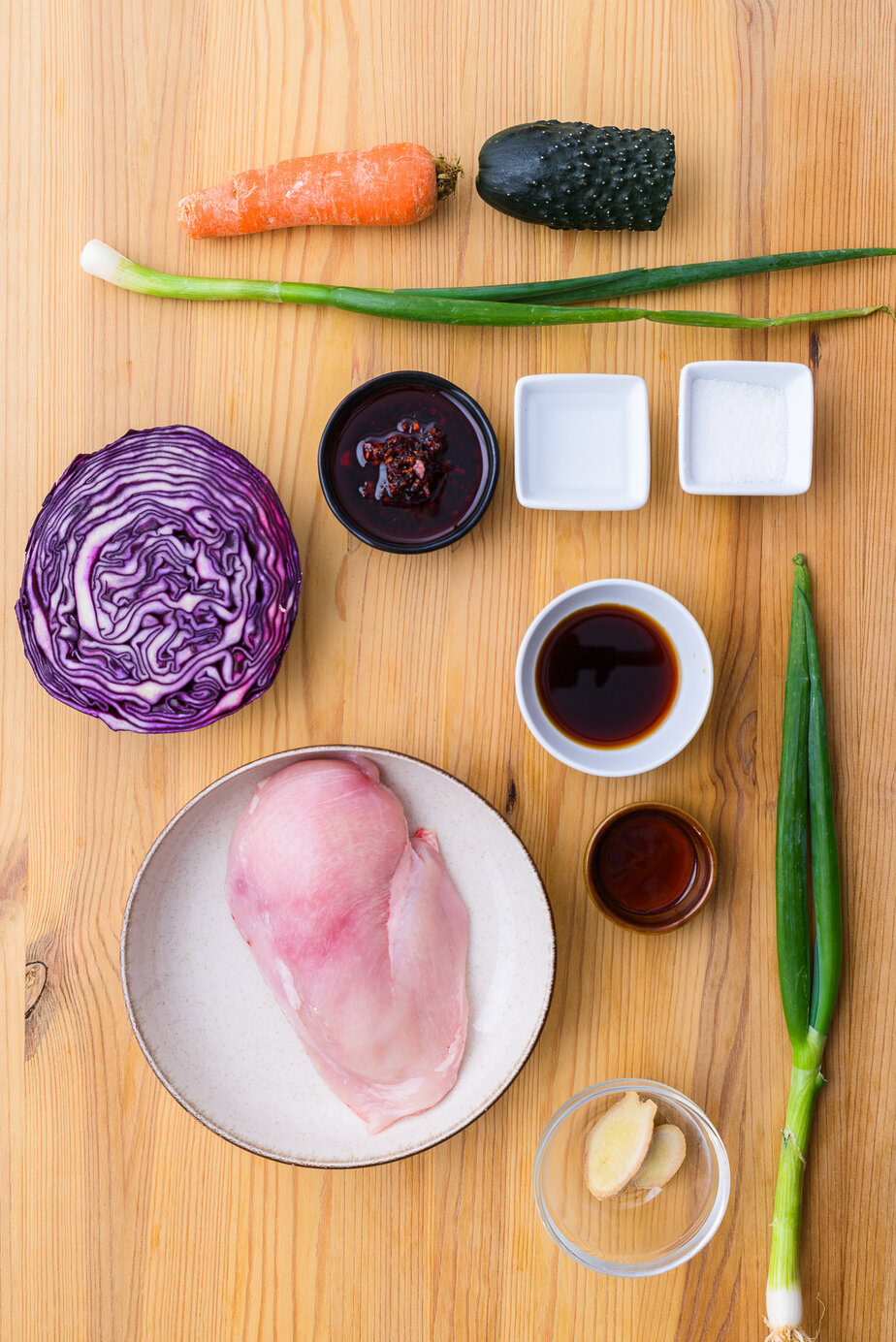
- Good-quality chicken (ideally free-range, or even a local or heritage breed) : the central ingredient; well-raised poultry offers a firmer texture and a cleaner, more pronounced flavor.
- Zhenjiang black vinegar (Chinkiang) : deep, malty acidity that balances the richness of the sesame and the sweetness.
- Light soy sauce : clean salinity and an umami boost; it seasons the sauce and gives it structure.
- Chinese sesame paste (zhī ma jiàng) : a pronounced toasted flavor; this is the creamy base of the sauce. Loosen it with cold water or broth to prevent graininess, and choose a well-toasted Chinese paste over a paler, milder tahini, as in a goma dare sauce. It can be omitted.
- Chili oil (with sediment) : heat and color; the flakes add texture and prolong the warming sensation.
- Toasted sesame oil : a finishing aroma that extends the toasted note.
- Optional : MSG (monosodium glutamate) : can enhance umami alongside the chicken’s IMP and the glutamates in the soy sauce, in the same spirit as Sichuan MSG noodles.
Authenticity markers and regional styles
To the eye as well as on the palate, a few simple cues help identify a faithful version of the dish and rule out imitations.
- Signs of authenticity : what to look for
- Served cold or at room temperature; gently poached or steamed chicken, pounded with a stick and then hand-shredded into irregular fibers.
- A clear presence of Sichuan pepper and its má effect, often absent from Westernized versions. In this recipe, it is assumed to be in the chili oil.
- Warning signs : what should raise doubts
- Mayonnaise, sriracha, sweet chili sauce, or breaded fried chicken served hot.
- Peanut butter as the main base of the sauce, a clear sign of a Westernized version.
- Regional styles to know
- Leshan style (more rustic) : a more pronounced red-oil profile, meat beaten more coarsely into irregular pieces rather than fine strands, and little green garnish.
- Chengdu style (more refined) : a creamier, more balanced guài wèi profile, generally milder and more sesame-forward, with very fine strands and carefully arranged cucumber. It belongs to the same aromatic family as Sichuan-style chicken or Sichuan beef.
These markers help distinguish the traditional version from Westernized adaptations and place the dish among the great Sichuan classics, such as xiaomian.
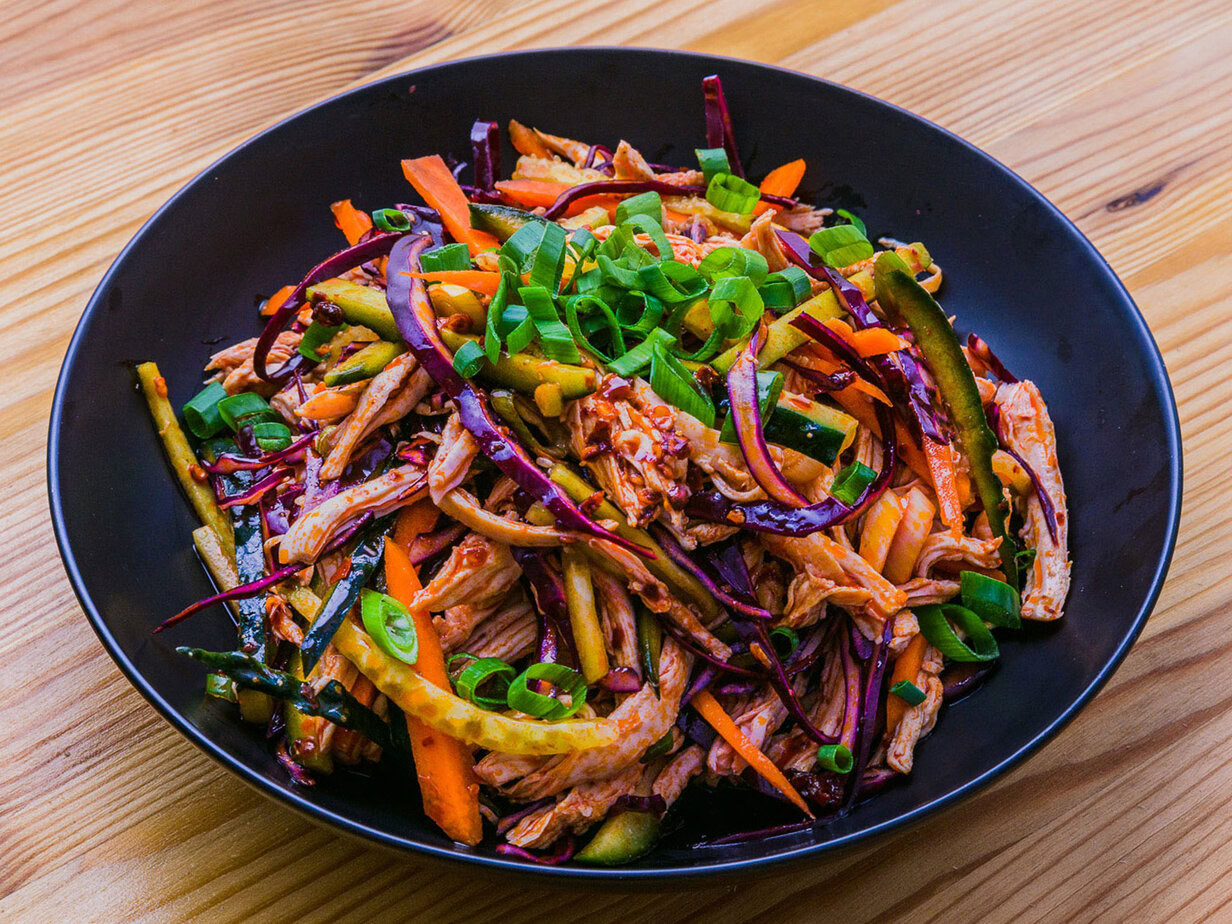
Ingredients
For poaching the chicken breast
- 300 g chicken breast
- 1 stalk scallion
- 2 slices ginger
Vegetables
- 0,5 cucumber julienned
- 80 g carrot julienned
- 50 g red cabbage thinly sliced
- 20 g scallion
Dressing
- 20 g light soy sauce
- 15 g vinegar
- 15 g sugar
- 3 g sesame oil
- 80 g chili oil
Instructions
Poach and shred the chicken
- Bring a saucepan of water to a boil.
- Add the chicken breast, scallion, and ginger.300 g chicken breast, 1 stalk scallion, 2 slices ginger
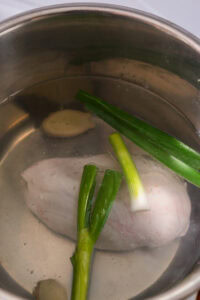
- Reduce the heat to very low, cover, and keep the water at a bare simmer (small bubbles, no vigorous boiling).
- Cook for 15 minutes.
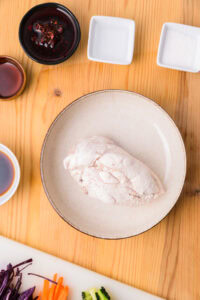
- Turn off the heat and let stand, covered, for 5 minutes.
- Remove the chicken and reserve a little of the cooking broth.
- Let the chicken cool until it is safe to handle, then shred it along the grain.
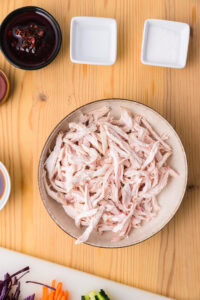
Make the sauce and assemble
- Whisk together the light soy sauce, vinegar, sugar, sesame oil, and chili oil.20 g light soy sauce, 15 g vinegar, 15 g sugar, 3 g sesame oil, 80 g chili oil
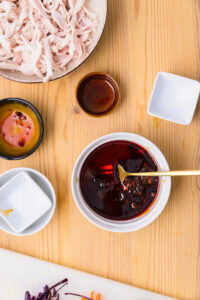
- Stir until the sugar dissolves and the sauce is well combined.
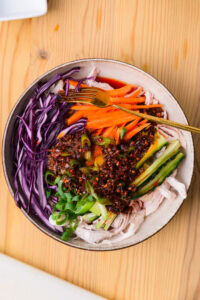
- Arrange the vegetables (cucumber, carrot, red cabbage, and scallion) over the shredded chicken.0,5 cucumber, 80 g carrot, 50 g red cabbage, 20 g scallion
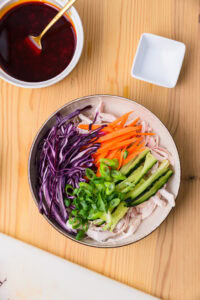
- Pour the sauce over top, toss evenly, and serve.
Notes
- The key to keeping chicken breast tender is to cook it gently at a low temperature, without a rolling boil.
- The traditional version contains fewer vegetables; here, we add extra for a fresher, lighter dish.
- Feel free to adapt the vegetables to your taste (bamboo shoots, carrot, cucumber, red cabbage, etc.).