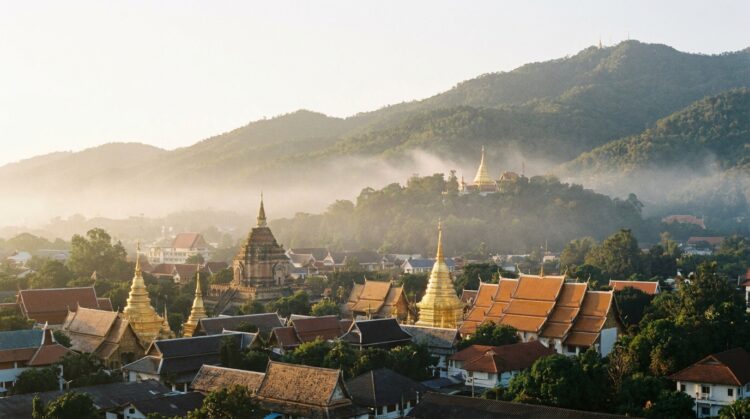
Chiang Mai is not a miniature Bangkok. Northern Thailand’s largest city spent more than two and a half centuries as the capital of its own kingdom. It still fits inside a square of moats, a wooded ridge rises just behind it, and it moves at a pace that surprises those arriving from the south. You can spend a morning walking around the old city without any plan at all and count the day a success. In fact, that is the best possible use of a first morning here.
What to do in Chiang Mai comes down, in practice, to four things: temples, northern cuisine, a day or two in the mountains, and evenings at the markets. The only factor the city really forces you to plan your trip around is the air. From February to April, smoke from agricultural and forest burning settles over the valley, and during the worst weeks Chiang Mai has been ranked the world’s most polluted city. That window is covered in detail below, because it should influence your booking dates.
This travel guide is your overview for visiting Chiang Mai: what the city is like, what each major draw has to offer, a 4- to 5-day itinerary that locals would not laugh at, the seasons, the cost of a day, and how to get around without being overcharged. Each section then links to a dedicated guide for the details. Prices are in Thai baht (THB), and 38 baht to the euro is a safe rounded figure.
What Chiang Mai is really like
King Mangrai founded the city in 1296 as the capital of Lanna, a name that translates as “kingdom of a million rice fields,” and it remained so until 1558. That matters more than a date on a plaque. The temples here are Lanna temples, with architecture distinct from that of central Thailand. The cuisine is northern, a long way from the Thai food most visitors already know. The old city, meanwhile, retains its defensive square layout and intact moats. Chiang Mai appears on UNESCO’s World Heritage Tentative List under the title “Monuments, Sites and Cultural Landscape of Chiang Mai, Capital of Lanna”: tentative means proposed, not inscribed.
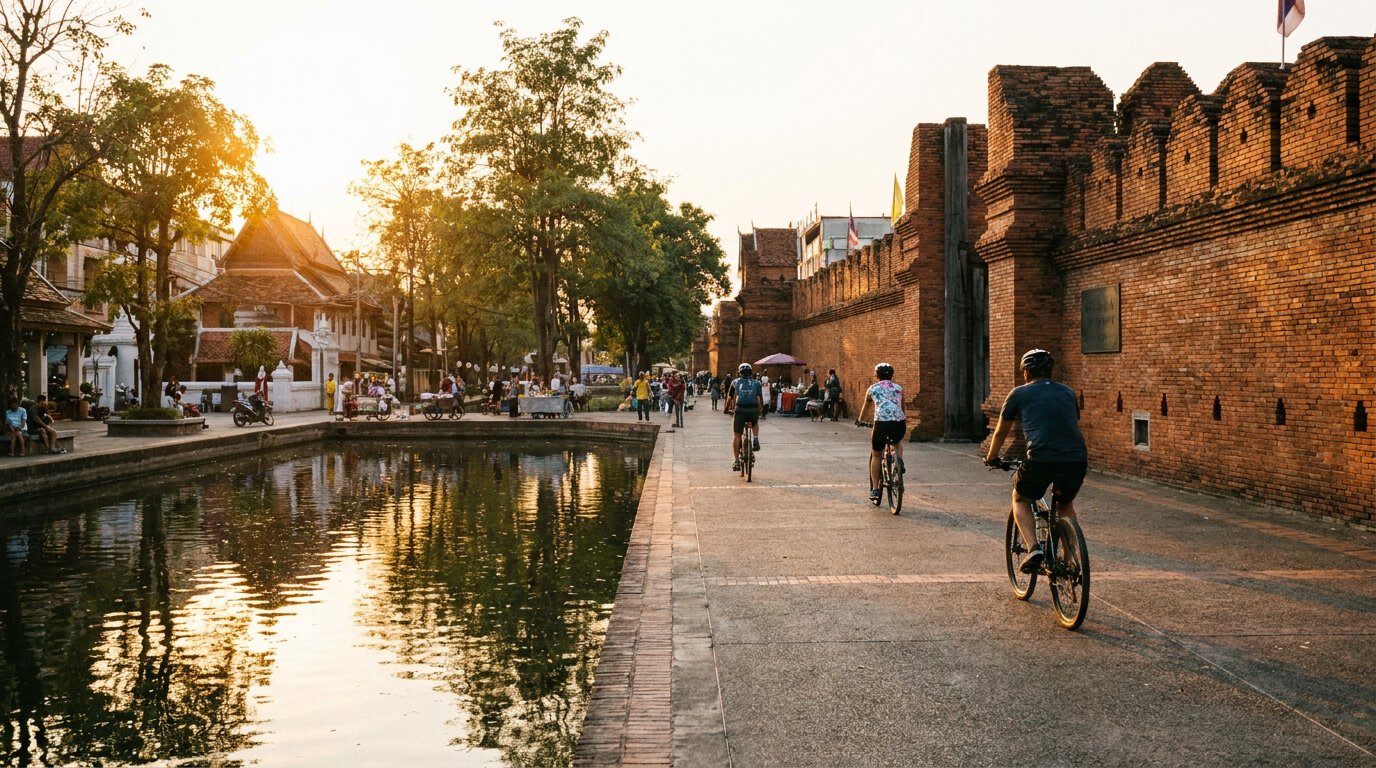
The scale is manageable. The Sunday walking market runs for about a kilometer from Tha Phae Gate into the old city, which gives you a rough sense of how much city fits inside the walls. Three gates handle almost all the traffic: Tha Phae to the east, Chang Phuak to the north, and Chiang Mai Gate to the south. The airport, CNX, is 5 or 6 km away. Close enough for arrival to be a fifteen-minute matter rather than a half-day affair.
Then there are the mountains, and they are what keep a week here from becoming repetitive. Doi Suthep, the ridge visible from almost everywhere in the city (doi means mountain in Northern Thai), is home to the temple that gives Chiang Mai its postcard image. Doi Inthanon, 70 km away in Chom Thong district, is Thailand’s highest point at 2,565 m. Both work as day trips, and both bring the temperature down enough to make you regret not packing another layer. Yet the first piece of advice locals give newcomers is still to leave half the schedule empty: walk around the old city without a map, stop at cafés, spend an evening in Nimman. Wandering pays off more here than temple-hunting.
The temples, and the one that takes real planning
Chiang Mai has hundreds of wats, and you are not going to visit them all. Four or five are enough for a stay. Inside the walls, Wat Chedi Luang is the most impressive, with its enormous ruined brick chedi lined with stone elephants; Wat Phra Singh, meanwhile, houses the golden Lai Kham viharn. West of the moats, Wat Suan Dok has a collection of white chedis. Wat Umong is a forest temple built around brick meditation tunnels, which makes a change from yet another golden hall.
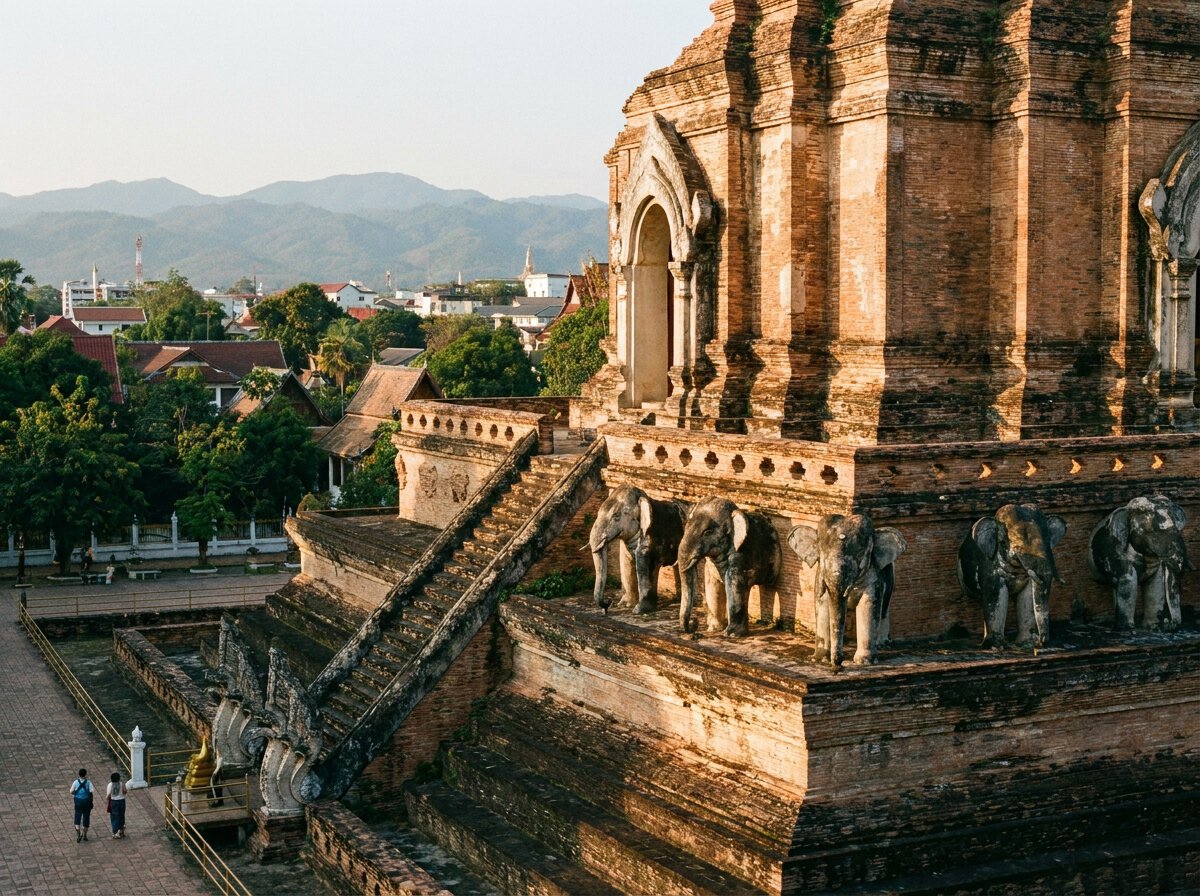
Entrance fees are modest, and openly different for Thais and foreigners. Wat Chedi Luang opens daily from 6 am to 6 pm and charges foreigners 40 THB, with free entry for children under 12 (one listing gives 50 THB). At Wat Phra Singh, the grounds are free and the assembly hall costs foreigners 40 THB, though it is unclear whether that 40 THB actually covers the whole site.
Wat Phra That Doi Suthep is the one that takes real planning. It is on the mountain, was founded in the late 14th century (sources give different years within the same reign), and opens daily from 8 am to 9 pm. Foreigners pay 30 THB, about EUR 0.80, while Thais enter free; the electric tram that saves you the steps costs 20 THB for Thais versus 50 THB for foreigners. Those steps belong to the naga staircase, 306 in total. There is a third way to get up there, the Monk’s Trail: the path climbs to Wat Pha Lat, a forest temple halfway up, then continues to the temple at the top. This is the ascent regular visitors recommend first. Set off early in the morning or late in the afternoon because of the heat, and expect steep stretches.
The catch is getting down, not getting up. Red songthaews wait at the temple all day, but the crowds thin out after sunset and the trail closes at 6 pm. One couple found themselves stranded at the top in the dark for about two hours and only got down around 8:30 pm, after locals called them a taxi. Book a Grab before you need one, and be aware that even a pre-booked Grab has been canceled on the spot. The method that works: take a Grab up, switch payment to cash, then ask the driver at pickup to wait and bring you back. One traveler secured the round trip for 800 THB. To find out which temples deserve your time and how to behave there, our selection of Chiang Mai’s most beautiful temples reviews them one by one.
Northern cuisine, and the khao soi rule
Northern Thai cuisine is a world of its own, and its signature dish is khao soi: egg noodles in a coconut milk curry broth, beneath a nest of crispy fried noodles, served with pickled mustard greens, shallots, and lime. When someone asked for a four-day itinerary, a local forum answered with a joke that doubles as advice: four days of khao soi and nothing else. Alongside it are sai ua, the herb sausage; gaeng hang lay, a Burmese-influenced pork belly curry; khao kha moo, braised pork knuckle over rice; nam ngiao, a tomato and pork rib noodle soup; and chili dips, nam prik ong with tomato and minced pork, and nam prik num with grilled green chilies, both eaten with kap moo, crispy pork rinds. If something is very good, the northern expression is lam tae tae.
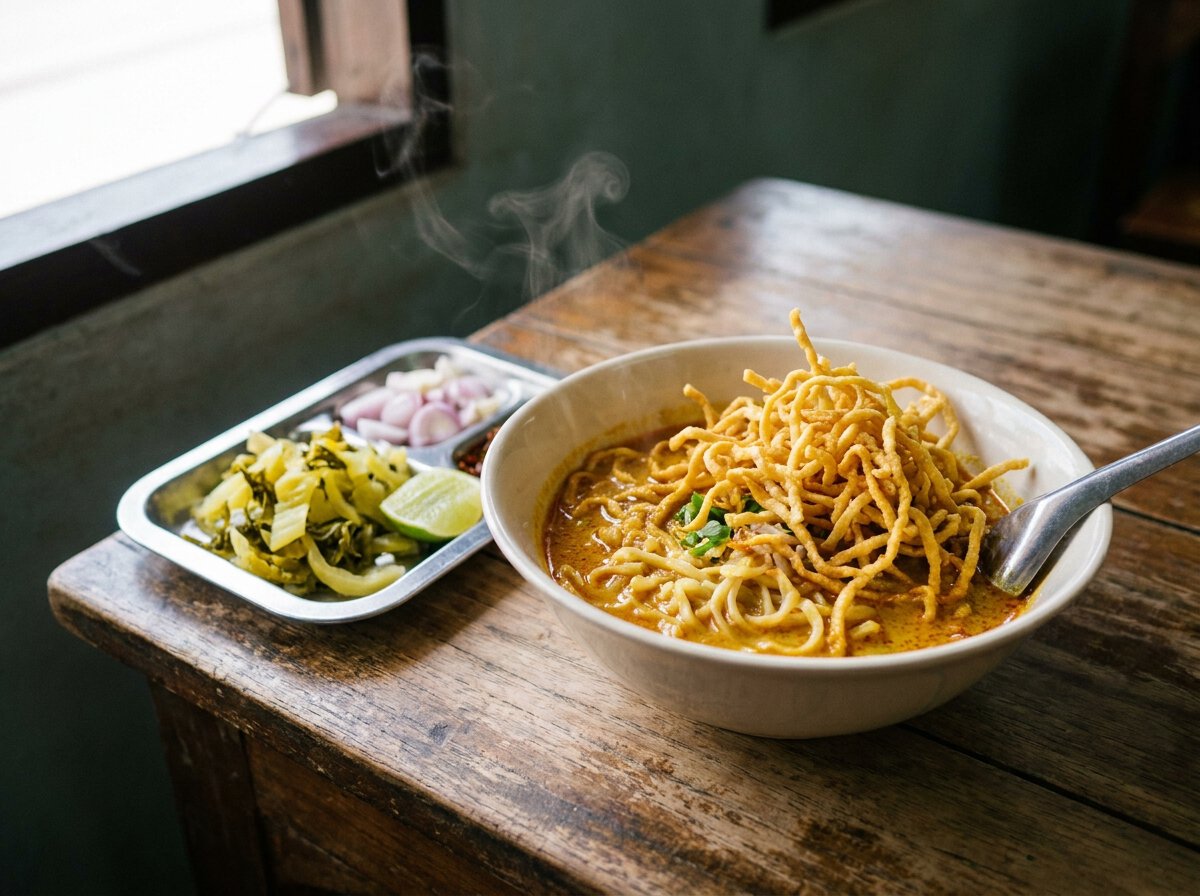
Timing matters more here than the address. Almost all the khao soi shops locals genuinely recommend close between 4 pm and 5 pm. Khao Soi Mae Manee, on soi 24 off Chotana Road, opens from 8 am to 4 pm and has been cooking its broth over charcoal for more than thirty years; Khao Soi Lamduan Fah Ham, in business for over seventy years, opens from 8:30 am to 4 pm. Khao soi is eaten for breakfast and lunch, not dinner, so plan a morning around it. These hours come from Thai listings that are a few years old: check before crossing the city for a bowl.
The easy-to-reach option is Khao Soi Nimman, on soi 7 off Nimmanhaemin, open from 11 am to 8 pm with prices starting at 55 THB. Thai reviewers find it tailored to central Thai tastes rather than distinctly northern. The right answer to “where can I find good khao soi?” is a category, not a business name: khao soi Islam, the beef version prepared by the Chinese Muslim community from Yunnan, the Chin Haw, who are credited with originating the dish. Around seven places are well known, and the sign of a good kitchen is the accompaniments, starting with the pickled mustard greens.
By Thai standards, Chiang Mai is also unusually easy for vegetarians and vegans, and most cooking schools offer vegetarian versions of all their dishes. After a class, the useful souvenir to take home is found at the supermarket: packets of ready-made curry paste, 16 to 40 THB each, worth more than any shop-bought spice gift set. For dishes covered one by one, with addresses, prices, and opening hours, see where to eat in Chiang Mai, dish by dish.
Outside the city: mountains, waterfalls, and elephants
One or two days outside the city is the right balance for a first visit, and your choice matters because travel times are longer than the map suggests. Doi Inthanon National Park is the big outing, 70 km away, with admission at 300 THB per foreign adult (about EUR 7.90) and 150 THB for children aged 3 to 14, plus a vehicle fee of 30 THB per car or 20 THB per motorcycle. A warning about the summit: there is no view up there, and what you reach is a parking lot full of minivans. The park is still worth the trip for its waterfalls, royal pagodas, and trails.
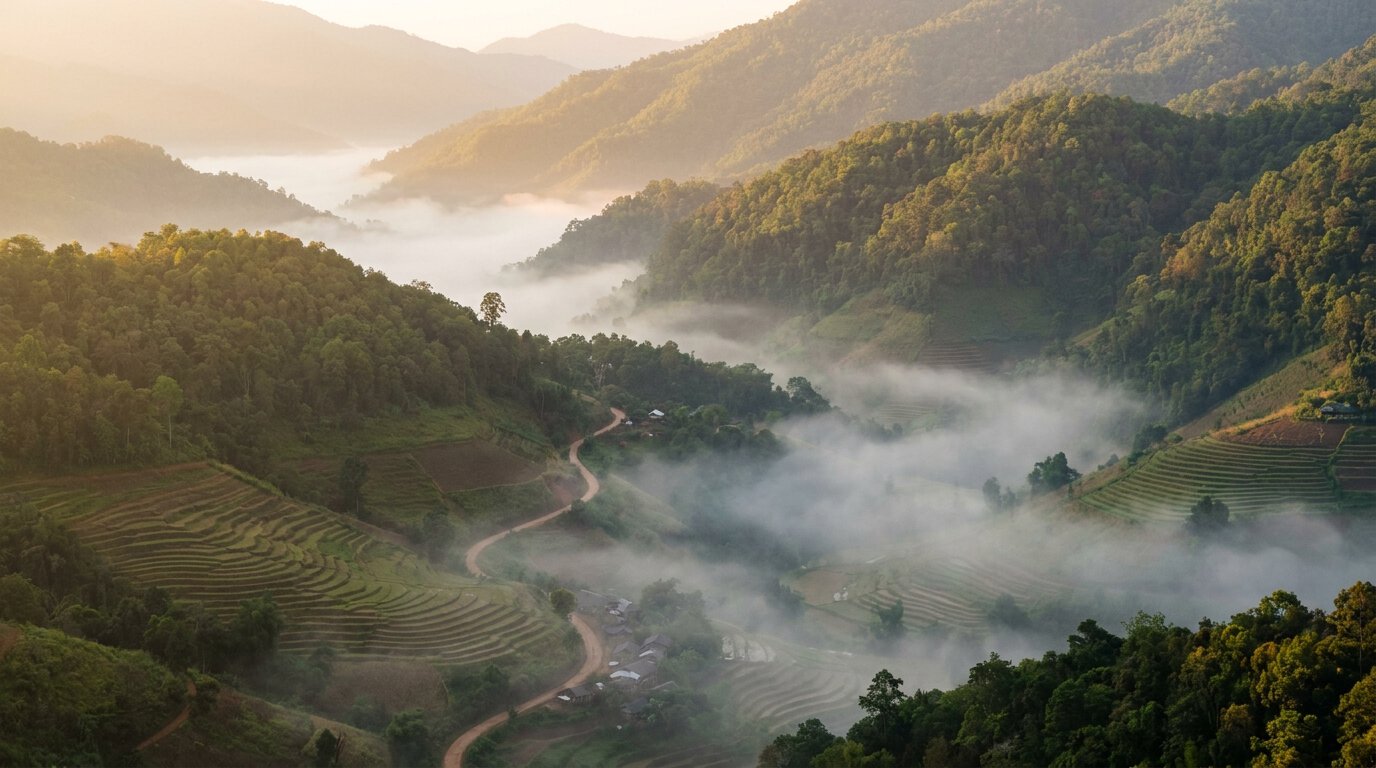
Bua Thong’s sticky waterfalls sound like a tourist trap on paper, yet almost nobody comes back disappointed. The limestone is porous enough to climb barefoot against the current, and that climb is the whole point of the outing; allow half a day including the drive. Mae Kampong, a mountain village east of the city, is the other easy half-day trip. Chiang Rai, which every itinerary tries to squeeze in, takes an entire day on its own and is better experienced with an overnight stay.
Elephants deserve a minute’s thought before you hit the booking button. Elephant Nature Park charges 2,500 THB per adult (about EUR 65) for a half-day, morning or afternoon, and 3,500 THB (about EUR 91) for its full-day packages. Morning visits start between 7:30 am and 8 am, afternoons between noon and 12:30 pm. A deposit secures the booking, reservations close 24 hours in advance, and payments are neither refundable nor transferable: check what the deposit covers when you pay it. The recurring criticism on the ground is greenwashing. Even well-regarded places face criticism for stacking morning, lunchtime, and evening encounters back to back, keeping the animals working all day. The filter experienced travelers apply is concrete: just one short encounter per day, and nothing involving riding, bathing, or touching the animal. Bathing is singled out because elephants use dirt as sun protection and washing it off can cause skin problems. Wild elephants, in fact, spend barely 2% of observed time bathing, compared with 18 to 20 hours a day walking and looking for food. A café near the city with elephants on site was flagged in mid-2025 because reviews showed tourists riding the animals again.
Two more warnings. Visits to Kayan villages with long-necked women, sold as add-ons to day trips to Chiang Rai, are a tourist trap, and locals make no secret of it. And you rarely need an organized tour: travelers take a Grab, switch payment to cash, and ask the driver for a round trip with two stops and waiting time. Prices, durations, and frank opinions are in our activities and excursions around Chiang Mai.
The markets, and how evenings unfold
Evenings revolve around the markets, and the vocabulary helps: a talat nat is a periodic market held on certain days at a fixed location, which is exactly what the walking streets are. The Sunday Walking Street is the main event, on Ratchadamnoen Road, running from Tha Phae Gate for about a kilometer into the old city. Stalls start setting up at 3:30 pm, the market opens around 4 pm, crowds build at 5 pm, and everything winds down between 10 pm and midnight depending on the evening and whom you ask. Arrive early if you want to see anything.
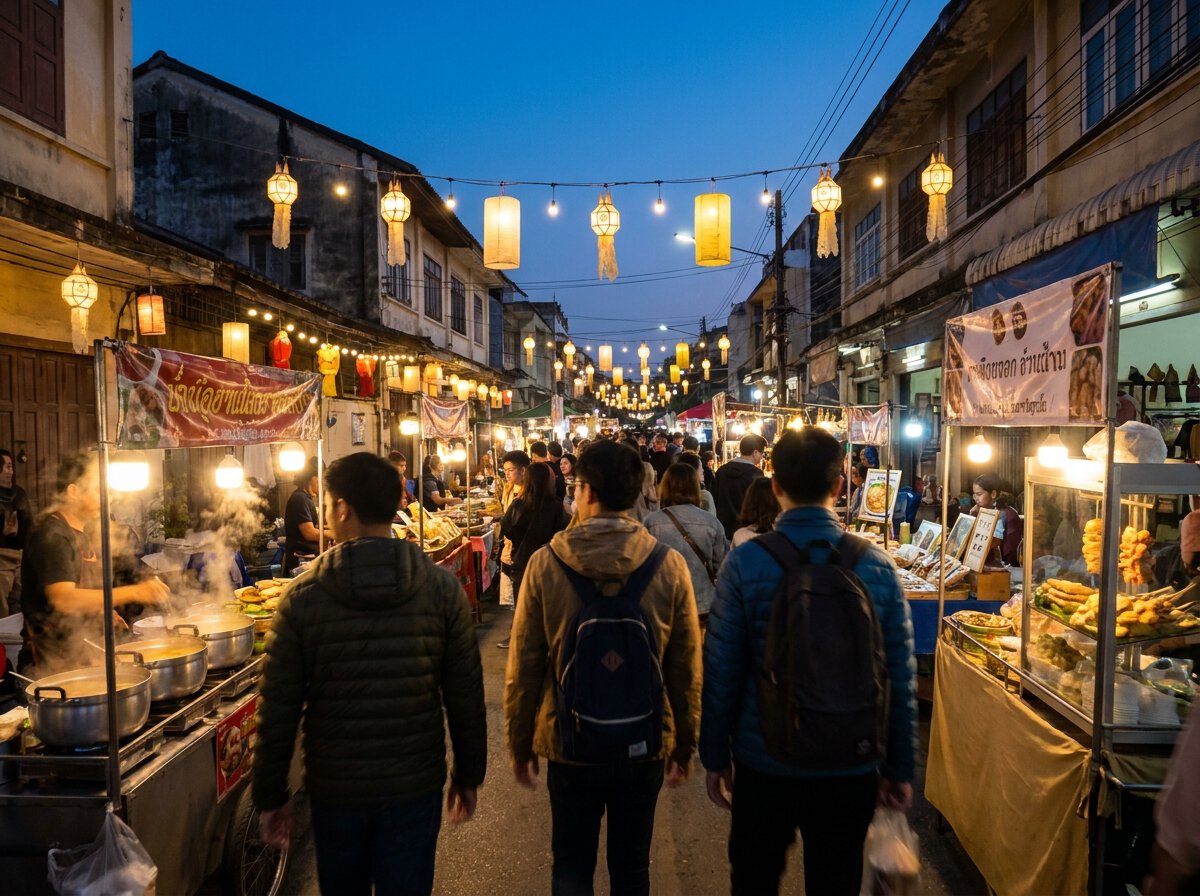
The Saturday Walking Street is the smaller sibling, on Wualai Road, the silversmiths’ street, running roughly from 5 pm to 10 pm or 11 pm (sources disagree on the closing time). Warorot Market, which locals call Kad Luang, is the daytime option and still operates as a real market rather than a souvenir department. If tourist-oriented markets wear you out, people will send you outside the old city: Kad Na Mor and the CMU night market near Chiang Mai University for student prices, Kad Manee, Jing Jai in the morning, and the walking streets in Saraphi and San Kamphaeng on Saturday evenings from around 5 pm.
One scam belongs in this section because it happens where tourist traffic is heaviest. You hand over a 500 THB note for an 80 THB dish, receive change for 100 THB, and when you protest the vendor produces a 100 THB note and loudly insists in front of other customers. Regular visitors’ defenses are simple: announce the denomination aloud as you hand over the note (“ha roi baht” for 500), pass it over slowly and clearly in view, or get change first at a 7-Eleven, where staff repeat the amount received aloud. The stalls and dishes to look for are in where to eat in Chiang Mai, dish by dish.
Where to base yourself
Five neighborhoods accommodate almost all visitors, and each makes for a different trip. Inside the moats, the old city puts the major temples and Sunday market within walking distance, which explains why most first-time visitors stay there. Nimmanhaemin, shortened to Nimman, is the modern side of the city and the café district, a short ride west of the walls. Chang Klan is the night bazaar neighborhood, Santitham the cheaper residential option north of Nimman, and the Ping River offers a quieter strip of terraces and guesthouses, away from both.
A practical test is worth more than any description of the atmosphere. The flat 30 THB shared songthaew fare applies inside the triangle formed by the moats, Nimman, and the night bazaar. Stay inside that triangle and every journey on a normal day costs you 30 THB; outside it, prices rise to 40 or 50 THB, which adds up. That triangle is the practical definition of “central” here, and it deserves more weight than a star rating. For neighborhood comparisons with real price ranges, read which neighborhood to choose for your stay in Chiang Mai.
Getting around the city
The red songthaew, rot daeng in Thai, is the backbone of transport: a shared pickup truck with two benches in the back and no fixed route. You hail it, say where you are going, and it takes you if the direction suits the driver. Inside the central triangle, the fare is 30 THB per person; longer journeys, or those where you are the only passenger, rise to 40 or 50 THB, and fares from the railway station or intercity bus terminal range from 50 to 100 THB depending on how many people are on board. From Tha Phae Gate to Warorot Market, it is 30 THB, a useful benchmark for judging any other quoted price.
The most common scam is confusion between a shared ride and a private hire. You hail a red pickup, give your destination, assume you are taking a shared 30 THB ride, and on arrival the driver asks for 200 THB because he has treated it as a private trip just for you. Songthaews parked at Tha Phae Gate quote tourists 100 to 200 THB for journeys that cost 30 THB when shared. Agree on the price before getting in, confirm whether it is per person, and hail moving trucks rather than parked ones. Deliberately hiring a vehicle privately can make sense: a full day to Doi Suthep, Wat Pha Lat, and Bhubing Palace costs 800 to 1,200 THB (EUR 21 to 32) for the vehicle.
Grab costs 70 to 200 THB for most tourist journeys, 80 to 180 THB from the airport to the old city, and 50 to 120 THB by GrabBike, and often works out cheaper than a privately hired songthaew; Bolt, inDrive, and Maxim also operate here. The recurring complaint concerns drivers who accept a ride, then demand about 50 THB extra in cash at pickup and cancel if refused, which is unjustified since Grab prices are fixed. Tuk-tuks ask 80 to 150 THB for short distances and apply markups of 200 to 300% at tourist spots. City buses on the six RTC routes, R1 to R6, cost 20 to 30 THB.
A Honda Click 125 scooter rents for 150 to 300 THB per day, and this is where an avoidable mistake gets expensive. Riding legally requires a helmet and an International Driving Permit with the motorcycle category (A), presented alongside your national license; the national license alone is not accepted. Fines range from 500 to 1,000 THB, and checkpoints stopping foreign riders are frequent around the old city moats, in Nimman, and on the roads to Doi Suthep and Pai. The fine is the small problem. Riding without the right documents normally invalidates your travel insurance, including the medical cover you would need after an accident.
A 4- to 5-day itinerary
A warning first, because this is the mistake that ruins short stays. Someone posted a four-day schedule including a full day in Chiang Rai and half a day at Doi Inthanon, and the verdict came back: it was actually a seven-day schedule. A half-day at Doi Inthanon is virtually impossible once you factor in four hours of driving or more. One big outing for every two days in the city is the pace that works.
Day 1: the old city on foot
Do not overload this day. Find Wat Chedi Luang while the light is still low, then let the rest unfold; Wat Phra Singh is a few minutes away along the same grid of streets. Eat your khao soi at lunch rather than dinner, since the good shops close at 4 pm or 5 pm. Finish at Tha Phae Gate in the early evening, when the square in front starts filling up.
Day 2: Doi Suthep and the Monk’s Trail
Set off early, both for the heat and the buses. Walking up the Monk’s Trail to Wat Pha Lat, then continuing toward Doi Suthep, remains the best version of this day. If you drive up, take the naga staircase rather than the tram. Sort out the descent before you find yourself standing in the dark: a pre-booked Grab, or a driver paid in cash to wait. Spend the evening in Nimman.
Day 3: a cooking class, or elephants
Either takes the whole day, and neither is worth rushing. A cooking class costs roughly 1,000 to 1,500 THB per person; the full-day format normally includes hotel transfers, a market visit, all ingredients, and a recipe booklet. An elephant day at Elephant Nature Park costs 3,500 THB; the morning half-day, starting between 7:30 am and 8 am, costs 2,500 THB.
Day 4: a day in the mountains
Choose one. Doi Inthanon, with its 300 THB entrance fee, easily fills the day and also offers an escape during smoke season, since the summit area sits above the smoke layer. Bua Thong’s sticky waterfalls with a temple stop are the lighter, half-day version. Mae Kampong is the third option if you prefer a village to a park.
Day 5: the markets, and the Sunday question
If your dates allow, arrange the trip so that one evening falls on a Sunday. The Sunday Walking Street is the busiest and best of the markets, open from 4 pm and packed by 5 pm. Spend the morning at Jing Jai or Warorot and reach the market before the peak. If Sunday is not possible, the Saturday market on Wualai is the substitute, and the Saturday evening walking streets in San Kamphaeng or Saraphi are the local version.
Add a fifth day and keep it empty. A second day without a schedule is worth more than another attraction: café-hopping, the tunnels of Wat Umong, the corners of the old city you walked past without noticing.
When to go, and the unvarnished truth about smoke season
Burning season is the one thing that should really change the dates you plan to visit Chiang Mai. From roughly February to April, agricultural and forest fires in northern Thailand, Myanmar, and Laos fill the valley with smoke. This is not traffic pollution like Bangkok’s: it is biomass smoke on a regional scale, and the city sits in a basin that traps it. The risk is not spread evenly across the window: late March and April see the worst of it.
The 2026 figures deserve to be read rather than summarized. On April 7, 2026, Chiang Mai had the world’s worst air quality, with a US AQI of 209 measured between 6 am and 7 am and PM2.5 at 137 micrograms per cubic meter, in the purple band. Twenty-five districts in the province exceeded the Thai standard of 37.5, with Mae Chaem highest at 148.6 and the city itself at 102.3, and 6,926 hotspots had been recorded between January 1 and April 6. The Thai press described January and February 2026 as milder than the previous year, with a collapse in the final week of March. Two years do not make a trend, so treat February through April as the risk window rather than assuming the bad air has permanently shifted later.
Locals are direct about what it feels like. One describes a city that smells like a campfire on good days and looks like Blade Runner on bad ones; another says days are measured by how visible the mountain is. On the other hand, a visitor who came during a hazy spell reported that, for temples, the old city, and meals, the trip had lost nothing. Both are true. It is a real drawback on a short vacation and a serious problem for people with asthma and young children, without making the city impossible to visit.
If you travel during this window anyway, here is the equipment and routine locals use:
- An N95 mask, not a surgical mask.
- A room with an air purifier if you can get one; Xiaomi is the default brand locally because replacement filters are easy to find.
- aqicn.org/city/chiang-mai and waqi.info for live readings, with historical charts farther down the aqicn page to see how bad each March and April was in previous years.
- Doi Inthanon as an escape: the summit area sits above the smoke layer and is cool, so the day still makes a proper outing.
Two dates draw travelers regardless. Songkran, the water festival, takes place nationwide from April 13 to 15, 2026, according to the official tourism authority, although hotel and travel guides commonly describe Chiang Mai celebrating longer, from April 12 to 16. Those extended local dates come from commercial rather than official sources, and Songkran falls right in the worst of the smoke window. Loy Krathong and the northern lantern festival, Yi Peng, fall around November 24 and 25, 2026, a much better time of year to be here. Be careful what you book: those dates come from ticketing sites selling the paid lantern release, and the free public celebrations along the Ping River and in the old city may not take place on exactly those two evenings.
Getting there from Bangkok, and entry requirements
The overnight train has a romantic side, and it really is good. Long-distance trains leave from Krung Thep Aphiwat Central Terminal, not the old Hualamphong station, a change that took effect on January 19, 2023, and still catches travelers off guard. The journey takes 11 to 13 hours depending on the service. Train 9/10 uses the newer Chinese-built sleeper carriages; it leaves Bangkok at 6:40 pm and arrives at 7:15 am, with fares from 938 THB for an upper berth in air-conditioned second class to 1,646 THB for a lower berth in first class. Train 13/14 leaves at 8:05 pm and arrives at 8:45 am, costing 768 to 1,446 THB. Train 7/8 runs during the day, from 7:30 am to 5:50 pm, with a second-class seat at 558 THB. Treat these prices as ballpark figures: the published railway figures are already dated.
The Thailand Digital Arrival Card (TDAC) is now mandatory for all international arrivals and has replaced the old paper TM6 form. It is free, must be submitted within the 72 hours before your arrival, and is valid for a single entry: leaving the country and returning requires a new one. Your passport must be valid for at least six months from the date of entry.
Visa exemption is something to check, not assume. As of late July 2026, the 60-day exemption is still in force. The Thai cabinet approved the end of the 60-day scheme on May 19, 2026, then the detailed measures on July 16, 2026: 59 countries and territories move to a 30-day exemption, including all 27 European Union member states, France among them. The rules take effect 15 days after publication in the Royal Gazette, and that publication was still pending at the tourism authority’s latest update. Until publication, current entry conditions remain in place, and anyone who entered before implementation keeps the length of stay they were granted. In practice: 60 days today, 30 days to come, and check before booking anything nonrefundable. All the logistics, month by month and cost by cost, are in our practical guide to planning your trip.
What a day in Chiang Mai costs
Three levels, built on the prices in this guide rather than invented averages. A tight-budget day is almost entirely food and transport: shared songthaews at 30 THB a ride, a bowl of khao soi from 55 THB, restaurant dishes around 80 THB, and temple admissions at 30 or 40 THB each. Two temples, three meals, and four songthaew rides keep the day to a few hundred baht.
A comfortable day swaps songthaews for Grab at 70 or 200 THB a ride and adds a proper activity. A cooking class at 1,000 or 1,500 THB, or Doi Inthanon at 300 THB per adult plus the 30 THB vehicle fee, puts the day in the 1,500 to 2,000 THB range once food and transport are included. This is where most stays land, because people come here for the activities.
A high-spending day comes down to one or two big items much more than luxury: hiring an entire songthaew privately for a mountain circuit at 800 or 1,200 THB per vehicle, or a day at Elephant Nature Park at 3,500 THB per adult. Add meals and you are over 4,000 THB. Note the line this section deliberately leaves out: the room. Accommodation shifts the daily total more than everything else combined, and it is priced neighborhood by neighborhood in which neighborhood to choose for your stay in Chiang Mai. One last word on money. Dual pricing is normal and official here, visible at Doi Suthep, where entry is free for Thais and 30 THB for foreigners, and the tram costs 20 THB versus 50. That is the system, not a scam. The scams are those described above, and they all involve a price nobody agreed to in advance.
How to use the rest of this guide
Chiang Mai forgives a loose schedule and punishes an overloaded one, so good preparation means choosing the three or four things you really want and leaving the other days open. If the temples are what bring you here, our selection of Chiang Mai’s most beautiful temples tells you which deserve your time and how to behave there, while our activities and excursions around Chiang Mai cover everything outside the moats, complete with prices and frank verdicts. Book the room first, because which neighborhood to choose for your stay in Chiang Mai shapes every journey you will make afterward, then sort out dates, budget, and entry requirements with our practical guide to planning your trip. And whatever else you cut, keep a morning free for where to eat in Chiang Mai, dish by dish, because the khao soi will be gone before 4 pm.