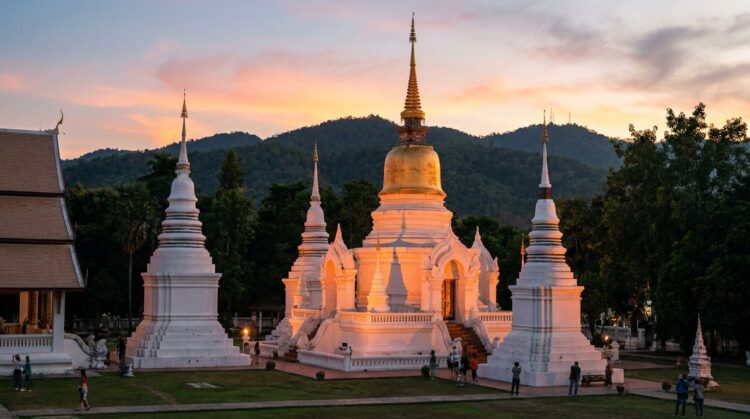
Chiang Mai has more than three hundred temples, and by the fourth you will stop really looking at them. Temple fatigue is the real danger here, not the heat or the crowds. One traveler almost walked past Wat Phra Singh in February 2026: he had already visited three wats that week. He went in anyway, and did not regret it. The answer is not endurance. It is choosing five genuinely different temples, then giving each a good two hours.
That is the plan for this article. Five temples, each with what you actually see there, the time of day that transforms the visit, how long to allow and the entrance fee, including ranges where sources contradict one another. Then comes etiquette, including two rules that English-language guides consistently forget. Finally, two walking routes through the old city. The season, budget and number of days the city deserves are covered in our complete guide to visiting Chiang Mai.
Two things to know from the outset. Chiang Mai temples have two-tier pricing, and Thai sources say so openly rather than hiding it. At several sites, Thai nationals pay nothing or a token amount, while foreigners pay a higher posted rate. The second thing, which most guides have yet to catch up with: the Monk’s Trail up to Doi Suthep has no longer been free since October 1, 2025. Prices below are in baht with their euro equivalents, based on roughly 38 THB to one euro, a rate that fluctuates.
How to choose five Chiang Mai temples out of three hundred
The tourist shortlist and the circuit locals actually follow are not the same thing. Thai visitors make a nine-temple merit-making tour, the wai phra kao wat (ไหว้พระ 9 วัด), built around a very different selection: Wat Phra That Doi Kham, Wat Umong, Wat Pha Lat, Doi Suthep, Wat Lok Molee, Wat Pan Sao, Wat Suan Dok, Wat Phra Singh and Wat Sri Suphan. Ask Chiang Mai residents which big names they would drop from a visitor’s list: they readily leave out Wat Phra Singh and Doi Kham to include Wat Umong instead. That is an opinion, not a verdict. Still, it tells you that the usual list ranks temples by fame rather than experience.
The five chosen here offer five different visits: a mountain pilgrimage site, a ruined giant within the city walls, a gilded royal hall, a network of forest tunnels, and a Buddhist university campus with white royal tombs. The other piece of advice residents keep giving boils down to one sentence: do something at a temple instead of ticking it off a list. Three temples where you made a genuine connection are worth more than eight you photographed.
Wat Phra That Doi Suthep: the mountain temple
Wat Phra That Doi Suthep Ratchaworawihan (วัดพระธาตุดอยสุเทพราชวรวิหาร) stands at around 1,050 m on the mountain west of the city. It is the only temple in this selection that is a half-day outing rather than a stop. Entry costs 30 THB (around 0.80 EUR) for foreigners, and nothing for Thai nationals. Allow one to two hours for the temple, two to four hours for the whole outing, including travel. It does not require a full day: people who live here combine it with an afternoon in Nimman.
How to get up there
The drive from the center takes 30 to 40 minutes depending on traffic. Shared songthaews (สองแถว), the red pickup trucks, charge 40 THB (1.05 EUR) per person each way from the entrance to Chiang Mai Zoo, and 60 THB (1.57 EUR) from Chang Phuak Gate. At least one English-language tourist page quotes 150 THB (3.92 EUR) from the zoo, roughly three times as much: know the local fare before negotiating. The catch lies elsewhere. Drivers wait for around ten passengers before leaving, so a solo traveler either waits or hires the vehicle privately, and a private round trip with 30 to 60 minutes of waiting at the top costs 300 to 700 THB (7.85 to 18.30 EUR) for the whole vehicle. Grab and Bolt will take you up and back down, but will not shuttle you around the mountain. If you want to visit Wat Pha Lat, the temple and Doi Pui village in one go, hire a driver for half a day. This mountain outing fits easily alongside the rest of our activities and excursions around Chiang Mai.
The naga staircase, the funicular and what it costs
From the parking lot, you choose between the stairs and the funicular. The staircase is flanked by two balustrades shaped like seven-headed nagas, the phaya nak (พญานาค), whose bodies form the handrails. Thai sources invariably count 306 steps; English-language sources print 300 or 309, and locals simply say the 300 steps. The climbing time is just as disputed: around 30 minutes according to one Thai guide, 10 or 15 according to another. Plan on the higher figure and you will find it easy.
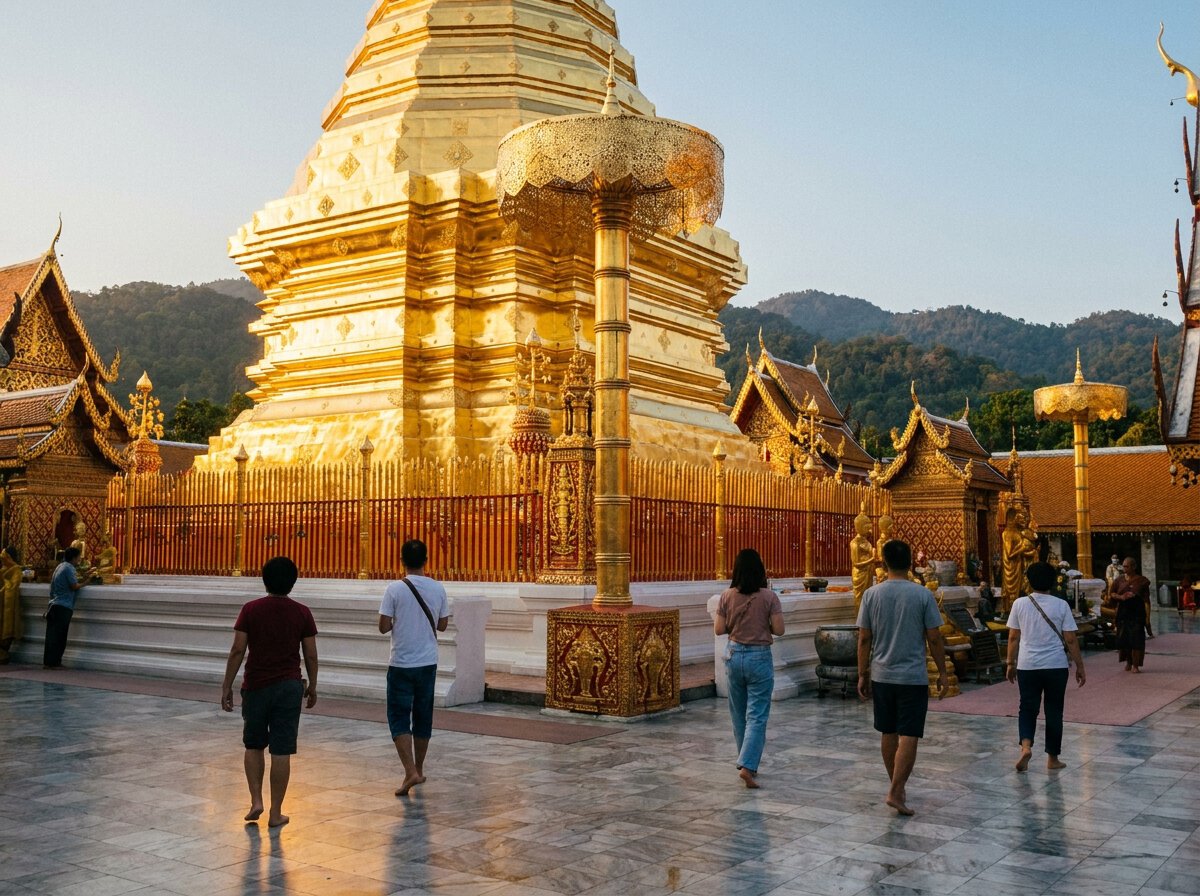
The funicular, the rot rang (รถราง), runs from 6 am to 6 pm. It is the example of two-tier pricing everyone cites: 20 THB (0.52 EUR) for Thai nationals, 50 THB (1.31 EUR) for foreigners, including the ride up and down. No reliable source settles whether the foreigner ticket also covers the 30 THB entrance fee, so keep enough to pay for entry separately. Signage is poor. One visitor climbed the entire staircase in February 2026 without realizing there was an alternative, and ended up sore for three days. Regular visitors recommend taking the funicular up and walking down the stairs.
When to go, and what you see
Come at sunrise. A visitor who took a Bolt up for dawn in February 2026 found almost nobody there and a clear view over the city, and residents rank this slot above the cautious “sunrise or evening” advice you read everywhere. Evening works too: the temple is busy from late morning until late afternoon, and regulars describe a different place once night falls. Opening hours, however, are worth checking yourself. One Thai guide says 6 am to 8 pm, another 8 am to 9 pm, and an English-language guide 6 am to 6 pm. Early morning fits all three; an evening visit does not.
You take off your shoes on the upper terrace, around the golden chedi, and tradition calls for walking around it three times clockwise. In the evening, monks chant on the terrace, and visitors are welcome if they remain barefoot, with shoulders and knees covered. If you arrive in clothing that is too revealing, the temple rents sarongs, the pha thung (ผ้าถุง), and shawls at the foot of the staircase. The penalty is a small payment, not a wasted trip.
A seasonal warning: during burning season, roughly February to April, the view from the summit disappears into pollution haze, the air is unpleasant, and locals avoid the mountain at this time. If you go up after dark, be aware that stray dogs sleep on the mountain road, often just beyond a bend. A strong reason to avoid traveling on two wheels.
Walking the Monk’s Trail, and why it is no longer free
Doi Suthep-Pui National Park began charging for the Wat Pha Lat nature trail on October 1, 2025. Fees are 20 THB for a Thai adult and 10 for a Thai child, 100 THB (2.62 EUR) for a foreign adult and 50 for a foreign child. Cash only, no QR-code payments. The ticket stub remains valid that day at other park checkpoints: a single payment therefore also covers Huai Kaeo, Mae Sa or Tad Mhok waterfall if you visit them on the same outing. The fee was initially enforced inconsistently before becoming a reality. A resident who walks the trail almost every day places the first time he was actually charged in mid-October 2025. Booths are staffed from around 8 or 8:30 am, and walkers who start earlier pass through without paying, as two independent accounts confirm. Any guide still describing this hike as free is out of date.
Then comes the danger no print guide mentions: aggressive dogs, with repeated recent incidents. One hiker was bitten by around five dogs from a pack of roughly ten, which attacked without barking first, and he believes a child could have been seriously injured. Another was bitten in November 2025 and had to begin a five-injection rabies vaccination course. Regulars believe the pack comes from the yard of a private house along the trail, not from the temple, whose dogs are friendly. The standard local precaution is to carry a stick, dog treats or grilled chicken. One frequent hiker encounters dogs on perhaps one outing in twenty, and is generally ignored. Prepare rather than cancel, but do not walk this trail alone with young children.
The route figures are disputed. The trailhead is at the end of Suthep Road, near Chiang Mai University, just south of the zoo. Guide websites place Wat Pha Lat (วัดผาลาด), the forest temple halfway up the slope, at 1.5 to 2 km and around 45 minutes away, with 160 m of elevation gain. A local account citing AllTrails gives 4.3 km and 220 m of ascent to the same point instead, and around 7.5 km with over 600 m of elevation gain for the full route to Doi Suthep. The blog figures seem too low. The terrain, however, is undisputed: the lower section is easy to moderate, the upper section from Wat Pha Lat is hard and steep, and only one walker in ten continues. Regulars follow this plan: walk up to Wat Pha Lat, take a red pickup for the rest, then walk the whole trail back down. Wear proper shoes, because some sections are slippery with loose stones, and bring poles for the descent if you value your knees.
Wat Chedi Luang: the broken giant in the middle of the old city
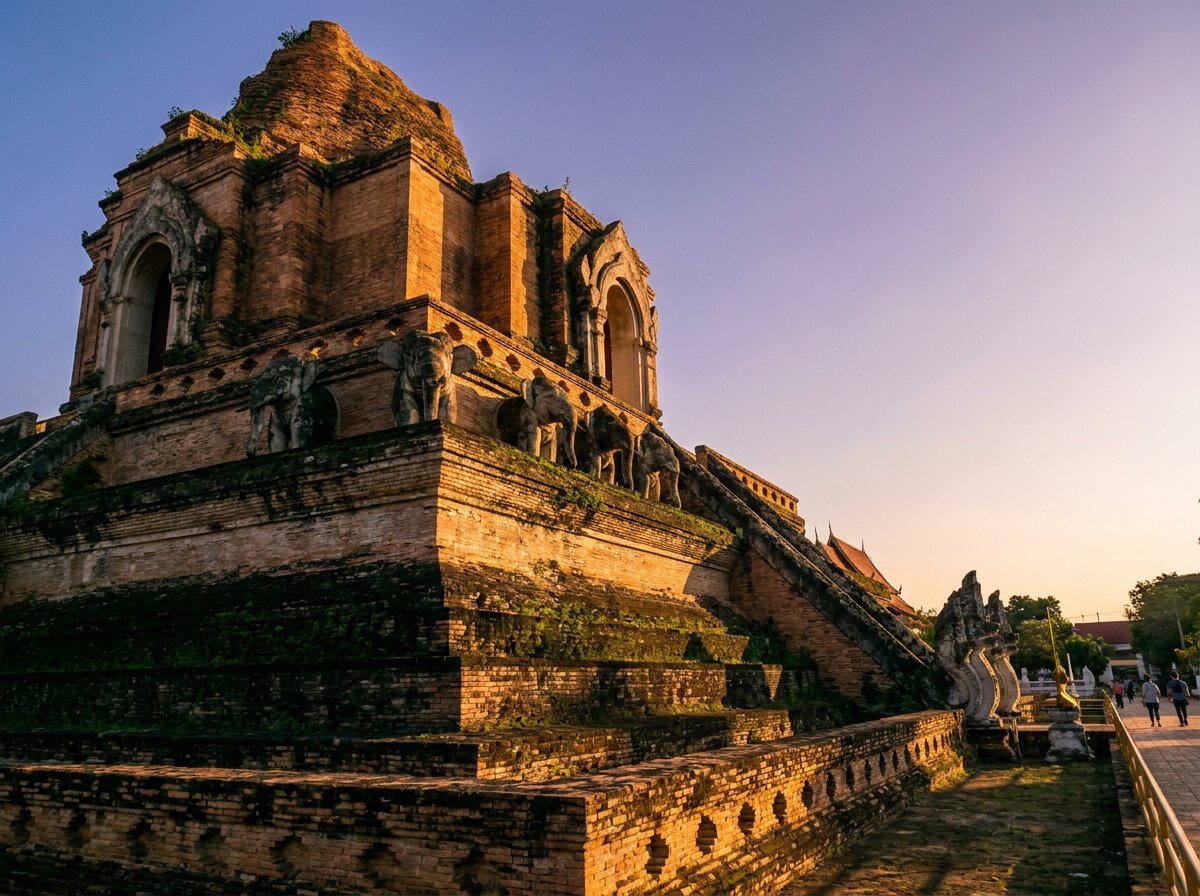
Wat Chedi Luang Worawihan (วัดเจดีย์หลวงวรวิหาร), the temple of the great chedi, houses Chiang Mai’s most impressive structure, and it is a ruin. Construction of the chedi began in the late 14th century under King Saen Muang Ma, before it was enlarged under King Tilokarat (reigned 1442 to 1487) to some 82 m high on a square base measuring 54 m on each side. It was then the tallest structure in the Lanna kingdom. The upper section collapsed during the great earthquake of 1545. What survives is the stump, still enormous, with weathered brick and stone elephants along the base. Its details are much easier to appreciate in the low evening light than at midday.
What you are looking at, and the entrance fee
The Emerald Buddha, Thailand’s most revered image, now kept in Bangkok, was housed in this chedi for 80 years, from 1468 to 1551. A jade replica occupies the niche. Allow 45 to 60 minutes to walk around, one to two hours if you sit down and take your time.
The entrance fee is where sources diverge. One English-language guide gives 40 THB for an adult and 20 for a child. A Thai guide lists 40 to 50 THB for foreigners and free entry for Thai nationals, and one visitor paid 50 in July 2026. The trend points toward 50 THB (1.31 EUR), though nothing official confirms it: carry that amount and expect to need exact change. Thai sources describe a contribution toward maintaining the site that the temple can adjust. Hours are just as uncertain: 6 am to 6 pm according to one source, 6:30 pm according to another, 5 pm according to a third. The reliably quiet window, according to Thai guides, is 7 to 9 am. After dark, the grounds are lit and much emptier, and several visitors in 2026 rated a nighttime visit above a daytime one.
The city pillar, the ticket office and the earthquake question
Within the grounds stands the shrine of the Sao Inthakhin (เสาอินทขีล), Chiang Mai’s city pillar. Women are not admitted to the building housing it, and men wearing unsuitable clothing are also turned away. Know this in advance and it need not spoil anything.
The ticket office reserved for foreigners generates real resentment. One visitor turned around without entering in November 2025, and made the same choice at Wat Sri Suphan and Wat Phra Singh, precisely because a place of worship was charging foreigners at a ticket counter. He noted that the ten other temples he had visited in the old city were free. The reaction is understandable, even though two-tier pricing is standard at Thai heritage sites, openly published rather than improvised at the counter.
Then there is the monument’s condition after the magnitude 8.2 earthquake whose epicenter was in Myanmar on March 28, 2025. The white chedi north of the viharn split, and the interior walls of the nearly century-old viharn cracked in several places, but engineers concluded that these were plaster cracks with no structural impact. The great chedi itself lost only a few loose bricks and was declared sound. In the sixteen months since, nothing available mentions scaffolding, netting, closures or restoration work here, and photographs from spring 2026 show the chedi standing and being visited normally. That is an absence of evidence rather than an official all-clear, so take it as such: the temple is open, the great chedi is intact and accessible, and if work is underway when you arrive, it will be minor. A visitor who came in December 2025 described it as very beautiful and very peaceful to explore.
One thing not to build an afternoon around: Monk Chat. A single English-language source advertises daily sessions from 9 am to 6 pm at outdoor tables on the north side of the grounds, free with donations encouraged, but no temple page or Thai-language source confirms this. A longtime resident answering the question in July 2026 said Wat Chedi Luang “used to have” a Monk Chat. He advised checking before showing up, and treated Wat Suan Dok as the reliable option. Check on the day, or go to Wat Suan Dok.
The Inthakhin festival
Once a year, the city pillar becomes the center of the only ritual of its kind in Thailand. The sai khan dok (ใส่ขันดอก) is the offering of small bowls of flowers to the Sao Inthakhin. During the festival, the temple is both at its liveliest and its most crowded. In 2026, it ran from May 13 to 19, with a closing day on May 20, and offerings could be made daily from 6 am to midnight. The dates shift each year with the Lanna lunar calendar: for any other year, plan on late May or early June, and confirm locally.
Wat Phra Singh: the royal temple
Wat Phra Singh Woramahawihan (วัดพระสิงห์วรมหาวิหาร) is a first-class royal temple in the western part of the old city. The reason to walk to the back of the grounds is the Viharn Lai Kham (วิหารลายคำ), the hall of golden patterns: small, gilded, with carved teak gables. It houses the Phra Buddha Sihing (พระพุทธสิหิงค์), one of Thailand’s most revered Buddha images. The wider grounds are grander and busier. The hall is the reason to come.
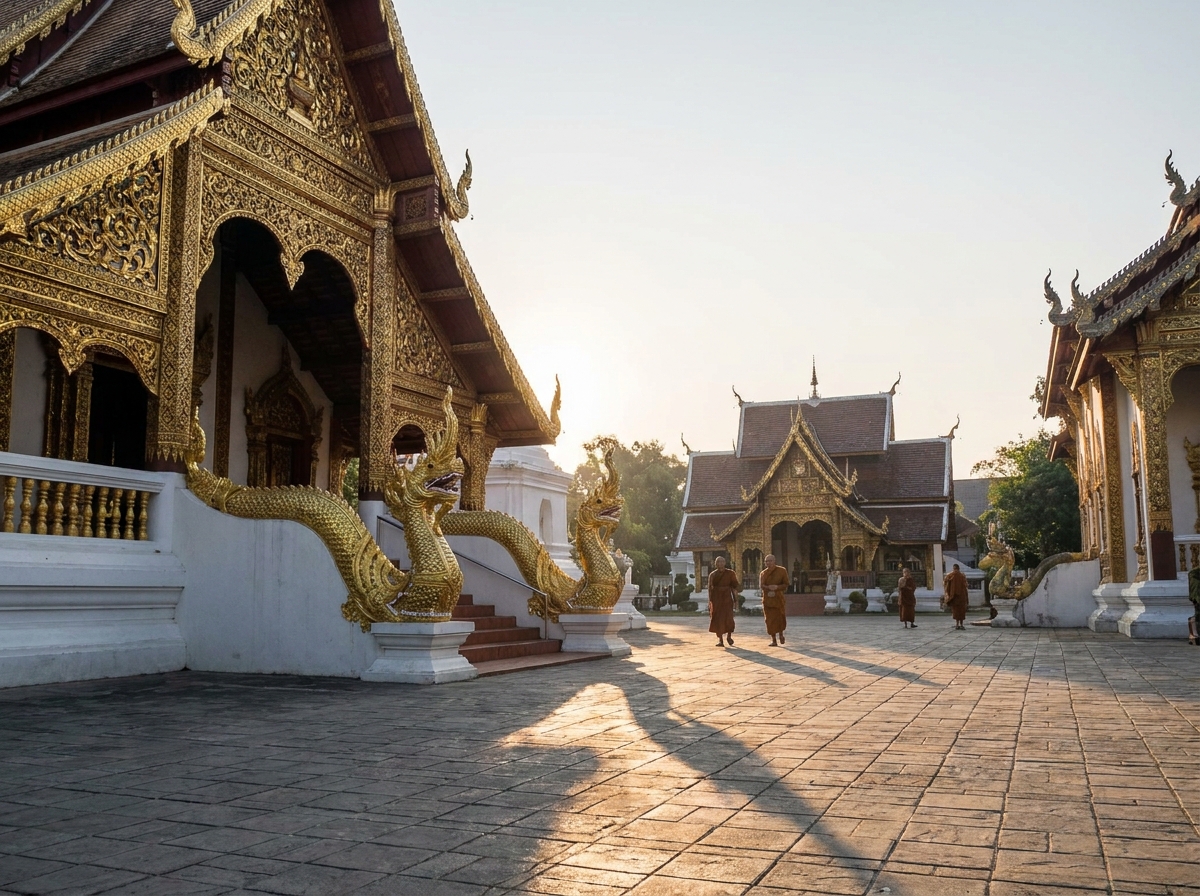
The entrance fee is the most confusing piece of information in this entire article. One English-language guide gives 40 THB. Two sources from 2026 list 50 THB for foreigners and free entry for Thai nationals, specifying that this applies to the Viharn Lai Kham rather than the grounds. Yet several visitors from early 2026 report entering without paying anything. The most plausible interpretation, unconfirmed, is that the grounds are free, a fee applies to the golden hall, and enforcement is inconsistent. Carry 50 THB and do not be surprised either way. Hours are no more consistent: 5:30 am to 7:30 pm according to one source, 7 am to 10 pm according to another, 8 am to 5 pm or 9 am to 6 pm on Thai pages.
Two time slots are worth aiming for. Shortly after opening, around 6 am, the courtyards are empty and novices line up: this is the moment regulars choose for photos. Late afternoon is the other, when the low sun catches the gilding. After dark, the grounds are lit and quiet, and several visitors in 2026 preferred that version. Motorcycle parking is free on-site. A route-planning tip from residents: Wat Phra Singh is inside the walls, so include it in an old-city walk rather than tacking it onto a day driving to Doi Suthep. It is also the temple most often skipped because of temple fatigue, which is why the routes below put it first rather than last.
Wat Umong: tunnels, forest and chickens
Wat Umong Suan Phutthatham (วัดอุโมงค์ สวนพุทธธรรม), the tunnel temple in the garden of the Buddha’s teachings, was founded around 1297 by King Mangrai. Umong (อุโมงค์) means tunnel, and that says it all: a roughly 700-year-old chedi rests on a network of brick meditation tunnels, with Buddha images, fragments of old paintings and a very much living bat colony. You take off your shoes to enter, some passages have low ceilings, and it stays cool inside whatever the temperature above ground.
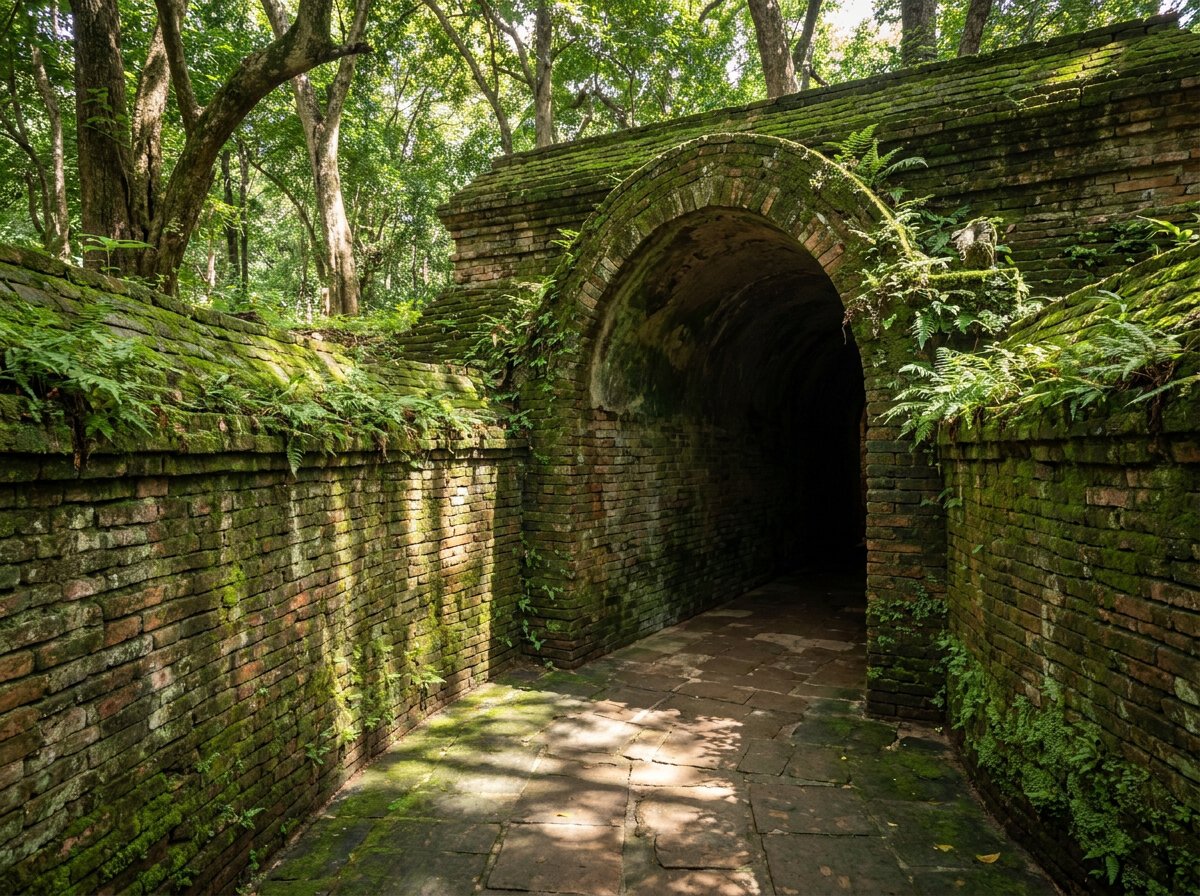
This is the only temple on the list that works in the middle of the day, because the park is shaded throughout. Thai guides place the almost silent window between 6 and 9 am, list 9 am to 3 pm as the busy stretch, then 4 to 5:30 pm as pleasant again before closing. A visitor who arrived early in January 2026 reported far more chickens than people on the grounds, which describes the place perfectly. Allow one to two hours. There are food and drink stalls on-site, and toilets. A songthaew from the center costs around 40 to 60 THB (1.05 to 1.57 EUR) per person, or 200 to 300 THB (5.23 to 7.85 EUR) to hire the vehicle privately.
Opinions are more sharply divided here than for any other temple on this list. Two commenters panned it, one calling the tunnels overrated, the other finding the site very poorly maintained. Chiang Mai residents say the opposite, and more of them say it: one of the most peaceful places in the area, spacious enough to claim a quiet corner for yourself, with the caveat that this holds true as long as there are not too many tourists. Wat Umong is the quiet temple, the one that has not been polished up. If you are looking for gilding and grandeur, you will be disappointed. If you want somewhere to sit for two hours, nowhere in the city does it better.
Entry should be free, with a donation box, according to Thai sources, although one visitor reported paying 20 THB in August 2025, perhaps for access to the tunnels. Closing time is around 6 pm according to the most credible source, but the times circulating range from 5 to 8 pm and none is reliable: do not plan to arrive late. Guides typically pair it with Doi Suthep, at the foot of the same mountain. Residents actually pair it with Baan Kang Wat, the small artists’ village ten minutes away. Wat Umong also advertises Monk Chat on Mondays, Wednesdays and Fridays from 5:30 to 7:30 pm, but the information comes from directory sites rather than the temple: confirm on the day.
Wat Suan Dok: white chedis, and the Monk Chat that actually happens
Wat Suan Dok (วัดสวนดอก), also called Wat Bupparam, is the flower garden temple, founded in 1371 by King Kue Na, sixth ruler of the Mangrai dynasty, on what had been the northern royal family’s pleasure garden. The cluster of whitewashed chedis everyone photographs is the Ku Chao Nai Fai Nuea (กู่เจ้านายฝ่ายเหนือ), the royal cemetery holding the ashes of Chiang Mai’s ruling house. Most English-language pages reduce this detail to “white stupas.” Come at sunset, when the low light turns them orange against the Doi Suthep ridge. Entry is free, donations only, according to Thai sources, although English-language aggregator pages quote 20 to 100 THB; the Thai source is more credible. Hours are 6 am to 6 pm.
The temple hosts the Chiang Mai campus of Mahachulalongkornrajavidyalaya Buddhist University. Hence the monks and novices who fill the site during the day, and the city’s oldest Monk Chat tradition, going back more than twenty years. It is free, with no reservation required, and longtime residents see it as one of the few doors still genuinely open to Thai Buddhist practice.
The schedule is where caution is needed. Third-party pages repeat Monday, Wednesday and Friday from 5 to 7 pm, widely copied but confirmed by no firsthand account. The official Monk Chat website lists office hours of Monday to Friday, 9 am to 5 pm, and no session times. The only dated firsthand account says something else again. A participant in 2026 describes a Friday program starting around 9:30 am. Half a day or a full day: teaching on the fundamentals of Buddhism, an introduction to several meditation methods with practice, a lunch break nearby, and a question-and-answer session to finish. Free. So go, but check the day and time locally, or with the Monk Chat office on Suthep Road, in the university’s academic affairs building, before fitting a session into your schedule.
Two comments from people who have been. Wear long trousers if you are a man: when asked directly, the resident English-speaking monk replied that trousers are preferred to shorts, which is stricter than the generic instruction to cover your knees. And prepare a real question, because the monks are learning English and enjoy practicing. Something that challenges them a little is better than yet another round on the meaning of robe colors and why monks do not eat after noon.
Temple etiquette: how to dress, where not to walk
Behavioral guidelines written in Thai are stricter and much more specific than the English-language summary of “cover your shoulders and knees.” Better to read the strict version and then relax than the other way around.
The dress code according to Thai sources
Prohibited for both men and women: sleeveless tops, thin straps, tank tops, crop tops, anything exposing the shoulders, shorts, skirts above the knee including skirts with high slits, and anything sheer. Required: a top with sleeves, plus trousers or a skirt covering the knees. Thai guidelines add that women should not overdo jewelry, makeup or perfume in a temple. Major temples post their rules at the entrance and rent cover-up clothing for a small fee. Arriving at Doi Suthep or Wat Chedi Luang in clothing that is too revealing therefore costs a modest rental fee, not the visit.
Take off your shoes before entering a viharn (วิหาร), an ubosot (อุโบสถ) or any hall housing a Buddha image, and place your shoes on the shelves provided. Never point your feet toward a Buddha image. Step over thresholds rather than on them. Avoid flash indoors, and do not climb onto prohibited parts of a chedi. Donations go into the boxes placed around the grounds; the local term is tham bun (ทำบุญ), making merit. QR-code donations are now common, but still bring small notes and coins: candles and flower offerings are all paid for in small change.
The two rules English-language guides forget
The first: a woman must never touch a monk directly, and must always sit lower than a monk. This is absolute, including in the most ordinary situations: passing an object, posing for a photo, sitting at a Monk Chat table. If something needs to change hands, set it down instead of handing it over.
The second: never walk in front of someone who is bowing or praying. In a busy viharn, people prostrate themselves in every direction, and the natural path across the hall usually cuts straight through someone’s prostration. Walk around behind them, quietly and without running. If you pay your respects yourself, the seated posture is kneeling for men, legs folded to the side for women, with three prostrations.
Two access rules are worth knowing before you reach the door, and they mirror each other. Women cannot enter the building housing the city pillar at Wat Chedi Luang. At Wat Sri Suphan, the Silver Temple, they cannot enter the ordination hall, which is reserved for men. Neither rule is directed at you personally, and both are longstanding.
One thing not to do: appoint yourself the temple police
Follow the rules, then leave other visitors alone. This deserves saying, because the instinct to report or confront inappropriately dressed tourists is particularly strong among French-speaking visitors, and because it does not match the way Thai people handle the matter. When a foreign visitor complained online about tourists’ clothing in temples in January 2026, the most upvoted replies put the complainant in her place rather than the tourists: you are not the temple police, leave that to the people here. A Thai commenter gave the local perspective bluntly. Thai people react much more strongly to destructive behavior than to a little exposed skin. Those who complain about it are mostly the neighborhood gossips. And the complaints overwhelmingly target young women, while male tourists in shorts attract no comment.
None of this means clothing does not matter, because genuinely destructive behavior is dealt with quickly. In January 2024, two European tourists in tank tops and shorts lay down to sunbathe on the lawn beside the old chedi at Wat Chiang Man. Passersby photographed them and alerted the temple, and they were asked to leave. The provincial cultural council then asked temples to enforce the rules more strictly, and guides to brief their clients better. Dress appropriately because those are the house rules. Then look at the temple rather than the other visitors.
Two walking routes through Chiang Mai’s old city
Inside the moat, the temples are close enough together that walking beats any organized tour, and forum regulars say so bluntly. Both routes only work on foot if you are staying inside or just beside the walls, one of the best arguments for choosing the old city when deciding which neighborhood to stay in. Watch the hours when planning: Wat Phan Tao closes at 5 pm and Wat Lok Molee at 6 pm, both shorter windows than those of the neighboring headline temples.
The short route, around two hours
Start early at Wat Phra Singh, in the west of the walled city, ideally at opening time. Walk east to Wat Chedi Luang in the center: this is the route’s centerpiece and the one to give the most time. Wat Phan Tao (วัดพันเตา) is right next door, on Phra Pokklao Road, a teak viharn that takes ten minutes and offers the route’s strongest contrast after the chedi’s mass of brick. Then head northeast to Wat Chiang Man (วัดเชียงมั่น), on Ratchaphakhinai Road, the first temple built in the city and once the residence of Chiang Mai’s founding king. Four temples, four different buildings, finished before the heat.
The long route, an afternoon
The longer version adds Wat Lok Molee (วัดโลกโมฬี), just outside the northern wall and more than 500 years old, which means crossing the moat and coming back. From there, improvise. With more than three hundred temples in the city and its surroundings, you can put together an itinerary almost anywhere inside the walls, which is exactly what the local nine-temple tour does. A Thai internet user walked a nine-temple version in the old city in a single afternoon, from 2 to 6 pm, based near Tha Phae Gate: a realistic pace if you keep stops short.
One scheduling conflict to resolve yourself. Seasoned travelers advise against walking through the old city during Sunday Walking Street market hours, when the serenity disappears. But on Sunday evenings, temple courtyards open up as food-stall areas for the market, and one visitor in June 2026 saw this as the very reason the Sunday market beats Saturday’s. Walk the route on a weekday morning, and return on Sunday evening to eat.
Tickets and approaches to ignore
Budget for the foreigner rate everywhere. The five temples plus the trail come to around 250 THB (6.55 EUR): better to know in advance, especially so it does not spoil the visit when you reach the ticket counter.
One approach to know about is the “temple closed” scam. Guides describe it like this: someone in an official-looking shirt announces that the site is closed for a ceremony, then produces a tuk-tuk driver who takes you on a commission-earning detour to a jewelry shop or tailor. Wat Phra Singh is cited as a target. Chiang Mai residents are not reporting this version at the moment: treat it as a general warning about Thailand rather than an active local threat. What visitors actually describe here is a friendly stranger in the street steering you toward a tailor’s shop. In any case, walk to the ticket office and read the posted hours yourself, because major temples are almost never completely closed. Unlicensed guiding is also actively prosecuted, with an arrest at Wat Chedi Luang on July 13, 2026: if a stranger attaches themselves to your group inside the grounds, they do not work for the temple.
Five temples, three or four days, and one read-through of the etiquette section before you leave. That beats a nine-stop minibus tour by a long way. When you are ready to build the rest of the trip around these five, the best season to come, the number of days the city deserves and the cost of a week here are detailed in our complete guide to visiting Chiang Mai.