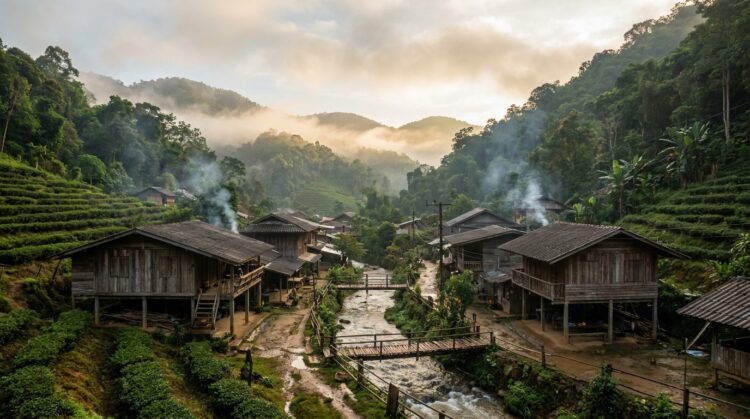
Chiang Mai is a small city surrounded by a vast expanse of mountains. You can walk around the old town in a morning. Everything else happens on the roads climbing out of the urban area, and that is where a week is either well spent or quietly wasted. What ruins an outing is almost never the destination: it is the wrong month, a driver charging twice what the previous customer paid, or a tour that skips the very trail you wanted to walk.
The activities in Chiang Mai described here are ranked by how much of your day each one consumes: first full-day trips out of town, then half-days, then evenings. Each entry gives the listed price, the time to allow and an honest assessment of whether it is worthwhile. Prices are in baht with their euro equivalents, and several vary according to nationality. For advice on when to visit and how the city is laid out, our complete guide to visiting Chiang Mai covers the basics.
Two rules apply throughout what follows. Book directly on the operator’s website, because online platforms take around 30% and a Thai operator generally sells the identical day trip for less. And take the calendar seriously: November to February is the cool, dry window for trails; May to October is when the waterfalls really flow. April, meanwhile, brings parched vegetation and haze from agricultural burning.
Doi Inthanon: what Thailand’s highest point really offers
Let us start with the disappointment, because it is the most reliable one in all of northern Thailand. Doi Inthanon’s summit stands at 2,565 metres, making it the country’s highest point, and you can see absolutely nothing from it. Trees, a car park full of minibuses, a radar antenna. People book the day trip on the strength of that number, drive for two hours and wonder where the view went. The summit deserves ten minutes; the mountain around it deserves the whole day. Locals add a corollary: if you cannot give the park a full day, including some walking, stay closer to town.
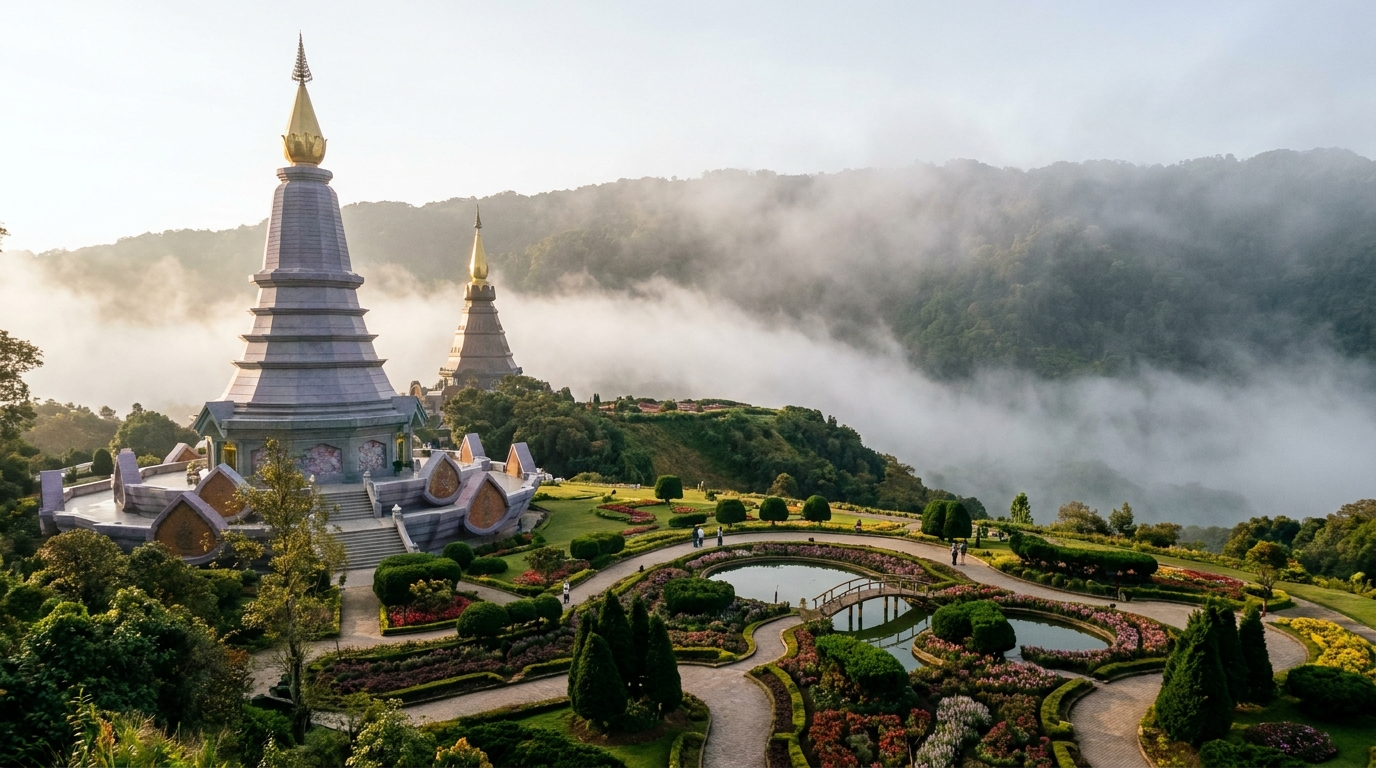
What makes the drive worthwhile is the ridge trail, the waterfalls, the Karen and Hmong villages along the park roads, and the twin royal pagodas above their flower-filled terraces. A very good day out, just not the one the marketing sells.
Getting there, and what it costs
Entry costs 300 THB (around 8 EUR) for a foreign adult and 150 THB (around 4 EUR) for a foreign child, with children defined as aged three to fourteen or under 140 cm; Thai nationals pay 60 and 30 THB (1.60 and 0.80 EUR). The listed vehicle fee is 30 THB per car and 20 THB per motorcycle (0.80 and 0.50 EUR), although some guides quote a flat fee of 100 THB (2.60 EUR). The journey takes 90 minutes to two hours: Route 108 to Chom Thong, 57 km, then Route 1009 for the 31 km climb. Neither Grab, Bolt nor songthaews serve the park: you therefore need your own vehicle, a private driver or a group tour. The ride-hailing fare of around 1,500 THB (39 EUR) that travellers keep finding is for Doi Suthep, another mountain much closer to town.
Allow 1,200 to 1,800 THB (31 to 47 EUR) for a full-day group tour, including park fees, transport and lunch. Operators catering to Thai customers sit at the lower end of the range, while old-town agencies generally charge 1,300 to 1,500 THB (34 to 39 EUR). Book the version that includes the Kew Mae Pan hike: regular visitors describe it as the add-on worth paying for. Private-driver prices vary much more widely: 2,500 THB (65 EUR) for the day in November 2025, plus park fees, versus 4,500 THB (118 EUR) quoted in June 2026 for a sunrise itinerary from 4:30 am to 1:30 pm, a rate two residents described respectively as fair and excessive. Get two or three quotes.
One thing not to take lightly: riding up Route 1009 on a rented scooter. It is steep, often wet and slippery, there are checkpoints, and dangerous overtaking is routine. Residents of this part of the province report frequent fatal accidents. If you are not an experienced rider, pay for a seat in the minibus.
The trails, which are the real reason to come
Kew Mae Pan is the trail to build your day around: a 3.2 km loop at roughly 2,000 m, two to four hours of walking, and 21 marked viewpoints along a ridge with sheer drops. It is seasonal, open from 1 November to 31 May and closed every year from June to October to let the forest regenerate. A local guide is mandatory, at 200 THB (5 EUR) per group, with ten walkers per guide and 50 groups per day, so the trail never becomes a procession. Some English-language sources quote 220 THB (5.75 EUR). Those same articles call it easy; one Thai hiker found it magnificent and worth the effort, but made clear she would not do it again.
Ang Ka Luang is the exact opposite: 400 m of wooden boardwalk through the summit’s sphagnum bog, a ten-minute walk, no guide required, included in your admission and genuinely otherworldly. Pha Dok Siew is the third option, a roughly two-hour walk led by Karen guides through jungle and rice fields to a bamboo bridge above a waterfall, again 200 THB (5 EUR) per group of up to ten people. Choose Kew Mae Pan in season, Pha Dok Siew outside it. As for waterfalls, Wachirathan is the loud, high-volume one on the road up, and it delivers in any month; Mae Ya is the tall, tiered waterfall in the south of the park. During the dry months, the smaller falls dwindle to trickles, although late May is a good compromise: almost no other visitors, cool mountain air, and the main waterfall still thundering.
The pagodas, the season and opening hours
The two royal chedis, Phra Mahathat Naphamethanidon, built in 1987 for the king, and Phra Mahathat Naphaphon Phumisiri, built in 1992 for the queen, overlook terraced gardens and open daily from 8 am to 4:30 pm. Their admission fee is the one figure nobody agrees on: Thai sources list 200 THB (5 EUR) for a foreign adult and 50 THB (1.30 EUR) for a Thai adult, while English-language guides quote a flat 100 THB (2.60 EUR) per person. Budget 200 THB. The nearby Royal Agricultural Station charges 20 THB (0.50 EUR).
The visitor centre opens from 8 am to 4 pm, and most sites remain accessible until around 4 or 5 pm. That explains why a tour leaving town at 9 am always feels rushed; for sunrise at the summit, departure is at 4 am. November to February is the best window for hiking, and the cherry blossom season lasts only two to three weeks, between mid-January and mid-February. If your stay is short, several locals would send you to Chiang Dao instead, with a stop at the sticky waterfall on the way back.
Mae Kampong: four hours, not a full day
Mae Kampong is a village of wooden houses stacked along a stream in Mae On district, 50 km east of town, or an hour to an hour and a half by car along Routes 1006 and 1317, with a very winding final stretch. No entry fee appears in either Thai or English-language sources. What people misjudge is the time needed: four to five hours is enough, and a full day leaves you stranded in a small village with nothing more to look at.
The sights are all close together. Wat Khantha Phruksa is the small temple built above the stream, Mae Kampong waterfall has seven tiers, and Kiew Fin, the viewpoint at roughly 1,500 m, is where a sea of clouds forms on cold mornings. Add the Pha Nam Lod rock formations, the Tin Tok Royal Project, the tree-perched café The Giant Chiangmai and a small walking street. Thai guides put the best window at mid-October to mid-February, for cool air, mist and stargazing. June to October offers a green alternative with waterfalls in full flow, if the waterfall matters more to you than the view.
Without a car, shared minibuses leave from Warorot Market, opposite the flower market near the Ping River, for 150 to 200 THB (4 to 5 EUR) one way, with a journey time of around 90 minutes. Seats sell out quickly: call the Sankamphaeng minibus cooperative the day before on 052-005-410, 082-280-7838, 084-222-3478 or 083-325-4965. A Grab or taxi costs 700 to 1,200 THB (18 to 31 EUR), and homestays need to be booked one to two months ahead in high season.
The honest caveat: this is no longer a quiet village at weekends. Residents complain about streets blocked by visitors, and one long-time local considers the place ruined. Come on a weekday, and come early.
Elephant sanctuaries in Chiang Mai: learn the criteria before learning the names
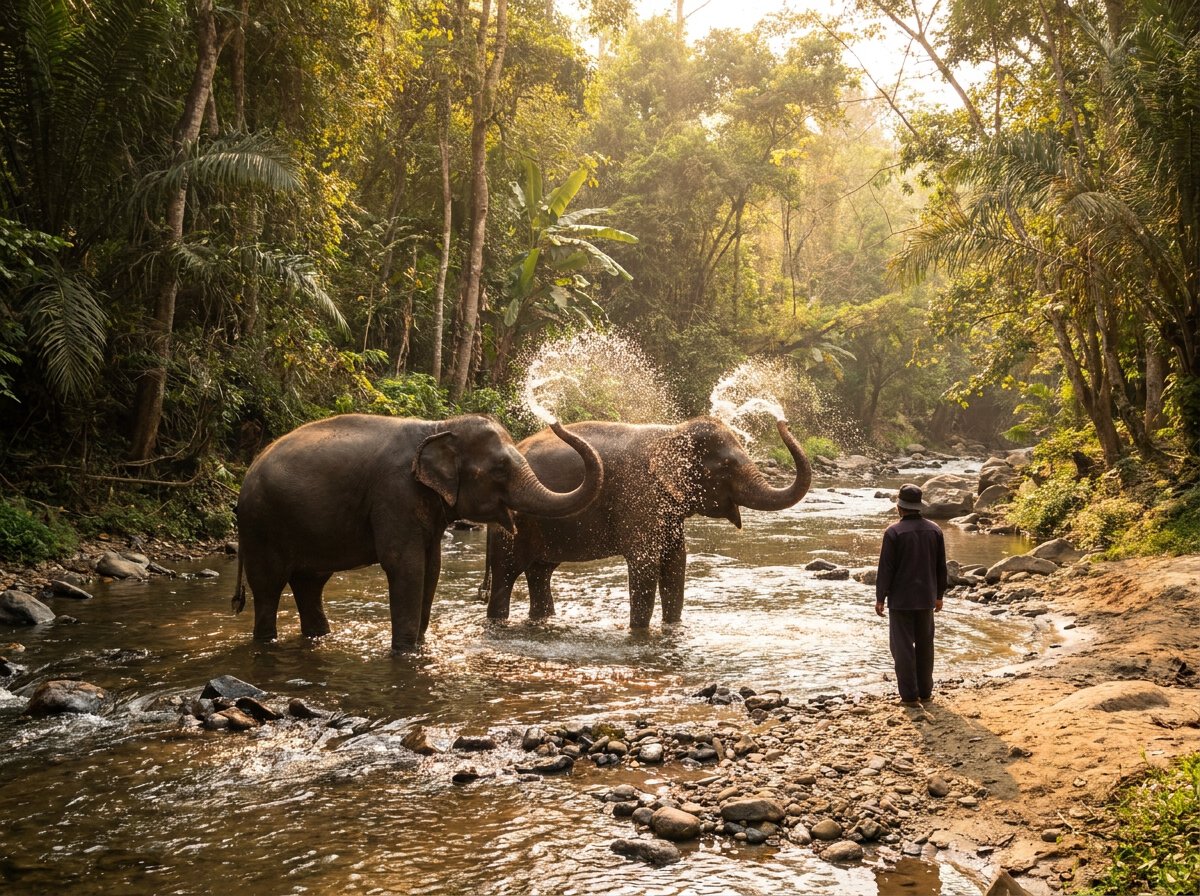
The Thai term for an elephant camp, pang chang, covers everything from businesses selling rides and daily shows to hands-off observation projects. The word sanctuary now works in much the same way, as a marketing label rather than a description. The sign at the entrance tells you nothing: it is the activity list you need to read.
The checklist that separates them
Between the criteria published by Thai tourism platforms and those applied by long-term residents, the overlap is clear enough to serve as a filter. Before booking, check all of the following:
- No riding of any kind.
- No shows and no forced activities.
- No breeding elephants for tourist attractions. Several babies on site at the same time are a warning sign, not a selling point.
- No bathing and no visitors throwing water over elephants.
- Reservations required, with a cap on the number of people admitted per session.
- A large space in which elephants roam freely, and genuine educational content about their care.
- Communications focused on conservation rather than entertainment.
A half-day option is generally a good sign: it exists specifically to limit group sizes. And note what is missing from this list: price. An expensive programme is not automatically the most ethical, and a longer day may simply mean smaller groups and more hours, not better animal welfare.
The bathing question, and where two standards diverge
Bathing is where travellers get caught out, and the answer changes according to the language in which you do your research. The English-language position in 2026 is that an elephant only tolerates being scrubbed and handled by strangers because it has first been broken: a camp that advertises no riding while still organising baths has therefore taken one step, not gone the whole way. Thai tourism platforms publishing their own ethical criteria in 2026 still present bathing as acceptable when framed as helping care for the animal. The two standards have not converged. Applying the stricter of the two is defensible, and that is what this article does, but do not assume every Thai operator shares it. Read the activity list before paying, not afterwards. This is by far the most frequent disappointment among travellers convinced they have booked an ethical day out.
The two places backed by something verifiable
Lists of approved sanctuaries circulate constantly, but they are informed opinions, not certifications. Two places are backed by verifiable facts: those are the two we name here.
Elephant Nature Park, in Mae Taeng district roughly sixty kilometres from town, has prohibited tourists from bathing with its elephants since 2018 so the animals can behave naturally, and none are tethered or ridden. Its 2026 prices are published: 2,500 THB (65 EUR) for a morning or afternoon half-day, with children aged three to eleven at half price and infants under two receiving a 25% discount; 3,500 THB (91 EUR) for the full-day Skywalk, which the park explicitly describes as hands-off, and the same price for Walking with Elephants and Sunshine for Elephants; 6,000 THB (157 EUR) for Care for Elephants or Elephant Highlands; 5,800 THB (151 EUR) for two days and one night; 15,000 THB (392 EUR) for the week-long immersion programme. Mornings start between 7:30 and 8 am, afternoons between noon and 12:30 pm. The park fills up quickly, bookings close 24 hours in advance and a deposit is required: this is therefore not a decision to make during the week of your visit in high season.
ChangChill, in Mae Win in Mae Wang district, operates on an observation-only basis: no riding or bathing, and visitors do not hand-feed the elephants. You walk through the forest and watch them from a distance. The place is supported by World Animal Protection, the only specifically named external endorsement in this category. A half-day includes hotel pickup and a hill walk that gets muddy after rain, with walking poles provided, and you cut sugar cane that is sent to the herd; groups can reach around twenty people. Treat the price circulating online with caution: the 1,900 THB net per person (50 EUR), plus 7% government tax and 10% service charge, comes from a partner hotel’s page rather than ChangChill’s booking form, so check directly with them.
Book directly, never through an intermediary
A booking intermediary operating under the name elephant-sanctuary.org accumulated a steady stream of complaints from late 2025 to early 2026, always following the same pattern: it resells other operators’ tours, takes card payments, communicates only through WhatsApp, and on the morning of the visit the driver does not arrive. Calls, emails and messages go unanswered. Some travellers were picked up an hour late and the day eventually went ahead; others waited for a car that never came, and at least one was blocked on WhatsApp and simply lost their money. The lesson goes well beyond this one website: book on the sanctuary’s own website, pay the sanctuary, and if the only contact channel is an instant messaging app, walk away. In a similar vein, the king cobra farm near town belongs on the avoid list alongside riding camps: a visiting herpetologist described its snakes as being kept under severe stress.
Cooking classes in Chiang Mai: the underrated half-day
It is easy to dismiss a cooking class as a Southeast Asian tourist cliché, but the counterargument deserves a hearing: Thai visitors to Chiang Mai deliberately book them during their own holidays too. The format is consistent: a market visit, then three to five dishes cooked at your own workstation, followed by eating what you have prepared. Classes are aimed at beginners, and nobody expects you to have cooked Thai food before.
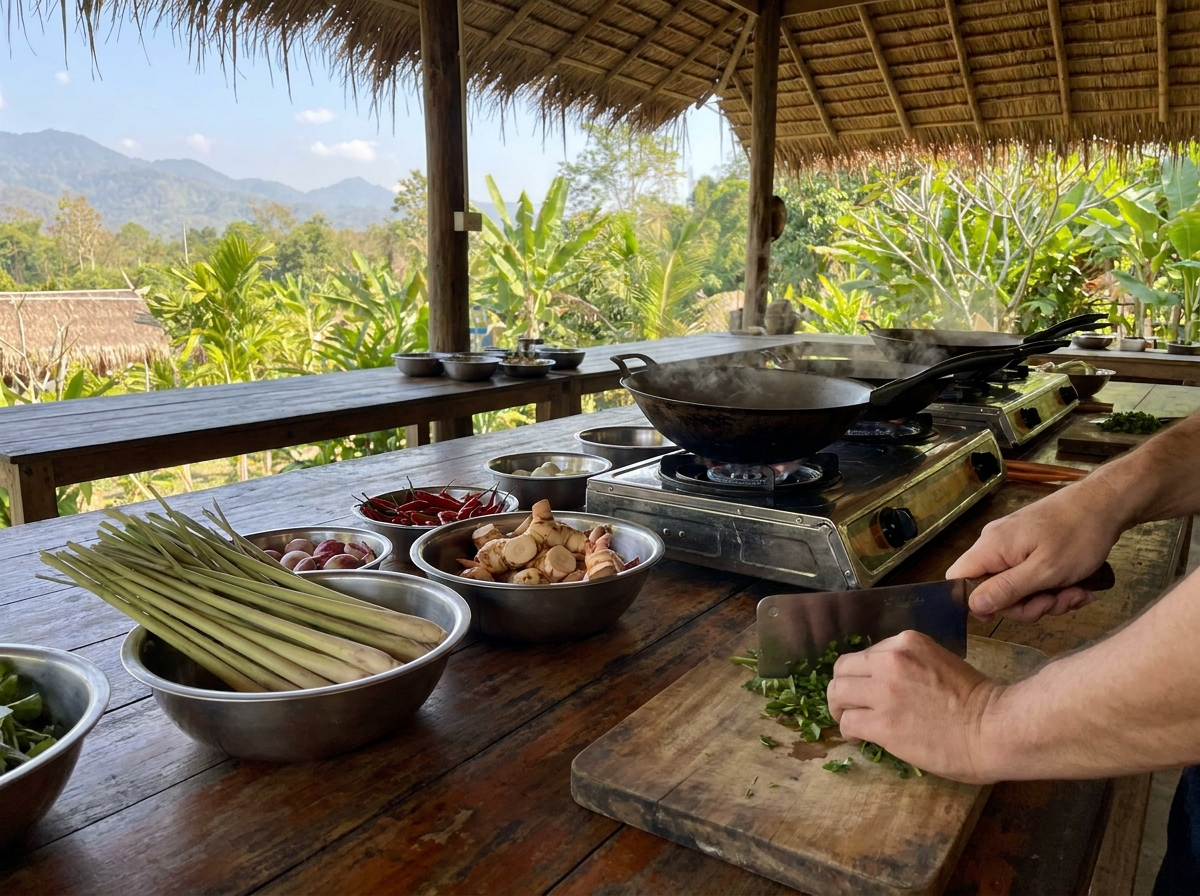
Prices are fairly uniform: around 1,200 THB (31 EUR) for a half-day, around 1,500 THB (39 EUR) for a full day, including the market visit. Asia Scenic lists its city class at 1,000 THB (26 EUR) and its farm class at 1,200 THB (31 EUR); the farm version runs from 9 am to 3:30 pm, with free pickup within the city. Other schools repeatedly mentioned in 2026 include Grandma’s Home Cooking School, Love Chiang Mai Cooking School (pickup in the old town, a market stop, then a class in Hang Dong), Thai Farm Cooking School, Baan Farm Thai, Aromdii, and Alotofthai, which runs five-person classes in the teacher’s own home.
What determines whether the day is worth the money: ask for the northern, or Lanna, programme. The default menu almost everywhere consists of pad thai, green curry and mango sticky rice, in other words dishes you can eat anywhere in Thailand, and that is why people go home underwhelmed. The Lanna programme offers different dishes: gaeng hang lay, the slow-simmered pork curry with ginger and tamarind; sai ua, Chiang Mai’s herb-packed sausage; and nam prik ong, the tomato and pork chilli dip. Grandma’s offers exactly this class and books out weeks ahead: reserve before you fly. Love Chiang Mai also teaches sai ua. One warning: Thailand does have high-turnover classes, the kind where an employee takes the knife out of your hands because you are chopping too slowly. Regular visitors say this is not the norm in Chiang Mai, but read recent reviews first.
Bua Thong: the sticky waterfall you can climb
Bua Thong makes no sense until you have seen someone do it. Calcium carbonate carried by the water has coated the limestone in a hard, porous crust that genuinely grips, allowing people to walk up the waterfall against the current, using ropes installed on the steepest sections. There are three levels to climb, and the classic approach is to take the stairs down to the bottom before climbing back up. Beside the falls is Nam Phu Chet Si, the cool seven-coloured spring, which is part of the same visit.
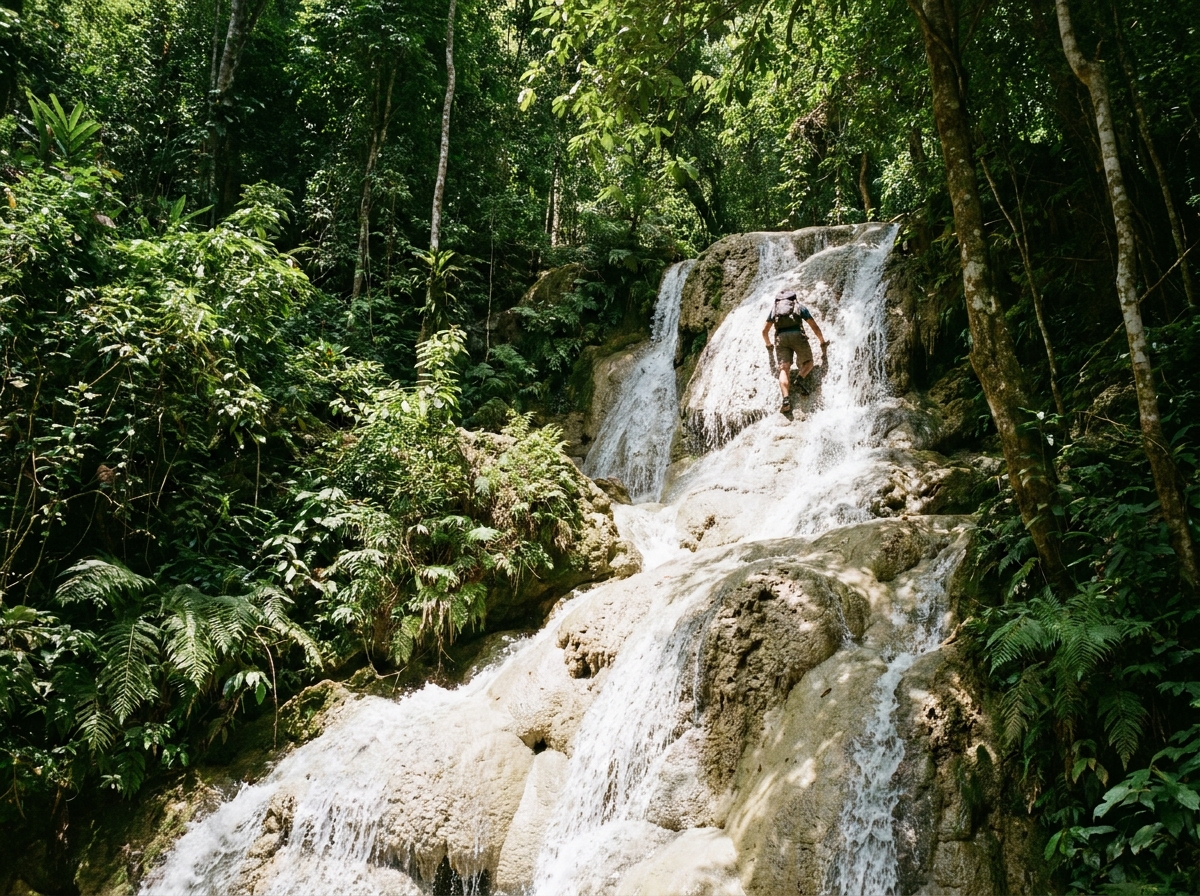
Check before making the drive. A major directory displayed a temporary closure notice when checked in July 2026, while travellers described perfectly normal visits during those same weeks and Thai sources reported no closure. The status is genuinely uncertain: call the park office on 093 193 3556 the day before. That call also settles the opening-hours question: generally 8 am to 5 pm, with a few recent reports of a 4:30 pm closing time.
Entry is free for everyone, for administrative reasons rather than generosity. Thailand’s parks authority still classifies Nam Tok Bua Thong and Nam Phu Chet Si as a proposed park, not yet formally established, so no fee schedule applies, and free entry will disappear once the park is officially created. There is no shop or restaurant at the park office: bring water and food.
The site is in Mae Taeng district, just over an hour along the road from Chiang Mai to Phrao: past Mae Jo University, roughly 43 km farther on, turn right around kilometre markers 48 and 49, then continue about 3 km in. Without a car, songthaew drivers at Chang Phueak terminal will take you there for roughly 1,000 to 1,500 THB (26 to 39 EUR) per vehicle, split between your group. Wear strapped sandals, not flip-flops. Wat Ban Den is on the same road, the obvious stop on the way back.
The limestone stays grippy in the rain, making this the most weather-resistant outing around Chiang Mai and a good choice for a wet day in the green season. It is also a popular outing: touristy, as one local puts it, in the sense that plenty of other people will be there doing exactly the same thing.
Chiang Mai’s Grand Canyon: two sites, two very different bills
The Grand Canyon is a flooded quarry in Hang Dong, 20 km southwest of the old town and a 30- to 45-minute drive away, and the two businesses operating on the site are constantly confused. The large one is Grand Canyon Water Park: 800 THB (21 EUR) for a foreign adult at the gate, 600 THB (16 EUR) for a child between 90 and 120 cm, free below 90 cm, versus 420 THB (11 EUR) for a Thai adult. The ticket includes admission, canoeing and kayaking, cliff jumping, giant inflatable slides, a life jacket and one zipline ride. Wakeboarding costs extra, at 1,250 THB (33 EUR) per person per hour. Resale platforms list the foreign ticket at a significantly higher price: buy it on site.
Right next door, the much smaller original site charges 30 THB (0.80 EUR) for entry and 50 THB (1.30 EUR) for the zipline. If you want to jump off a cliff into green water for the price of a bowl of noodles, this is the one. If you have children who can spend six hours on inflatables, pay for the water park.
Evenings: walking street markets, Night Safari or the old town
The two walking street markets are not the same market
This is what catches out the most visitors in the evening. The Sunday walking street market runs along Ratchadamnoen Road from Tha Phae Gate, roughly from 4 to 10 pm. The Saturday market occupies a different street, Wua Lai Road, from 5 to 11 pm. Both are huge and crowded, and many locals find them so similar that doing both amounts to wasting an evening. With just one weekend in town, choose Sunday for the setting inside the city walls.
Come hungry rather than to shop. The food lanes are the real reason to be there, and knowing what to order changes the whole evening: our guide to what to eat at Chiang Mai’s evening markets explores them stall by stall. To avoid the crowds entirely, residents point to the weekend morning markets, Jing Jai and Cham Cha, or the Nong Ho flea market.
The Night Safari, and the calculation to make before booking
Chiang Mai Night Safari sells an evening tram ride past animal enclosures, plus a musical fountain show. Published prices for 2026 are 1,200 THB (31 EUR) for a foreign adult and 600 THB (16 EUR) for a foreign child, versus 300 and 150 THB (8 and 4 EUR) for Thai visitors: a foreign family therefore pays four times the local rate for the same tram. Children under 100 cm enter free, Thai nationals over 60 receive a 50% discount on site with ID, and people with disabilities and monks of any religion enter free. Prices change: confirm on the official ticketing website. With children, the tram and fountains make for an easy evening. Without them, those 1,200 THB buy plenty of dinner and live music in town.
What locals do instead
The standard local evening starts at the food stalls by Chang Phueak Gate, where the khao kha moo stand run by the woman in the cowboy hat has a queue for good reason, then continues inside the city walls. North Gate Jazz Co-Op is the live-music institution, packed and spilling out into the street on good nights. The Troubadour, behind the Starbucks near Tha Phae Gate, is the quieter option, and Chiang Mai Originalive sits beside the moat. The entire evening costs a fraction of a safari ticket.
Half-days closer to town, and the places residents mention
Doi Suthep is the obvious half-day outing, the one almost everyone does: the temple sits on the ridge just above town, and Doi Suthep-Pui National Park admission is 100 THB (2.60 EUR) for a foreign adult and 50 THB (1.30 EUR) for a child, versus 20 and 10 THB for Thai visitors. Treat it as a morning rather than a whole day, and read up on Wat Phra That Doi Suthep in detail, its own admission fees and its dress code before setting off. Along the same road up, the walk to Huay Kaew waterfall and Wang Bua Baan makes for a decent stretch of the legs.
Beyond that, here is the list that comes up when you ask locals what is left once the classic circuit is done: Chiang Dao caves, the gardens of Doi Ang Khang, Fang hot springs, Wat Sri Suphan and its silver temple in town, the woodcarving village of Baan Tawai, Pha Chor canyon, Huay Tueng Thao reservoir, the Samoeng loop and Mon Cham. Thai visitors, when asked what is really worth spending money on here, mention a cooking class, ziplining, white-water rafting and climbing the sticky waterfall, a rather different selection from that of foreign tourists.
Bookings, quotes and the dual-price ticket counter
For excursions from Chiang Mai, booking is where money slips away. Platforms take around 30%, and a Thai operator selling the same day at Doi Inthanon on its own website lists it at 1,200 THB (31 EUR), versus 1,500 THB (39 EUR) or more elsewhere. Private-driver quotes for an identical day range from 2,500 to 4,500 THB (65 to 118 EUR), and even residents disagree on what is fair: ask three people before accepting one.
For outings that Grab and Bolt actually serve, there is a useful local trick: order the ride, switch payment to cash, and the driver will often offer to wait and bring you back for a flat fee. One group paid 2,000 THB (52 EUR) for a day from 10 am to 4:30 pm, with luggage and an airport drop-off at the end. And expect dual pricing at the main attractions, posted rather than improvised: 300 THB versus 60 at Doi Inthanon, 1,200 versus 300 at the Night Safari, 800 versus 420 at the water park. Budget for the foreign rate rather than the figure a Thai friend gave you.
Build the week around one big day in the mountains, a half-day with elephants or in a kitchen, and evenings on foot: Chiang Mai then stops feeling like a checklist. If you are still deciding how many days to give the city, when to come and what it all costs, our complete guide to visiting Chiang Mai covers the seasons, budget and practical details.