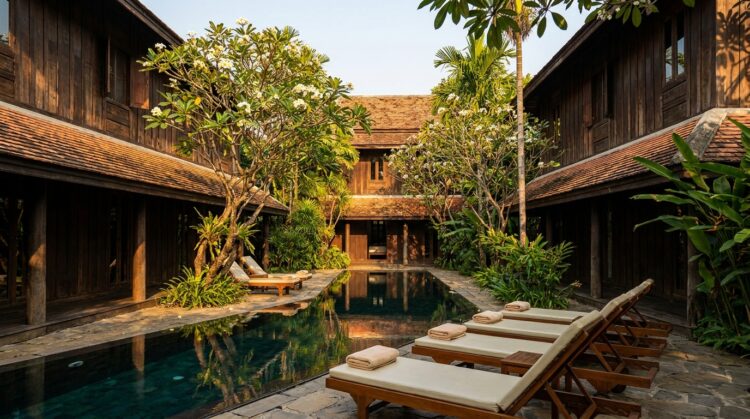
Chiang Mai fits its five most useful neighborhoods into a few square kilometers, which should make choosing easy, but does not. A ten-minute Grab ride separates a walled old city where you can walk from one major temple to the next, a café district beneath a flight path, and a riverside where the real question is less about the view than the building’s flood barriers.
To help you decide where to stay in Chiang Mai, this guide takes a neighborhood-by-neighborhood approach rather than a hotel-by-hotel one: the old city inside the moat, Nimmanhaemin, the Ping riverside around Wat Ket, Santitham north of the walls, and Chang Khlan (also spelled Chang Klan) around the Night Bazaar. For each: the feel of the streets, what you can reach on foot, what residents complain about, who it suits, and what a night costs, using named properties rather than invented price ranges. Prices are in baht (THB), based on roughly 38 THB to 1 EUR. The rest of the trip is covered in our complete guide to visiting Chiang Mai.
One rule before getting into the details. If you are staying for less than a week, choose one neighborhood and stay there. Residents repeat this endlessly: an 11 am checkout and a 3 pm check-in swallow most of a day, and over six days, that means spending a sixth of your holiday moving between two neighborhoods a few minutes apart by taxi.
Getting your bearings: the moat, the river, and the mountain
Chiang Mai’s old city forms a square surrounded by walls and a moat, with each side measuring about 1.5 km. By most counts, it has five gates: Pratu Chang Phuak to the north, Pratu Tha Phae to the east, Pratu Suan Dok to the west, and Pratu Chiang Mai and Pratu Suan Prung on the southern side. Tha Phae Gate is the landmark everyone uses: hotels advertise their distance in minutes from it, and the Sunday market starts there. This square sits between the Ping River to the east and the Doi Suthep ridge to the west, the mountain you can see at the end of Nimman’s streets.
Distances from Chiang Mai International Airport (CNX) are short, and published figures do not agree: the old city is 3 or 5 km away depending on the source, Chang Khlan and the Night Bazaar about 3.8 km, both quoted as a 10- or 15-minute drive, and Nimman about 15 minutes door to door. Nowhere is far from the airport, and CNX has operated 24 hours a day since April 2014, with no official nighttime curfew: an early flight therefore depends less on your chosen neighborhood than on traffic along the way.
There is no metro, nor anything resembling Bangkok’s public transport. Bus routes exist, but residents consider only two options realistic. Red songthaews (สองแถว, colloquially รถแดง rot daeng) are shared pickup trucks: 30 to 40 THB per person for a city trip in 2026, with most drivers now asking 40 and some still accepting 30, and quotes of up to 60 THB for short or private rides. Cash only, paid when you get out; flag one down and state your destination before boarding. Grab remains the default option for most foreign visitors. Fares for the same route vary from hour to hour: reported prices include 27 THB between Central Festival and the old city, and 75 or 200 THB between Nimman and the old city.
Walking times are where straight-line distances mislead you. In the same conversation, residents estimate the walk from Nimman to the old city at 20 minutes, then 35 or 45 minutes; by Grab, allow 5 to 15 minutes. Walking to the center from north of the moat looks straightforward on a map but is not, because the ring road outside the walls carries heavy traffic. Then there is the heat, from March to May and often beyond: at 36 degrees, as one visitor puts it, you feel every one of those 15 minutes.
Chiang Mai’s old city: everything inside the walls
Most first visits unfold inside the moat, and Thai advice for anyone without a vehicle is consistent: stay ในคูเมือง, inside the moat. Regulars on Thai forums go a step further than English-language guides and recommend the Wat Phra Singh end, where there is a wide choice of three-star hotels with breakfast included. Around them, the lanes are lined with small guesthouses and teak shophouses converted into six-room properties, along with plenty of hostels.
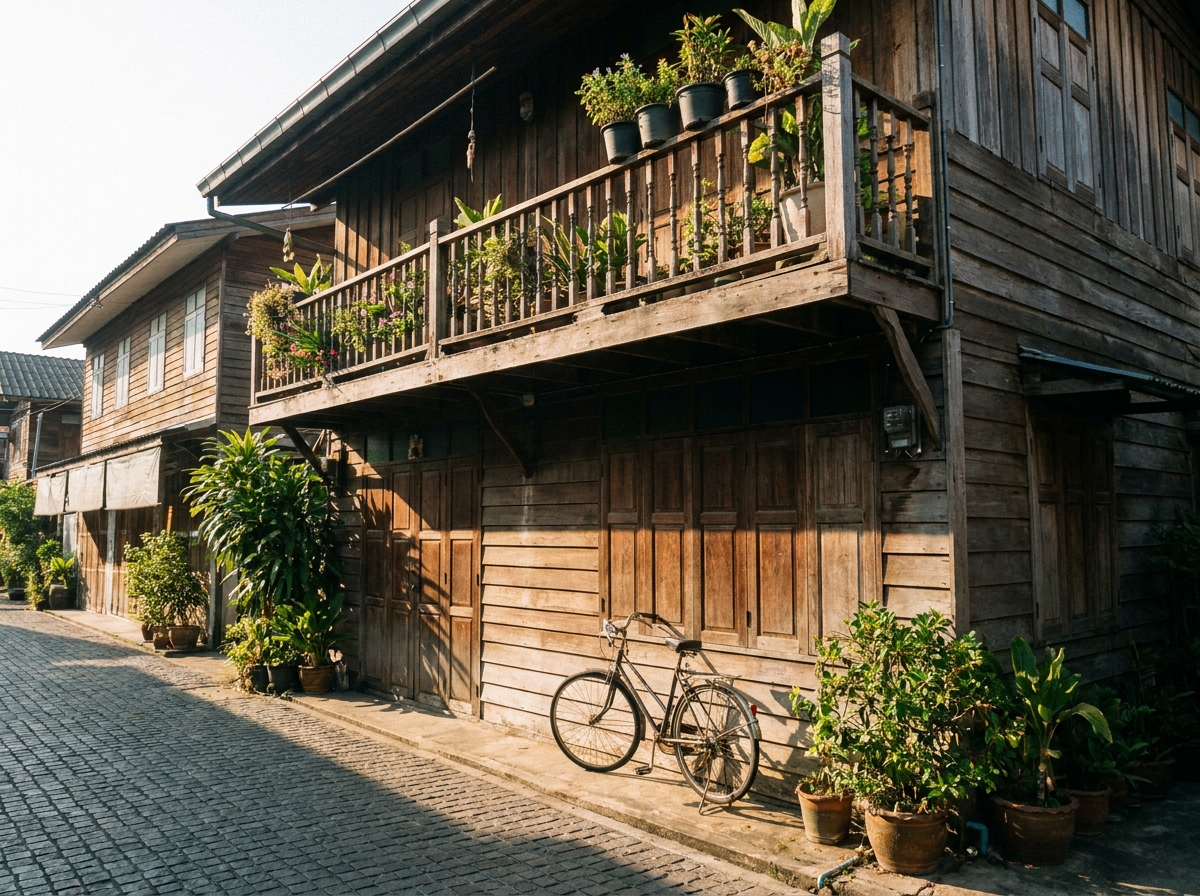
The argument in its favor is walkability, and it is a strong one. You can visit the main temples in the old city on foot in a single morning without ever calling a car. On Sundays, Walking Street takes over Thanon Ratchadamnoen, the main east-west road, from Tha Phae Gate to Wat Phra Singh from around 5 pm (sources give closing times of 10:30 pm or midnight). On Saturdays, the other Walking Street sets up on Thanon Wua Lai, the silversmiths’ street just outside the southern moat, within walking distance of most old city hotels. Talat Warorot, the covered daytime market locals call kad Luang, occupies the eastern edge, toward the river.
The argument against it is that you are sleeping in the part of town built for visitors. For several long-term residents, the old city is a destination rather than a place to live, and one visitor found it simply chaotic. If you want a street where businesses serve the people who live there, this is not it. Also note that the small park with a playground in the southwestern corner inside the walls was closed for renovation ahead of the flower festival in December 2025, and its reopening has not been confirmed.
Inside the walls, prices start low. Hostels around Tha Phae and Sri Phum range from 104 to 594 THB at MeU2 and iSmile, 116 to 768 THB at 248 Street Hostel, and 127 to 280 THB at Iris Hostel. Nearby, more design-focused properties also remain cheaper than most riverside hotels: The Common Hostel runs from 323 to 841 THB, and Hostel Lullaby near Wat Phra Singh from 338 to 1,322 THB.
Nimmanhaemin: cafés, students, and the aircraft question
Thanon Nimmanhaemin connects the Rin Kham intersection to Thanon Suthep, and everyone shortens it to Nimman. Foreign visitors see this neighborhood as the city’s café and coworking district. Thai visitors describe it first as a student neighborhood and a café district, which is closer to reality: Chiang Mai University borders it to the west, and the shabu restaurants and dessert shops cater to Thai students. One resident summed up its relationship with the old city neatly: if the old city is the tutorial level, Nimman is the expansion pack.
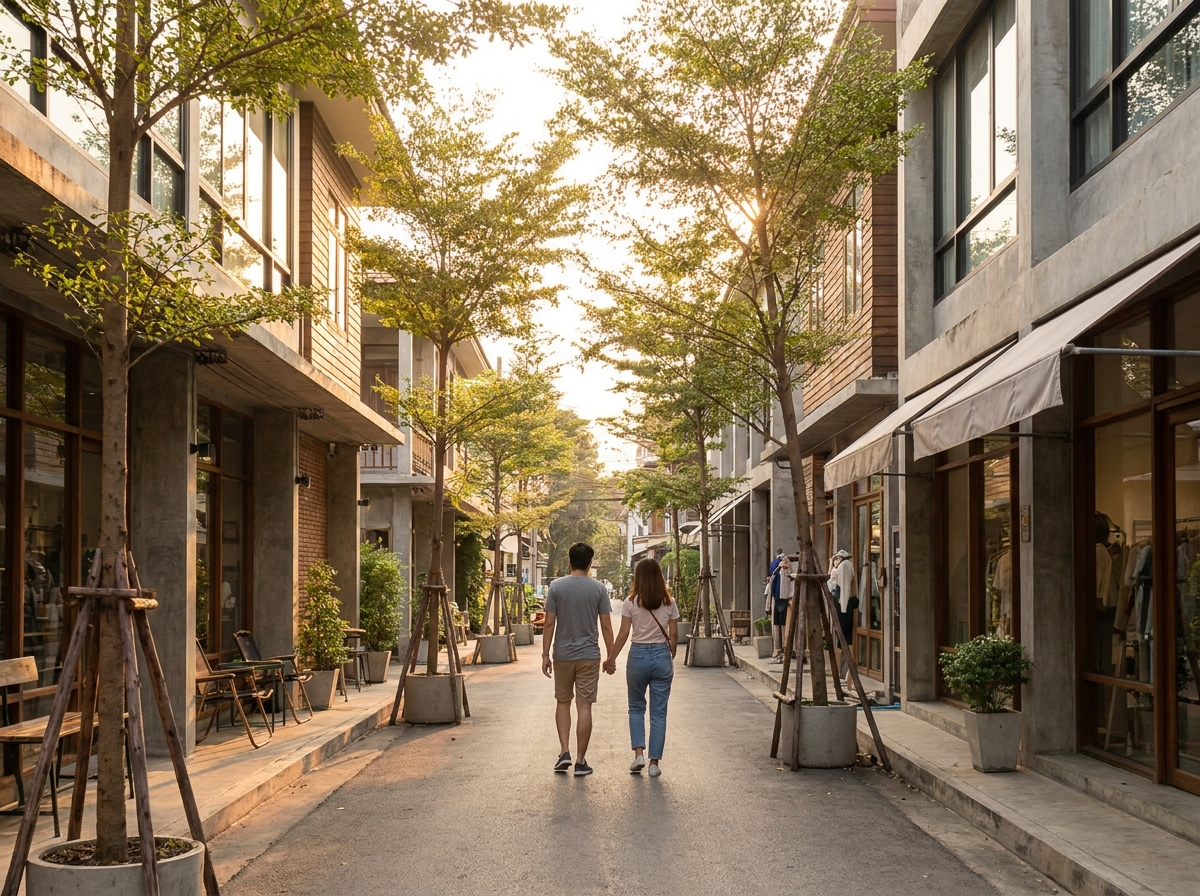
The most useful thing to understand about Nimman is that the expensive part is small. The tourist-price corridor is confined to the narrow strip around Maya Lifestyle Shopping Center and One Nimman. Walk ten minutes away, especially west toward the university, and residents say you are back in ordinary Thai streets: ordinary prices, cheap restaurants, a little greenery. Thanon Sirimangkalajarn is the street where Thais go out drinking, not foreigners, and Thanon Suthep, behind the university, fills with affordable street vendors at dusk, until around 8 pm. One resident eats all their meals for less than 80 THB a day at neighborhood stalls while describing rents on the main road as absurd. The soi number in an address tells you how far from that road you will be sleeping.
Daily logistics are simple: a Rimping supermarket inside Maya, with a Makro and a Lotus nearby. The complaint is traffic. Thanon Huay Kaew and the traffic lights outside Maya come up in every complaint, and things get worse when the university’s roughly 40,000 students are in class. In high season, expect queues outside restaurants and a search for a free seat in cafés. Parking a scooter becomes a problem in its own right.
Then there is aircraft noise, which divides residents more than any other issue in the city. The flight path runs straight toward Maya, so buildings beneath it take the full impact. Someone who lived there for two months eventually gave up and moved for this reason, mentioning planes twice in a four-point complaint. Another says it is a 10 out of 10 for the first two or three days, then becomes background noise you no longer hear. Small military aircraft fly daily and are described as louder than airliners. The contradiction comes down to building orientation. Two guests staying in neighboring Hillside buildings had opposite experiences: one faced east-west, the other north-south, in line with the flight path. Ask which way your room faces, not whether the neighborhood is noisy. If you would rather not play that game, Santitham and Chang Phuak are described as barely affected, 10 or 15 minutes away.
Price-wise, Nimman is more expensive than the old city, and an honest assessment gives a general direction rather than a figure: residents all say it costs more, but the neat percentages you read elsewhere cannot be traced to any source. The actual figures: La Casa de Nimman, on Nimmanhaemin Soi 17, advertises rooms from 900 THB, Rimnim Hostel ranges from 271 to 668 THB, and Thai discussion threads looking for Nimman rooms under 1,000 THB a night confirm that this bracket exists. Thai users recommend U Nimman, at the Nimman intersection, as convenient with or without a vehicle. For longer stays, two reference points recur: V Residence, next to Maya, at 6,000 THB a month, and a resident’s friend paying less than 9,000 THB on Nimman Soi 6.
The Ping riverside and Wat Ket: peace, and flooding
The riverside is two places. The west bank, near the old city, is lively and commercial. The east bank is Wat Ket, more precisely Wat Ketkaram, a heritage neighborhood of old shophouses, small guesthouses, and waterfront restaurants lining Thanon Charoen Rat. It is the quiet half, close enough to walk to Talat Warorot (also the departure point for songthaews to Mae Kampong) and far enough from the Night Bazaar to let you sleep.
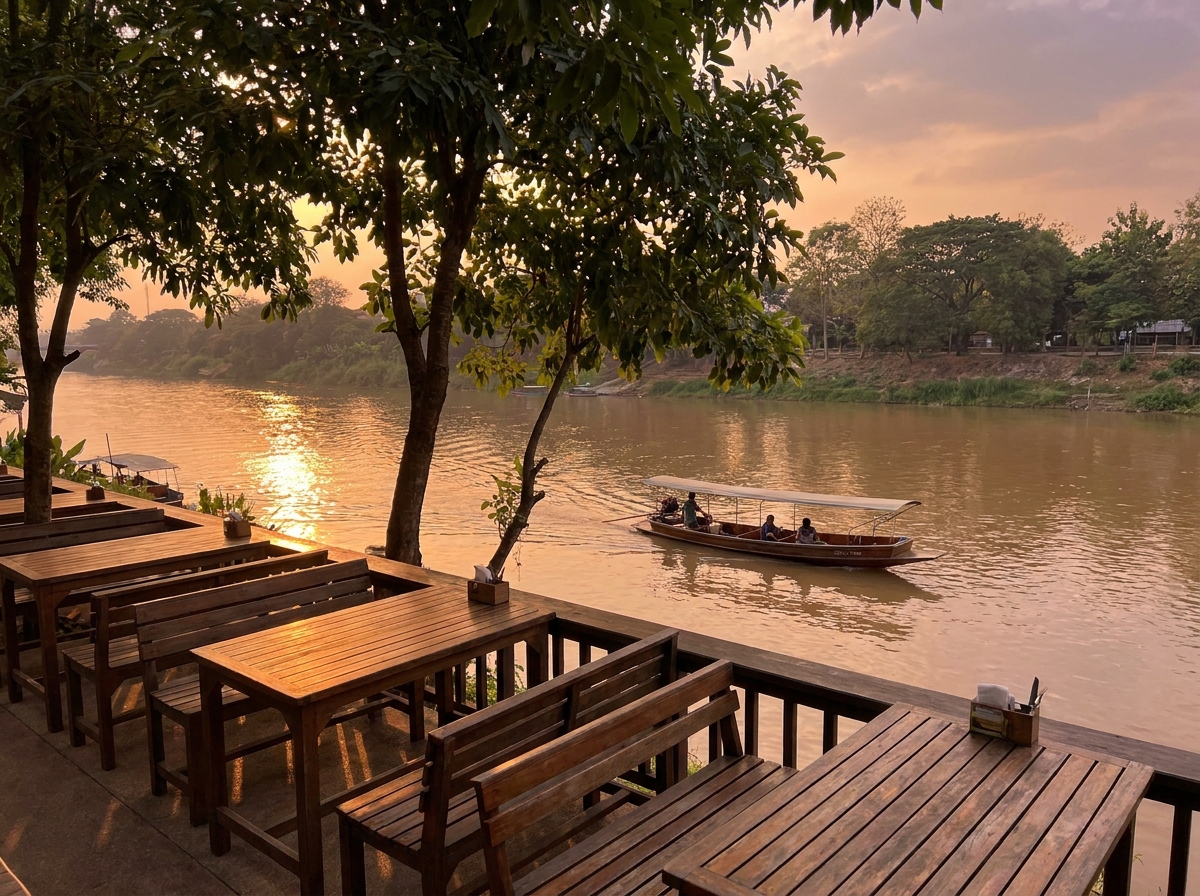
English-language guides present the riverside as the luxury option. Thai selections disagree. Listed starting rates begin at 655 THB at B2 Riverside Colonial, 700 THB at i-river chiangmai and Baan Ing Ping, and 720 THB at Villa San Pee Seua. Above those come At Pingnakorn Riverside at 1,100 THB, River Art Hotel at 1,129 THB, Lanna Dusita Riverside Boutique Resort at 1,135 THB, and Holiday Inn Chiangmai at 1,325 THB, with Little Shelter at the top at 1,920 THB. Treat these figures as indicative: they come from a Thai selection from January 2024, so they show the shape of the market, not this week’s rate. B2 Riverside Colonial, at 9 Thanon Charoen Rat in Wat Ket, is also listed at between 650 and 2,500 THB per room per night, showing how wide the range at a single property can be.
Now comes the part no brochure prints. On October 5, 2024, the Ping peaked at 5.30 m at the Nawarat Bridge station, its highest level in 50 years. At least three people died, floodwaters remained in the city for around 102 hours, some 245 km² of the basin were covered, and preliminary damage was estimated at nearly 10 billion THB. This was not an isolated incident. On September 27, 2025, the governor issued an alert when the Ping exceeded the critical level of 3.7 m at the P.1 station at Nawarat Bridge, with 3.80 to 3.90 m forecast between 10 pm and midnight that night. He asked residents in low-lying areas on both banks, outside the flood barriers, to move their belongings to higher ground. The peak risk period runs from late September through October.
The riverside remains a good choice, but a seasonal one. That leaves a question to ask before booking: has the building installed flood barriers? Since 2024, this has become a genuine differentiator between two properties on the same street. Outside the September-to-October window, the east bank remains the most peaceful central place to stay in Chiang Mai, with a view no other neighborhood offers.
Santitham: good value north of the moat
Santitham lies immediately north of the moat, on the western side, and takes its name from its temple, Wat Santitham. Residents use “Santitham” and “Chang Phuak” interchangeably for the same broad area, and there is no clear boundary to give you. What does exist: Talat Thanin, the large fresh market, a Tops supermarket about 500 m south, and a walking track at Chiang Mai Municipal Stadium. The market is signposted ตลาดศิริวัฒนา Talat Siriwattana, while everyone calls it ตลาดธานินทร์ Talat Thanin, the northern Thai form, which explains why it is hard to find on a map. Chiang Mai Rajabhat University borders the neighborhood to the east, keeping food cheap and the streets lively on weekdays.
It offers the best value of the central neighborhoods, and the figures are more solid than anything published by English-language sources. Thai rental sites put the usual range for Santitham apartments and dormitories at 3,000 to 5,000 THB a month, with the cheapest listings at 1,600 THB. Named examples: Wat Santitham apartments at 3,500 to 8,000 THB, and T T Court, where an air-conditioned dormitory room starts at 2,800 THB and a VIP room at 3,500 THB. English-language nomad blogs discuss Chiang Mai rents in terms of condos at 15,000 or 25,000 THB and completely miss this bracket, even though it is what the neighborhood’s Thai students pay. One resident estimates that living here costs about 25% less than in Nimman.
The neighborhood also answers the aircraft problem: residents say it is barely affected, 10 or 15 minutes from Nimman. The catch is noise of another kind: bars, with the strip around Chiang Mai Horumon singled out, and the buildings themselves. Reviews of Santitham condos mention thin walls, poorly insulated windows, street noise, and neighbors’ air-conditioning compressors. Two different residents give the same advice, and it is worth taking literally: stand in the street at 9 pm before committing, and never book a full month without viewing the place. Walking to the old city from here is also less pleasant than the map suggests.
Chang Khlan and the Night Bazaar: the market on your doorstep
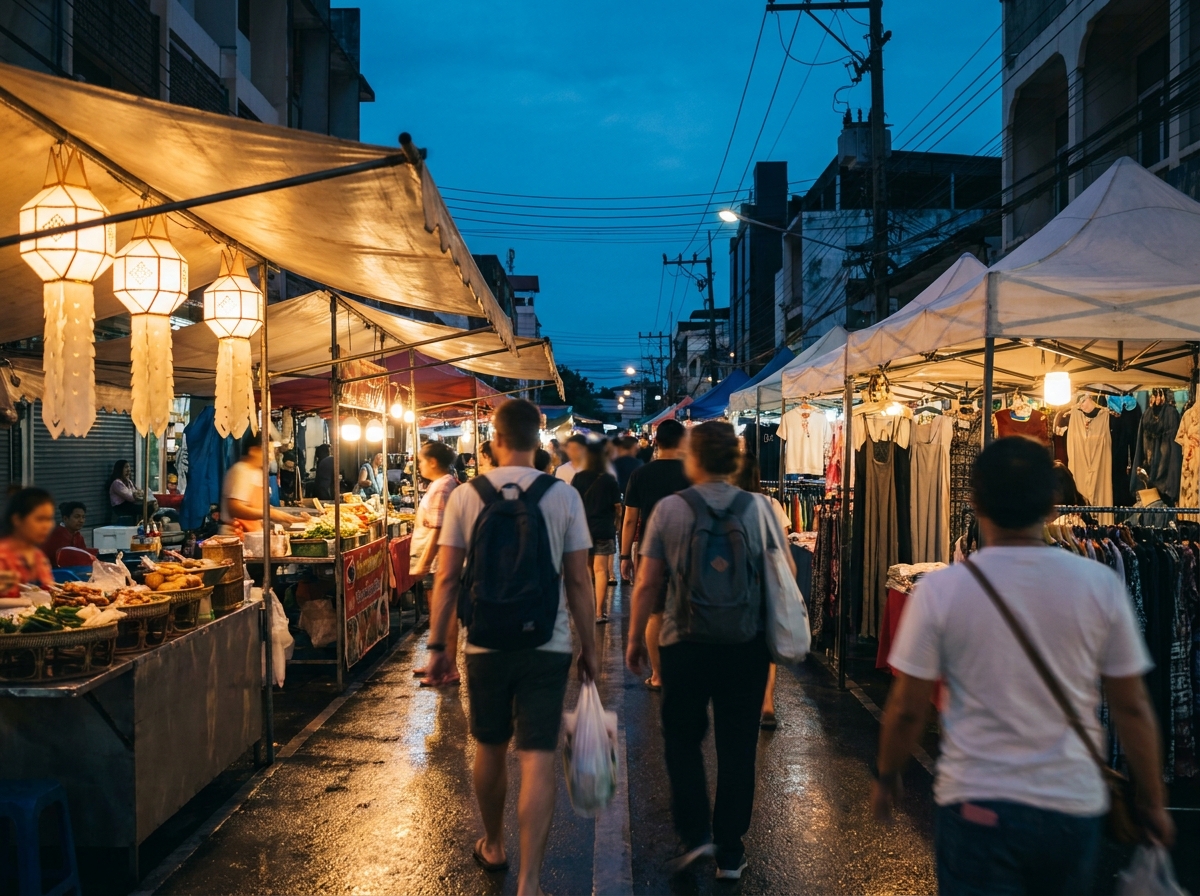
Chang Khlan stretches between the old city and the river, to the southeast, anchored by the Chiang Mai Night Bazaar on Thanon Chang Khlan. The important distinction: the Night Bazaar opens every night of the week, a permanent market rather than a weekend event, so you do not have to plan dinners around the day. This is central Chiang Mai’s most hotel-dense area, where the five-star properties cluster, about 3.8 km from CNX with a quoted journey time of 10 or 15 minutes.
Take flood risk here as seriously as on the riverside, because Thanon Chang Khlan appears in coverage of both events. In September 2025, five major city-center hotels, the Shangri-La, InterContinental, Marriott, Dusit, and Empress, urgently evacuated guests to safe areas. The Thai press names Chang Khlan Road, Ban Pa Prao Nok, and Prachachuen Road among the flooded streets, and confirms that the five-star hotel cluster was in the flood zone. One resident’s summary could not be more direct: do not stay on Chang Khlan unless you do not mind flooding.
The counterpoint is that buildings have responded. The Shangri-La’s flood barriers held: the hotel stayed dry and open while its neighbors went underwater. Many Chang Khlan buildings have since installed similar systems, and a resident of the Astra condo reports that theirs has just finished installing them around lifts and entrances. So ask the question. On the same street, one property will have barriers and the next will not. For long stays, residents give the condo stock mixed reviews: Shine comes up as well built and well guarded, with a good location, Peaks also receives good ratings, while Doi Ping, Floral, Rimping, and Galare Thong are regarded as older buildings with inattentive owners.
The other drawback is the intensity. A market neighborhood that runs every evening eventually wears you down: a resident’s friend staying long term found Chang Khlan’s chaos excessive and moved. For three or four nights, with the market on your doorstep and the airport 15 minutes away, it works.
The five neighborhoods side by side
The short version of “where to stay in Chiang Mai,” before the recommendations by situation.
| Neighborhood | Atmosphere | On foot | Main drawback | Best for |
|---|---|---|---|---|
| Old city (inside the moat) | Historic and dense, built for visitors | Main temples, Sunday Walking Street, Wua Lai on Saturdays | Very tourist-focused, sometimes chaotic | First visits, families, travelers without a vehicle |
| Nimmanhaemin | Modern student district, plenty of cafés | Maya, One Nimman, university food streets | Aircraft noise and traffic, main-road prices | Working in cafés, long stays, nightlife |
| Ping riverside / Wat Ket | Quiet and green, old shophouses | Charoen Rat restaurants, Talat Warorot | Flood exposure, from late September through October | Couples, peace and quiet, a view |
| Santitham | Local and cheap, a little rough around the edges | Talat Thanin, Tops, stadium track | Bar noise, poorly insulated buildings | Long stays, tight budgets |
| Chang Khlan (Night Bazaar) | Commercial, lively every evening | Night Bazaar, major hotels, riverside | Flood exposure, relentless pace | Short stays, early flights, shopping |
What a night really costs
Many pages display neat price tiers by neighborhood for Chiang Mai. Treat them with suspicion: those publishing a table generally give identical ranges for all five areas, which tells you nothing. Pages that refuse to pin down rates have the best reason for doing so: those rates do not hold. Here is what named properties actually advertise.
At the very bottom, hostels in the old city and Wua Lai start at around 104 THB and rise to 800 or 1,300 THB at the top of their ranges: Suneta Hostel, in Ton Pho, spans 190 to 853 THB, 60 Bluehouse 228 to 828 THB, hobnob 292 to 487 THB, and Hidden Garden on Wua Lai 508 to 887 THB. Riverside starting rates cluster around 655 to 720 THB for the most affordable properties and 1,100 to 1,325 THB for reliable midrange options, subject to the January 2024 caveat mentioned above.
Two implications. First, the range within a single property often exceeds the gap between two neighborhoods: your dates therefore matter more than which side of the moat you sleep on. Second, beyond a month, the nightly market is the wrong market: Santitham dormitories at 3,000 or 5,000 THB a month and Nimman studios at 6,000 or 9,000 THB operate in a different economy, and the cheapest of these properties are never advertised online.
Booking, and the questions worth asking
For a short stay, choose one neighborhood, take the 11 am checkout seriously, and if you come in high season, expect Nimman’s restaurants and cafés to fill up and traffic around Maya to thicken. One factor should guide your choice of room rather than neighborhood: burning season, which our practical guide covers alongside when to visit and what budget to plan for. This is why you should check whether a room has proper air filtration and windows that seal tightly.
Whatever the area, these are the questions that separate a good booking from a bad one:
- Does the building have flood barriers, and where have they been installed? (Riverside and Chang Khlan, non-negotiable from September through October.)
- Exactly which way does this accommodation face relative to the flight path? (Nimman, where orientation matters more than the building.)
- What lies between the room and the nearest bar, and how thick are the walls? (Santitham and anywhere north of the moat.)
- How long does the walk to Tha Phae Gate really take, rather than the straight-line distance on a map?
- Does the advertised nightly price apply to your dates, or is it the property’s lowest rate?
For a long stay, residents keep repeating the same tactic: book a base for a few days, then find your actual rental in person. Online listings cover only a small fraction of the stock, agents will not hold anything for someone outside Thailand, and good places go within hours. One online commenter lost an apartment in the two hours it took to reach the bank and withdraw the deposit. Three-month contracts are hard to secure and six-month minimums are standard, though often negotiable. If you are hunting in the budget bracket, search for “dormitory” rather than condo or apartment, because that is the word used to list affordable properties, when they are listed at all.
Which neighborhood suits your trip
A first visit
The old city, near Tha Phae Gate. This is where residents converge when asked, and the reason is walkability: the temples, Sunday market, and Saturday market on Wua Lai are all accessible without a vehicle, removing the daily friction of a city without a metro. The verdict of a resident of 15 years: Nimman and the old city around the moat are the two neighborhoods that work; everywhere else requires a scooter. Choose the old city for a first trip, and see whether Nimman appeals for the second.
Traveling with children
The old city again, for the same reason: short distances mean fewer taxi negotiations with a tired child, and the three-star hotels with breakfast around Wat Phra Singh are made for exactly this. Check before promising the playground at the southwestern corner of the walls, which was closed for renovation in December 2025. Avoid the riverside in late September and October, and think twice about Chang Khlan, where market crowds linger late every night.
A long stay
Santitham if budget is the constraint, Nimman if it is the working environment. Santitham gives you a fresh market, a supermarket, a running track, and monthly rents in the 3,000 to 5,000 THB bracket, around 25% less than Nimman according to one resident’s estimate. Nimman gives you cafés, a supermarket in the mall, and studios between 6,000 and 9,000 THB, at the cost of aircraft noise and term-time traffic. In both cases, book a few nights first, walk the streets at 9 pm, and only then sign.
A tight budget
Hostels inside the moat if you are here for a few days: several sit between 100 and 300 THB at the bottom of their ranges, hard to beat for a central location. Santitham if you are here for several weeks, where listings start at around 1,600 THB a month and 2,800 THB gets you an air-conditioned dormitory room at T T Court. In both cases, eat where the neighborhood eats: one Nimman resident manages all their meals for less than 80 THB a day ten minutes from the main road, and Thanon Suthep, behind the university, offers cheap food at dusk until around 8 pm.
A short stay with an early-morning flight
Chang Khlan. The neighborhood is about 3.8 km from the airport, with a quoted journey time of 10 or 15 minutes, the Night Bazaar opens every night rather than just on weekends, and for two or three nights, the intensity that exhausts long-term residents becomes the attraction rather than the problem. Book a building equipped with flood barriers if your dates fall in late September or October, and remember that CNX operates 24 hours a day without a curfew: being close to the airport does not mean being close to peace and quiet.
Chiang Mai rewards a decision based on what you will do each day rather than a pool photo. Choose your neighborhood well and the city opens up on foot; choose badly and you will spend the trip in the back of a Grab. Once you have settled on your area, our guide to visiting Chiang Mai connects the rest: how many days to give the city, and the weather awaiting you on arrival.