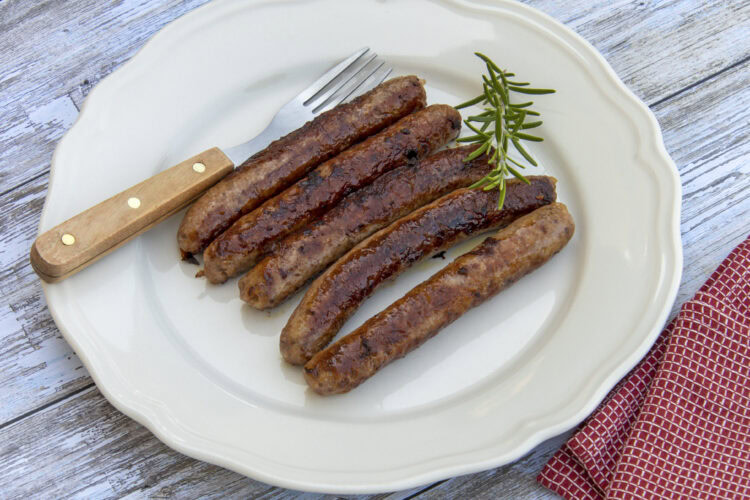
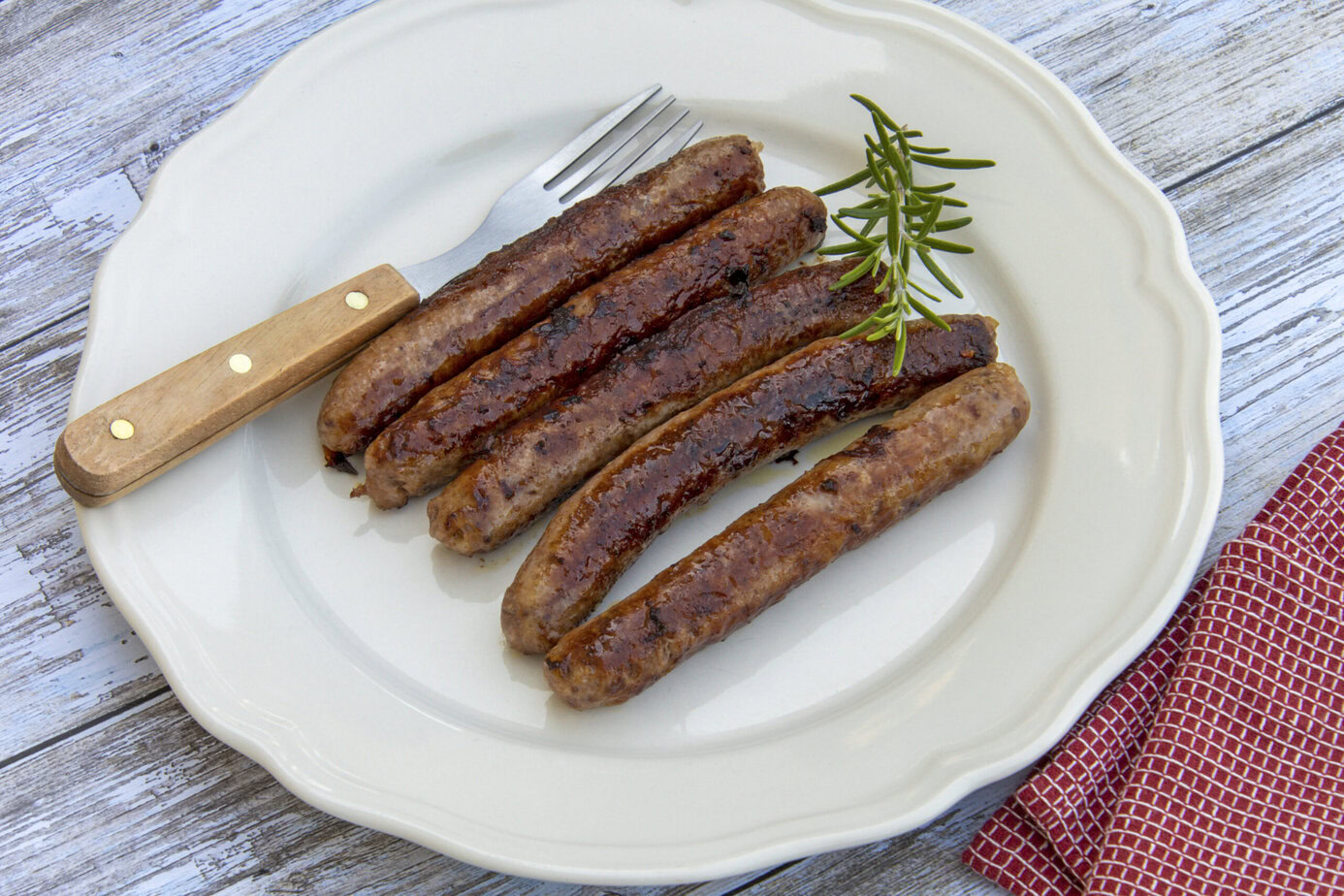
Eight chipolatas in a single layer, 12 minutes at 180 °C, turning halfway through.
The casing snaps, the juices run clear, and the kitchen doesn’t smell like frying. That’s exactly what you want from a chipolata, and it’s exactly what the air fryer delivers: no pan to scrub, no barbecue to light. Twelve minutes is just enough time to set the table. The mustard is already waiting on the side.
What are chipolatas?
A chipolata is a thin pork sausage in a natural casing, seasoned with salt, pepper, and sometimes herbs. Its slim shape is what makes it work so well here : it cooks quickly and evenly, before the outside has time to dry out.
The casing does the rest. It tightens in the heat, stretches taut, then gives with the little snap you’re after. The hot air dries and browns the skin, while some of the fat renders out into the drawer.
From Sunday barbecue to the basket
Chipolatas belong both to the repertoire of French charcuterie and to the world of outdoor cooking : embers, long tables, ratatouille. They’re usually cooked on a grill over high heat, with all the splatter that comes with it.
The basket does the same job indoors, even in February, without filling the kitchen with smoke. Convection replaces the radiant heat of the coals and gives you the same taut skin, as long as you leave space between the sausages and turn them halfway through.
Main ingredients
Eight chipolatas, or about 480 g, will feed four people. Look for natural casings and a good balance of meat and fat. Below 10 % fat, the sausages can turn dry and benefit from a light brushing of oil.
Otherwise, no added oil and no marinade. Chipolatas contain enough fat to cook themselves, and that fat ends up in the drawer rather than on the plate.
Extra seasoning is optional, since the butcher has already done most of the work : a pinch of herbes de Provence, a little fine salt, a twist of black pepper. The real finishing touch comes at the table, with mustard, ketchup, honey, or one of your homemade condiments.
Technical pointers
Arrange them in a single layer, leaving about 1 cm between each sausage. When two chipolatas touch, they steam where they meet and come out gray in that spot. A 3.5 to 5.5 L basket holds 6 to 8 sausages; a 2.6 L model holds 4.
A 2 minute preheat makes a difference at the start of cooking. In a cold basket, the sausages warm up and release moisture instead of browning, which leaves the skin pale and wrinkled.
Whether to prick them or not divides cooks. Pricking releases a little fat and helps prevent a taut casing from bursting and splattering hot juices; leaving them unpricked keeps the meat juicier. Two or three light pricks with a fork, not ten, give you the best of both worlds.
Cooking time depends on the thickness, not the recipe. Keep the temperature at 180 °C : 10 minutes for thin sausages, 12 for standard ones, 14 for thick ones. The air fryer cooking chart gives similar timings for everything else.
The most reliable guide is the internal temperature, 70 °C at the center. If you don’t have a thermometer, cut one open : the meat should be beige all the way through, with no trace of pink, and the juices should run clear.
Two small details help avoid unpleasant surprises. Smoke usually comes from fat heating in the empty drawer : a little water in the bottom under the basket is enough to stop it. And if you want an extra-crispy skin, finish with 2 minutes at 200 °C rather than cooking at that temperature all the way through; the margin before the sausages dry out is very small.
Ingredients
Chipolatas
- 8 chipolatas about 480 g
Optional seasoning
- 1 pinch Herbes de Provence
- 1 pinch fine salt
- 1 grind black pepper
For serving
- mustard
- ketchup
- honey
Instructions
Preparation
- Remove the chipolatas from the refrigerator 15 to 20 minutes before cooking.8 chipolatas
- Separate the chipolatas if they are sold linked together.
- Lightly prick each chipolata 2 to 3 times with a fork.
- Preheat the air fryer to 180 °C for 2 minutes.
Air Frying
- Arrange the chipolatas in the basket in a single layer, without overlapping, leaving about 1 cm between each sausage.
- Season with Herbes de Provence, salt, and pepper, if using.1 pinch Herbes de Provence, 1 pinch fine salt, 1 grind black pepper
- Cook at 180 °C for 12 minutes, turning the chipolatas after 6 minutes.
- Check that the meat is no longer pink in the center; cook for 2 more minutes at 200 °C for deeper browning, if desired.
Serving
- Remove the chipolatas from the basket and serve immediately, piping hot, with mustard, ketchup, or honey.mustard, ketchup, honey
Notes
- Preheating for 2 minutes helps with browning: in a cold basket, the chipolatas release moisture first and brown less evenly.
- To prick or not: 2 to 3 light pricks strike a good balance, reducing the risk of bursting without drying them out too much.
- Cook in a single layer with about 1 cm of space between the sausages; otherwise, the contact points will steam and stay pale.
- No oil is needed, unless you are using very lean sausages (< 10% fat).
- A reliable doneness cue: 70 °C at the center; without a thermometer, the meat should be evenly beige throughout and the juices should run clear.
- For extra crispness, cook at 180 °C, then finish for 2 minutes at 200 °C.
- To reduce smoking, pour a little water into the drawer under the basket, especially when cooking a second batch.
- From frozen: cook for 15–16 minutes at 180 °C, separating the sausages and turning them halfway through.
- For a glaze (honey/syrup), brush it on only during the last 2 minutes to prevent burning.
- Storage: keep for up to 3 days in the refrigerator; reheat for 3–4 minutes at 180 °C in the air fryer.