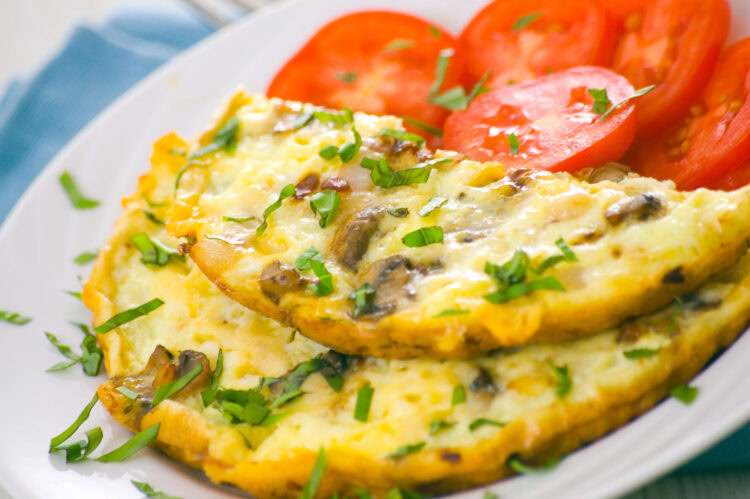
Four beaten eggs, a splash of milk, a greased dish, and 8 to 10 minutes at 160 °C in the basket.
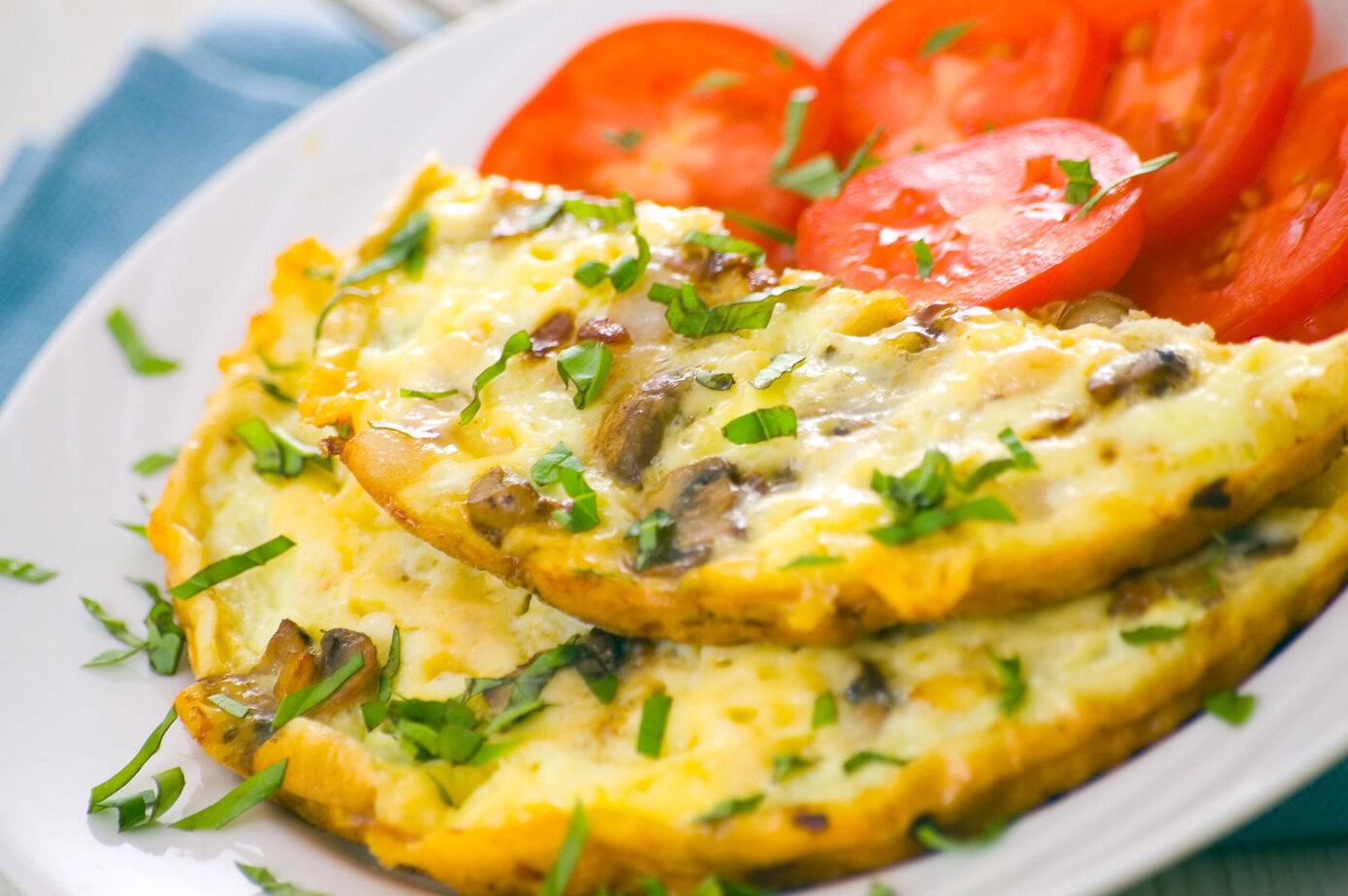
The dish emerges from the basket puffed and golden on top, still gently quivering in the center. The aroma of warm eggs and herbs reaches you before the plate does, and the spoon slips into a soft, almost creamy texture. No pan to tilt, no omelette to fold at exactly the right moment : the air fryer does the work while you set the table. Ten minutes later, breakfast is a whole lot better than yesterday’s.
What is an air fryer omelette ?
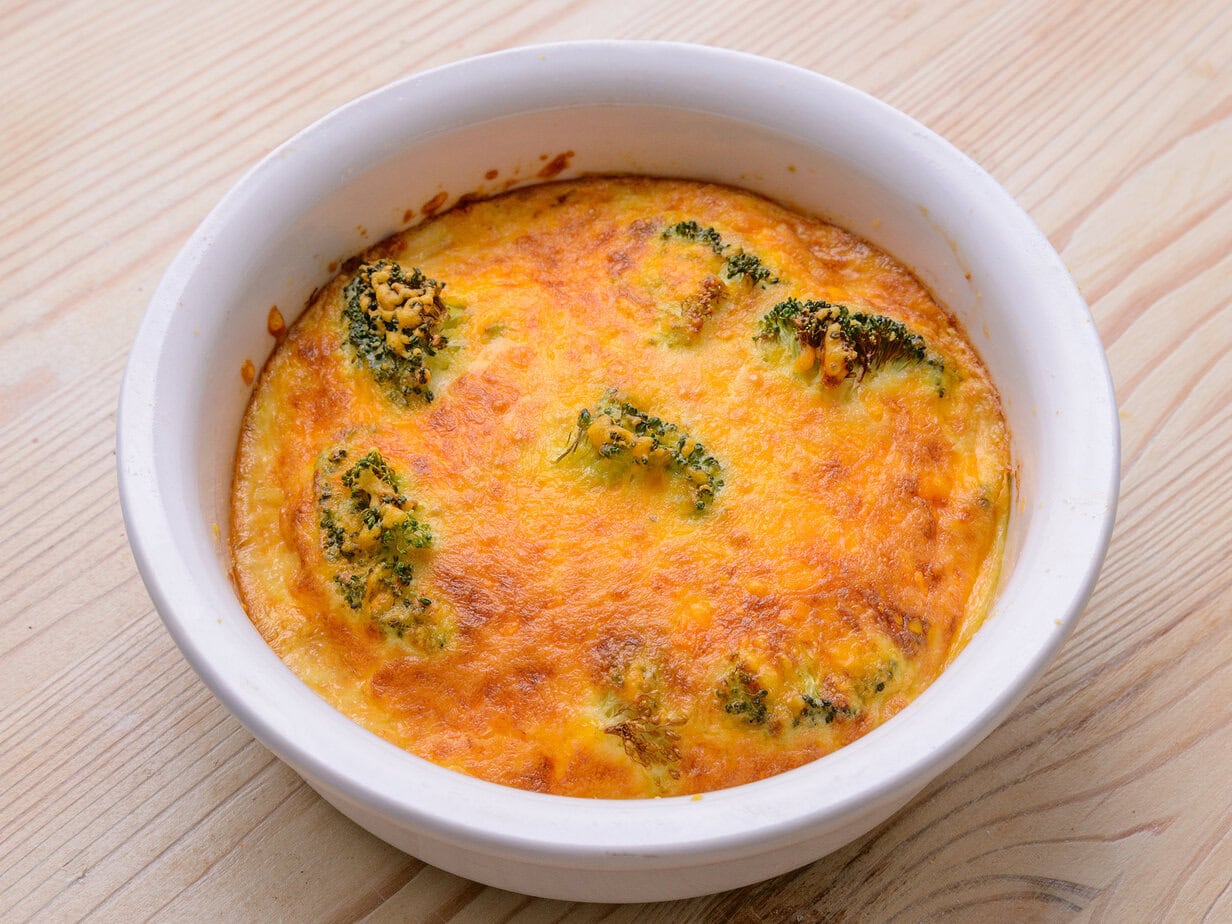
It’s simply beaten eggs with a little milk, seasoned with salt and pepper, poured into a greased dish and set in the basket. Because the basket is perforated, it cannot hold liquid directly : you need a ceramic, silicone, metal, or Pyrex dish small enough for air to circulate around it. The word omelette still refers to the same egg base. What changes is the cooking method.
The hot air circulates around the dish while the base conducts the rest of the heat. The result is a thick, slightly puffed omelette, golden on top, tender in the center, with crisp edges wherever the fat has heated. It is closer to a soft frittata than to a classic rolled omelette cooked in a pan.
From the French skillet to the basket
The French omelette is all about technique : tilting the pan, controlling the heat, folding without tearing. It all happens in two minutes, and the cook never lets go of the handle.
In the basket, the focus shifts to the dish, the thickness of the egg layer, and the timer. The handwork disappears, and so does the need to watch it constantly. That’s what makes this a recipe for hurried mornings rather than a technical exercise, and what makes it so practical for a protein-packed breakfast, brunch, or weeknight dinner.
The omelette’s main ingredients
Four fresh eggs make two servings and give the dish its structure. Their proteins coagulate to hold everything together, while the yolks add color and richness. Add the salt to the mixture rather than after cooking so it seasons evenly.
The two tablespoons of milk are not just there for looks. The water and fat they add prevent the rubbery texture that eggs alone can develop in fan-forced heat. A spoonful of cream does the same job, with a richer result.
Greasing the dish helps with unmolding as much as it adds flavor, because eggs stick quickly to a hot, dry surface, even a nonstick one. The pinch of herbs is optional : chives, parsley, and scallions all hold up well in the heat. Any fillings, on the other hand, should be prepared beforehand. Slice the ham and cheese thin, and sauté watery vegetables, especially tomatoes and mushrooms, first; otherwise, they will release moisture and the center will never set properly.
Technical tips
Never fill the dish more than three-quarters full. The omelette rises considerably in the circulating heat and will spill into the drawer if you fill it to the rim.
Beat the eggs for at least 1 minute. The trapped air is what makes them rise : if the mixture is only lightly beaten, the texture will be dense and rubbery.
Stay between 160 and 170 °C. Any hotter, and the outside will brown before the center sets. The air fryer cooking chart gives the same benchmarks for everything else in the basket.
A 3-minute preheat prevents a two-tier omelette, set on the bottom and still raw on top. After that, keep the appliance closed : every time you open it, the temperature drops and the omelette deflates.
Remove the dish when the top feels set to the touch but still jiggles slightly in the center : residual heat will finish the job. Let it rest for 1 to 2 minutes, just long enough for the eggs to pull away from the sides. If you unmold it right away, the omelette will split in two.
Ingredients
For the omelette
- 4 eggs
- 2 tablespoons milk
- salt
- black pepper
- 1 pinch mixed herbs optional
For the dish
- olive oil spray oil or a few drops, for greasing the dish
Instructions
Preparation
- Crack the eggs into a bowl.4 eggs
- Add the milk.2 tablespoons milk
- Season with salt and black pepper.salt, black pepper
- Add the mixed herbs, if using.1 pinch mixed herbs
- Whisk for at least 1 minute to aerate the mixture.
- Grease an air fryer-safe dish, including the bottom and sides.olive oil
Air frying
- Preheat the air fryer to 160 °C for 3 minutes.
- Pour the beaten eggs into the dish, filling it no more than three-quarters full, then place the dish in the basket.
- Cook at 160 °C for 8 to 10 minutes, until the top is lightly golden and set but still slightly wobbly in the center.
To finish
- Let rest for 1 to 2 minutes.
- Turn out and serve immediately.
Notes
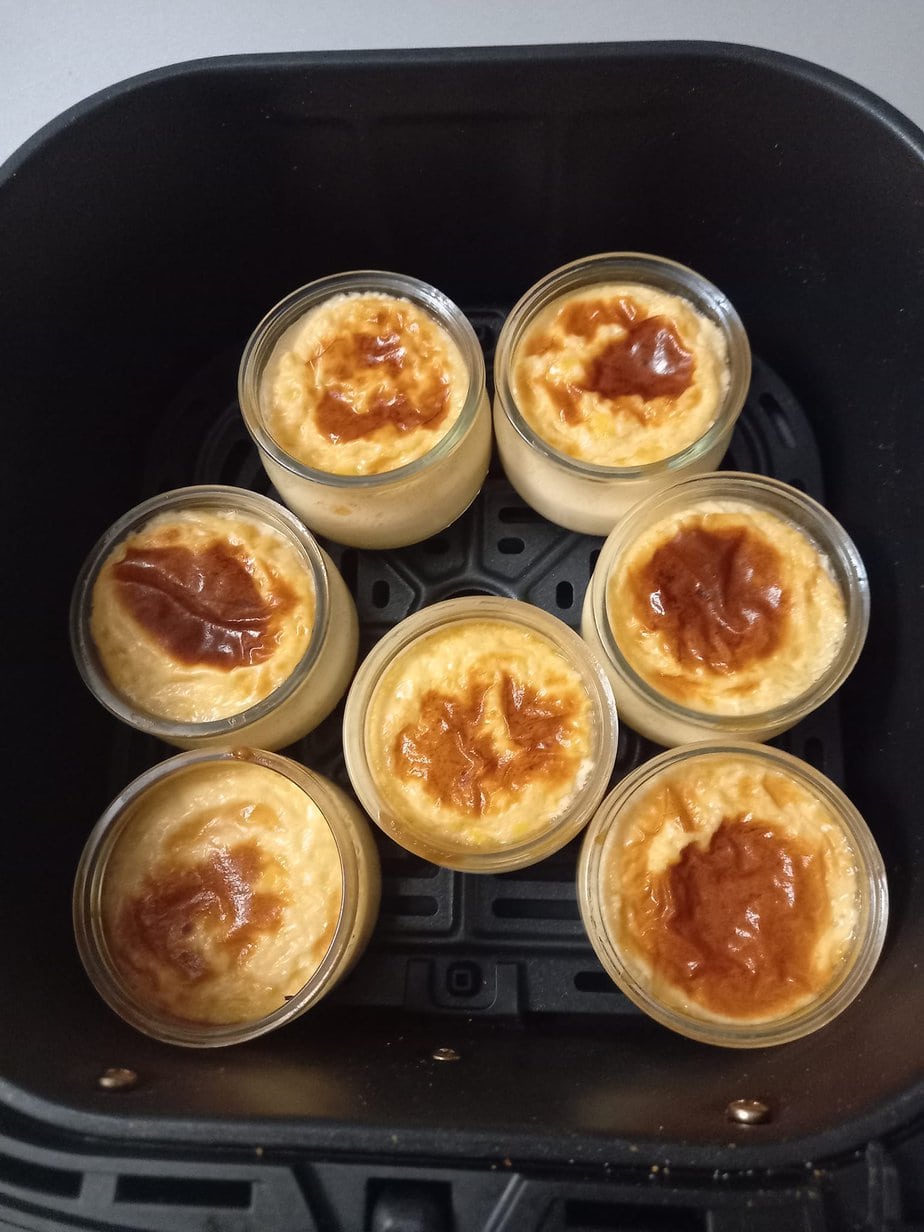
- Use a ceramic, silicone, or metal dish that fits inside the basket while still allowing air to circulate (ramekins, a small Pyrex-style dish, or parchment paper folded into a bowl shape all work well).
- Never fill the dish beyond 3/4 full: the omelette rises quite a bit in the air fryer.
- Grease the dish even if it is nonstick; lining the bottom with a square of parchment paper makes unmolding easier.
- Whisk the eggs for at least 1 minute for a lighter texture (or whip the whites to stiff peaks and fold them in).
- Stay between 160 and 170 °C to avoid a dry exterior and an undercooked center.
- Doneness cue: the top should be set with a slight wobble in the center; residual heat will finish the cooking as it rests.
- Avoid opening the air fryer during cooking: one quick check at the end is enough.
- No-dish variation: line the basket with parchment paper, add a little olive oil, and cook for 6 minutes at 200 °C (for a flatter, frittata-style omelette).
- If you add fillings such as ham, cheese, or vegetables, prep them ahead of time and precook watery vegetables so they do not release excess moisture.