

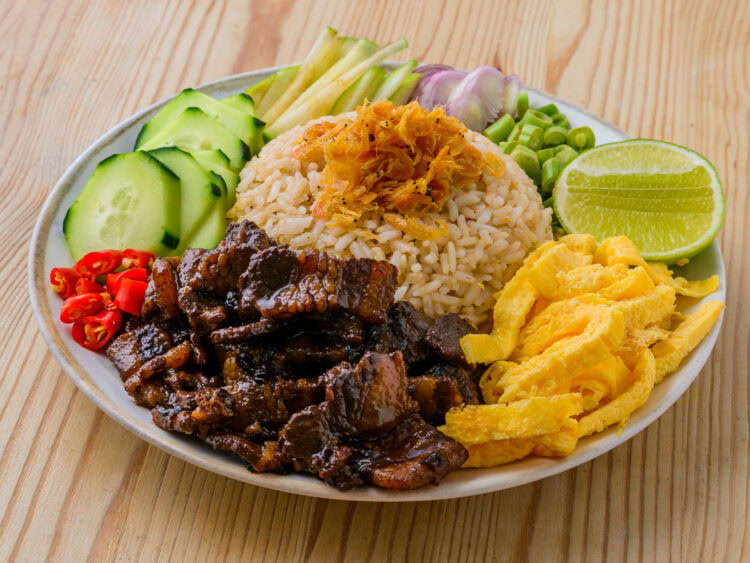
Thai fried rice perfumed with shrimp paste, served with caramelized pork and a spread of crisp, fresh garnishes.
The first thing that hits you is the briny, smoky aroma. It rises from a mound of brown‑purple rice, gleaming under the market lights. A single plate concentrates four essential tastes: the fermented salinity of shrimp paste; a candy-like sweetness; the bright acidity of mango; and a hint of chile.
Khao Kluk Kapi still surprises even seasoned fans of Thai cuisine, as it refuses to be filed under simple “fried rice dishes.” Each bite offers a miniature lesson in balance, nostalgia, and restraint, and it curiously remains absent from most tourist menus, ready to surprise the next adventurous palate.
From royal kitchens to home tables
The story begins in the early 19th century. At the court of King Rama II, cooks took inspiration from a dish of the Mon people: they combined fermented shrimp paste, already a cornerstone of the cuisine, with day-old rice. The result recalls an older princely dish based on grilled catfish.
For all its heady aroma, it’s comfort food at heart. In 1907, while traveling in Europe, King Chulalongkorn noted in his diary that he dreamed of the version his grandmother mixed by hand—a memory that attests to its royal pedigree.
For a long time, though, that hand-mixed approach made Khao Kluk Kapi seem too informal for receptions, etiquette frowning on fragrant, hands-on mixing. Over time, Bangkok households made the recipe their own, trading silver trays for simple enameled bowls.
In recent decades, you can find it at some street vendors, especially in the country’s central region. They arrange the condiments with near-ceremonial precision and prove that day-old rice can still draw a queue at lunchtime.
The essentials on a true Khao Kluk Kapi plate
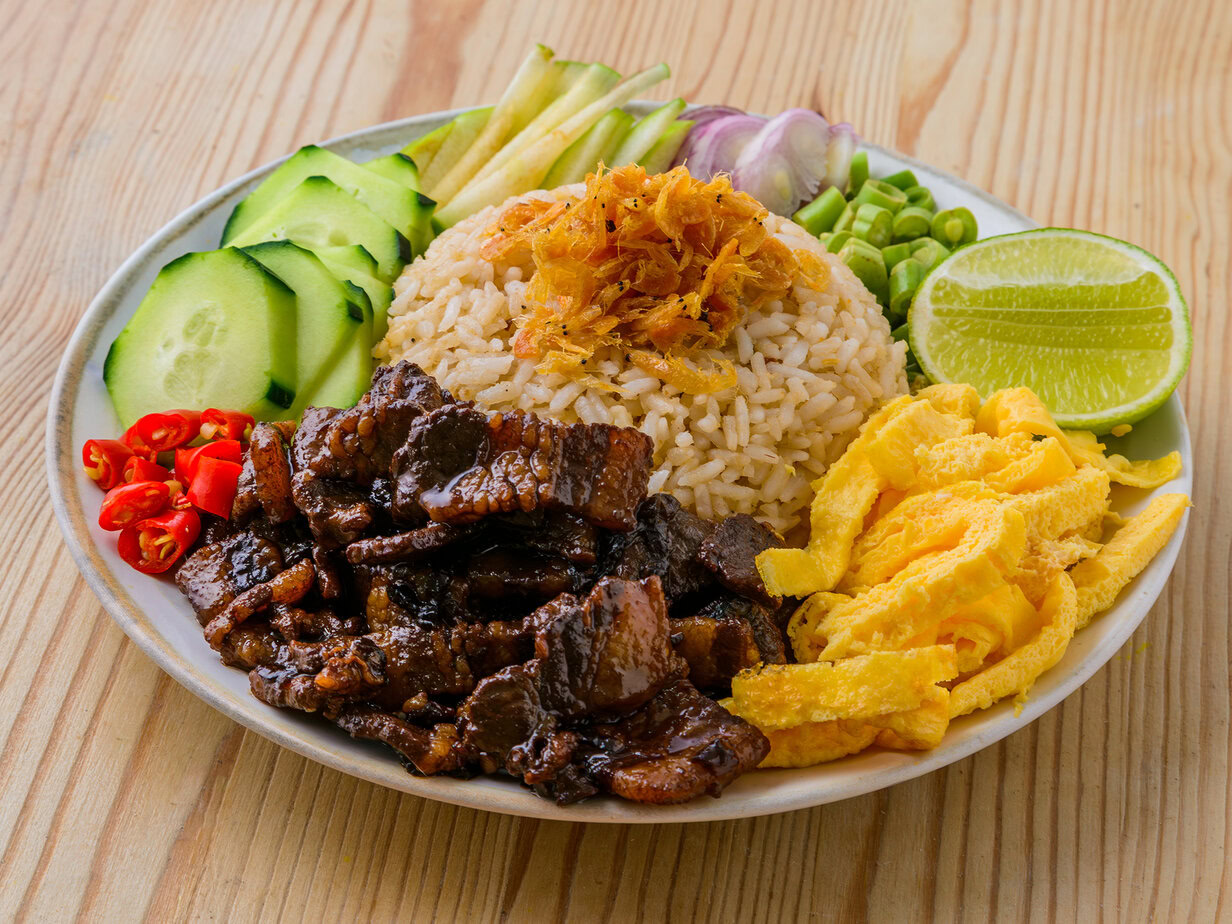
Shrimp‑paste‑scented rice and the “Magnificent Seven”
Everything revolves around kapi. A good cook starts by toasting or stir-frying the paste, a deep purple, until its fishy aroma turns nutty, then folds in day-old jasmine rice—or the firmer Khao Sao Hai—so that each grain is evenly coated.
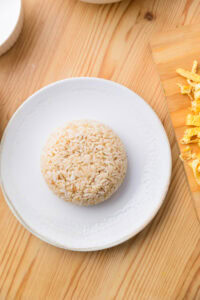
Done well, the rice shows a consistent brown‑purple hue (granted, true purple paste is hard to find here), gives off a subtle marine aroma, and never turns acrid.
Seven accompaniments complete the plate:
- Sweet pork: pork belly cubes braised until tender, lacquered with palm sugar and soy sauce for sticky depth.
- Chinese sausage: thin pan-warmed slices that exhale a garlicky sweetness. Optional.
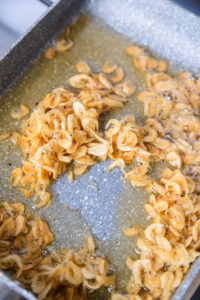
- Crispy dried shrimp: plunged for a few seconds in oil; they then pop like little salty sparklers. To many Thais, the plate feels “naked” without them.
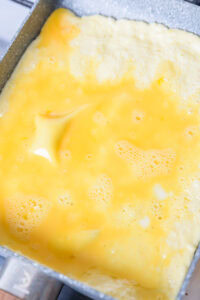
- Egg ribbons: a thin, crepe-like omelet, cut into yellow confetti to add softness and color contrast.
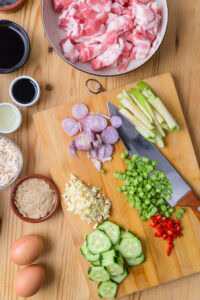
- Green mango, unripe: julienned into tangy shards that cut through the richness; lime juice is only a makeshift substitute.
- Raw shallots & bird’s eye chiles: a sharp bite and searing heat, served as translucent petals and scarlet rings.
- Cucumber and cilantro: refreshing crunch and herbaceous fragrance—a palate cleanser between bites.
Ask Thai traditionalists and they’ll rattle off the markers of an authentic version: a dome of brown‑purple rice thanks to real shrimp paste, a neatly ordered wheel of condiments and—an unequivocal reminder—a finely sliced omelet, never a limp fried egg on top. Pale rice, the absence of mango, or the addition of oyster sauce are immediate red flags.
Online, entire threads read like culinary investigations: expats trading tips to replace green mango, purists lamenting restaurants that “pad‑thai” the dish, and chef Andy Ricker dryly reminding everyone that it’s simply impossible to make Khao Kluk Kapi without kapi.
Even in Bangkok, some upscale bistros have tried slipping in yardlong beans, a move that draws side‑eye from vendors who have been perfecting these traditional proportions since childhood.
Cultural context and the art of enjoying it in Thailand
In Thai culinary philosophy, a dish is considered krop krueng, “perfectly seasoned,” only when each fundamental taste answers the call. Diners manifest this principle by mixing the rice and condiments themselves at the table, a ritual many happily compare to a Thai‑style bibimbap.
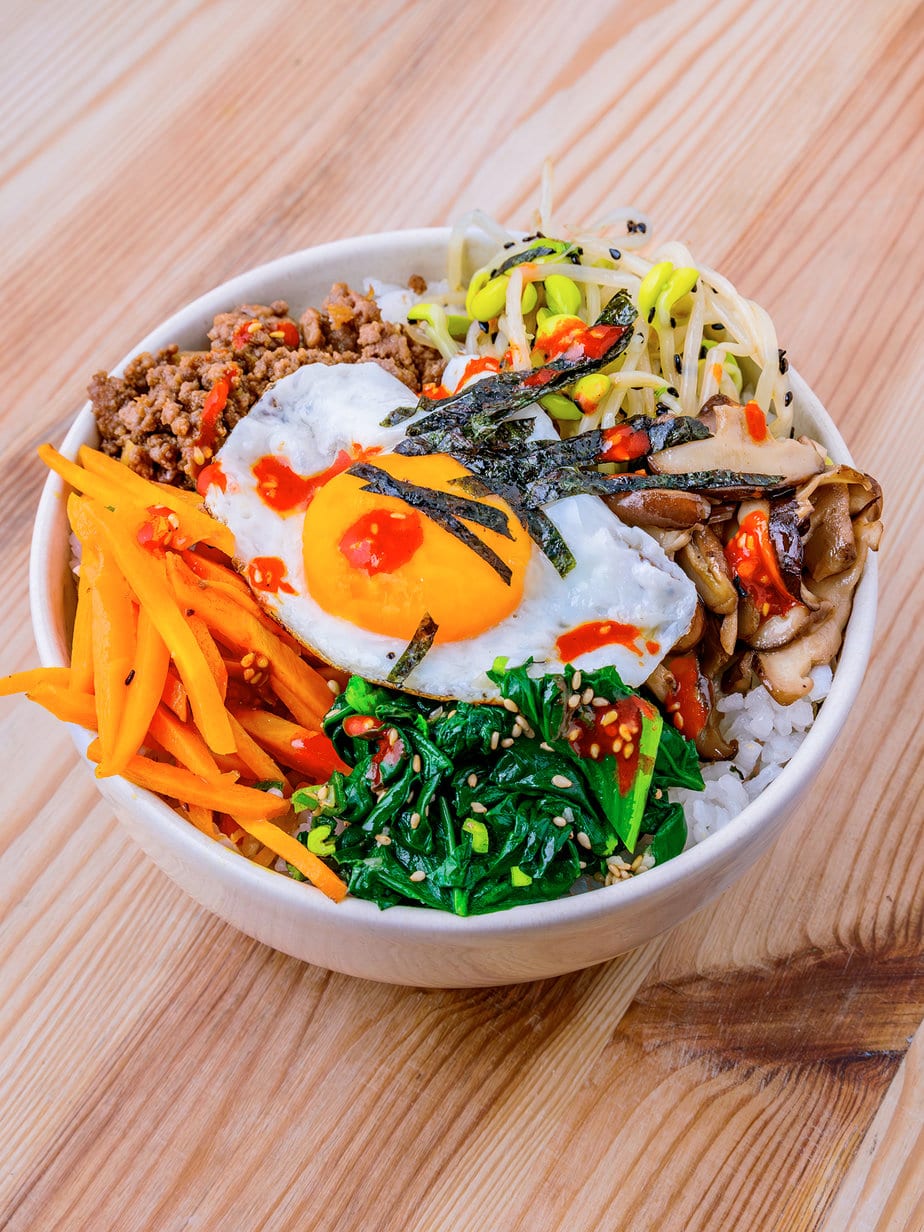
This gesture also salutes domestic frugality: leftover rice joins proteins and vegetables forgotten in the pantry, brightened with a spoonful of shrimp paste, ubiquitous throughout the country.
Born in the central plains, the dish today sparks particular pride in the South, a great lover of shrimp paste, where markets line up buckets of kapi in shades ranging from clay to plum.
Khao Kluk Kapi — Thai Shrimp Paste Fried Rice with Sweet Pork
Print Recipe Pinner la recette Ajouter à ma listeEquipment
Ingredients
Rice
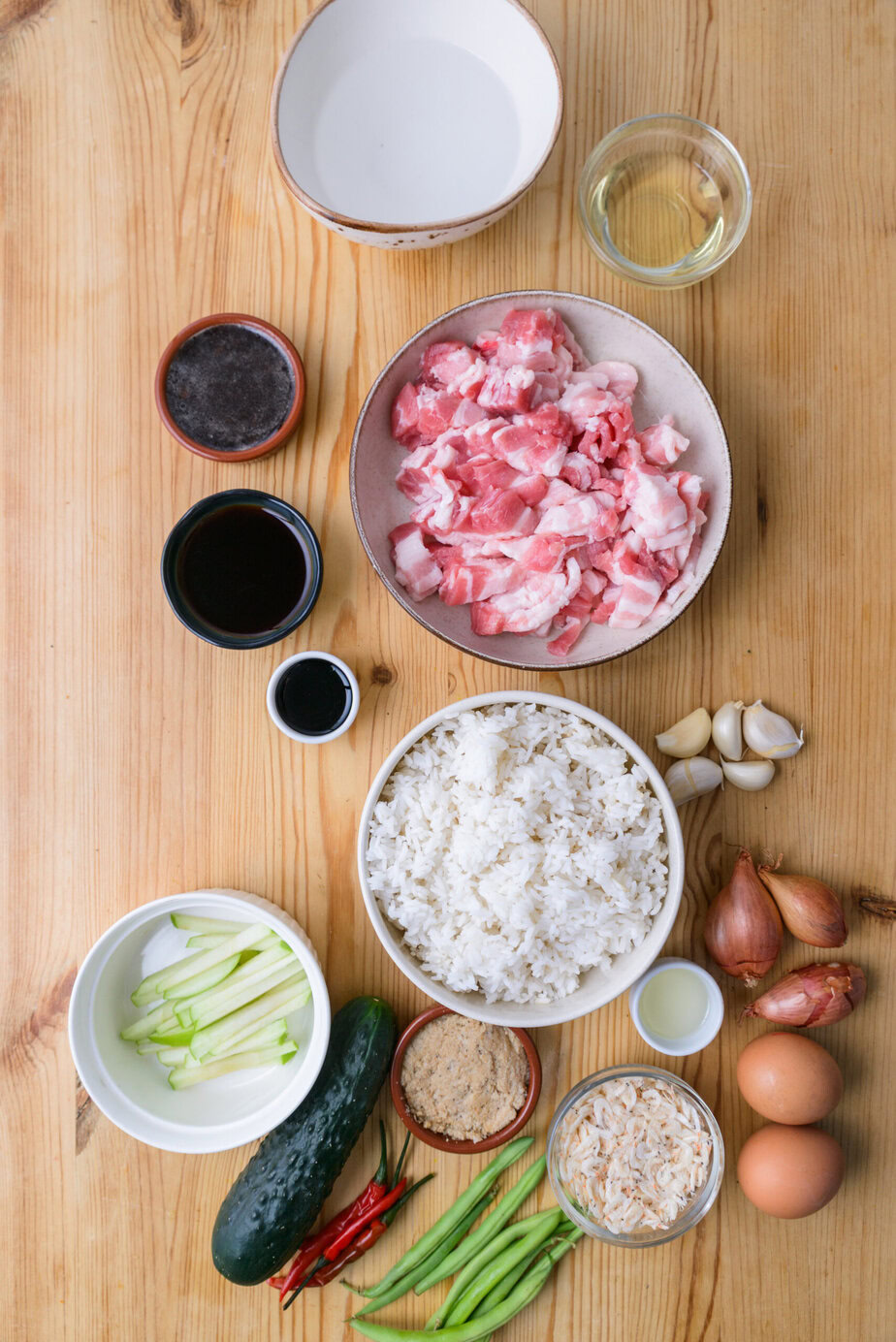
- 5 servings cooked jasmine rice
- 5 tablespoons shrimp paste
- 5 cloves garlic minced
- 3 tablespoons oil for stir-frying
Sweet Pork
- 800 g pork belly cut into bite-size pieces
- 4 shallots thinly sliced
- 300 g coconut sugar semi-liquid palm sugar
- 3 tablespoons light soy sauce
- 1 tablespoon dark soy sauce
- 240 ml water
- 3 tablespoons oil
Garnishes
- thin omelet strips cut into fine strips
- fried dried shrimp crispy
- tart green mango julienned, optional
- long beans sliced
- shallots thinly sliced
- Thai chilies sliced
- Chinese sausage fried and sliced, optional
- lime wedges
- cucumber slices
Instructions
Sweet Pork
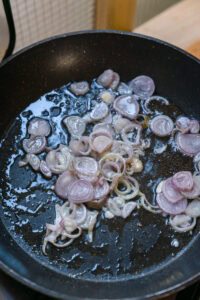
- Heat the oil and sauté the shallots until fragrant.3 tablespoons oil, 4 shallots
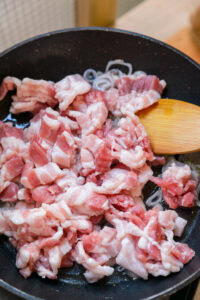
- Add the pork belly and stir-fry briefly.800 g pork belly
- Pour in the water, cover, and simmer over low heat for 1 to 2 hours until tender.240 ml water
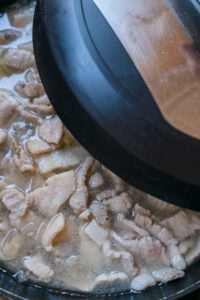
- Uncover, add the sugar and soy sauces, then reduce until a syrupy glaze forms.300 g coconut sugar, 3 tablespoons light soy sauce, 1 tablespoon dark soy sauce
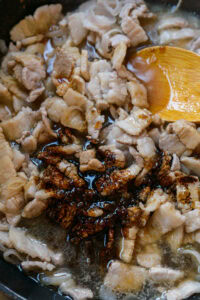
- Keep the sweet pork warm.
Rice
- Mix the shrimp paste with the cooked rice until evenly coated.5 tablespoons shrimp paste, 5 servings cooked jasmine rice
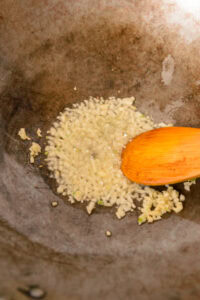
- Heat the oil in a wok and fry the garlic until fragrant.3 tablespoons oil, 5 cloves garlic
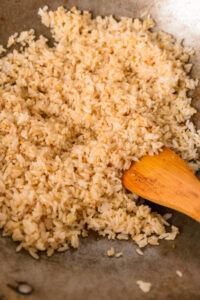
- Add the coated rice and stir-fry over medium heat until hot and aromatic.
Garnishes
- Beat the eggs, cook a thin omelet, roll it up, then cut into strips.thin omelet strips
- Soak, then fry the dried shrimp until crispy.fried dried shrimp
- Prepare the mango, long beans, shallots, chilies, and sausage as described.tart green mango, long beans, shallots, Thai chilies, Chinese sausage
Service
- Mound the rice in the center of each plate.
- Arrange the sweet pork and all the garnishes around it.
- Invite diners to squeeze the lime over and mix everything together before eating.lime wedges
Notes
- Khao kluk kapi is served “build-your-own” style: everyone adjusts the sweet, salty, sour, and spicy elements to taste.
- A slightly fatty cut, such as pork shoulder, yields a glossy glaze.
- Good Thai shrimp paste is available at Asian grocery stores; a tart green apple can stand in for green mango.
Nutrition
Culinary sources
• Khao khluk kapi (ข้าวคลุกกะปิ) – Wikipedia (Thai)
• Khao khluk kapi – Wikipedia (English)
• Khao khluk kapi: health article – Village Doctor Foundation (Thai)
• Khao khluk kapi rich in minerals – Thai Taste Therapy (Thai)
• Mae Krua Hua Paak, volume 4 – Old stories retold (Thai)
• Week 9: Thai – Khao khluk kapi ข้าวคลุกกะปิ (shrimp paste fried rice) – Reddit (r/52weeksofcooking) (English)
• What Thai dish or drink is, in your opinion, underrated? – Reddit (r/Thailand) (English)
• An anatomy of Khao khluk kapi – a Thai dish deconstructed – Ohsirin (English)
• Khao khluk kapi – easy recipe – Thai Food Made Easy (English)
• Pok Pok’s Andy Ricker: how to order Thai food – Condé Nast Traveler (English)


Parfait pour les repas d’été quand les mangues vertes sont de saison, c’est devenu mon plat fétiche pour les déjeuners du week-end avec les garnitures à partager au milieu de la table 🙂
Made this about 4 times now, and the shrimp paste rice with that sticky sweet pork never disappoints; the build-your-own garnishes make every plate feel fresh and balanced 😊
Made this Khao Kluk Kapi for dinner and the kids were weirdly quiet in the best way, then promptly asked for seconds and cleaned their plates 😊
Tellement rapide à préparer un soir de semaine, même en rentrant crevé et sans beaucoup de temps, tout s’assemble facilement dans le wok. Les saveurs sont incroyables et le côté “build-your-own” avec les garnitures a sauvé mon dîner 😋