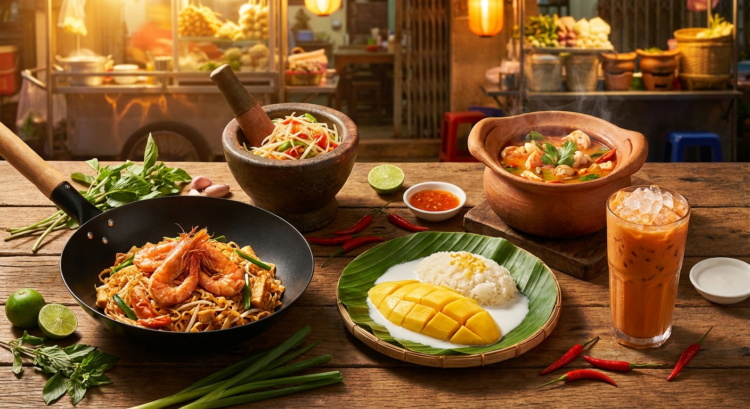
Bangkok has more than 300,000 street food vendors, in every soi and along every canal. From 6:00, office workers grab moo ping and sticky rice at 15 THB a skewer (0.40 EUR, the price of a piece of chewing gum in France), and at midnight Chinatown’s pavements are still packed with food lovers hunched over bowls of peppery rolled noodles.
Here are the places where I ate, neighbourhood by neighbourhood, with what I ordered and the prices. If you want to plan a trip to Bangkok, start with the food.
- Where to eat in Bangkok at night?
- What to eat in Bangkok?
- Where to eat a bowl of noodles?
- Where to eat a crab omelette?
- Which market should you choose for food?
- Which restaurants should you eat at?
- Which neighbourhood should you choose for good food?
- How much does it cost?
- Is it safe to eat street food?
- My other Bangkok guides
Where to eat in Bangkok at night?
My favourite place for dinner in Bangkok is Yaowarat, Chinatown: the city’s highest concentration of street food, drawing food lovers for more than a century. After sunset, the jewellery shops on Yaowarat Road close and stalls take over the pavements beneath the neon lights.
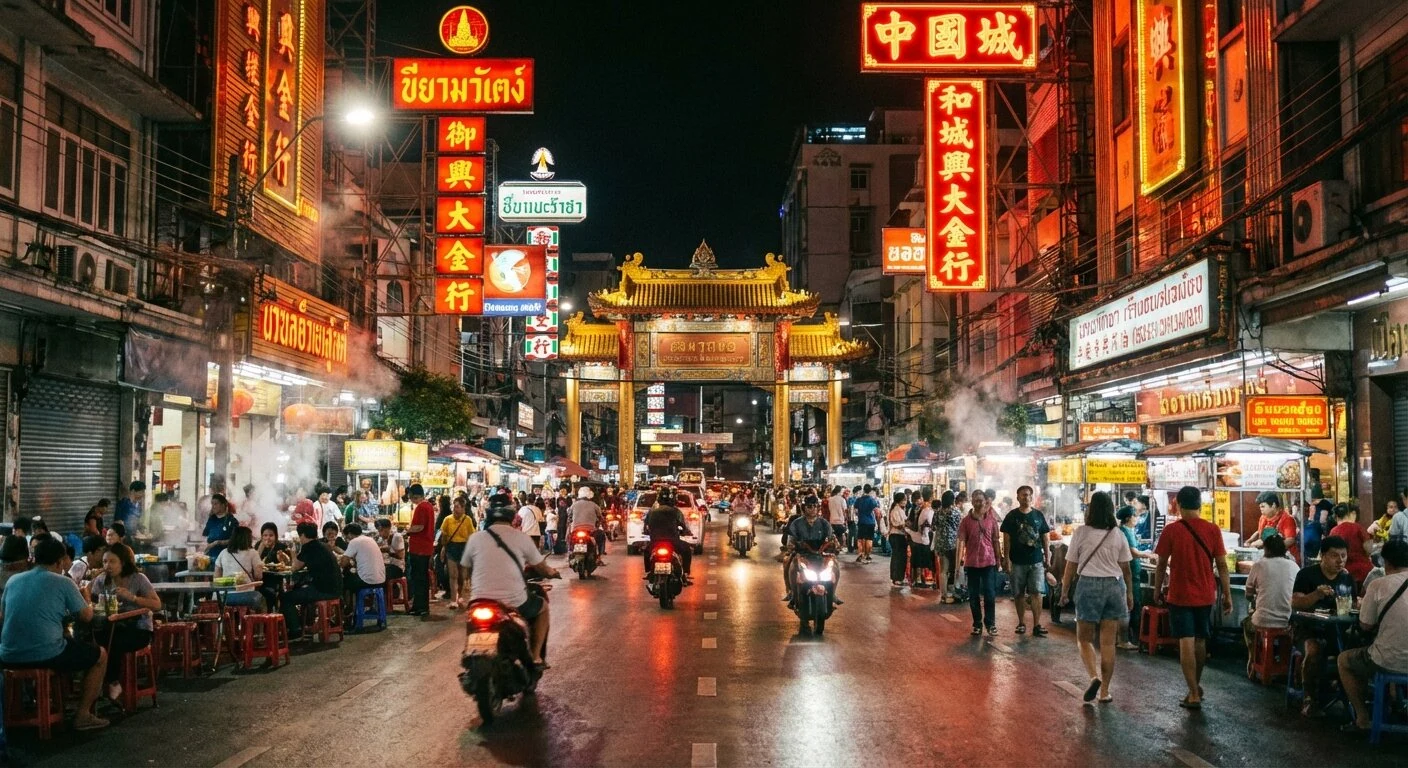
Yaowarat Road on a weeknight
Go on a weeknight, from 18:00 to 22:00: at weekends, the crowds are so dense that you spend more time squeezing through than eating. The main stalls stay open well past midnight, then the evening continues in the bars of Chinatown’s Soi Nana (not to be confused with the one in Sukhumvit), such as Teens of Thailand and Tep Bar. In the morning, between 6:00 and 9:00, I found Talat Kao, the old fresh market, full of locals buying ingredients. It disappears completely in the evening, and most tourists never see it.
Yaowarat’s holy trinity
3 dishes define Chinatown, and I tried all 3. Kway chap is wide rice noodles rolled into tubes in a peppery broth, with braised offal and crispy pork. I ate my first bowl at Guay Jub Ouan Pochana, in the entrance of an old cinema, a benchmark version. Guay Jub Mr. Joe has Michelin recognition and a fast-moving queue. Both are excellent.
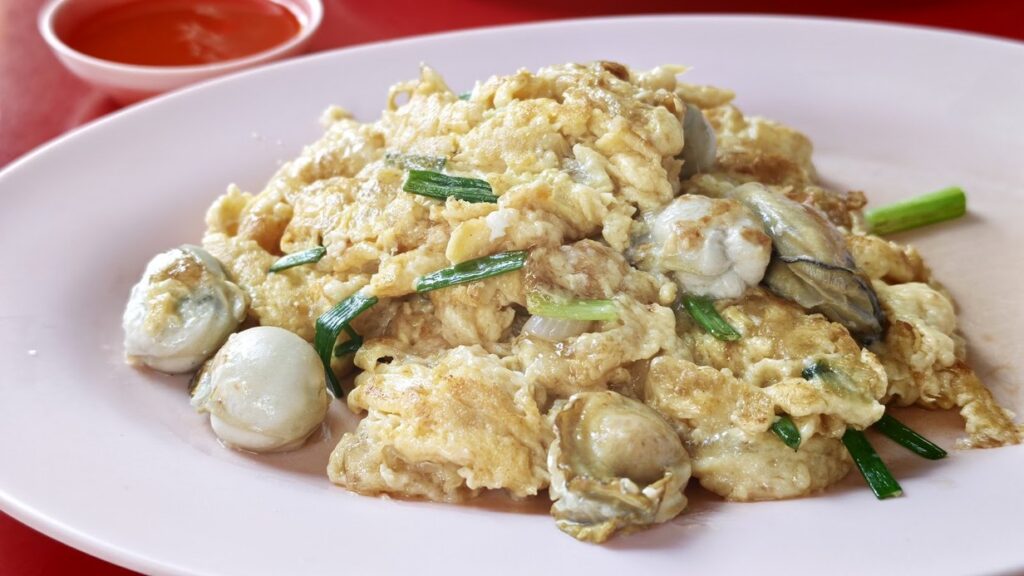
Hoi tod is an oyster omelette, a gloriously greasy pancake loaded with small oysters or mussels, crispy or soft as you prefer. Nai Mong Hoi Thod has been making it for decades: it’s my top stall in the neighbourhood.
Pa tong go are Chinese-style fried dough sticks to dip in pandan custard (sangkaya), a distant cousin of pastry cream. Pa Tong Go Savoey has Michelin recognition, and I think its custard alone is worth the stop.
T&K Seafood or Lek & Rut?
T&K Seafood (green shirts) and Lek & Rut (red shirts) have been competing side by side for decades, serving grilled prawns, squid and crab on plastic tables set out on the pavement, from sunset until late. I found them tourist-oriented and a little expensive for Bangkok. I prefer Lek & Rut, but neither is a must when the rest of Chinatown offers so much for less.
The sois around Yaowarat Road
Yaowarat Road is the most famous, most crowded and most expensive stretch. Walk 5 minutes down any soi (alley) and you can eat more cheaply, often better, with less of a queue. At Jek Pui Curry, I queued with locals for a yellow curry, eaten on a red plastic stool with no table. Nai Ek Roll Noodle serves crispy pork in a peppery broth, Krua Porn La Mai makes rad na (noodles in thick gravy) on a sizzling hot plate, and for a quiet sit-down break, Texas Suki or Hua Seng Hong serve proper Cantonese dim sum. If you want to stay near Chinatown, Talat Noi and the Old Town are within walking distance of all this.
What to eat in Bangkok?
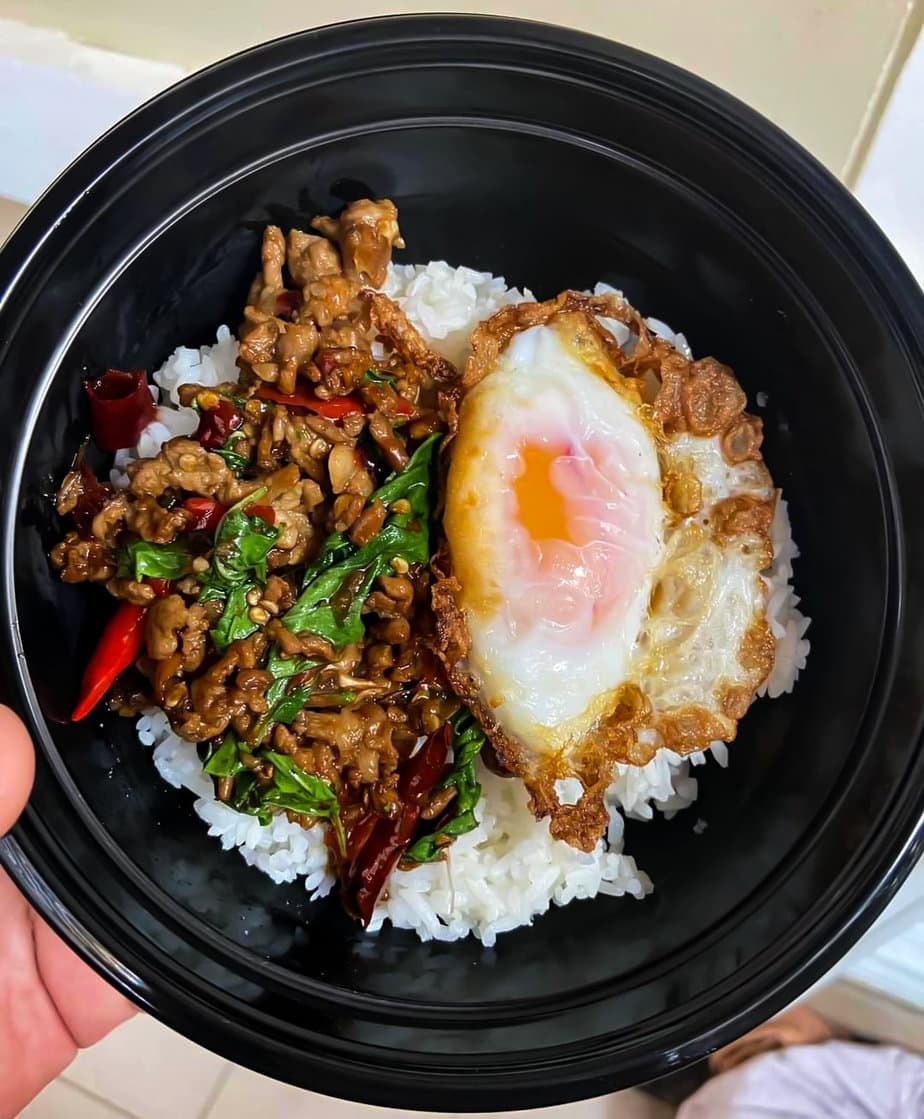
To understand Bangkok’s Thai cuisine, start with pad kra pao: ask a Thai person or a long-term expat what the true national dish is, and they will almost certainly name this one. It’s holy basil stir-fried in a wok with minced pork (or chicken), served over rice and topped with a fried egg with a runny yolk, for 40 to 60 THB (1 to 1.60 EUR) at any stall. Tourists start with pad thai; locals eat pad kra pao 3 times a week. I cook the chicken version at home, and my Thai basil chicken recipe is here.
Som tam is a green papaya salad pounded to order in a mortar, with your choice of chilli level: even “medium” will be very spicy for a Western palate. It’s eaten with sticky rice and gai yang (grilled chicken) or kor moo yang (grilled pork neck), which I preferred for its more tender texture. Every Isaan food stall serves this combination for 80 to 120 THB (2 to 3 EUR, the price of a coffee with milk at a pavement café), one of the most satisfying meals in the city. I make it at home, and my som tam recipe is here.
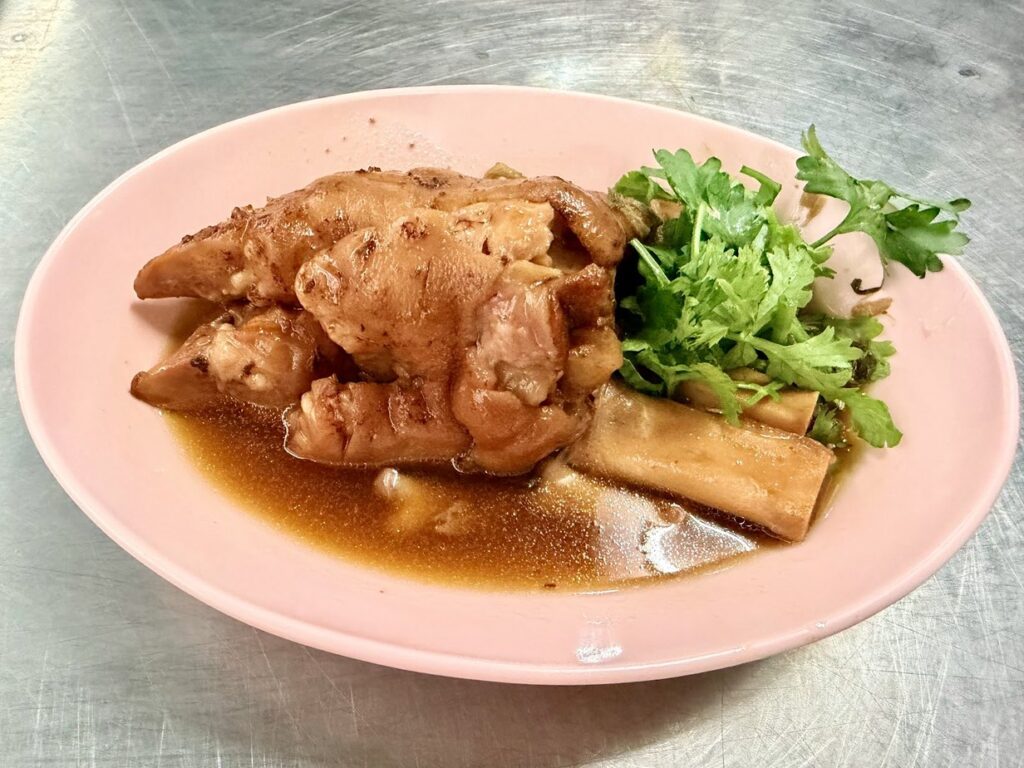
Khao ka moo is braised pork hock over rice, simmered until the meat falls apart under your fork, a little like confit. Charoen Saeng Silom has a Michelin Bib Gourmand for this dish, at 50 to 80 THB (1.30 to 2 EUR). I went in the morning, and that’s the rule: by early afternoon, it’s sold out. Elsewhere, follow a queue of locals to a stall that serves only this dish, with a large pot of braised pork and a vendor wielding a cleaver.
Moo ping are grilled pork skewers marinated in garlic, coriander root and palm sugar, sold from morning carts on almost every street corner, at 10 to 15 THB a skewer (0.25 to 0.40 EUR). With a bag of sticky rice, it’s the quintessential Thai breakfast, and I ate it like everyone else, standing up, walking to the BTS or waiting for a motorcycle taxi. No address needed: the carts are everywhere and almost all excellent. I make it at home too, and my moo ping recipe is here.
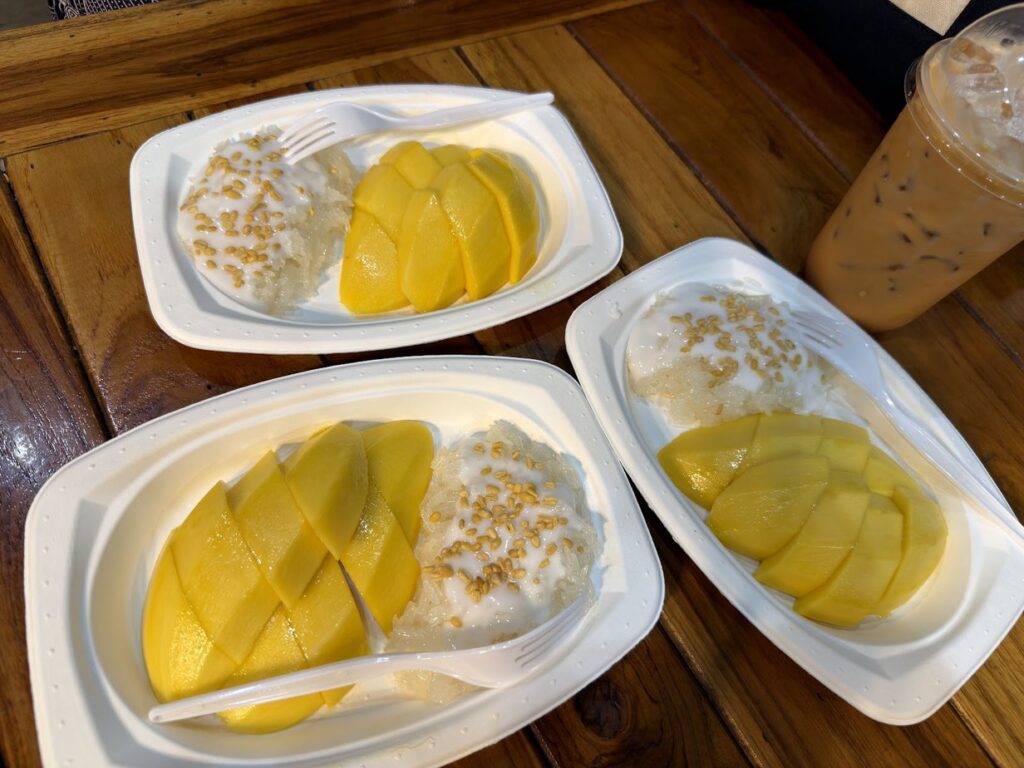
Mango sticky rice, sweet coconut milk sticky rice topped with slices of ripe mango, is available year-round, but it’s much better from April to June, at the peak of the Thai mango season. I had mine at Kor Panich in the Old Town, a historic spot that has been in business for more than a century. Expect to pay 60 to 100 THB (1.60 to 2.60 EUR), depending on the stall and the mango. To recreate it at home, my mango sticky rice recipe is on the site.
To learn these dishes, a cooking class is one of the best activities in Bangkok: in half a day, pad thai, green curry, tom yum, som tam and mango sticky rice, after a visit to a fresh market (often Klong Toei) where you buy your ingredients. Expect to pay 1,500 to 3,000 THB (40 to 80 EUR), depending on the school and group, on Klook or GetYourGuide. For me, Chiang Mai offers better value for cooking schools, but Bangkok’s classes are still good, and the market teaches you about Thai ingredients.
Where to eat a bowl of noodles?
Boat Noodle Alley, Victory Monument
Boat noodles (kuay teow reua) arrive in tiny bowls the size of a coffee cup: I ordered 5 at once and stacked the empty bowls in front of me, as tradition demands. The broth is dark and full-bodied, often enriched with pig’s blood, a bit like a rich French civet stew. In Victory Monument’s “Boat Noodle Alley”, a bowl costs 15 to 20 THB (0.40 to 0.50 EUR), and 10 bowls, for less than 200 THB (5 EUR), will fill you right up. For air conditioning, Thong Smith, a shopping mall chain, makes a very decent version, including an extravagant A5 Wagyu beef option that I found surprisingly good.
Khao soi in Ekkamai and Ari
This curry noodle soup from northern Thailand is Chiang Mai’s gift to Bangkok. For authenticity, I went to Hom Duan in Ekkamai, run by owners from the north. More contemporary, Ong Tong, in Ari, has a Michelin Bib Gourmand and a thick broth that draws a crowd of regulars. Khao Soi Samer Jai, also in Ari, makes a very creamy version with more coconut milk. Expect to pay 80 to 120 THB (2 to 3 EUR) at all 3.
Jeh O Chula, near Chulalongkorn
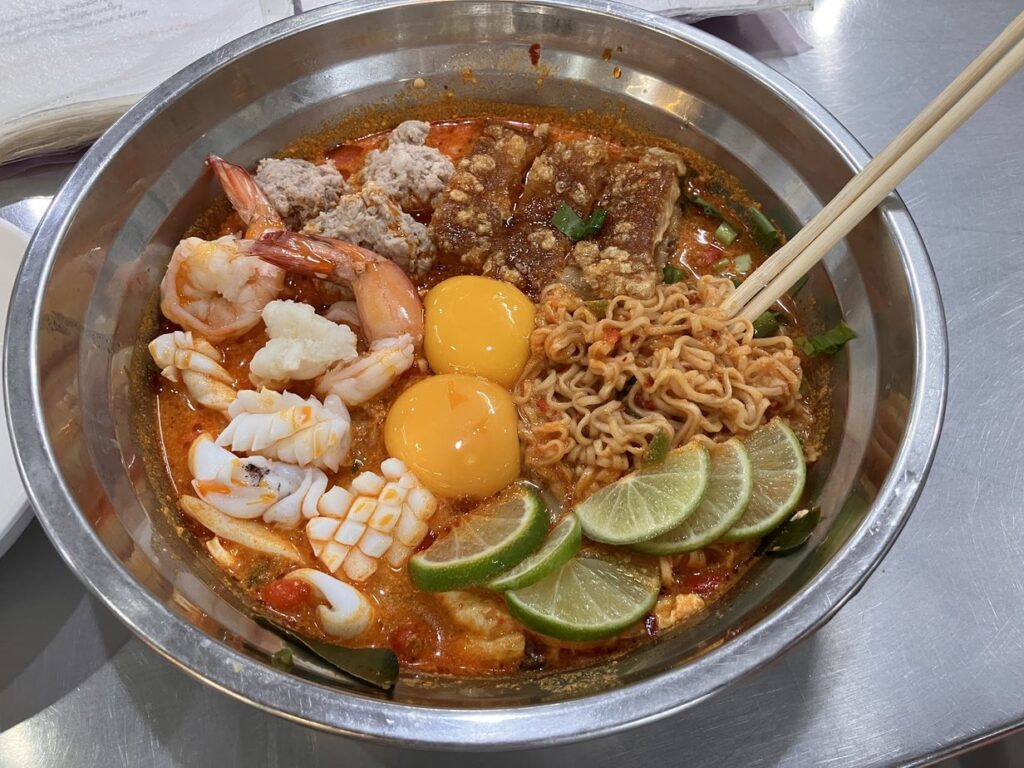
Tom yum goong (spicy shrimp soup) is Thailand’s most famous soup, and my favorite tom yum in Bangkok is the “Mama Oho” at Jeh O Chula, a Michelin Bib Gourmand spot near Chulalongkorn University: a huge pot of tom yum with instant noodles, seafood and a raw egg cracked into the boiling broth. It’s a late-night institution with long lines, so I booked my spot on Klook.
Wattana Panich and Rung Rueang
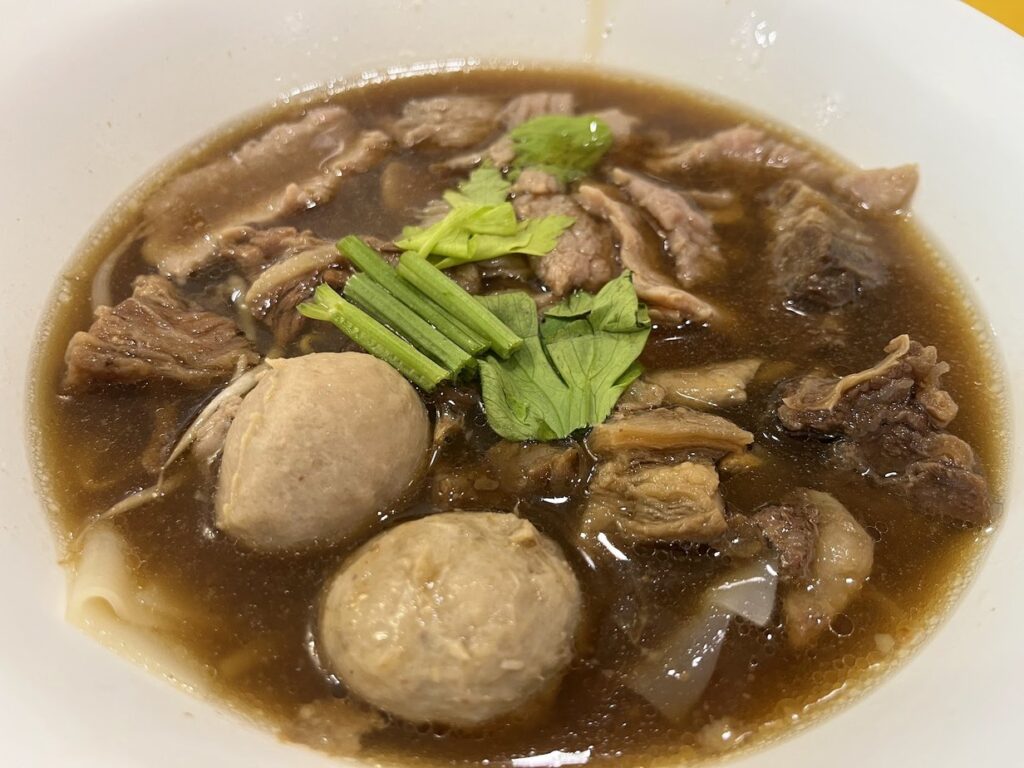
Wattana Panich, in Ekkamai, serves beef noodle soup from a broth that has been simmering continuously for more than 50 years, the same base topped up every day: I haven’t found this depth of flavor anywhere else, and anyone who loves French demi-glace will understand immediately. For pork, Rung Rueang Pork Noodle, on Sukhumvit 26, serves what I consider the best noodle soup in the city.
Where to eat a crab omelet?
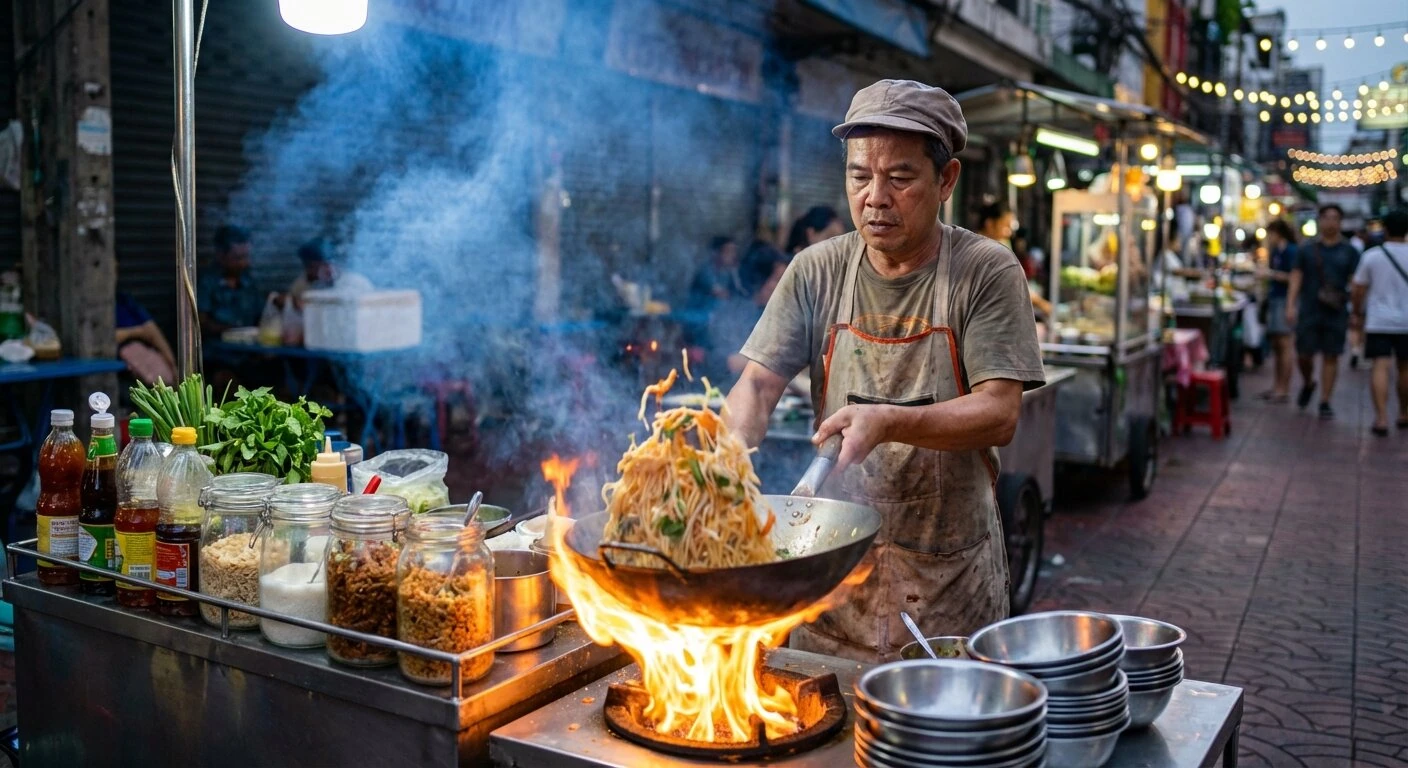
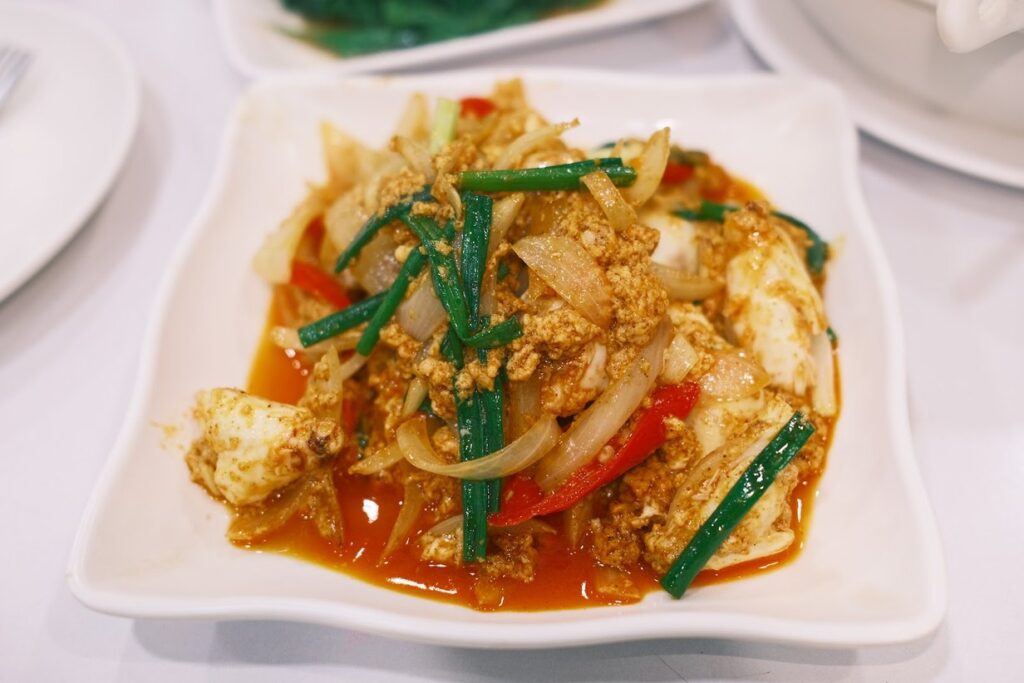
Raan Jay Fai is Bangkok’s most famous street food stall, with a Michelin Guide star for street food, a unique case worldwide. The chef, Supinya Junsuta, is in her 70s and cooks every dish herself, wearing welding goggles against the heat of the charcoal. I ordered her crab omelet, stuffed with big chunks of fresh crab and cooked in a wok over roaring flames, for more than 1,000 THB (26 EUR, the price of a dish at a good Parisian bistro), and her drunken noodles (pad kee mao) are excellent too.
To eat there, I arrived before 8:00 to put my name on the reservation sheet. The restaurant opens around 9:00-10:00, and the wait lasts 3 to 4 hours, standing in the heat, out on the street, with no air conditioning. It’s closed on Sundays, Mondays, and sometimes Tuesdays.
For some, the food is exceptional and watching Jay Fai work in front of her flames is a once-in-a-lifetime moment. For others, the wait is absurd for food you can get 90% of the way to elsewhere, when that time would be enough to try 5 other places. I agree with both sides: with a week in Bangkok, try Jay Fai; with 3 or 4 days, go for one of the alternatives below.
Krua Apsorn, Nhong Rim Klong and Raan Kaew
These 3 places serve comparable crab dishes without hours of waiting. At Krua Apsorn, a former favorite of the Thai Royal Family, I found the crab omelet fluffier and less greasy than Jay Fai’s, and the yellow crab curry among the best in the city. Nhong Rim Klong has air conditioning, big chunks of crab and much lower prices. Raan Kaew serves crab curry at a fraction of Jay Fai’s price, in a laid-back curry restaurant.
Which market should you choose for food?
Jodd Fairs
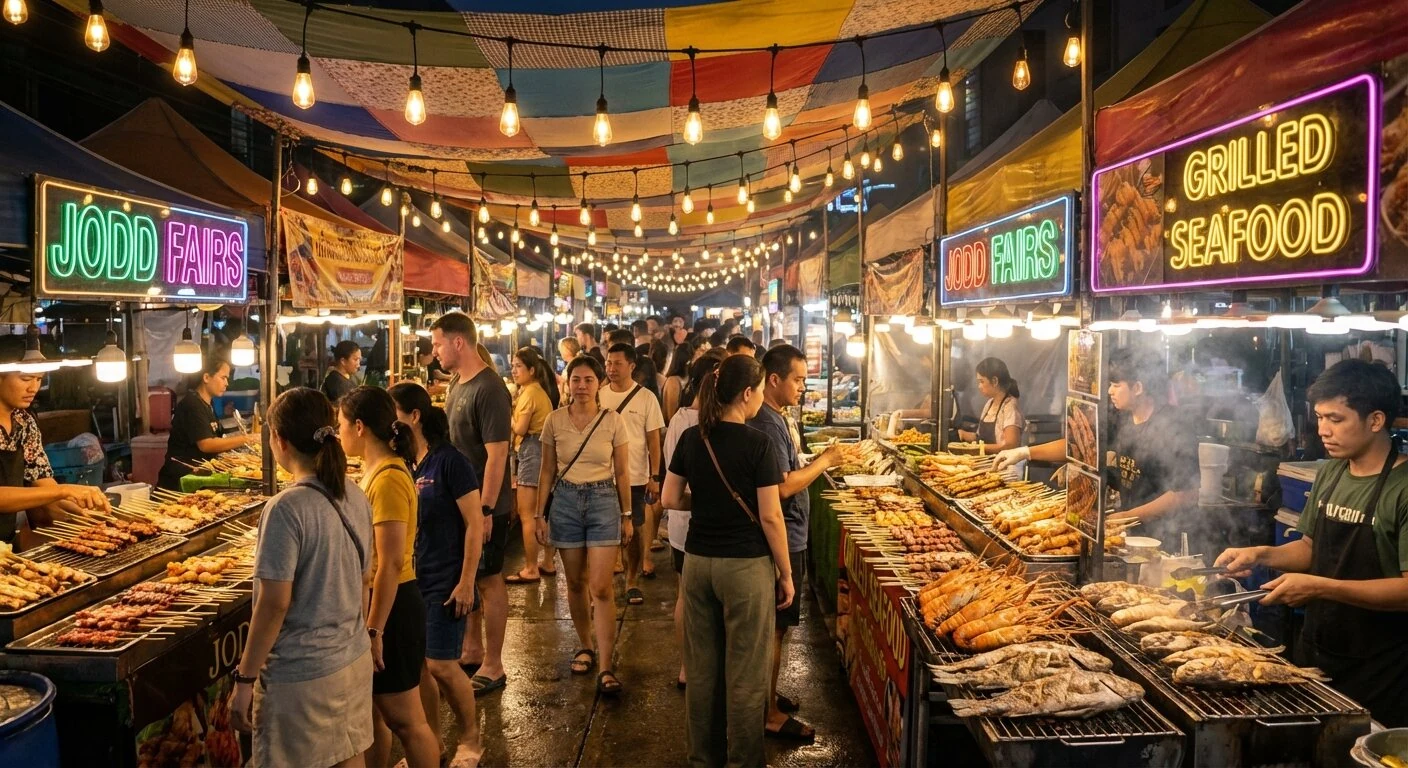
This is the go-to night market for tourists right now. The DanNeramit location, near Ha Yaek Lat Phrao BTS station, is the more spacious and photogenic of the 2 active sites, with its fairy-tale castle backdrop. The Ratchada location, near Big C, carries on the spirit of the old Train Market. Both are clean and organized, with English menus and polished presentation for social media.
The prices reflect that: a smoothie costs 80 to 100 THB (2 to 2.60 EUR), compared with 30 to 40 THB at a street stall, and seafood platters start at 500 THB (13 EUR). You’re paying for the atmosphere and comfort, and for an easy first evening, Jodd Fairs delivers.
I ordered leng saap (volcano ribs or “spicy pork mountain”): pork bones simmered in a very spicy, sour lime broth, piled into a highly photogenic mountain. Be warned, it’s sour and spicy, and many people expect American-style barbecue ribs. Order a small portion with rice or an omelet to balance the acidity, put on the plastic gloves provided (it’s messy), and head to the Maeklong Noodles stall for the market’s best version.
Chatuchak Weekend Market
Chatuchak is a daytime market, open from 9:00 to 16:00 on weekends, with plenty to snack on. I tried the coconut ice cream served in a half-shell, with roasted peanuts and sticky rice. Moo Yang Nam Peung, in Section 22, makes honey-grilled pork that draws a constant crowd, Viva 8 has a paella stall with a DJ, and Hello Garlic sells buttery garlic breadsticks with a loyal following. The heat is oppressive, so keep snacking, drink smoothies to stay cool and forget about a proper sit-down meal: walk, eat, walk, eat.
Talad Rot Fai, Wang Lang and Huai Khwang
These are the locals’ markets. Talad Rot Fai Srinakarin (Train Night Market) is farther from the center, with a vintage atmosphere, and I preferred it to Jodd Fairs. Wang Lang Market (10:00-14:00, near Siriraj Hospital) serves seriously good local food at Thai prices, including filled bread from Wang Lang Bakery and shrimp wontons from Saimai Wonton. Huai Khwang stays lively late into the night, with a very local crowd.
Khlong Lat Mayom and the floating markets
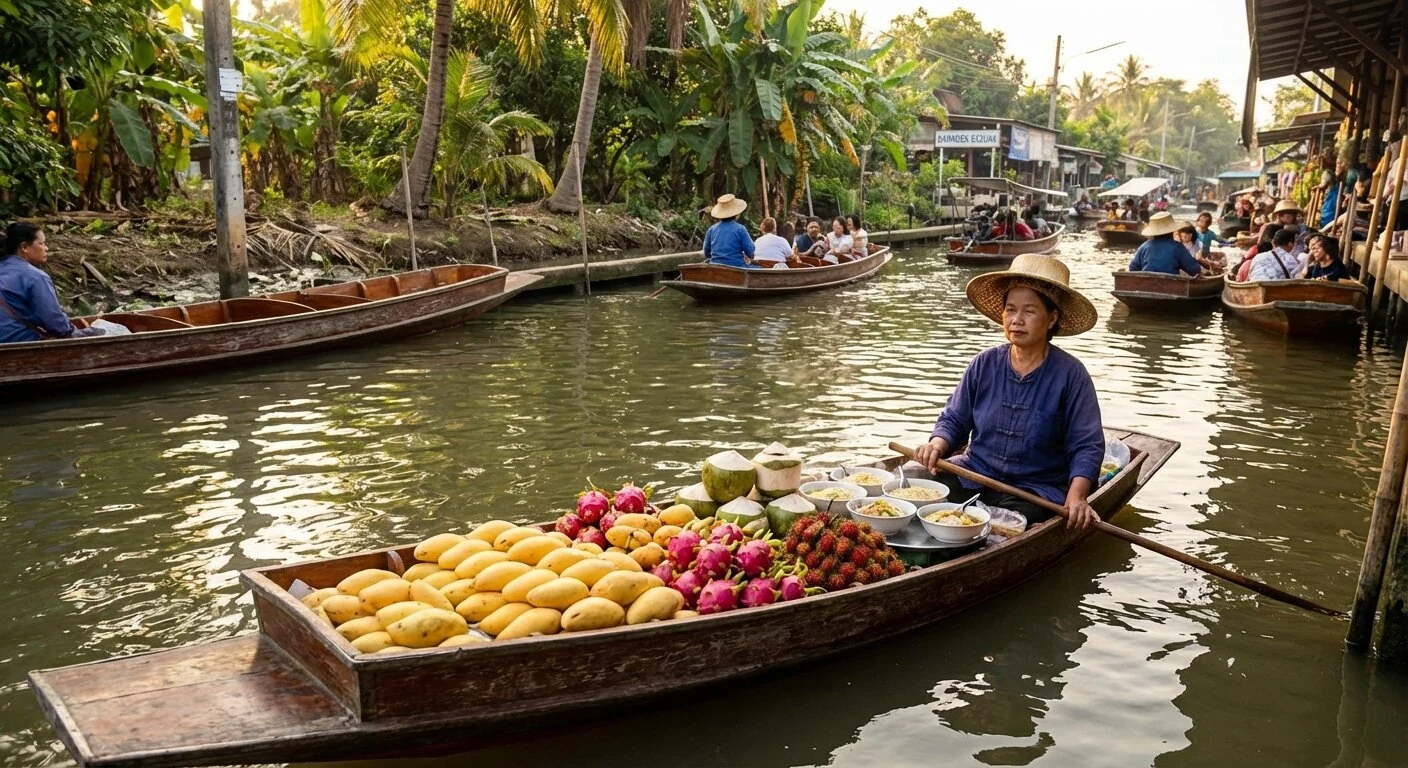
In Bangkok itself, I visited Khlong Lat Mayom, the most authentic of the floating markets: open only on weekends, with vendors on boats and stalls along a canal. You come here to eat: grilled seafood, boat noodles prepared on actual boats, coconut pancakes and seasonal fruit, in a neighborhood market that welcomes tourists. The more famous Damnoen Saduak and Amphawa are day trips: Amphawa, about 1.5 hours to the southwest, is the better of the 2 in my eyes, and Damnoen Saduak has become very commercial. I cover them in detail in my guide to things to do in Bangkok.
Where to eat at a restaurant?
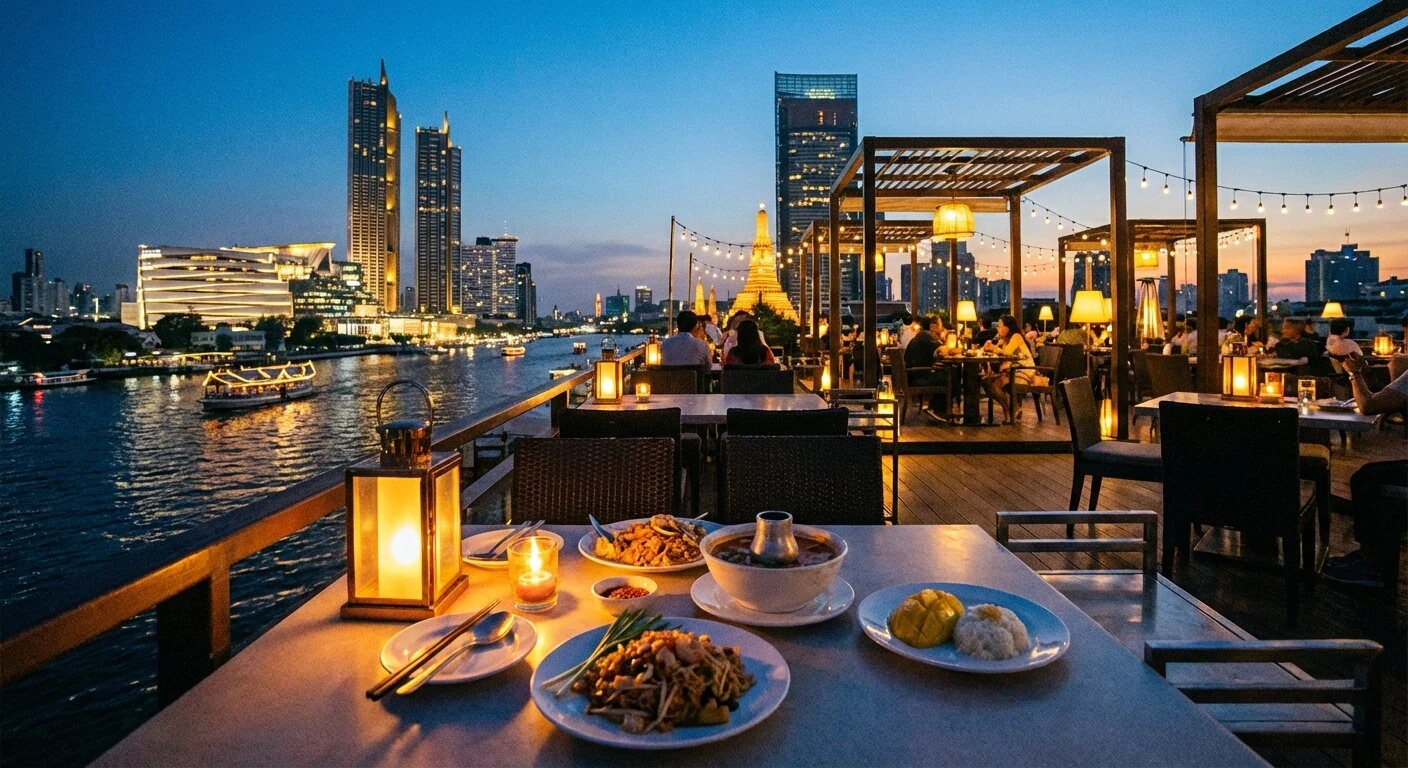
Bangkok’s high-end dining is solid, but the city’s magic lies in its street food and mid-range spots: a tasting menu at 5,000 THB (130 EUR) means 5 or 6 fewer meals at 100 THB.
Gaggan Anand (now under the name Gaggan) has appeared several times on the Asia’s 50 Best list, with a tasting menu of avant-garde Indian cuisine with Thai influences, at around 8,000 to 10,000 THB per person (210 to 260 EUR, comparable to a Michelin-starred restaurant in Paris). Bo.Lan, dedicated to traditional Thai recipes and sustainable sourcing, earned a Michelin star before its founding chefs moved on to new projects: check its current status before going. Sorn, a southern Thai restaurant, has 2 Michelin stars and dishes most tourists never come across.
For a drink with skyline views, several hotel rooftops along the Chao Phraya and in Sukhumvit serve cocktails starting at 300 to 500 THB (8 to 13 EUR). The view comes before the food: I had a drink at sunset, then headed back down for dinner on the street.
Here Hai, Somboon Seafood and Suda
The most satisfying restaurant meals generally cost 200 to 600 THB per person (5 to 16 EUR). At Here Hai, I fell in love with the crab fried rice, and Somboon Seafood has been making its stir-fried crab curry at several branches for decades. Pe Aor Tom Yum Kung serves a spectacular, creamy tom yum with whole prawns. Suda Restaurant, near BTS Asok, is an old-school open-air spot that has survived the neighborhood’s gentrification, with solid Thai cooking and a dining room full of expats and locals.
Which neighborhood should you choose for good food?
Where you choose to stay in Bangkok determines what you can eat within walking distance, because traffic makes every trip across the city very slow. Yaowarat (Chinatown), my favorite neighborhood, has the densest concentration of food spots and is at its best in the evening for Thai-Chinese seafood. The Old Town (Phra Nakhon) brings together Jay Fai, Thipsamai, Pad Thai Fai Ta Lu and Krua Apsorn, all within walking distance of each other and Bangkok’s main temples.
Ari is the go-to neighborhood for northern Thai food, with the city’s best khao soi and trendy restaurants, while Ekkamai, home to Hom Duan and Wattana Panich, is worth a special trip. Victory Monument is the budget neighborhood, and Silom and Soi Convent fill up at lunchtime with food carts catering to office workers. Sukhumvit and Asok have the widest international variety, plus Pier 21 and Rung Rueang. To get off the tourist trail, cross the river to Thonburi and Talad Phlu: stalls run for generations, at local prices, with no English menus or tourists.
When I was there, I stuck to 1 or 2 neighborhoods a day, without crossing the city by taxi. A morning at Wang Lang Market, an afternoon at Chatuchak and an evening in Chinatown already fill a day, and the Old Town brings together temples and food in the same area, so plan your food stops around Bangkok’s temples and activities.
How much does it cost?
Bangkok is among the cheapest cities in the world for eating well. My food budget was 500 THB per day (around 13 EUR) for 3 meals and snacks, barely the price of a daily special at a Parisian brasserie. A khao gaeng (curry over rice) at 50 THB (1.30 EUR) from a street vendor is often better than a 300 THB meal at a white-tablecloth restaurant, and thousands of unnamed stalls cook to this standard for around 1 euro a plate, less than an espresso at a counter in Paris. I cover the rest of the budget in my budget and practical tips for Bangkok.
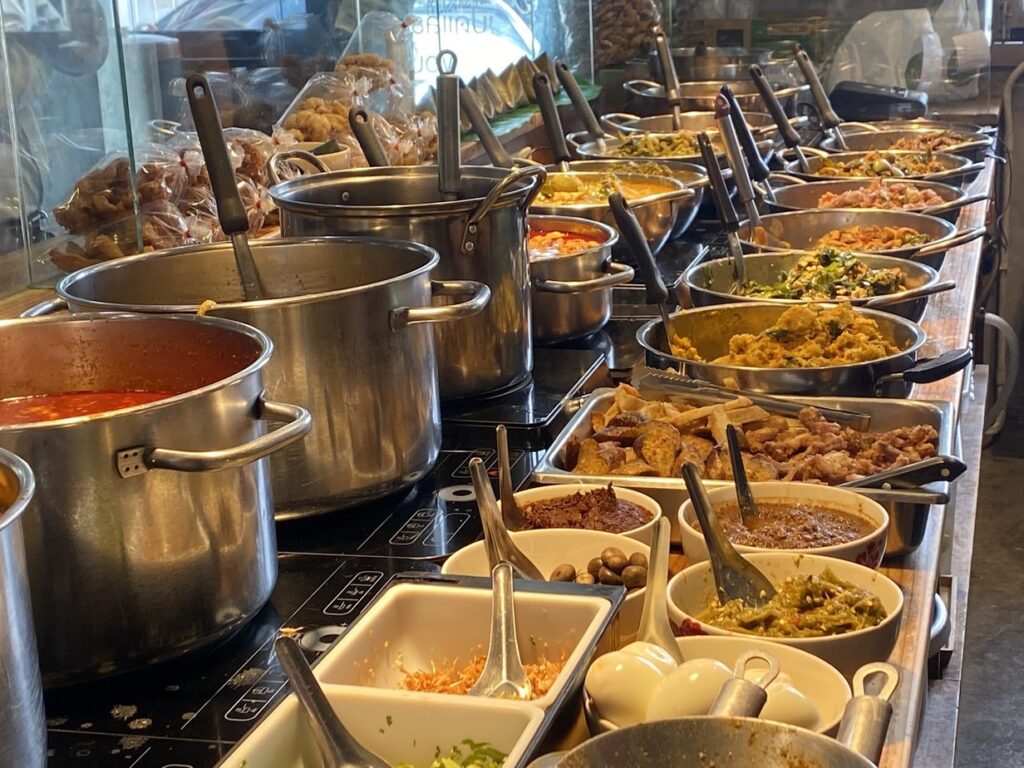
For under 100 THB (2.60 EUR), khao gaeng from any stall costs 40 to 60 THB (1 to 1.60 EUR): I pointed to whatever looked tempting behind the glass, and it was spooned over rice, the everyday lunch of millions of Thais. A pad thai from a cart (excluding Thipsamai), a pad kra pao with a fried egg or a som tam with sticky rice also costs 40 to 60 THB, and 5 bowls of boat noodles at Victory Monument (15 to 20 THB per bowl) cost less than a smoothie at Jodd Fairs.
Follow office workers between noon and 13:00 to the lunch markets hidden behind the towers for the best value. Between 6:00 and 9:00, street food is at its cheapest and freshest of the day, as vendors start with fresh ingredients. At a night market, head to the back rows for lower prices and shorter queues. Avoid any restaurant displaying “We Speak English” or “No Spicy” at the entrance. For a reliable sit-down meal, Kub Kao Kub Pla is a Thai shopping mall chain where locals actually eat: consistent quality, authentic flavors, air conditioning and reasonable prices.
Pier 21, the food court at Terminal 21
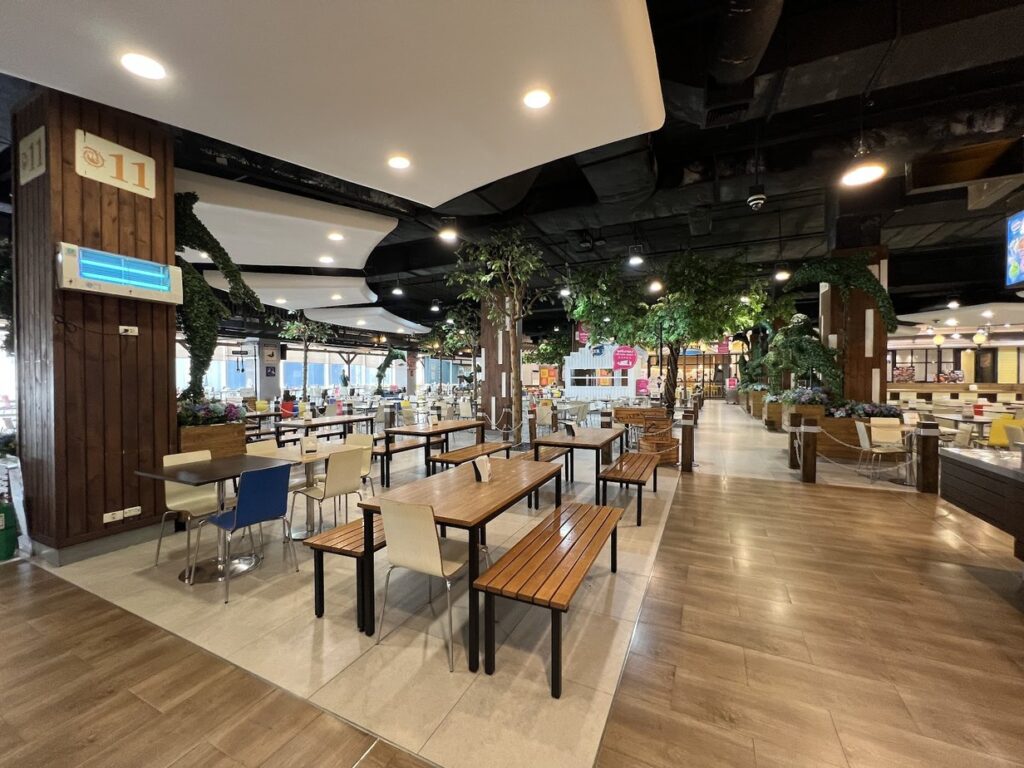
This is my best budget tip. The food court at Terminal 21 shopping mall (BTS Asok) serves dishes at 30 to 50 THB (0.80 to 1.30 EUR), street food prices, with air conditioning, clean preparation areas, seating and genuinely good quality. Locals eat there regularly. I bought a prepaid card at the entrance, ordered from different stalls and got the remaining balance back when I left, as simple as cafeteria tickets.
Is it safe to eat on the street?
The best rule: a queue of Thai customers signals safe and probably good food, while a queue of tourists signals a dish that might be mediocre. High turnover means ingredients haven’t been sitting around in the heat, and a dish cooked to order in a blazing-hot wok is safer than food prepared ahead and kept under a heat lamp. Eat where the cooking happens in front of you.
Avoid raw seafood such as goong ten (dancing shrimp) if you don’t trust its source: raw freshwater shrimp carry a risk of parasites. For me, the city’s worst pad thai is on Khao San Road. Shopping mall food courts (Terminal 21, MBK, CentralWorld) offer street food quality with cleaner preparation areas, a good option if your stomach needs a gentle start.
Use each stall’s condiment station (sugar, chili vinegar, fish sauce, dried chili flakes) and adjust like the locals, with a squeeze of lime, a pinch of sugar, a splash of nam pla: the base seasoning is a starting point. As for fried insects, I started with bamboo worms, which taste like salty corn puffs; crickets and silkworms are crunchier, with a stronger flavor.
Eating vegetarian is trickier than it looks, because Thai cooking uses fish sauce (nam pla) and shrimp paste in almost everything. The word to remember is “jay” (or “je”), meaning Buddhist vegan: a yellow or red flag with Chinese characters outside a restaurant or stall signals entirely plant-based cooking all year round. So Vegan, in Chinatown, is a reliable, dedicated spot. During the annual Vegetarian Festival (Tesagan Gin Je), usually in September or October, yellow flags appear throughout Yaowarat and the city, and every stall offers Thai dishes made with plant-based proteins, often fried, so not necessarily light.
For halal food, the Soi Convent area in Silom has several Thai Muslim restaurants, and I found the khao mok gai (Thai chicken biryani) from its lunchtime carts excellent. The Ramkhamhaeng neighborhood also has a concentration of halal street food: ask for “halal” or look for signs in Arabic.
My other Bangkok guides
I’ve also written about things to do in Bangkok, Bangkok’s most beautiful temples, where to stay in Bangkok and planning a trip to Bangkok. If you’re also island-hopping in Southeast Asia, compare it with my places to eat in Phuket and Bali, or with where to eat in Hanoi, from phở to bún chả: Bangkok simply has far more choice. Everything is gathered in my complete Bangkok guide.