Bangkok rewards travelers who do their homework before they arrive. The city’s transport network has at least six different modes, each with its own payment quirks. The scam ecosystem around the main temples is polished enough to deserve its own user manual. ATMs charge fees that add up quickly if you withdraw the wrong way. And the weather cycles through three distinct seasons that decide when to go and what to pack.
This guide covers the practical side of a trip to Bangkok: visas, budgets, transport, money, scams, health, and timing. If you’re after a broader overview of what to see and do, our comprehensive Bangkok guide is for you. This article is its logistical companion.
Visa: straightforward for French citizens
France is on Thailand’s visa-exempt list. You get 60 days on arrival (recently extended from 30 days) and can extend once for an additional 30 days at any immigration office. The extension costs 1,900 THB (about €50). Bring your passport, a passport photo and a completed TM.7 form.
Two things the immigration officer might ask for: proof of onward travel (a confirmed ticket out of Thailand within the visa period) and proof of funds (20,000 THB, roughly €530 in cash). The money check is rare for EU passport holders, but the onward ticket question comes up more often. Have both ready.
The TDAC: fill it in before your flight
Thailand has replaced the old paper TM6 arrival card with the TDAC (Thailand Digital Arrival Card). You fill it out online on the official government site (tdac.immigration.go.th) at least 72 hours before your flight. It asks for your passport details, flight information and the address of your accommodation in Thailand.
The TDAC is free. If a site asks you to pay, you’re on a fraudulent page. Use only the official .go.th domain.
Detailed budget: what Bangkok really costs
Bangkok is one of the cheapest major capitals in Southeast Asia for tourists, and your daily budget depends almost entirely on where you eat and how you get around. Street food and public transport keep costs very low. Air-conditioned restaurants and taxi rides push them up quickly.
| Budget level | Daily cost (excluding hotel) | Accommodation | Food | Transport |
|---|---|---|---|---|
| Backpacker | 30–40 EUR | Hostel dorm (250–350 THB / €7–10 per night) | Street food only (50–70 THB per meal) | Public bus + BTS/MRT |
| Mid-range | 60–80 EUR | 3-star hotel with pool (~1,500 THB / €40) | Street food for lunch, restaurant for dinner | BTS/MRT + Grab in the evening |
| Comfort | 150+ EUR | 4–5-star hotel (3,500+ THB / €92+) | Restaurants, rooftop bars | Grab everywhere |
The sweet spot for most travelers falls in the mid-range bracket. At 2,000–3,000 THB per day (€53–79) you eat well, ride in air-conditioned transport, visit temples and treat yourself to a Thai massage without checking your bank balance after every purchase. For comparison, a lunch that would cost €15 in a Paris brasserie is 2–3 EUR in street food here.
A rule of thumb often quoted on forums holds true: “If you spend 1,000 THB a day on food and going out, you’re already living very well.” The real money pit is alcohol. A large Chang at 7-Eleven costs 60 THB (€1.60). The same beer in a rooftop bar costs 180–300 THB. Cocktails in places like Sky Bar climb to 400+ THB (€10.50+) each.
How much things cost: crib sheet
Street-food dish: 50–80 THB (€1.30–2.10). Meal in a Terminal 21 food court: 40–60 THB (€1.05–1.60). Coffee from a street cart: 40 THB (€1). Starbucks: 120+ THB (€3.15). Single BTS ride: 16–59 THB. Entry to the Grand Palace: 500 THB (€13). One-hour Thai massage: 200–400 THB (€5–10). Bottle of water at 7-Eleven: 7–10 THB (about €0.25).
For budget eating strategies and the best food courts, check our Bangkok street-food and restaurant guide.
How to get there from France
As of early 2026 there is no regular nonstop flight between France and Bangkok. From Paris CDG the most common one-stop routes go through a Gulf hub: Qatar Airways via Doha, Emirates via Dubai, or Thai Airways (when the seasonal nonstop Paris–Bangkok flight operates). From Lyon-Saint-Exupéry or Marseille-Provence connections usually route through Istanbul (Turkish Airlines) or Doha. Total flight time with one connection ranges from 13 to 16 hours.
Return tickets from Paris generally range between €450 and €800 depending on season and how far ahead you book. Compare on Liligo, Google Flights or Kayak. Departures from November to January are the most expensive; May–June are usually the cheapest.
Two airports: know which one is yours
Bangkok has two airports, 40 km apart. Boarding the wrong shuttle costs you 90 minutes.
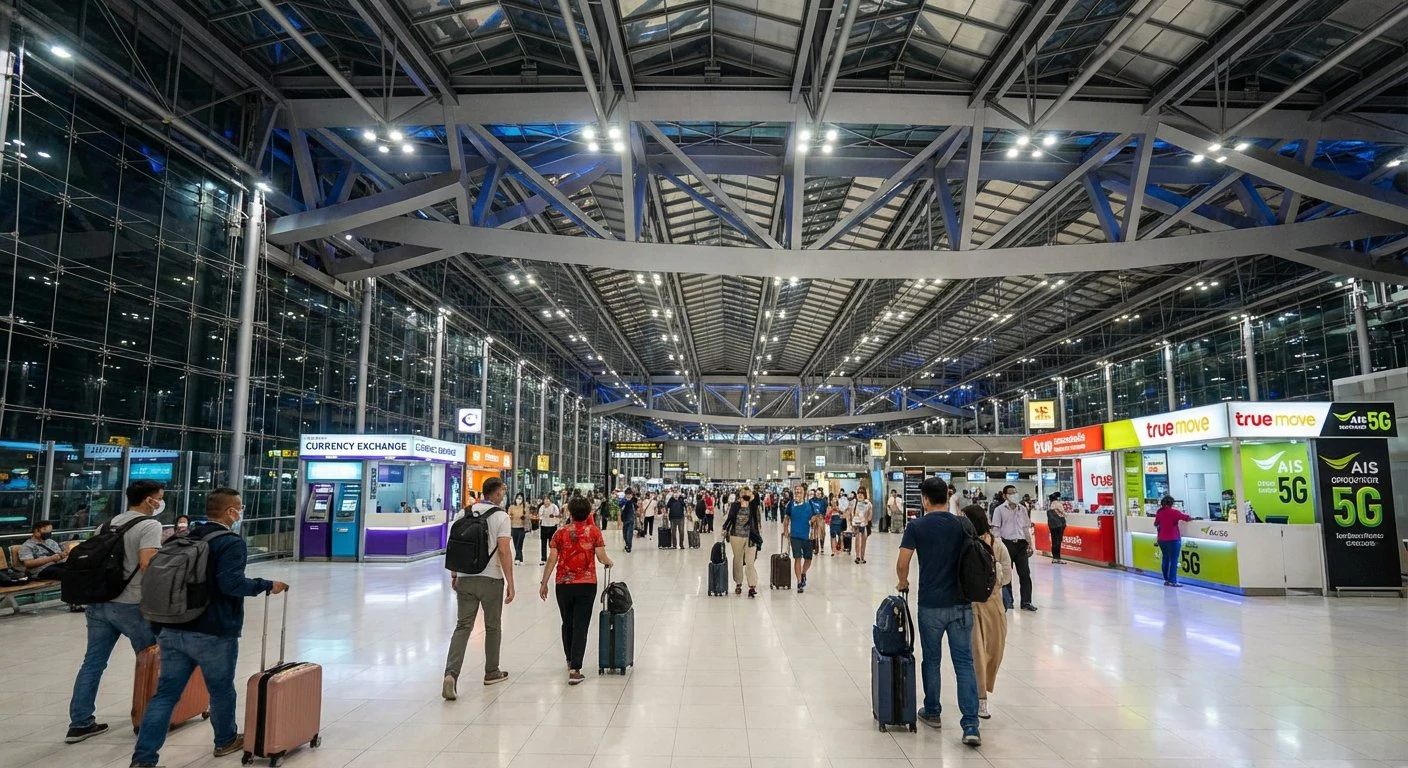
Suvarnabhumi (BKK)handles most international flights, including those from Paris. It is connected to the city centre by the Airport Rail Link (ARL): 45 THB (a little over €1), roughly 30 minutes to Phaya Thai station where you transfer to the BTS Sukhumvit line. Fast, cheap and immune to traffic jams.
Official taxis cost 400–600 THB (€10–16) to downtown Bangkok (meter fare + 50 THB airport surcharge + expressway tolls). Go to the first floor, one level below arrivals, and take a numbered ticket from the vending machine. Keep this ticket: it carries the driver’s ID in case of a problem. Ignore anyone who approaches you in the arrivals hall offering a ride.
Don Mueang (DMK)serves low-cost carriers like AirAsia, Nok Air and Lion Air. There’s no rail link. Your options are the A2 bus to BTS Mo Chit station (30 THB) or a taxi (300–500 THB to downtown, €8–13).
Two money- and stress-saving tips: carry small notes (100 THB bills) because drivers routinely claim they can’t change a 1,000 THB note. And if you land between 4 p.m. and 7 p.m., take the train. Taxi rides to Sukhumvit during rush hour can take two hours.
Getting around Bangkok
Bangkok has at least six ways to get around, each with its niche. The BTS covers the modern shopping districts. The MRT serves Chinatown and the area near the Grand Palace. Boats serve the riverside temples. Grab fills in everything the trains miss. Here’s how to use them.
BTS Skytrain
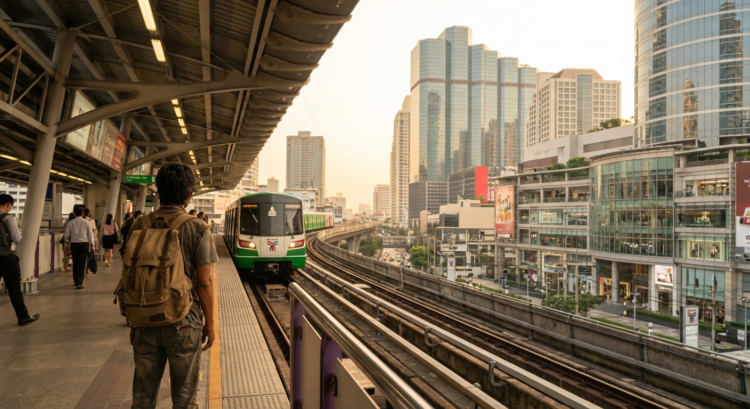
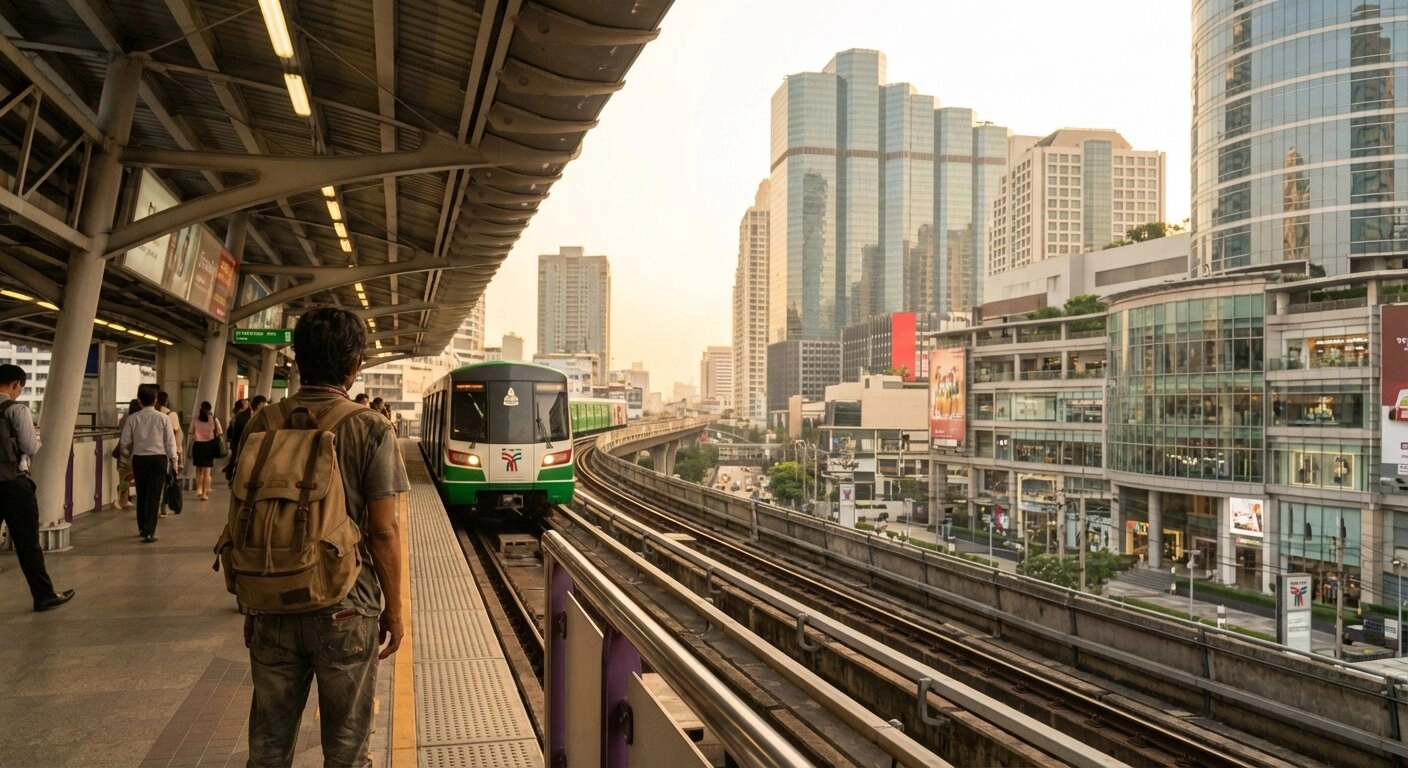
The elevated BTS has two lines. The light-green Sukhumvit line runs north-south along the main tourist and shopping corridor. The dark-green Silom line branches south-west. Together they cover most areas of interest to visitors.
Key stations: Siam (interchange between the two lines, large malls), Saphan Taksin (boats for the Chao Phraya at Sathorn Pier), Phaya Thai (Airport Rail Link interchange), Asoke (MRT interchange, Terminal 21 food court), Mo Chit (Chatuchak Weekend Market), National Stadium (MBK Center).
Single rides cost 16–59 THB depending on distance. A day pass costs about 140 THB (€3.70).
The Rabbit card is a stored-value smart card that lets you skip the ticket-machine queues at peak times. Top it up with cash at station counters (bank cards are not accepted for top-ups). Don’t load too much money; getting a refund is difficult.
One annoying detail: the BTS does not accept contactless bank cards. The MRT does. Two rail networks, two payment systems.
MRT
The MRT underground blue line forms a rough loop and covers areas the BTS misses: Hua Lamphong (Chinatown), Sanam Chai (near the Grand Palace and Wat Pho), Chatuchak Park and Sukhumvit (interchange with BTS Asoke).
The MRT accepts Visa and Mastercard contactless payment directly at the gates, making it the simpler of the two networks for tourists without a local transport card.
Chao Phraya Express Boats
The river bus network links downtown to the Grand Palace, Wat Arun and the Khaosan Road district. It’s also a good way to reach the city’s main activities and excursions. The central departure point is Sathorn Pier, a short walk from BTS Saphan Taksin.
The orange-flag boat charges a flat fare of 16 THB per trip, no matter the distance—about €0.40. It stops at every main pier and sails alongside commuters heading to work. It’s the cheapest public transport in Bangkok. Key stops: N8 Tha Tien (Wat Pho, ferry to Wat Arun), N9 Chang (Grand Palace), N13 Phra Arthit (Khaosan Road area).
The blue-flag tourist boat costs 30–150 THB and comes with an English-speaking guide. Less crowded, more comfortable, four times the price.
A free option: the IconSiam mall runs a complimentary river shuttle from Sathorn Pier. It’s a pleasant mini-cruise for zero euros.
Tuk-tuks: do one ride, then stop
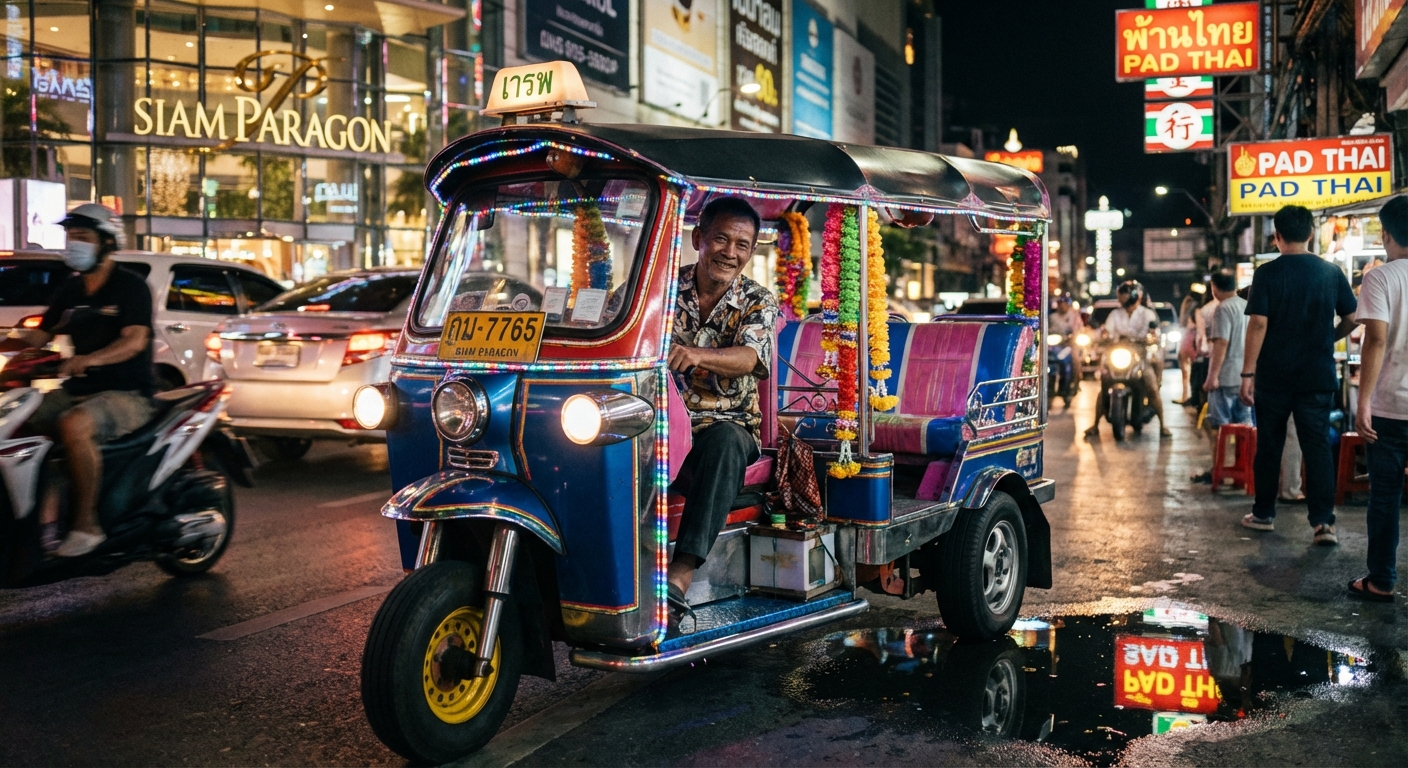
Tuk-tuks are now more tourist attraction than transport. They cost more than taxis, expose you to heat and exhaust fumes, and are the main vehicle—literally—for Bangkok’s classic scams. Locals barely use them anymore.
If you want the experience, take a short ride. Agree on the fare before you get in and compare it to the Grab price for the same route on your phone. If the tuk-tuk fare is 80 % lower than Grab’s, it’s a trap: the driver plans to detour via gem shops and tailors where he earns commissions.
A better alternative: MuvMi, an app for electric tuk-tuks with fixed prices and no commission detours. It operates in the Sukhumvit and Ari districts.
Taxis
Metered taxis are cheap and widely available. The flag-fall is 35 THB for the first kilometre (under €1), and most journeys within central Bangkok cost 80–200 THB (€2–5). That’s less than a Paris bus ride.
The non-negotiable rule: insist on the meter. Say “meter” as you get in. If the driver refuses and offers a flat fare, close the door and find another taxi. Walk one block away from any tourist site and hail a moving taxi rather than one already parked. Moving taxis are far more likely to use the meter.
In rain or late at night it’s harder to flag a taxi on the street. That’s when Grab comes into its own.
Grab and Bolt
Grab is the local Uber. Fixed price shown before booking, card payment, GPS tracking, driver identity on screen. It’s the simplest option for solo travelers and anyone who doesn’t want to haggle.
Bolt is 30–50 % cheaper than Grab but with trade-offs: longer waits, higher cancellation rates, and some drivers who prefer cash and may cancel card-paid rides.
Strategy: check Bolt first for the lowest fare. Switch to Grab if no Bolt driver is available or you’re in a hurry. Download both apps before you leave.
You can also use either one as a price reference: look at the app fare before bargaining with a street taxi to know the fair price for the trip.
A universal rule: never take a car during rush hour (7–9 a.m., 4–7 p.m.). Traffic in central Bangkok at those times can turn a 5 km ride into 90 minutes of gridlock. A Grab from Siam to Sukhumvit Soi 55 that takes 10 minutes at noon can last over an hour at 5:30 p.m. Take the BTS or MRT instead.
Motorcycle taxis
Spot the orange vests. Motorcycle-taxi drivers cluster at designated stands all over the city, with prices often posted on a sign. It’s the fastest last-mile option: from the BTS station to your hotel, or from the mouth of a soi to a restaurant 1 km away.
Short hops cost 10–30 THB. Wear the helmet they provide (it’s mandatory). Not recommended with luggage or in heavy rain.
For a detailed look at neighbourhoods and the transport lines that serve them, see our Bangkok neighbourhood guide.
Money: ATMs, exchange and the cash question
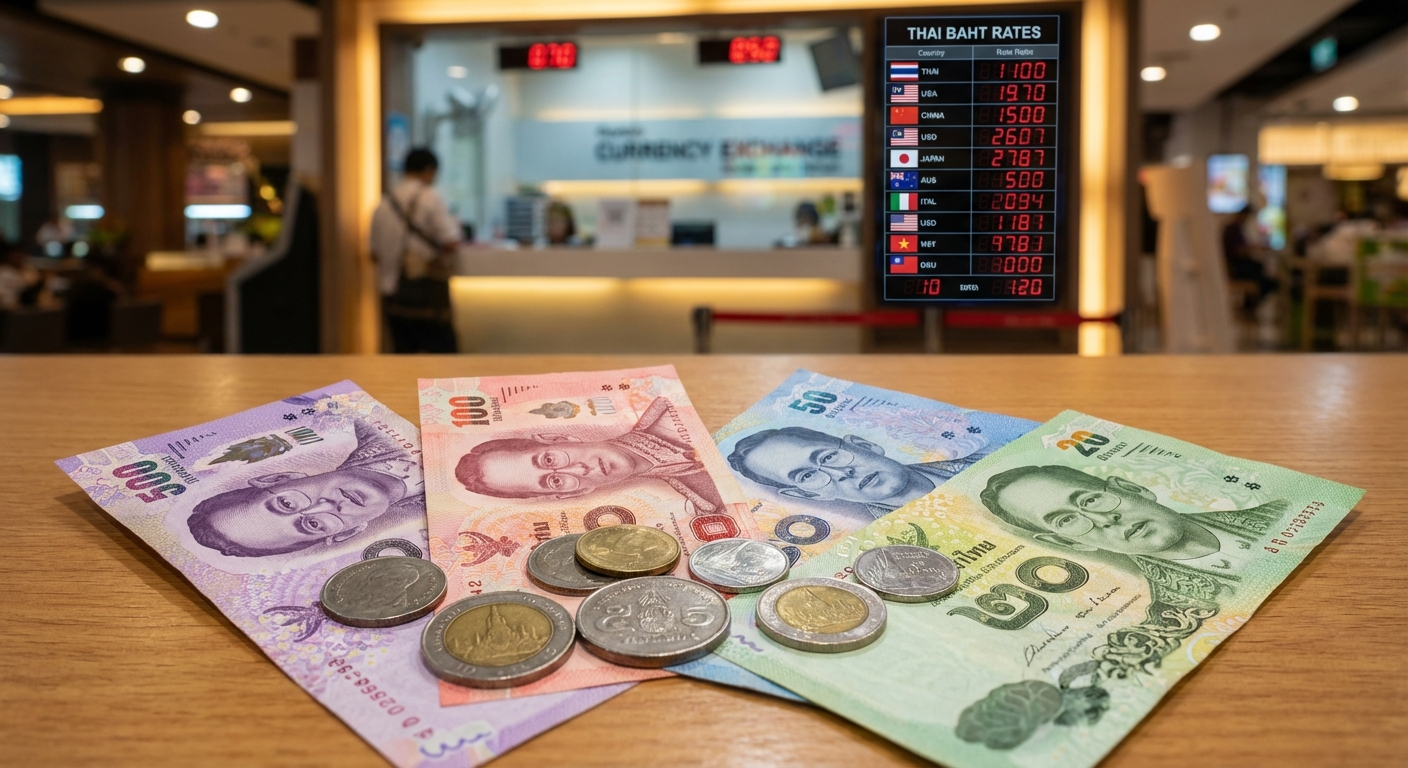
Currency exchange
The most repeated tip on every Bangkok forum: do not change money in the airport arrivals hall. Rates there are 10–15 % worse than in the city centre.
Instead, head to the airport basement near the Airport Rail Link station, where you’ll find a SuperRich booth (Green or Orange). SuperRich offers rates close to those in town. In the city, SuperRich branches near Pratunam and Central World give the best euro rates.
Bring crisp large-denomination euro notes (€50 or €100) in good condition. Torn, folded or very old notes may be refused.
Don’t exchange all your cash in France: EUR/THB rates in Thailand are far better than what French banks give for baht. Change the bare minimum at Roissy (or none) and do the bulk on the ground.
ATMs: the 220 THB fee and the conversion trick
Every Thai ATM slaps a fixed 220–250 THB fee (about €6) on withdrawals with a foreign card. These charges are unavoidable and are on top of whatever fees your French bank adds. Check before you leave: some online banks like Boursorama, Fortuneo or Revolut offer better terms for overseas withdrawals.
To limit the damage: withdraw the maximum each time. Krungsri Bank (yellow ATMs) and Bangkok Bank (blue ATMs) allow 30,000 THB per transaction. Most other banks cap at 20,000 THB.
The conversion trick that saves you 5–10 % each withdrawal: when the ATM screen asks “Do you want us to convert?” or shows a conversion rate in euros, always select “No” or “Continue without conversion.” This is called DCC (Dynamic Currency Conversion).
The Thai bank uses a lousy exchange rate and pockets the difference. Always refuse; let your own bank convert at the interbank rate and keep that 5–10 % for yourself.
Cash or card
Cash is still the main payment method for street food, markets, tuk-tuks, motorcycle taxis and small eateries. Bank cards work in malls, hotels, upscale restaurants and via the Grab app.
Always carry a mix of small bills: 20, 50 and 100 THB notes. Taxi drivers routinely claim they can’t change a 1,000 THB bill. Break your large notes at any 7-Eleven (they always have change) before heading out for the day.
Tipping
Thailand doesn’t have a strong tipping culture, but the practice is spreading in tourist areas. In restaurants, rounding up the bill or leaving 20–50 THB is appreciated (10 % in high-end places). After a massage: 50–100 THB. Taxi and Grab drivers: not expected, but rounding up is polite. Hotel porters: 20–50 THB per bag.
Health and safety
Heat
Bangkok hovers between 32 °C and 38 °C year-round with high humidity. Dehydration strikes fast, especially if you chain-visit temples on foot. Buy large water bottles at 7-Eleven (7–10 THB, €0.25) and sip constantly. The same 7-Eleven sells electrolyte drinks that help too. Plan indoor breaks in malls or cafés with air-con between noon and 3 p.m., when the heat peaks.
Food safety
Bangkok street food is generally safe if you follow one rule: eat where the locals eat. A heavy customer turnover means fresh food. A busy stall with a queue is more reliable than an empty restaurant with a menu in five languages. Wok-fried dishes and soups cooked to order (high heat in front of you) are the safest bets.
Ice in Bangkok is safe. It is factory-made from filtered water and comes in distinctive tubular or cylindrical shapes. Food courts in malls are another safe, air-conditioned option.
If your stomach protests, it’s often a reaction to unfamiliar spice levels rather than contamination. Activated charcoal tablets sold at the pharmacy counter of any 7-Eleven work well. Imodium is also available over the counter at all pharmacies.
Hospitals
Bangkok has international-standard private hospitals at prices very reasonable by French standards. Bumrungrad International Hospital on Sukhumvit Soi 3 has English-speaking staff and welcomes patients from around the world for medical tourism. Bangkok Hospital is another large private chain. A GP consultation at Bumrungrad costs about 1,000–2,000 THB (€26–53), less than a sector-2 specialist in Paris.
French travellers should know that the EHIC (European Health Insurance Card) only covers care within the EU and EEA: it is therefore useless in Thailand.
You need separate travel insurance before departure. Buy a policy that covers medical evacuation: local care is affordable, but an air-ambulance repatriation to France can exceed €50,000. Chapka Cap Aventure, ACS Globe Traveller and AXA Assistance all offer plans covering Southeast Asia. Check that your policy includes two-wheel coverage if you plan to ride a scooter during your stay.
Also check the benefits of your bank card (Visa Premier, Mastercard Gold): they often include travel insurance for trips under 90 days, provided you paid for the flight with the card.
General safety
Bangkok is overall safer than Paris for violent crime. The biggest physical danger is traffic: motorbikes ride on the sidewalks, drivers don’t stop at crosswalks, and crossing a six-lane road is a skill you’ll acquire by day two.
Solo female travellers generally consider Bangkok a safe destination. Night-life districts (Nana, Soi Cowboy, Khao San Road) call for normal going-out precautions: don’t accept drinks from strangers, keep your phone in a front pocket in crowds.
Emergency numbers: Tourist Police on 1155 (English-speaking, useful for scam disputes) and ambulance on 1669. Also note the French embassy in Bangkok: +66 2 657 5100 (for consular emergencies).
Eight scams to know
Bangkok’s scams are well-documented, recurring and avoidable if you know the patterns. Here are the eight you’re most likely to encounter.
1. “The Grand Palace is closed.”The number-one scam in Bangkok. A well-dressed man approaches you near the Grand Palace and tells you it’s closed for a ceremony, royal event or cleaning. He kindly suggests a tuk-tuk to visit other temples instead. The tuk-tuk takes you to gem shops and tailors where the driver gets kickbacks, and you lose three hours under pressure to buy overpriced items.
The Grand Palace is almost never closed. Walk to the entrance yourself and ignore anyone who says otherwise.
2. The gemstone scam.Linked to the tuk-tuk tour above. You end up in a jewellery shop where a salesman explains there’s a “special government export sale that ends today.” There is no government gemstone sale. The stones are either worthless or marked up tenfold. Victims regularly pay 30,000+ THB (€790+) for gems worth a fraction of that.
3. The tailor scam.Same pattern: a friendly stranger guides you via tuk-tuk to a specific tailor. You pay US$200–500 (€185–460) for a suit described as “cashmere” or “Armani fabric” that turns out to be cheap polyester. Your deposit is gone, and the police treat it as a civil dispute. For quality tailoring, forums regularly recommend Tailor on Ten, Empire Tailors or Raja’s.
4. The taxi-meter refusal.The driver quotes an inflated flat rate or “forgets” to start the meter. Solution: say “meter” before boarding. If he refuses, close the door. Use Grab as a price benchmark: check the app fare before bargaining with a street taxi.
5. The restaurant redirection.Your taxi driver claims the restaurant you asked for is “closed,” “burned down” or “has a two-hour wait.” He takes you to a similarly named place where he earns a commission. Follow your route on Google Maps. If the driver deviates, ask him to stop.
6. The ping-pong-show bill.Touts on Patpong or near Nana Plaza promise “free entry” or “beer for 100 baht.” Inside, the menu changes. The bill comes to 3,000–6,000+ THB (€79–158+). Bouncers block the exit until payment. Avoid any upstairs bar where you can’t see inside from the street.
7. The dating-app bar scam.A Tinder or Bumble match suggests meeting in a specific bar. The person orders over-priced drinks, five to ten times the normal rate, then disappears when the bill arrives. Countermeasure: you choose the venue. If the person insists on a particular bar near Asoke or Nana, move on.
8. The jet-ski damage claim.More common on Thai islands than in Bangkok, but good to know. A renter leases you a jet-ski, then claims pre-existing damage on return. He demands 20,000+ THB (€530+) for “repairs.” Forum consensus is simple: do not rent jet-skis in Thailand.
The principle that prevents most of these situations: if someone offers you something you didn’t ask for, don’t take it. Strangers near tourist attractions who speak perfect English and approach you out of the blue always have an ulterior motive.
SIM cards and connectivity
Thailand’s best mobile network for coverage is AIS, followed by TrueMove H. DTAC trails far behind in rural areas and on the islands.
You can buy a SIM in the airport arrivals hall for 900–1,200 THB, or wait until you reach a 7-Eleven in town and pay 49–300 THB for the same coverage. The airport markup is about €3–5 but gives you immediate internet for Grab and Google Maps the moment you exit.
For Free Mobile subscribers: the €19.99/month plan includes 25 GB of roaming data in many countries, including Thailand. Check the current terms in your subscriber space before departure.
If your carrier doesn’t offer generous roaming, buy an eSIM via Airalo or MobiMatter before your flight. Slightly pricier than a local SIM, but it activates on landing with no need to visit a shop.
When you buy a local plan, ask for “unlimited data at max speed.” Plans advertised as “unlimited” without specifying full speed often throttle you after a few gigabytes.
Wi-Fi is widely available in hotels, cafés, malls and most restaurants. Download an offline map of Bangkok on Google Maps before you leave as a backup.
What to pack
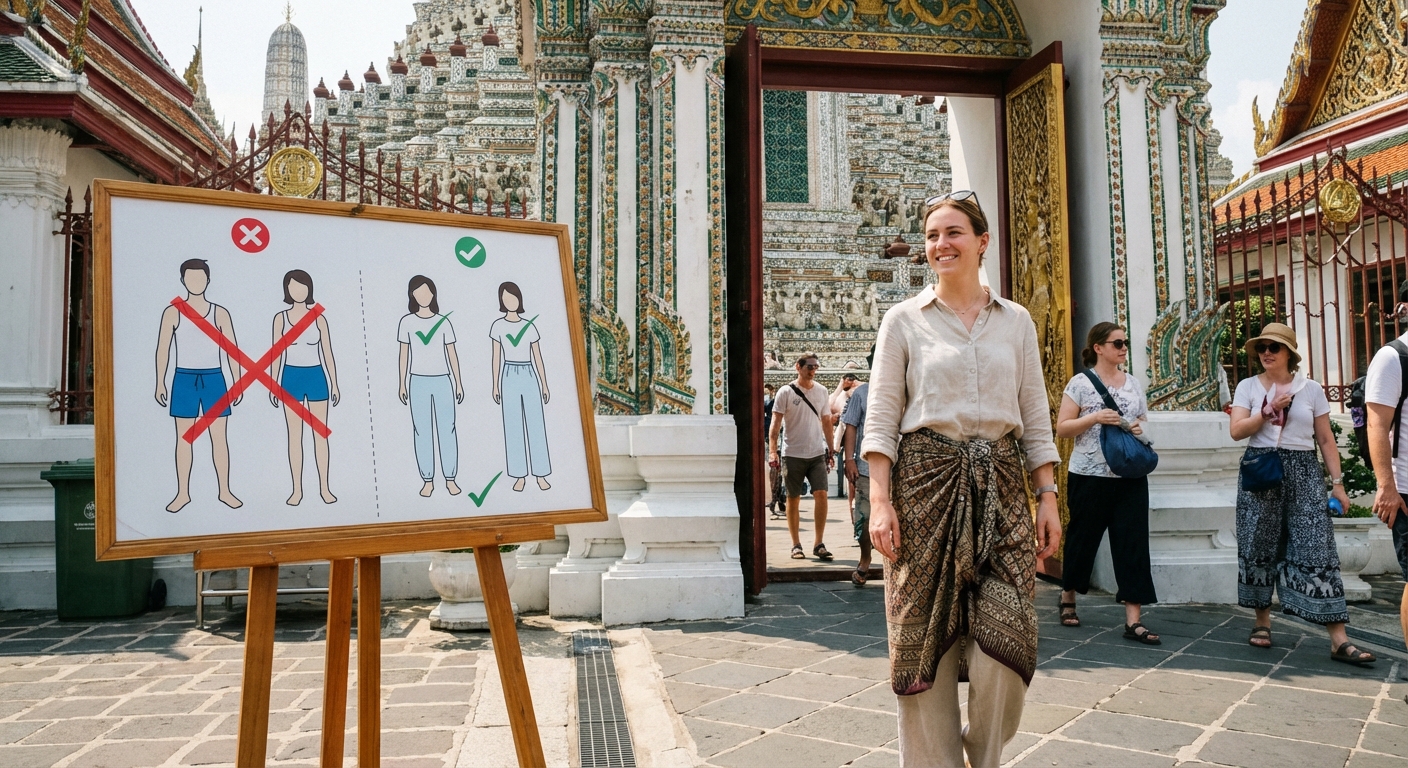
Temple dress code
Every Bangkok temple requires shoulders and knees to be covered. The Grand Palace enforces this strictly: no shorts, no tank tops, no sheer clothes, no sandals. Some temples sell sarongs or wraps at the entrance for 20–100 THB, but bringing your own light trousers or sarong spares you the hassle.
Getting turned away for dress-code violations is also the opening scammers use to redirect you to jewellery shops.
Remove your shoes before entering any temple building. Non-negotiable.
Essentials
Light, breathable clothing (cotton or linen) for the heat. Comfortable walking shoes for uneven pavements and temple grounds. A compact umbrella or waterproof shell for sudden downpours. Sunscreen (bring it from France; it’s two to three times more expensive in Thailand). A reusable water bottle. A photocopy of your passport stored separately from the original. A small cross-body bag for crowded markets and transport.
Power adapters: Thailand uses plug types A, B, C and O. Most European two-pin plugs (type C) fit without an adapter in type C and O outlets. Bring a universal adapter just in case for places that have only US-style sockets.
Mosquito repellent: buy it locally in any 7-Eleven or pharmacy. Thai brands are effective and cheap. Dengue is a real risk, especially in the rainy season.
Best time to visit Bangkok
Cool season: November to February
The best weather. Temperatures drop to 25–32 °C, humidity falls and rain is rare. December and January are the most pleasant months. The downside: it’s peak tourist season, hotel prices rise and popular sites are crowded. It also overlaps with the French Christmas and February school holidays, driving up flight demand.
Hot season: March to May
Temperatures hit 35–40+ °C with oppressive humidity. Outdoor sightseeing between noon and 3 p.m. is hard to bear. April brings Songkran, the Thai New Year water festival: three days of giant water fights in the streets, if you don’t mind being soaked constantly. Crowds during Songkran are intense.
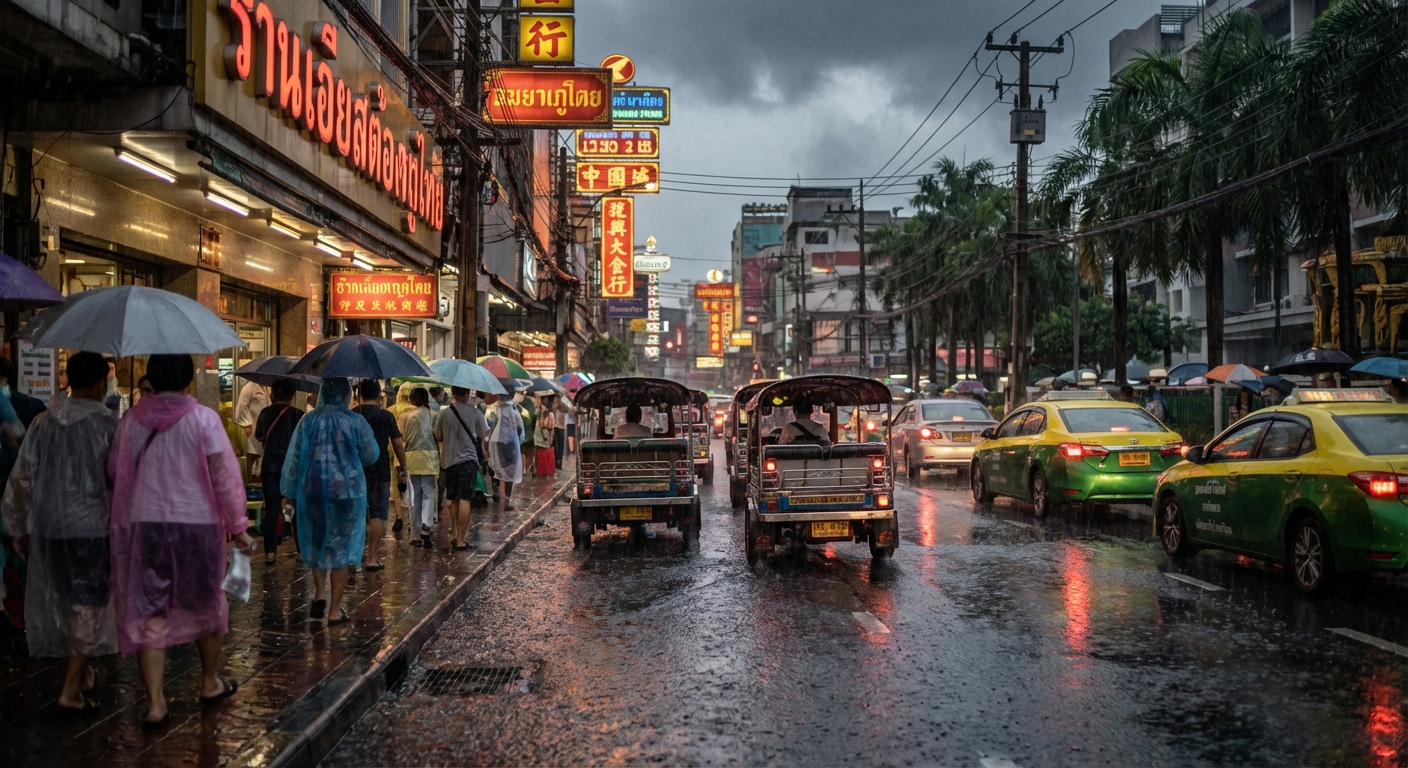
Rainy season: June to October
Daily afternoon thunderstorms lasting one to two hours, then the sky clears. Mornings are usually dry. Temperatures run 28–35 °C. September and October are the wettest months, with occasional flooding in low-lying areas.
The upside: hotel prices drop significantly, tourist crowds thin out and the rain rarely ruins a whole day. If you’re on a tight budget, the rainy season offers the best value for money.
Many four-star hotels that list 3,000 THB a night (€79) in January fall to 1,500 THB (€40) in July. Bring a good rain jacket and plan indoor activities (malls, cooking classes, massage sessions) for the afternoon when the downpour hits.
Useful apps to download before you go
Grab (ride-hailing and food delivery, the most useful app). Bolt (cheaper alternative to Grab). Google Maps (reliable for BTS, MRT, bus and boat routes in Bangkok). MuvMi (electric tuk-tuk app for Sukhumvit and Ari). ViaBus (real-time bus tracker). Line (messaging app widely used in Thailand, more than WhatsApp; some hotels and shops communicate only via Line). Airalo or MobiMatter (buying an eSIM if you prefer that to a physical SIM). XE Currency (THB/EUR converter for checking prices in real time).
If you’re heading south
Many travellers pair Bangkok with a stay on the Thai islands. If Phuket is the next stop on your itinerary, our practical guide to planning a trip to Phuket covers flights from Bangkok, ferries and island logistics. For a completely different Southeast Asian experience, our Bali trip-planning guide covers the visa, budget and transport differences you’ll encounter there.
Return to our comprehensive Bangkok travel guide for a city-wide overview.
If you’re continuing to Vietnam, read our practical guide to planning a trip to Hanoi.