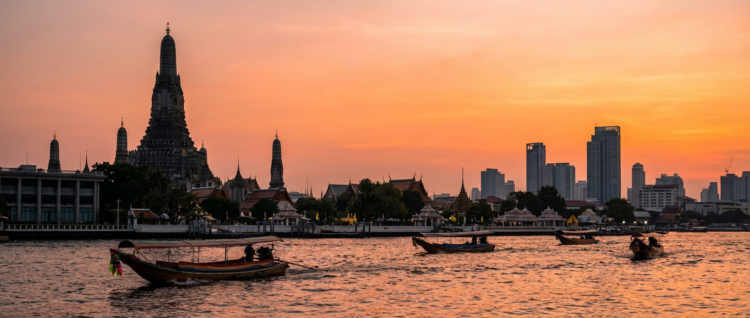
Bangkok has 2 sides: monks collecting alms at dawn along quiet canal-side lanes, and midnight food stalls on Yaowarat Road, where smoke from charcoal grills fills the entire block. It’s noisy, hot, sometimes stifling, and one of Southeast Asia’s most striking cities.
Here’s what I recommend for your visit to Bangkok: temples worth the trip, the right neighborhood, street food for next to nothing, and practical tips to save you plenty of hassle, with a detailed guide linked for each topic.
- What to see in Bangkok?
- What to eat in Bangkok?
- What to do in Bangkok?
- What to do in Bangkok at night?
- What to do around Bangkok?
- Where to stay and how much to budget?
- When to go?
- How to get there and get around?
- Is it safe?
- My other Bangkok guides
What to see in Bangkok?
Bangkok (Krung Thep in Thai, officially renamed Krung Thep Maha Nakhon in 2022) is Thailand’s capital and by far its largest city, with around 11 million people in the wider urban area, more than the Greater Paris metropolitan area. The Chao Phraya delta gives it its flat terrain and canals (khlongs), hence its old nickname, the “Venice of the East.”
The old town (Rattanakosin) surrounds the Grand Palace on the east bank, while Chinatown (Yaowarat), to the south, packs gold shops and food stalls into its crowded streets. The modern commercial center stretches east along Sukhumvit Road and the BTS Skytrain, through neighborhoods such as Asok, Phrom Phong, Thong Lor and On Nut. The west bank, Thonburi, is home to Wat Arun in a quieter, more residential setting.
Of more than 400 temples (wats), 3 make up the essential circuit in the old town, within walking or boating distance of each other. You’ll find the dress code and lesser-known spots in my guide to Bangkok’s most beautiful temples.
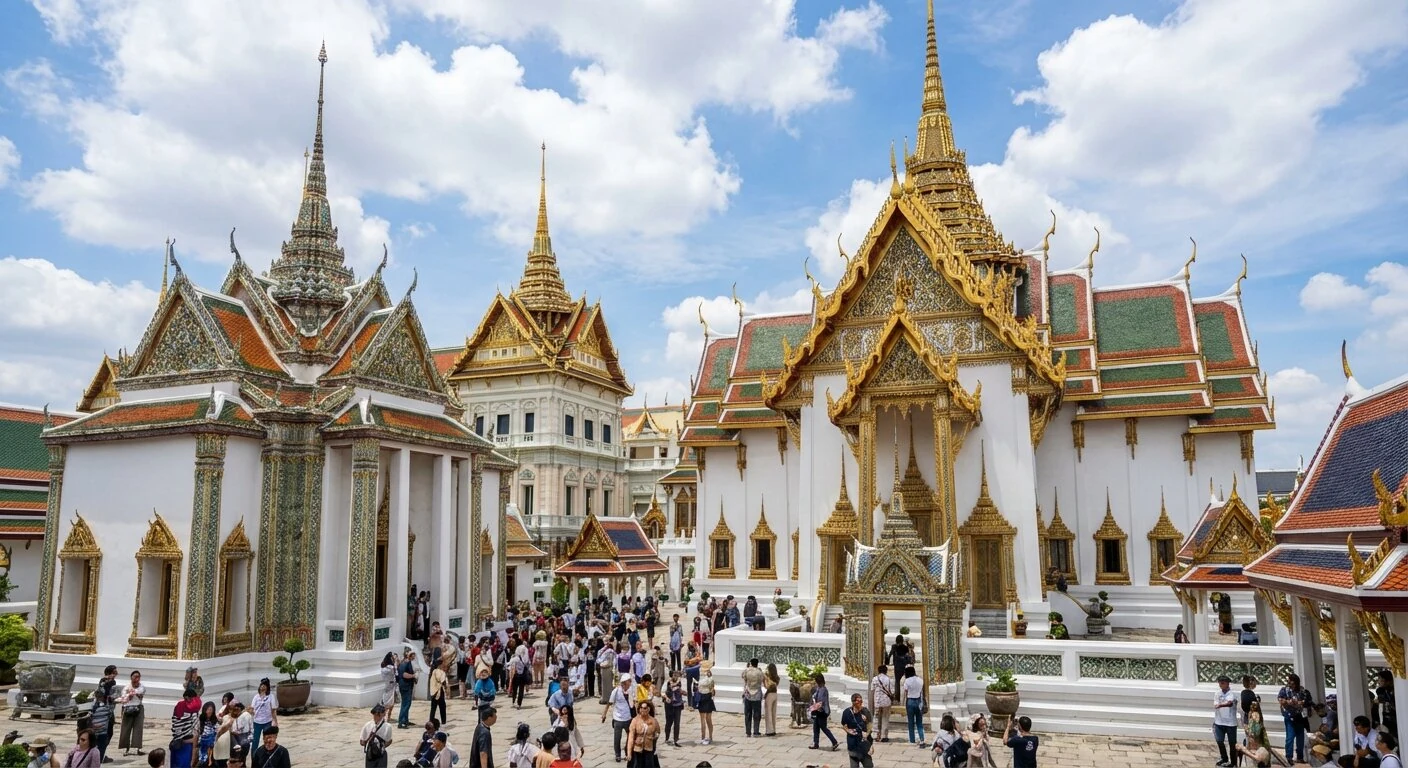
Grand Palace and Wat Phra Kaew
The number 1 attraction, and the most debated. The complex dates back to 1782, when King Rama I made Bangkok the capital by moving the royal court from Thonburi, across the river. Within it, Wat Phra Kaew houses the Emerald Buddha, Thailand’s most sacred religious image. I arrived at opening time, at 8:00, to beat the crowds and the heat: allow at least 2 to 3 hours, keep your knees and shoulders covered, and don’t wear sandals (the dress code is strict). Entry costs 500 baht (around €13), it’s overcrowded and I find it less atmospheric than Wat Pho, but you should see it at least once.
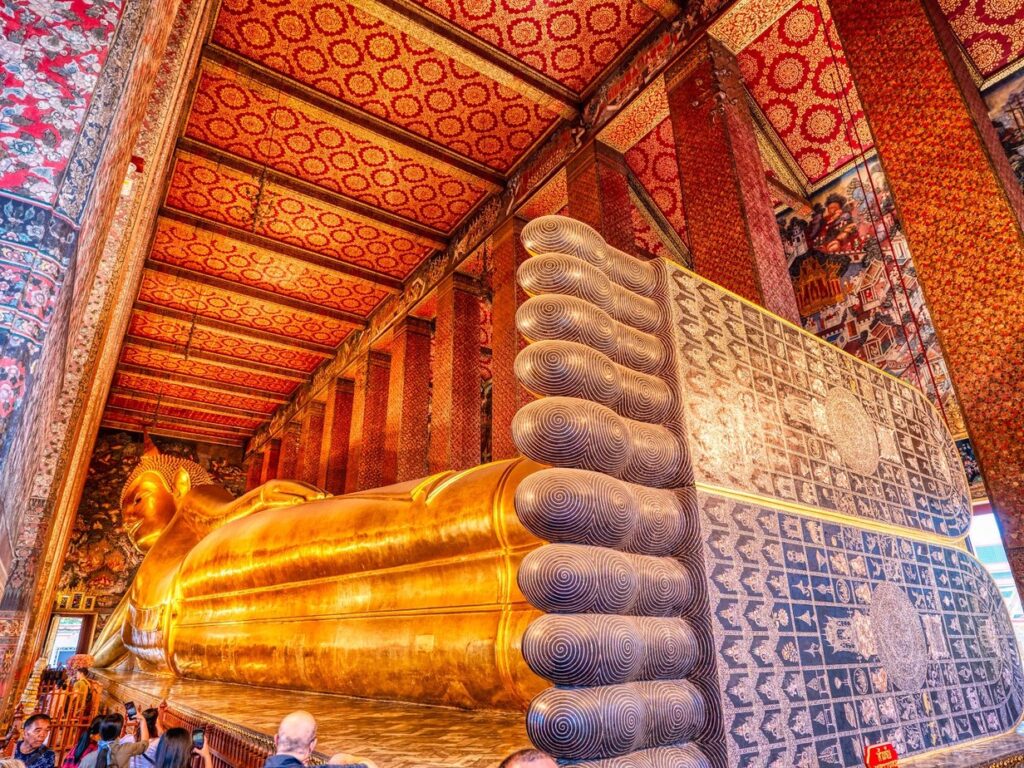
Wat Pho
Right next to the Grand Palace, this is my favorite of the 2: the 46-meter reclining Buddha covered in gold leaf, one of Bangkok’s most photographed sights, set in more spacious, less chaotic grounds. Wat Pho is also the birthplace of traditional Thai massage, and I had a massage right there in the grounds, given by trained practitioners. Combine it with the Grand Palace in a single morning.
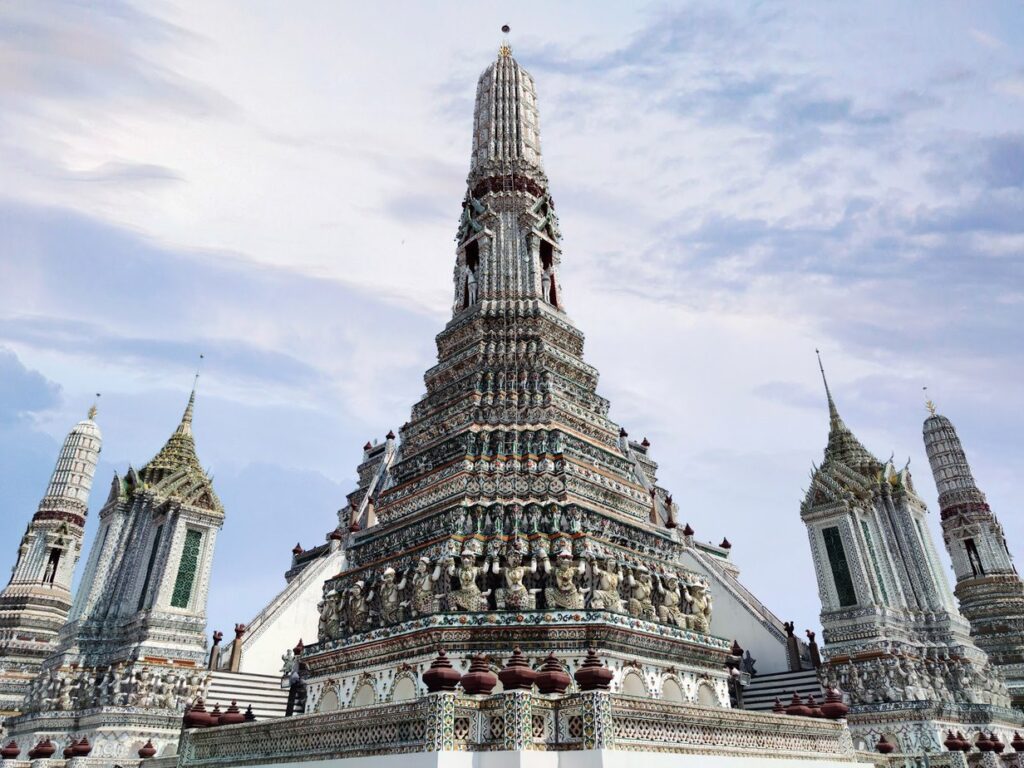
Wat Arun
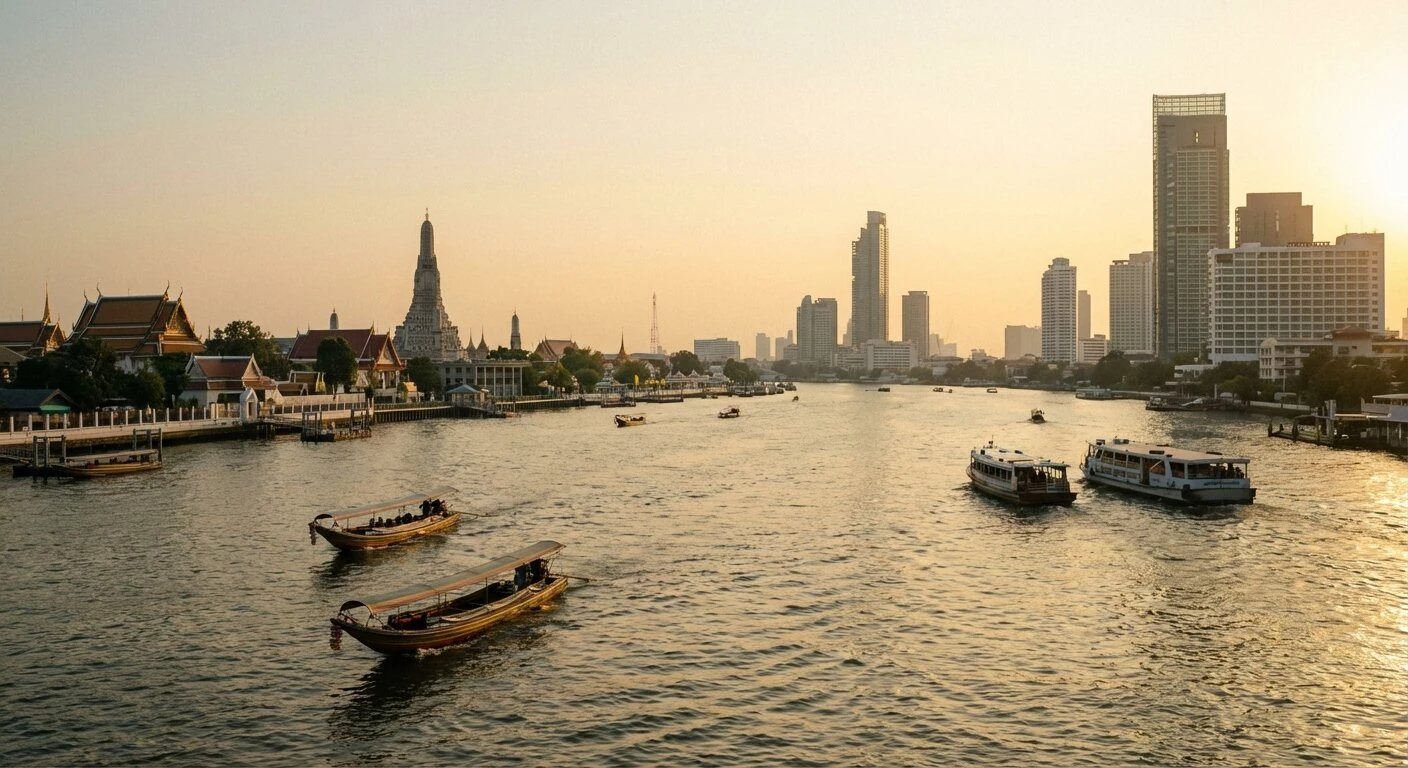
The Temple of Dawn stands opposite Wat Pho, across the river, a short ferry ride away (around 4 baht, a handful of cents). Its central prang (the tower) is covered in Chinese porcelain and colored glass that catch the light, and I climbed its steep steps for the river views. Go in the late afternoon for the golden light, then watch the sunset from the opposite bank, at The Deck restaurant or from the public piers on the Wat Pho side. For me, Wat Arun at sunset is non-negotiable.
Wat Saket and Wat Traimit
After temple number 3, they all start to blur together: “temple fatigue” is very real. Beyond the big 3, I climbed the more than 300 steps of Wat Saket, the Golden Mount, which is less crowded and good exercise, with a 360-degree view over Bangkok’s vast sprawl. Wat Traimit, in Chinatown, houses the world’s largest solid gold Buddha statue (5.5 tonnes), a quick visit to combine with a food tour of Chinatown. My temple guide covers other options, including Jim Thompson House, the Erawan Shrine and lesser-known temples.
What to eat in Bangkok?
For me, eating is Bangkok’s main attraction: you can eat very well for next to nothing, with an almost unbelievable variety on any street. Specific restaurants and food courts, neighborhood by neighborhood, are in my guide to where to eat in Bangkok; here are the Thai dishes you absolutely must try.
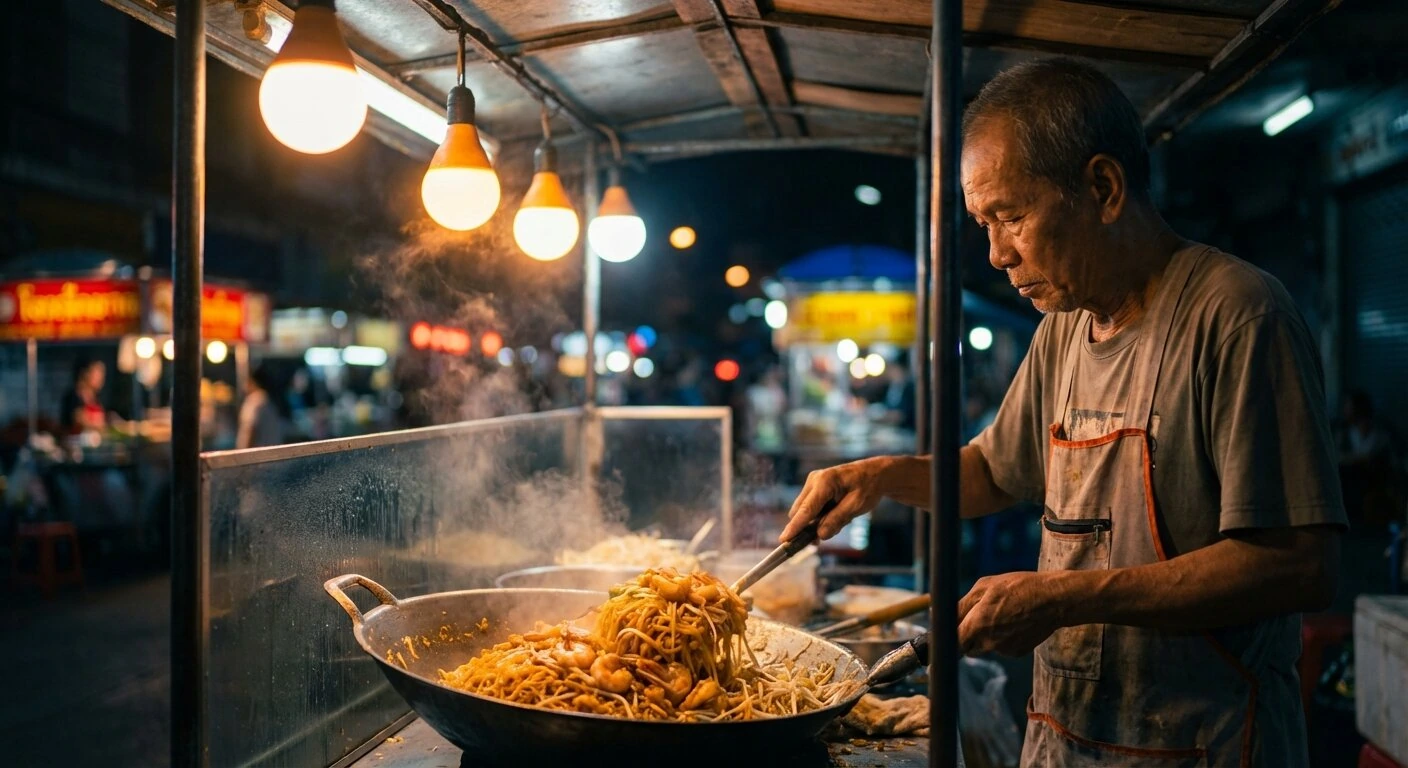
Moo ping, grilled pork skewers, can be found on practically every street corner, especially in the morning: sweet, lightly caramelized, served with sticky rice, at 10-20 baht per skewer (less than €0.50). Start here if street food intimidates you; I make them at home, and my moo ping recipe is here.
Boat noodles come in small bowls with a rich, dark broth, at 15-20 baht each (around €0.40-0.50): I ordered several to try the variations, which is the whole point of the small portions. Pad kra pao, a holy basil stir-fry over rice, usually with minced pork or chicken and a fried egg on top, is the go-to lunch for Thai office workers. If you’re not used to Thai chilies, ask for “phet nit noi” (a little spicy), and to make it at home, my chicken pad kra pao recipe is on the site.
Pad thai is nice, and you can have it if you feel like it, but in Bangkok I prefer pad see ew, noodles with soy sauce that are more representative of Thai noodles. In any case, avoid the versions on Khao San Road, and branch out beyond pad thai with pad kra pao, boat noodles, moo ping and khao soi.
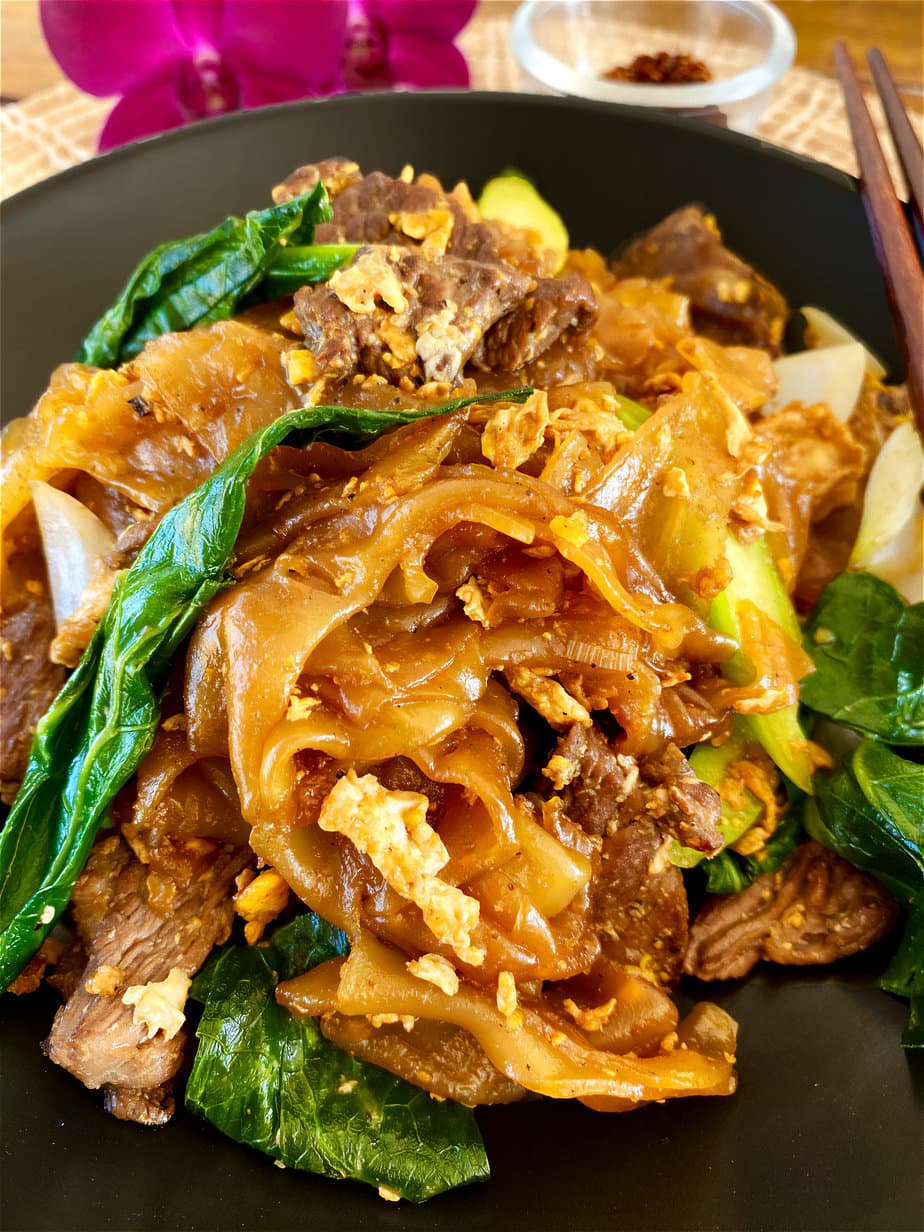
Khao soi, a curry noodle dish from northern Thailand, combines soft and crispy noodles in a coconut-based broth: I found it in food courts such as Pier 21, at Terminal 21. Mango sticky rice, sticky rice soaked in sweetened coconut milk with slices of ripe mango, is the dessert I recommend without hesitation. You’ll find it everywhere, the street vendors’ versions are usually the best, and my mango sticky rice recipe is here.
Chinatown (Yaowarat Road)
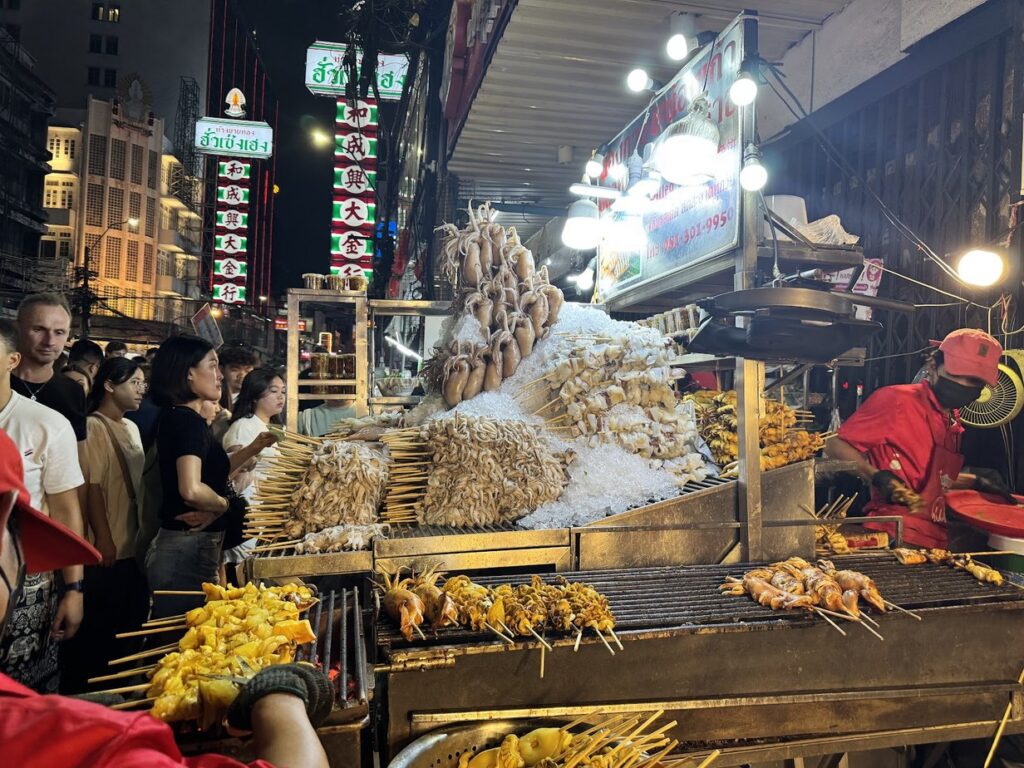
For me, the undisputed champion of food in Bangkok. I went in the evening, when the street fills with vendors: grilled seafood, Chinese-style noodle soups, mango sticky rice to eat as you wander, and dozens of other dishes. Budget 200-400 baht (€5-10) for a generous food crawl across several stalls; some are closed on Mondays.
Pier 21, at Terminal 21
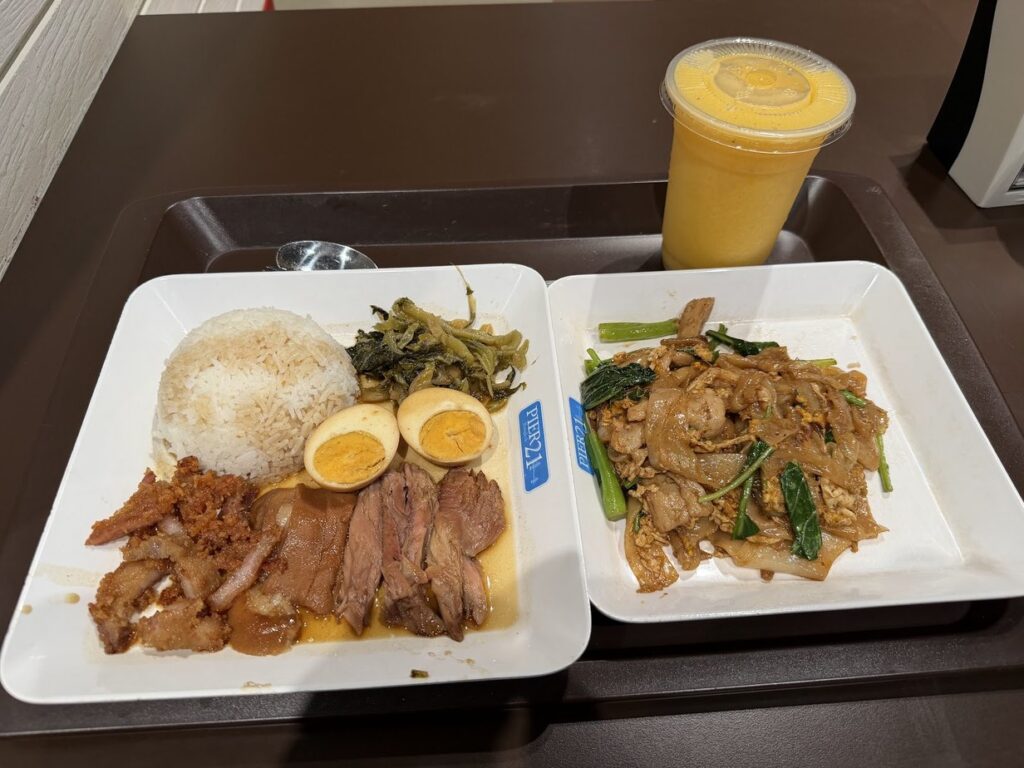
My go-to spot for cheap food in Bangkok: the Pier 21 food court at Terminal 21, on the top floor of the mall, at Asok BTS station. Meals cost 30-50 baht (around €0.80 to €1.30), it’s clean, air-conditioned, and the variety is enormous. I loaded money onto a rechargeable card at the counter, and any unused balance can be refunded when you leave.
Jodd Fairs and IconSiam
Jodd Fairs (Rama 9), near Rama 9 MRT station, is my favorite night market for food. It has largely replaced older markets such as the Train Night Market: cleaner, more modern, more polished and photogenic, with a good selection of stalls. At IconSiam’s ground-floor food court, real street food vendors cook inside a luxury mall. These food courts are excellent, cheap and clean, and they’re an integral part of Bangkok’s food culture.
In terms of hygiene, street food is safe at busy stalls with a line of Thai people waiting. The ice is commercially made (produced in factories, without tap water), so iced drinks are no problem, but avoid tap water and raw salads if you have a sensitive stomach. My common-sense rule: “Follow the locals. If you see a line of Thai office workers, join it.”
What to do in Bangkok?
Bangkok has enough to keep you busy for weeks. My guide to activities in Bangkok covers each topic in detail; here’s what I prioritize.
Chatuchak and Or Tor Kor
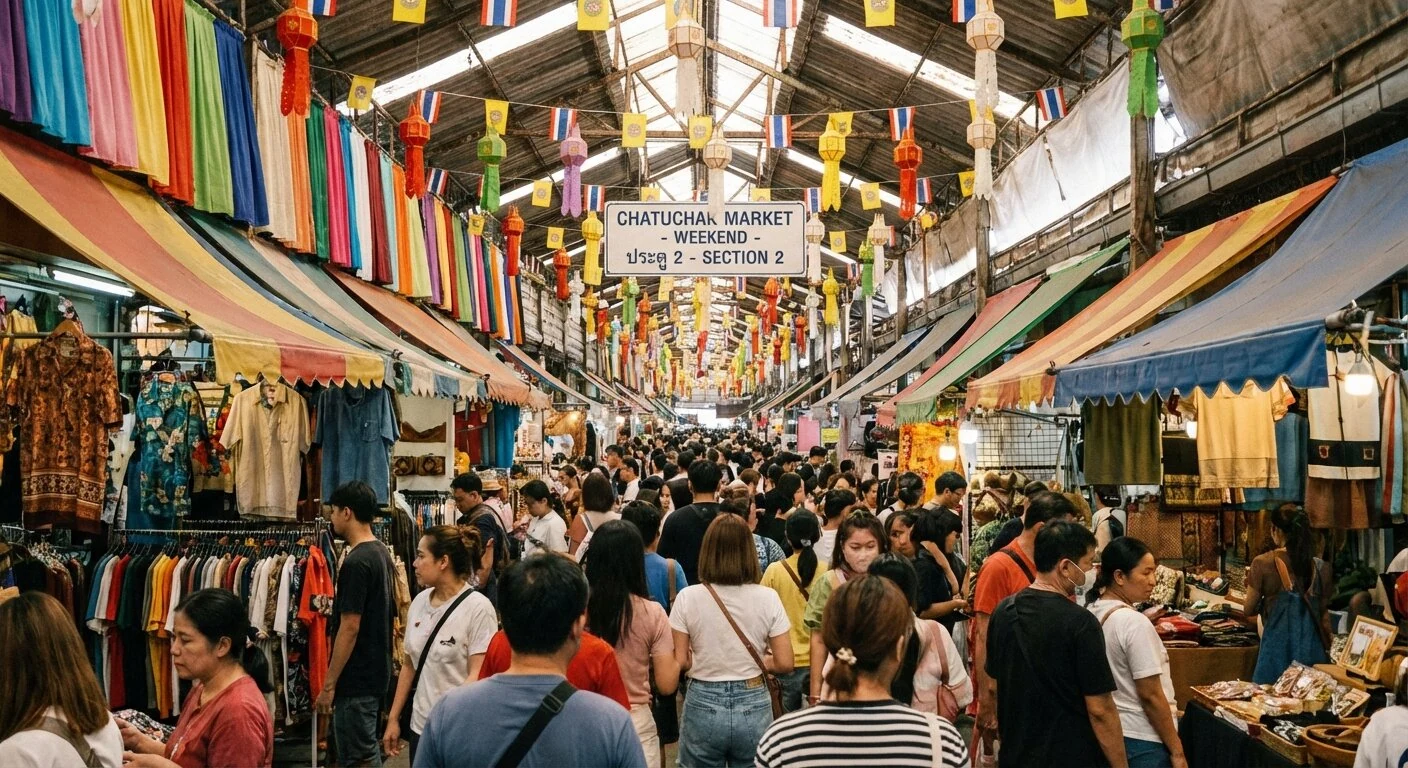
Chatuchak Weekend Market, one of the world’s largest open-air markets, has more than 15,000 stalls selling vintage clothing, handmade ceramics, plants and much more. It only opens on Saturdays and Sundays, and I went early in the morning, before the heat made the narrow aisles unbearable. Right next door, Or Tor Kor Market is a food market with high-quality tropical fruit: try mangosteen, rambutan, and durian if you’re feeling adventurous.
Shopping malls, from Siam to Terminal 21
Terminal 21 has a different world city as the theme of each floor, and its architecture and decor are worth a look beyond the Pier 21 food court. For air-conditioned shopping, the Siam neighborhood has everything you need: Central World and Siam Paragon are the flagship malls, while MBK Center is best for cheap souvenirs, electronics and bargaining. Platinum Fashion Mall is my go-to for wholesale and low-cost clothing.
Lumphini Park and Benchakitti Forest Park
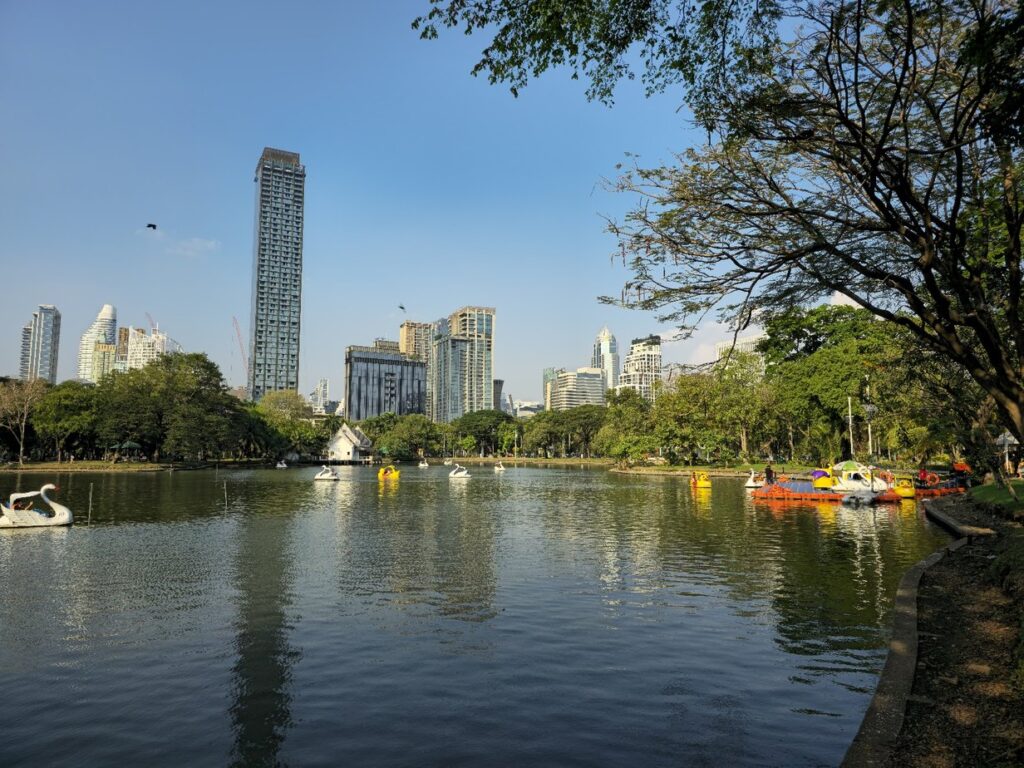
Lumphini Park, Bangkok’s largest central park, is a bit like a tropical version of the Bois de Boulogne: morning walks, pedal boats on the lake, tai chi at dawn, and wild monitor lizards roaming freely, which I spotted there, harmless but impressive. Benchakitti Forest Park has a recently expanded elevated walkway through wetlands right in the city center: admission is free, and an evening stroll with skyline views at sunset is worth the detour.
Bang Krachao
Bangkok’s “Green Lung” is a jungle island in a bend of the Chao Phraya. I rented a bike at the pier and cycled through mangroves and small communities, feeling as though I’d left Bangkok: a half-day outing, ideal on weekdays when Chatuchak is closed.
Thonburi and Talad Noi
On the west bank, I took a boat ride along Thonburi’s khlongs: traditional stilt houses, small temples and daily life along the canals. The Jim Thompson House museum is a preserved teak house with an intriguing disappearance story and shady gardens, while Talad Noi, the photogenic old neighborhood near Chinatown, mixes street art and trendy cafés.
What to do in Bangkok at night?
Nightlife is spread across neighborhoods, each drawing a different crowd. Thong Lor and Ekkamai are where Bangkok’s young professionals go: craft cocktail bars, Japanese-influenced restaurants and clubs. Khao San Road is the classic backpacker party strip, with cheap drinks, loud music and everyone packed into the street.
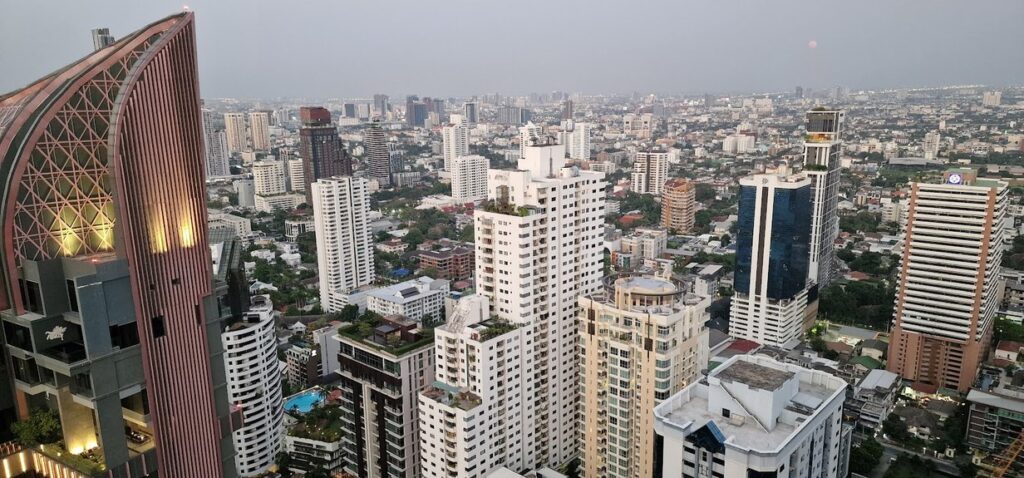
Khao San is chaotic: 30 minutes was enough for me, then I retreated to the quieter parallel street, Soi Rambuttri, for a more relaxed beer. For rooftop bars, I went up to Octave, at Marriott Sukhumvit, for its 360-degree views and a calmer atmosphere than some of the more popular spots. Tichuca is popular for its glowing jellyfish-shaped decorations, but fills up very quickly.
The Deck, directly opposite Wat Arun, is my go-to for a sunset drink, with the illuminated temple across the river. Two typically Bangkok experiences are also worth it: a Muay Thai fight (several stadiums host them regularly, and the atmosphere is intense) and a Khon performance at the Royal Theatre, a traditional Thai masked dance offering a completely different side of the culture. More options for going out in my activities guide.
What is there to do around Bangkok?
Around Bangkok, I recommend 4 excursions. The city is also a starting point for exploring the rest of Thailand.
Ayutthaya
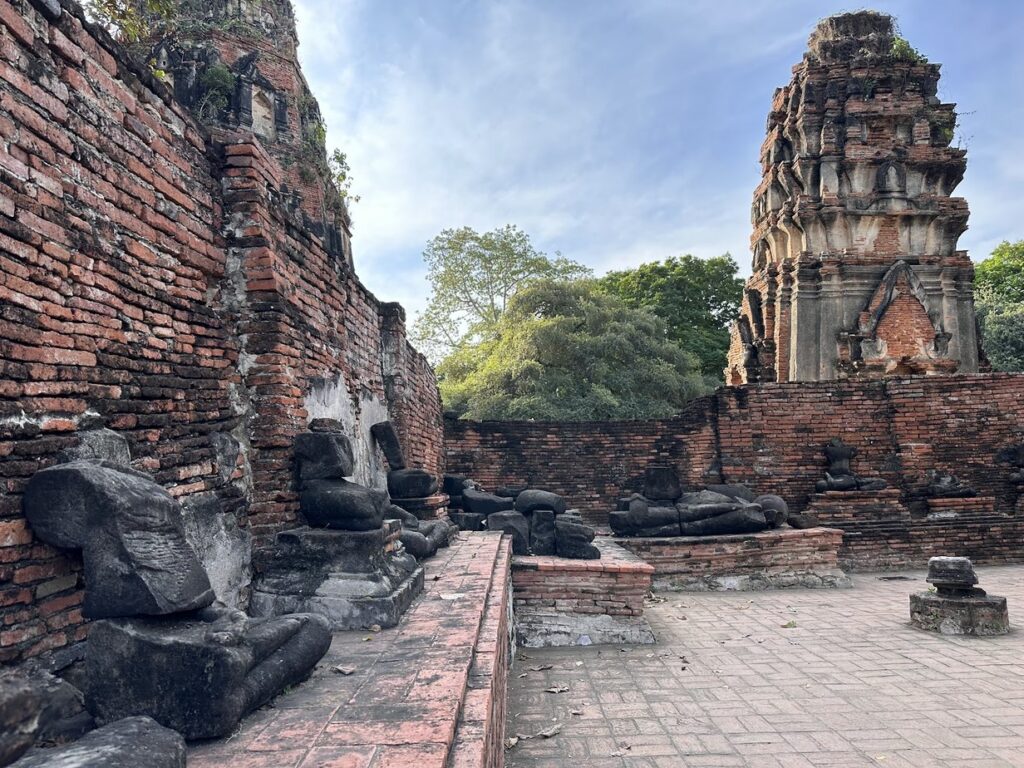
For me, this is the best day trip from Bangkok: the ruins of the former Thai capital, destroyed by the Burmese in 1767, its ancient temple complexes, its Buddha heads entwined in tree roots and its crumbling palace walls. I went by train, early in the morning: departures from Hua Lamphong or Bang Sue station, 15-20 baht (less than €0.50), around 1 hour 30 minutes, and you can also hire a driver.
Once there, hire a tuk-tuk or a bicycle: Wat Mahathat (the famous Buddha head in the tree roots), Wat Phra Si Sanphet and Wat Chaiwatthanaram are the main sights. Allow a full day, returning to Bangkok in the late afternoon, then rest at your hotel and have a quiet dinner near your accommodation.
Floating markets
Make your own way to Khlong Lat Mayom (weekends, close to the city, popular with locals) or Amphawa (evening market, fireflies, Friday to Sunday). Avoid Damnoen Saduak, the most commercialized floating market and a tourist trap, especially if booked through an agency: organized tours add a hefty markup.
Kanchanaburi and the Ancient City
Kanchanaburi has the Bridge on the River Kwai and World War II history. It is farther away than Ayutthaya (around 2-3 hours of travel), so spending a night there makes sense. The Ancient City (Muang Boran), a huge open-air museum on the outskirts of Bangkok, recreates Thailand’s most famous temples and historic buildings on a smaller scale: rent a golf cart and spend a full day there to enjoy temple architecture without the crowds at the actual sites.
After Bangkok: Chiang Mai, the islands, Phuket and Bali
4 to 5 days is how long I recommend spending in Bangkok before heading to the islands, Chiang Mai or elsewhere in Thailand. The city has 2 airports (Suvarnabhumi for international flights and most domestic flights, Don Mueang for budget airlines like AirAsia and Nok Air), plus trains and buses to destinations across the country.
You can reach Chiang Mai by plane (1 hour) or overnight sleeper train (12-13 hours), an experience in itself that saves you a night in a hotel. Book early on 12Go.asia or the official D-Ticket website, because the overnight sleeper train to Chiang Mai fills up weeks ahead in high season, and avoid random street-side “travel agency” counters and their hefty markups. For the southern islands (Koh Samui, Koh Phangan, Koh Tao), fly to Surat Thani then take a ferry, or get a combined bus-ferry ticket. Krabi is a 1 hour 30 minute flight away, followed by a longtail boat to Railay Beach.
If Phuket is on your list, allow 1 hour 30 minutes by plane or 12 hours by overnight bus; my complete guide covers its beaches, food and logistics. Bali, around 4 hours 30 minutes away by direct flight, is often combined with Thailand: Bangkok for urban energy, temples and food, Bali for rice terraces, beach culture and a slower pace.
Where should you stay, and what should you budget?
Your neighborhood shapes your entire stay, and my number 1 rule is to stay near a BTS or MRT station: a hotel that looks great and cheap but is a 20-minute walk from the nearest BTS station will cost you hours in traffic every day, so pay a little more to be 5 minutes from a station. I compare prices on Booking.com and Agoda (very popular in Asia) to take advantage of deals. Each area is covered in detail in my guide to where to stay in Bangkok.
Sukhumvit (Asok and Phrom Phong)
My recommendation for a first visit, and the neighborhood where I stayed. Asok is where the BTS and MRT lines meet, with Terminal 21, restaurants and nightlife within walking distance. Phrom Phong, 1 stop farther east, is slightly more upscale, with good cafés, the EmQuartier shopping mall and Benjasiri Park. Avoid lower Sukhumvit (Soi 4-23, around Nana) if the red-light district does not interest you.
Silom and Sathorn
The central business district, connected to the BTS and MRT and close to Lumphini Park, combines local street food with more refined restaurants. Its well-lit streets and good sidewalks make it a good choice for solo travelers, particularly women traveling alone.
Riverside
Quiet, with a resort-like atmosphere, this is the luxury hotel district (Mandarin Oriental, Shangri-La, Peninsula). The trade-off: boats or long taxi rides to reach the malls and modern city center, so stay near Saphan Taksin BTS station to have access to both trains and boats.
The Old Town (Rattanakosin)
Within walking distance of the Grand Palace, Wat Pho and Khao San Road, ideal if temples are your priority. The downside: no BTS, limited MRT coverage, and taxis or buses to reach the rest of the city.
On Nut, Phra Khanong and Ari
Farther east along the BTS line, On Nut and Phra Khanong have lower prices, excellent local food markets and a growing community of expats and digital nomads. W District, in Phra Khanong, has an outdoor food court and a beer garden that is popular in the evenings, and around Tesco Lotus in On Nut, a full meal costs less than 50 baht (€1.30) at the street food stalls. The BTS journey toward the Old Town is longer (around 30 minutes to Saphan Taksin for the boats), but daily life here feels more like the “real Bangkok,” ideal for a longer stay or if you are watching your budget.
Ari, on the BTS line, has tree-lined streets, independent cafés, a local feel and very few tourists. Thong Lor and Ekkamai are where Bangkok’s wealthy young crowd goes for nightlife and upscale dining, with good brunches in Thong Lor.
Budget-wise, you can get by on 500-1,000 baht per day (€13-26): street food, hostels, public transport and free temple grounds. A mid-range budget is around 2,000-3,000 baht per day (€53-79), with decent hotels, street food and restaurants, occasional Grab rides and paid temple entry. A comfortable budget starts at 5,000 baht per day (€130 and up): riverside hotels, fine dining, private transport and rooftop bars. A 1-hour Thai foot massage costs 200-400 baht (€5-10), so a daily massage counts as recovery for your feet.
When should you go?
Bangkok has 3 seasons, all shaped by heat and water. From November to February, the cool, dry season brings the most pleasant months: 25-32 °C, manageable humidity and little rain. But this is high season, with higher hotel prices, crowds at the main temples and peak demand for direct flights from Paris.
The hot season, from March to May, regularly reaches 35-40 °C, and April is the hottest month: outdoor sightseeing only before 9:00 or after 17:00. Songkran, the Thai New Year and its water festival in mid-April, is worth braving the heat if you do not mind getting soaked from head to toe.
From June to October, the rainy season brings afternoon showers, usually lasting 30 to 60 minutes, then the sky clears, and mornings are generally clear. Hotel prices drop, the temples are less crowded and the city turns green: I do not find it a deal-breaker.
Whatever the time of year, the heat dictates your schedule, and the phrase I keep in mind is this: “Do not overplan. The heat is in charge.” My routine: outside early in the morning (by around 11:00, you are drenched in sweat), indoors during the peak heat from 13:00 to 16:00 (an air-conditioned mall, museum or massage parlor), then outside in the evening, when the temperature drops and the street food stalls light up. It is the locals’ rhythm, and it works.
My golden rule: 1, at most 2 major activities per day, grouped by area, without traveling back and forth between opposite ends of the city on the same day. 3 temples, 2 markets, 1 cooking class and 1 rooftop bar in the same day sounds ambitious on paper. In 35 °C heat and high humidity, it is a recipe for exhaustion: plan air-conditioned breaks and a 1-hour foot massage in the middle of the day to recover.
How do you get there and get around?
French citizens qualify for a visa exemption on arrival for 30 days (extended to 60 days in recent years: check the current policy on the Thai embassy in France’s website before booking), with no paperwork required beforehand. At immigration, keep your passport, a return or onward flight booking and your hotel address handy. To stay longer, you can get a visa extension at Bangkok’s immigration offices, or do a “border run” to a neighboring country.
Most flights from Paris-CDG land at Suvarnabhumi, often via a layover in Doha, Dubai or Singapore, and immigration generally goes smoothly, despite long queues at peak times (from midnight to 2:00, when these flights arrive). I took the Airport Rail Link (ARL) into the city center, the cheapest and fastest option, which connects to the BTS at Phaya Thai and the MRT at Makkasan. For a taxi, head to the official rank on the ground floor of arrivals and ignore anyone offering rides in the arrivals hall upstairs: the standard fare is the meter, plus a 50 baht airport surcharge, plus tolls. With heavy luggage or a hotel far from a station, a taxi or Grab is more practical than dragging your suitcases through connections.
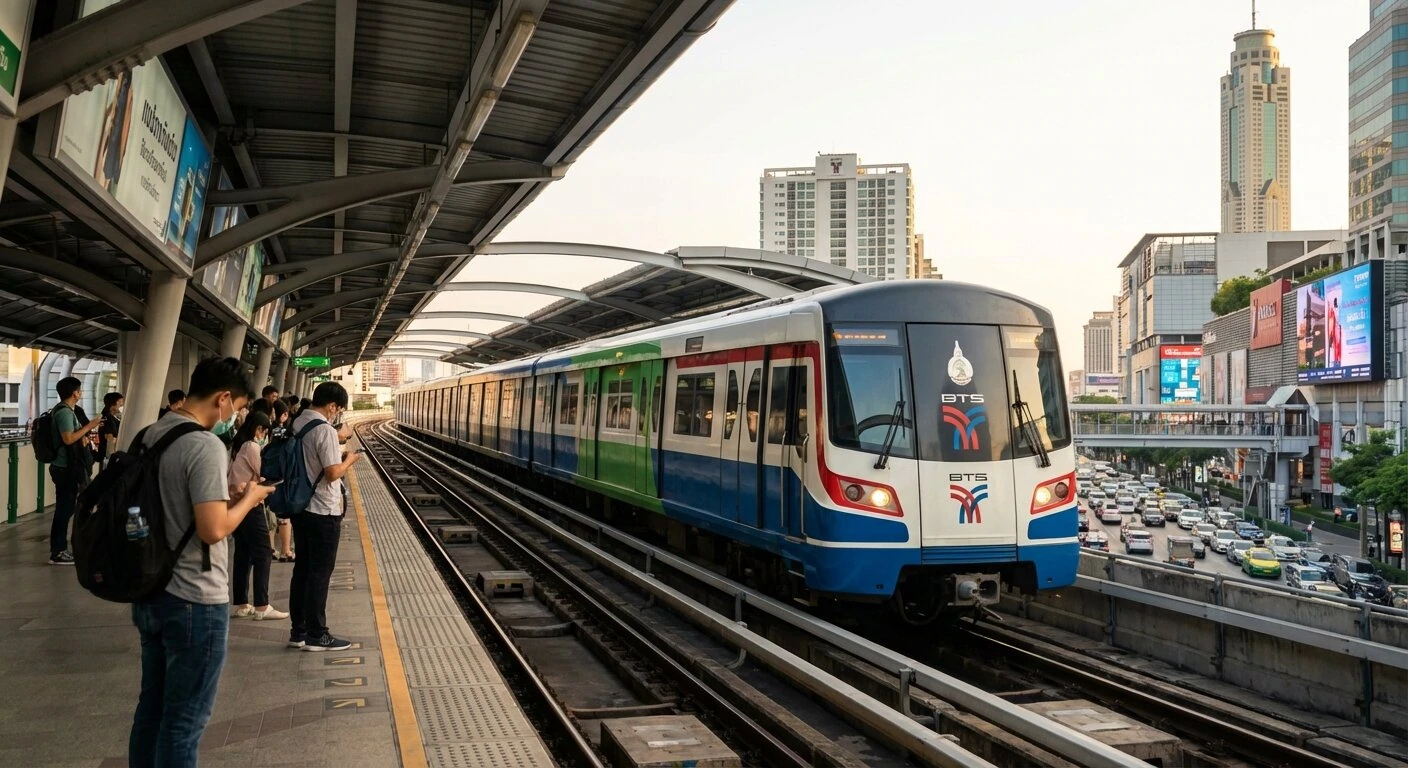
Bangkok’s traffic jams are legendary: 5 kilometers by car can take 90 minutes at rush hour, so between 7:00 and 9:00 and between 17:00 and 19:00, avoid all road transport: stick to the BTS, MRT or walking. The BTS Skytrain (above ground, 2 lines) and the MRT (underground) are fast, air-conditioned, cheap (16-59 baht per trip, or €0.40 to €1.50) and together cover much of the city. Buy single-trip tokens at the machines, or a Rabbit card (BTS) for convenience.
The orange-flag Chao Phraya Express Boat services, connected to Saphan Taksin BTS station, are the best way to reach the old town’s temples, with a pleasant ride along the river. Around 16 baht per trip (€0.40).
Grab and Bolt are Southeast Asia’s ride-hailing apps, the equivalent of Uber, which doesn’t operate in Thailand. Grab is more reliable and more widely used, while Bolt is often cheaper but has fewer drivers. Both give you a fixed price upfront and GPS navigation, with no language barrier or haggling. Download both before leaving France, along with Google Maps and Google Translate.
Tuk-tuks are fun for short trips, as long as you always negotiate the price before getting in. A driver offering you a suspiciously cheap 10-20 baht ride will take you on a forced detour to gem shops and tailors where he earns a commission: politely decline and move on.
For mobile data, buy an AIS or True Move SIM card in the airport arrivals hall or at any 7-Eleven. A tourist SIM with 1 to 2 weeks of data costs a few hundred baht (€5-10) and makes GPS navigation and booking a Grab easier.
Seemingly on every street corner, 7-Eleven stores serve as convenience stores, SIM card shops, air-conditioned pit stops and cheap places to eat: hot meals (toasted sandwiches, rice dishes), electrolyte drinks to recover from the heat, toiletries, and pretty much anything you forgot to pack. I took refuge in them just for the air conditioning, a perfectly legitimate survival strategy in the heat.
Is it safe?
Bangkok is very safe by big-city standards: violent crimes against tourists are extremely rare, and the risks are financial (scams, overcharging) rather than physical. Don’t wear flashy jewelry (snatch theft by motorcycle is the only real street crime risk) and don’t get into arguments with locals. The advice I keep in mind is: “If an argument starts, leave.”
Cash is essential: street food stalls, tuk-tuks, small shops and markets operate on cash only, and only shopping malls and upscale restaurants accept cards. Thai ATMs charge a flat fee of 220 baht (around €6) per withdrawal, regardless of the amount, on top of any fees from your bank in France: withdraw the maximum allowed (20,000-30,000 baht, or €530-790) each time, and always keep a few hundred baht in your pocket.
Krungsri Bank ATMs (yellow) allow higher withdrawal limits. When the screen offers a currency conversion, always choose “Thai Baht”: the “Euro” option is a markup scam called Dynamic Currency Conversion. SuperRich exchange bureaus in shopping malls offer better rates than airport counters or ATMs, and cards with no foreign transaction fees (Boursorama, Revolut, N26) cut costs significantly; all the details are in my guide to planning a trip to Bangkok.
Scams follow predictable patterns. The most common: a well-dressed person approaches you near the Grand Palace, tells you it’s closed for a “Buddhist holiday” or “cleaning” and offers to take you to a gem shop or tailor. The Grand Palace is never closed for these reasons: ignore them and go straight to the ticket counter.
The friendly stranger who approaches you uninvited near a tourist attraction, speaking confident English, is setting a trap, as Thai people are generally reserved with strangers. The opening line is usually “Where are you from?”, followed by an increasingly elaborate pitch: smile, say “No thanks” and keep walking, because politely stopping to listen is exactly what these touts need.
Some taxi drivers refuse to use the meter and offer a fixed fare, which is always higher: get out and find another taxi, or take a Grab. In Patpong and other nightlife districts, touts sell tickets to “shows”, traps where you’ll be locked in a room and forced to pay thousands of baht for drinks you didn’t order. Ground-floor bars in established areas like Soi Cowboy are generally transparent about prices.
A “government-sponsored gem sale” or a once-in-a-lifetime deal on tailored suits is a commission scheme: keep walking. For a tailored suit in Bangkok, choose the tailor yourself, using Google Maps reviews and travel review sites.
As for health, no vaccinations are mandatory, but check the latest recommendations on the Institut Pasteur or Santé publique France website. Your European Health Insurance Card (EHIC) doesn’t cover Thailand: make sure you take out travel insurance, with Chapka (Cap Assistance), ACS or AXA, for example, covering medical expenses, repatriation and cancellation for Southeast Asia. Bangkok’s private hospitals (Bumrungrad, Bangkok Hospital) are excellent but expensive without insurance.
The monarchy is deeply respected, and lèse-majesté laws are strict and enforced: never speak negatively about the royal family, and never step on Thai money, which bears the king’s image. In temples, cover your knees and shoulders, remove your shoes before entering any building, and don’t wear tank tops or short shorts; vendors outside temples sell cheap “elephant pants” if your outfit isn’t suitable. Don’t touch anyone’s head (it’s considered sacred) or point your feet toward people or images of Buddha (feet are the lowest part of the body).
My other Bangkok guides
For more detail, I’ve written guides to where to eat in Bangkok, where to stay in Bangkok, what to do in Bangkok, Bangkok’s most beautiful temples and planning a trip to Bangkok, covering budgets, visas and seasons. If you’re continuing on to Vietnam, my complete guide to visiting Hanoi covers the other major Southeast Asian capital. To recreate what you ate in Bangkok at home, start with my guide to Thai cuisine.