Bali has a way of overwhelming first-time visitors. Between temple circuits, waterfall chasing, surf lessons, volcano hikes, and cooking classes, most people try to cram two weeks of activities into five days and end up spending more time stuck in traffic than actually doing anything. The trick is knowing what’s genuinely worth your time and what’s become popular only because it looks good on Instagram.
This guide covers 20 activities and excursions that are worth your time, with honest takes on which ones live up to the hype and which you can skip. If you’re still planning your trip, check out our complete guide to visiting Bali for logistics, itineraries, and budget tips.
Temples
Bali has thousands of Hindu temples, and your driver will happily take you to a dozen of them in a single day. That’s a mistake. Temple fatigue sets in fast, and most visitors find that two or three well-chosen temples leave a much stronger impression than rushing through seven. Here are the ones that genuinely justify the trip.
Tanah Lot
Tanah Lot is the postcard temple: a small shrine perched on a rock formation just offshore, silhouetted against the sunset. The reality at peak hours is less poetic. You walk through a dense corridor of souvenir stalls to reach a viewpoint packed shoulder to shoulder with tour groups, all jostling for the same camera angle. You can’t actually enter the temple itself.
The secret weapon is timing. Arrive at sunrise instead of sunset and you’ll have the place virtually to yourself. At low tide, you can walk to the base of the rock; at high tide, the temple appears to float above the waves, which makes for the best photo. If you still go at sunset, skip the crowd down below entirely. The clifftop cafes overlooking the site sell cold Bintangs and offer the same view without the jostling.
Uluwatu Temple and the Kecak Fire Dance
Uluwatu sits on a cliff edge about 70 meters above the ocean, and the temple grounds are essentially a short clifftop walk with views south along the coastline. You can’t enter the inner temple. What makes Uluwatu unmissable is the Kecak Fire Dance, performed at sunset in an open-air amphitheater carved into the cliff. About fifty men sit in concentric circles, chanting “cak-cak-cak” while dancers reenact a scene from the Ramayana, and the sun drops into the Indian Ocean behind them. It’s touristy and commercial, and yet genuinely striking.
Two practical warnings. First, the monkeys here are organized thieves. They snatch sunglasses off your face, earrings from your ears, and phones from your hand, then a handler appears to “rescue” your belongings for a fee. Remove everything before entering. Second, getting transport after the show is chaos because 500 people all need a ride at 7:30 PM. Either hire a private driver for the evening (about 300,000 IDR for five hours) or plan to have dinner at Jimbaran Bay afterward, which is nearby, and wait out the rush.
Tirta Empul
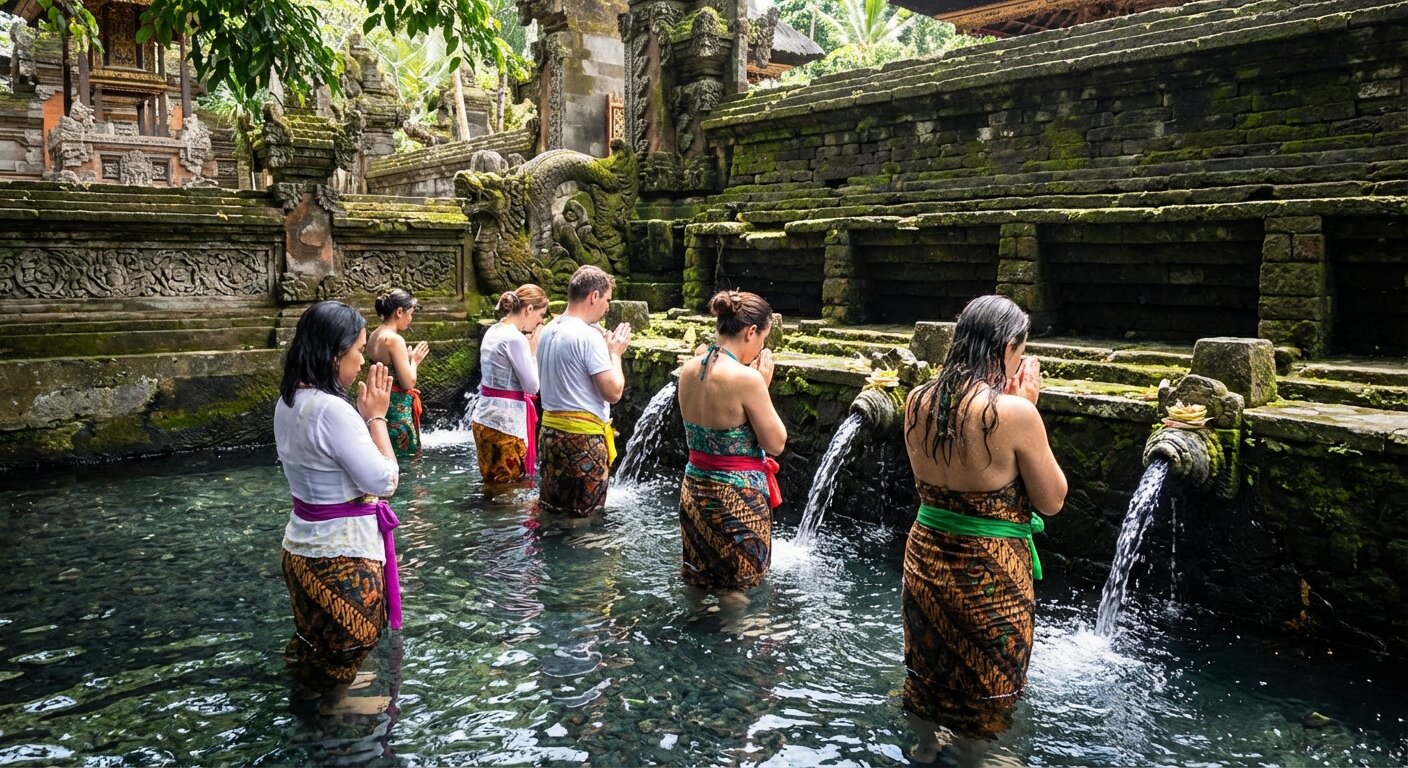
This is the temple where visitors can participate in a Balinese water purification ritual, standing under a series of stone spouts fed by a natural spring. Unlike most temples where you observe from behind a rope, here you actually get in the water and move from fountain to fountain following a specific sequence. It’s one of the few temple visits where you feel like a participant rather than just a spectator.
Arrive before 10 AM. After that, the pools fill up with influencers staging elaborate photo shoots and the contemplative atmosphere vanishes. A sarong is required (you can rent one at the entrance). Whatever you do, don’t swallow the water: temple spring water stomach illness is a well-documented traveler mistake. For a quieter alternative with the same ritual, try Sebatu or Tirta Sudamala, two smaller temples with far fewer visitors.
Besakih (the Mother Temple)
Besakih is the most important Hindu temple in Bali, a complex of 23 separate temples climbing the slopes of Mount Agung. The scale is unmatched anywhere on the island. On a clear day, the terraced shrines lead your eye all the way up to the volcano’s summit. The drive takes about 90 minutes from Ubud, and the complex is large enough that crowds thin out the deeper you go. If you only have time for one temple outside of Ubud, this is an excellent choice.
Temples worth knowing about
Gunung Kawi is a set of ancient rock-carved shrines reached by descending about 300 steps through a river valley. The atmosphere is far more contemplative than any of the big-name temples, and the climb back up through the rice paddies is half the appeal. Pura Kehen in Bangli draws almost no tourists but has elaborate stone carvings and an enormous banyan tree growing through the entrance.
Taman Ayun in Mengwi has large reflecting pools and manicured gardens, and works well as a quick stop if you’re already passing through the area. And Saraswati Temple in the center of Ubud is free and has a lotus pond that looks its best in the morning light.
One temple to avoid: Lempuyang, also known as the “Gates of Heaven.” The famous reflection photo is faked using a phone screen held under the camera, and the queue to take it can exceed two hours. The temple itself is fine but doesn’t justify either the drive or the wait.
Terraced rice paddies
Tegallalang
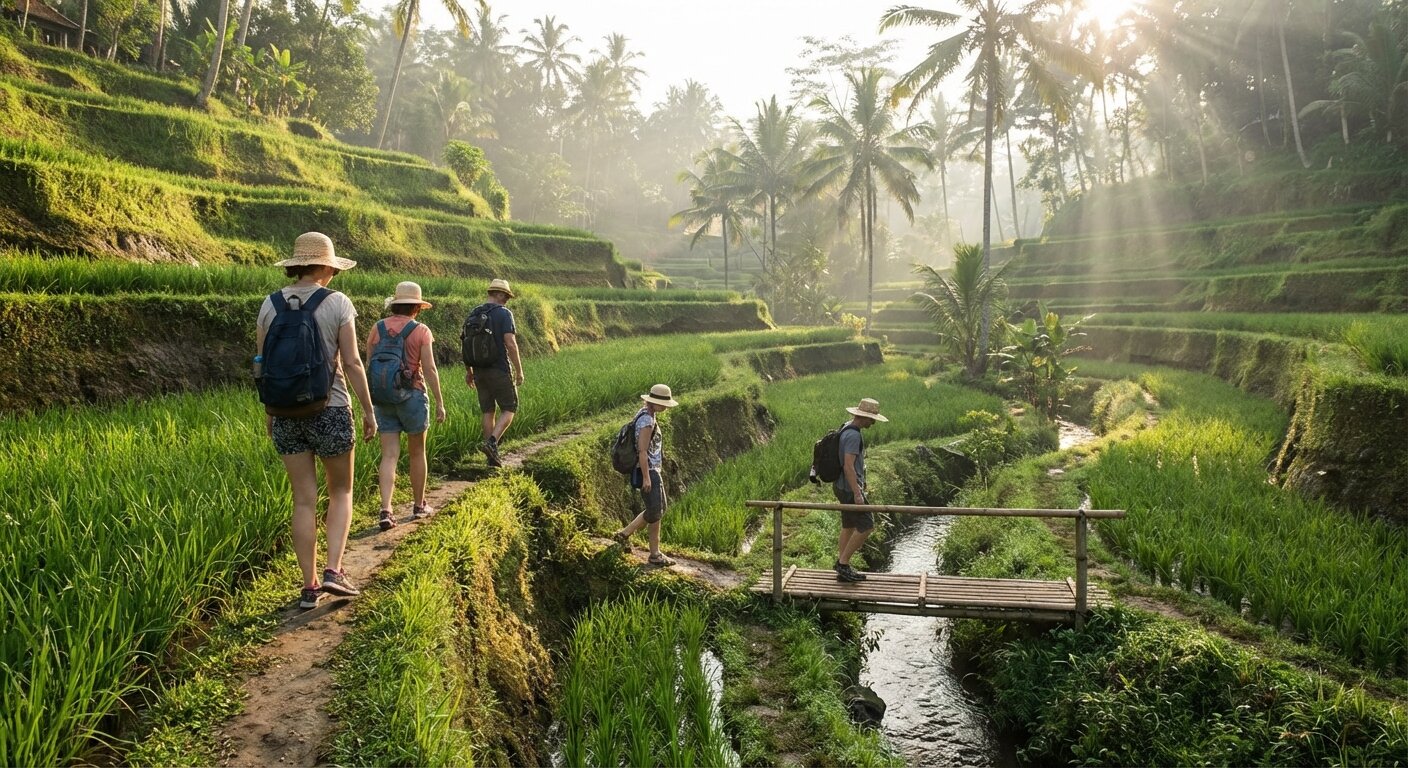
Tegallalang is the rice terrace that appears in every Bali travel video: brilliant green steps cascading down into a river valley about 20 minutes north of Ubud. It’s genuinely beautiful, but the ground-level experience has become painful. Vendors line every path, “donation” requests pop up at every turn, and by mid-morning the narrow walkways are clogged with bus-tour groups.
Go at sunrise, around 6 AM, and you get the terraces in soft golden light with virtually nobody around. The heat is also manageable at that hour, which matters because the walk involves steep, uneven steps with no shade. Wear proper shoes, not sandals.
Jatiluwih
If Tegallalang is the Instagram version, Jatiluwih is what people actually picture when they think of Balinese rice fields. UNESCO World Heritage-listed and spread across 600 hectares, the terraces stretch in every direction with far fewer tourists and zero vendor hassle. The scenery is more expansive and you can walk for over an hour along paths between the paddies without encountering another group. It’s about 90 minutes from Ubud, so most visitors combine it with a stop at Bedugul or one of the northern waterfalls.
Sidemen Valley
Sidemen feels like what Ubud was 20 years ago, according to travelers who know both. The valley sits in the shadow of Mount Agung, with terraced rice fields, weaving workshops, and bamboo guesthouses that cost a fraction of Ubud prices (see our guide to where to stay in Bali for the best options). You can wander through the fields without anyone trying to sell you anything. For a quieter, less commercialized version of the rice terrace experience, Sidemen is the best option currently available on the island.
Water activities
Surfing
Bali’s surfing reputation is well-earned, but the waves vary hugely by spot, and most beginners end up at the wrong beach. Canggu is the place to learn. Batu Bolong and Old Man’s Beach have sandy bottoms, forgiving whitewash waves, and dozens of surf schools competing, which keeps lesson prices reasonable (about 350,000-500,000 IDR for a two-hour group session). Board rental without a lesson runs about 50,000-100,000 IDR per hour.
The vibe is social and beginner-friendly, with warungs and smoothie bowls waiting on shore between sessions.
Uluwatu is where experienced surfers go, and the waves there break over sharp coral reef. Currents are strong, entry points require jumping off rocks, and emergency room visits for reef cuts are common. Don’t surf Uluwatu unless you’re confident on a board.
“Baby Padang” in the Uluwatu area is recommended as a beginner exception, but it gets dangerously crowded on good swell days. A sensible strategy: spend your first week learning at Canggu, then take a day trip to Uluwatu to watch the pros from the clifftop warungs. The view alone is worth the trip.
Diving
For learning to dive or getting certified, head to Amed or Tulamben on the northeast coast. The water is calm, there’s little current, and you can walk straight into the ocean from the beach. The main attraction at Tulamben is the USAT Liberty, an American cargo ship torpedoed by a Japanese submarine in 1942 that now lies in about 30 meters of water just 25 meters from shore. The wreck is covered in coral and fish, and the shallow sections are accessible even to snorkelers.
The mellow conditions make it one of the best places in Southeast Asia to do your PADI Open Water certification (usually three days, about 300-350 euros).
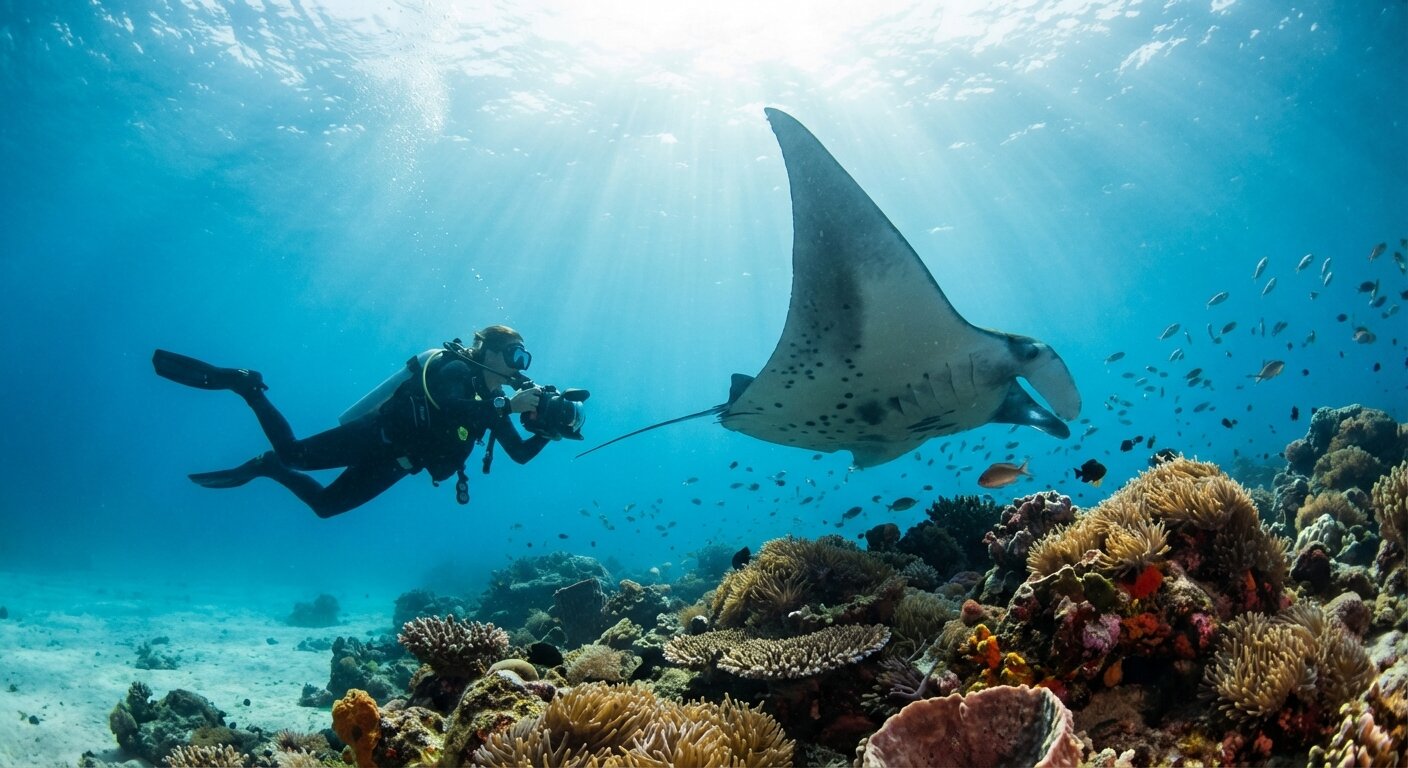
Nusa Penida is the destination for experienced divers chasing manta rays and the huge, bizarre mola mola (ocean sunfish). The diving there is spectacular but the currents can be brutal. Several dive operators describe the place as a “washing machine” on bad days. Don’t dive Penida as a freshly certified beginner. The smart approach: get certified in Amed over three days, then take the fast boat to Penida for fun dives once you have a few logged dives under your belt.
Snorkeling
You don’t need to be a diver to see marine life in Bali. The USAT Liberty wreck at Tulamben is accessible from the surface, with coral-covered sections starting at just three meters deep. Manta Point off Nusa Penida offers a high success rate for spotting manta rays from the surface, though the water can be choppy and the boat ride rough. Amed has calm, clear water for easy reef snorkeling right from the beach.
White water rafting
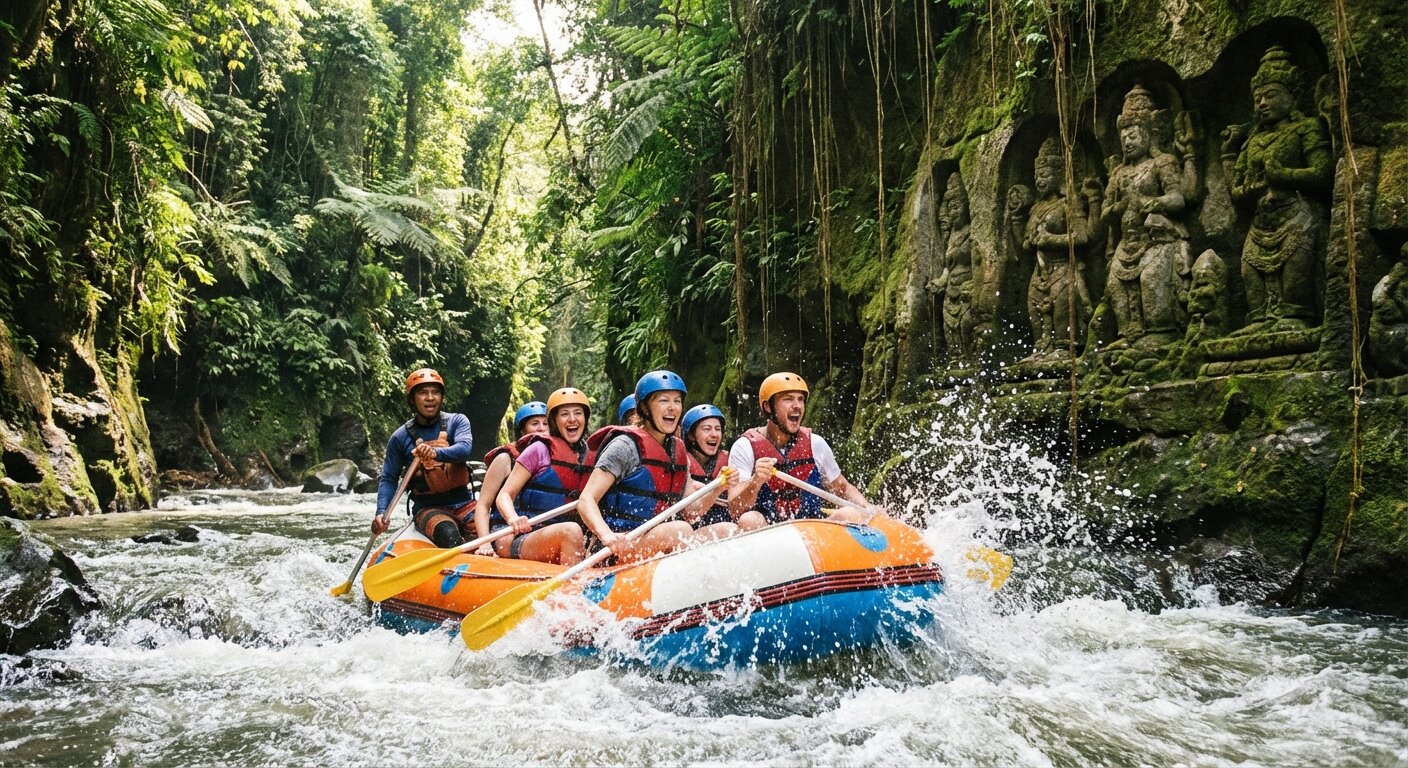
Two rivers offer rafting near Ubud, and the choice depends entirely on what you’re looking for. The Ayung River is the gentler option: Class II-III rapids through a deep jungle gorge with carved faces in the canyon wall, overhanging vegetation, and small waterfalls trickling down the sides. It’s mellow and suitable for families, kids over seven, and anyone who wants to enjoy the scenery rather than hold on for dear life. The Telaga Waja River, further east near Karangasem, has bigger drops, faster current, more committed Class III-IV sections, and a more physically demanding course that leaves you completely spent and grinning. Both trips run about two hours on the water and include lunch.
Most hotels can book rafting for you, but the markup is steep. Book directly with operators online and you’ll pay about half the hotel-quoted price. Expect to pay between 250,000 and 450,000 IDR depending on the river and operator.
Mountain trekking
Mount Batur sunrise hike
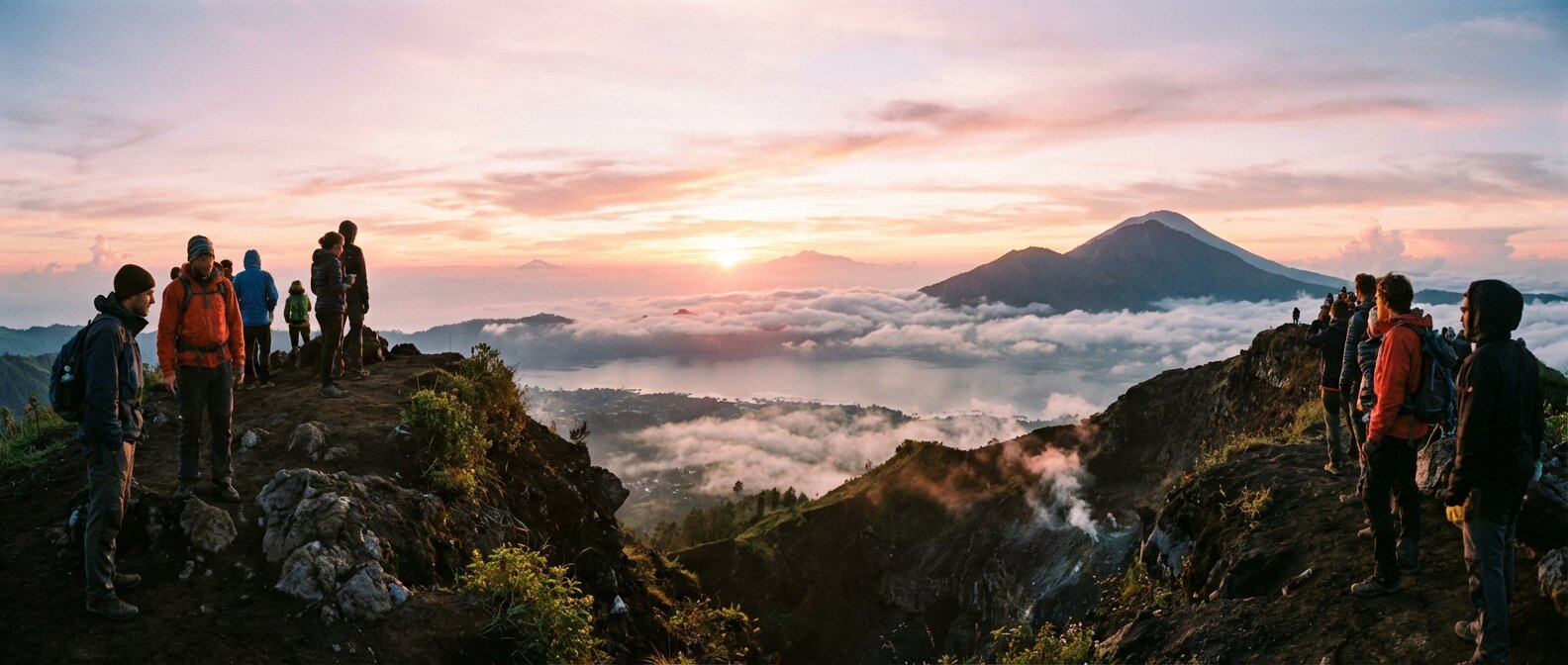
The Mount Batur sunrise hike is probably the single most popular excursion in all of Bali, and that popularity is both its greatest asset and its biggest problem. On a clear morning, you reach the summit just as the sun rises above Mount Agung and the caldera lake below, with views stretching all the way to Mount Rinjani on Lombok. On those mornings, the panorama is a completely legitimate 10 out of 10.
The experience of getting there is closer to a 4. Your driver picks you up around 2 AM. You arrive at the trailhead around 3:30 AM and join a line of hundreds of hikers trudging up single file, each wearing a headlamp, forming a visible chain of lights snaking up the mountain.
The trail itself isn’t technically difficult (average fitness is fine) but the volcanic gravel is loose and the pre-dawn start means you’re doing it on no sleep. A local guide is effectively mandatory: the trekking association controls access to trailheads and hikers who try to start without a guide report aggressive confrontations. Guides cost 25-35 USD per person for group treks.
The key upgrade experienced travelers recommend: book a private guide instead of a group tour. Private guides will leave earlier, let you set your own pace, and position you away from the main crowd at the summit. The cost difference is modest (50-70 USD for a private guide vs. 25-35 for a group) and the experience improves dramatically.
Mount Agung
If Batur feels too easy or too crowded, Mount Agung is the serious alternative. At 3,031 meters, it’s Bali’s highest peak and an active volcano that last erupted in 2017-2019. The hike takes 5 to 7 hours up depending on the route and fitness level, requires good physical condition, and starts even earlier than Batur (around 11 PM the night before for a sunrise summit). There are two main routes: from Pasar Agung Temple on the south side, which is shorter but steeper, and from Besakih Temple on the north side, which is longer but reaches the true summit.
The summit views, when the clouds cooperate, take in the entire island and the neighboring volcanoes of Lombok. It’s a real mountain trek, not a tourist excursion, and you should only attempt it if you have experience with multi-hour hikes at altitude. A guide is mandatory and costs about 60-80 USD.
Cultural experiences
Balinese cooking class
A cooking class is one of the most consistently highly rated activities in Bali, and it’s easy to see why. The typical format: you visit a local market in the morning to buy ingredients with the instructor, learning to identify the spices and produce that form the foundation of Balinese cuisine. Then you spend four to five hours in a family compound or open-air kitchen learning to prepare six or seven traditional dishes: satay with peanut sauce, lawar (a vegetable and coconut salad), bebek betutu (slow-cooked duck wrapped in banana leaf), nasi goreng, and various sambals ground by hand in a stone mortar. Then you eat everything you’ve made. Most classes cost 20-35 euros per person and include the market visit, all ingredients, and recipes to take home.
Ubud has the highest concentration of classes, though good options also exist in Seminyak and Sanur.
What makes these cooking classes work is that they’re genuinely interactive and small-group, usually capped at 8-12 participants. You’re chopping lemongrass, grinding spice paste with a mortar and pestle, learning the difference between base genep and base gede (the two fundamental spice pastes), working over open flames, and eating with the family who taught you. It’s one of the few tourist activities in Bali where you leave feeling like you’ve learned something rather than just watched something.
Silver jewelry workshop in Celuk
The village of Celuk, about 20 minutes south of Ubud, has been a center for silver and gold smithing for generations. Several workshops offer half-day classes where you design and hammer your own silver ring or pendant under the guidance of a local artisan. Prices run about 300,000-500,000 IDR depending on complexity and silver weight. It’s a hands-on activity with a tangible souvenir at the end, and the workshops are small enough (usually 2-6 people) to get real one-on-one instruction.
Batik making
Batik workshops, mostly clustered around Ubud, teach the wax-resist dyeing technique used across Indonesia. A typical session lasts two to three hours: you draw a pattern on fabric, apply hot wax to the areas you want to keep undyed, then dip the fabric in natural dyes. You leave with your creation. The process is more meditative than exciting, which makes it a good counterpoint to the more energetic activities on this list.
Lesser-known cultural experiences
If you’re staying in a homestay or small guesthouse, ask your host if you can join them in making canang sari, the small woven palm-leaf offering baskets that Balinese Hindus place in front of doorways, shrines, and crossroads every morning. Most hosts are happy to teach it, and it’s a quiet, genuine window into daily spiritual practice that no tour operator packages.
Penglipuran Village, a traditional community about an hour from Ubud, is worth a short visit for its exceptionally well-preserved architecture and bamboo-lined streets, though the village has become somewhat tourism-oriented.
Day trips and island escapes
Nusa Penida
Nusa Penida is the wild island visible from Bali’s southeast coast, known for its towering cliff formations, turquoise waters, and the T-Rex-shaped headland at Kelingking Beach. It’s become one of the most visited destinations in the Bali region, and how you approach it makes the entire difference between a great experience and a miserable day.
The consensus among people who’ve been: don’t do Nusa Penida as a day trip from Bali. The fast boat takes 30 to 45 minutes each way, the roads on the island are terrible (deep ruts, single lane, blind corners), and the main viewpoints are far apart. A day trip means you spend 80 percent of your time in transit and 20 percent fighting crowds at the same three spots everyone else visits.
You arrive at Kelingking around 10 AM alongside fifteen tour buses, take a sweaty photo at a packed viewpoint, then get back in the car.
Instead, stay one to three nights on the island. This lets you hit the west-side viewpoints (Kelingking, Broken Beach, Angel’s Billabong) before 9 AM or after 4 PM, when the day-trippers are gone.
The east side (Diamond Beach, Atuh Beach) is generally less chaotic and arguably more beautiful. Don’t try to cover both sides in a single day. Hire a driver rather than renting a scooter: the roads are genuinely dangerous for inexperienced riders, with steep grades, loose gravel, and no guardrails.
Nusa Lembongan
If Nusa Penida feels like too much hassle, Nusa Lembongan is the easier, more mellow alternative. Smaller, flatter, and better set up, with good restaurants, clear water for snorkeling along the north coast, and a relaxed pace that feels like what Bali might have been 15 years ago. The mangrove on the south side is worth a kayak trip, and the Devil’s Tear blowhole on the southwest coast puts on an impressive show when the swell is up.
You can comfortably explore the whole island by scooter in a day. Lembongan also works as a base to take short boat trips to Penida for sightseeing without having to deal with Penida’s limited and often disappointing accommodation.
Ubud Monkey Forest
The Sacred Monkey Forest Sanctuary in central Ubud is home to about 1,200 long-tailed macaques living among moss-covered stone temples and banyan trees. For staying in Ubud surrounded by rice paddies and steps away from the forest, we’ve written a dedicated guide. Visitor reactions are sharply divided. Some find the place magical, walking through an ancient forest with monkeys swinging overhead and climbing the temple ruins.
Others find it stressful: the monkeys are bold, territorial, and known to bite tourists who make eye contact, carry food, or wear dangling accessories.
The ground rules: remove all jewelry, sunglasses, and hats before entering. Don’t carry food and don’t open any bags. Don’t make eye contact with the monkeys and don’t touch them. If a monkey jumps on you, stay still and it will lose interest. Entrance costs 80,000 IDR. If you follow the rules, it’s a pleasant 45-minute walk, but it’s not for everyone.
Waterfalls
Bali has dozens of waterfalls and most travel itineraries try to squeeze three or four into a single day. That’s overkill. They start to blur together after the second one, and the hikes in tropical humidity are more tiring than they look. Pick one or two based on what you’re after.
Sekumpul
If you only visit one waterfall in Bali, make it Sekumpul. It’s the most spectacular on the island: twin falls dropping about 80 meters into a jungle pool, framed by tropical vegetation on all sides.
The catch is the access. The descent involves more than 350 steep steps, river crossings, and a humid jungle trail that will leave you drenched in sweat before you even reach the water. The climb back up is worse. Allow 2-3 hours total and bring water.
A common scam: people will stop your car miles from the real parking area, claiming the road is closed or a guide is mandatory. Both claims are false. Drive through to the official ticket booth and parking area. Sekumpul is in northern Bali, so it combines well with staying in Munduk or Lovina rather than as a day trip from Ubud.
Tukad Cepung
Tukad Cepung is a cave waterfall where, on a sunny morning, sunlight pierces through an opening in the rock ceiling and illuminates the falling water in dramatic light beams. The visual effect is unique among all of the island’s waterfalls. The crucial detail: you need to arrive before 9 AM to see the light rays. After that, the sun angle changes and the cave is just a dark, damp space. You can’t really swim here. Bring water shoes because the riverbed is rocky and slippery.
Other waterfalls to consider
Banyumala Twin Waterfalls, also in the north, is the best option if you actually want to swim. The pool is deep, clean, and relatively uncrowded. Nungnung and Leke Leke are good picks if you’re based near Ubud and want something accessible without driving to the north coast. Gitgit is easy to reach but has become fairly commercialized.
One to avoid: Tegenungan, south of Ubud. It’s the most accessible waterfall on the island and, consequently, the most overrun. The pool is packed by late morning and the experience feels more like a water park than a nature excursion.
Yoga and wellness
Bali’s yoga scene centers on Ubud and Canggu, and the two places attract different crowds. Ubud draws those seeking immersion: multi-day retreats, juice cleanses, sound baths, and spiritual workshops. Canggu has a younger, more laid-back crowd, with drop-in classes that fit between surf sessions and cafe hopping.
The practical advice from long-term residents: don’t book an expensive all-inclusive yoga retreat before you arrive. Instead, rent a quiet room in Ubud or Canggu and buy a class pass (five to ten sessions) at a studio you like. This approach costs a fraction of the retreat price and gives you the freedom to try different teachers and styles rather than locking into a single program.
In Ubud, The Yoga Barn is the largest and most social studio, with dozens of daily classes in multiple styles. It’s busy and commercial but great for meeting other travelers. Radiantly Alive is a smaller, more focused alternative with quality teaching.
In Canggu, The Practice draws serious practitioners with its traditional approach, while Serenity Eco Guesthouse combines affordable yoga classes with a relaxed, unpretentious vibe.
Beach outings
Bali’s coastline varies hugely from one area to the next. The black volcanic sand of the north and east looks nothing like the white sand beaches of the south, and surf conditions, swimming safety, and overall vibe change just as much from one spot to another. Rather than repeating what we’ve already covered, check out our guide to the best beaches in Bali, which breaks down 15 beaches by what they’re actually good for: swimming, surfing, snorkeling, sunset cocktails, or just lying on the sand without anyone trying to sell you something.
Practical information for planning your excursions
Transportation
For any sightseeing day involving multiple stops, hire a private driver. A full day (8-10 hours) costs 30-45 euros (our guide to Bali’s neighborhoods helps you choose a base to minimize travel time), and the driver handles traffic, suggests the best timing for popular spots, watches your stuff while you hike, and takes all the logistics off your plate. Book through your accommodation or via apps like Klook. For short point-to-point trips around town, use Gojek or Grab (Bali’s ride-hailing apps). If you flag down a street taxi, only use Bluebird (look for the blue bird logo on the car) because they use the meter.
Other street taxis in Bali often charge inflated prices.
Scooter rental is cheap (50,000-75,000 IDR per day) and tempting, but Bali traffic is genuinely dangerous. Roads are narrow, drivers are unpredictable, and medical facilities outside of Denpasar are limited. If you’ve never ridden a scooter in Southeast Asian traffic, Bali is not the place to learn.
Timing and grouping
Bali traffic is worse than any navigation app suggests. A drive that shows 40 minutes on Google Maps can easily take 90 minutes at peak hours, especially around Denpasar, Kuta, and the approaches to Ubud. The single most important logistical tip for Bali: group your activities by region.
Visit the northern waterfalls and Jatiluwih on the same day. Combine Tegallalang, Tirta Empul, and Gunung Kawi in a morning around the Ubud area. Don’t try to visit a temple in the north and a beach in the south on the same day. You’ll spend four to six hours in a car and arrive at both places at the worst possible time.
What to wear and bring
A sarong is required at every temple. You can buy one for 30,000-50,000 IDR or rent one at most major temples. Comfortable closed-toe shoes matter for volcano hikes, waterfall treks, and rice paddy walks. Reef shoes or water shoes are worth packing if you plan to snorkel at Tulamben or visit Tukad Cepung waterfall. Sunscreen, a reusable water bottle, and a light rain jacket cover most situations.
For more detailed practical advice on budget, safety, health, SIM cards, and day-by-day itinerary suggestions, check out our practical tips for visiting Bali.
What about Phuket?
If you’re deciding between Bali and other Southeast Asian destinations, Phuket offers a different mix of activities with more emphasis on island hopping, boat tours, and underwater exploration around the Andaman Sea. The temple culture and terraced rice field scenery that define Bali have no equivalent in Phuket, but the offshore islands around Phuket and its dive sites are easier to access and less affected by crowds. Our guide to activities and excursions in Phuket covers the comparison in detail.
For more adventures in Asia, check out our must-do activities in Bangkok.
Also discover our must-do activities in Hanoi.