


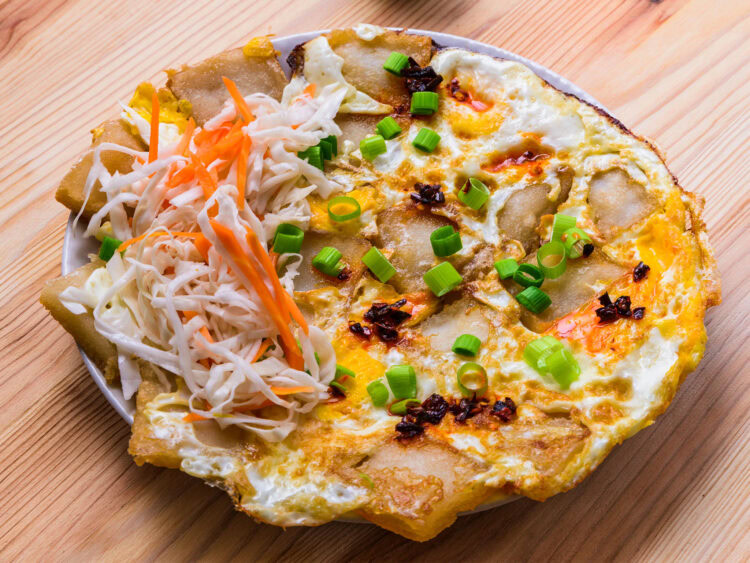
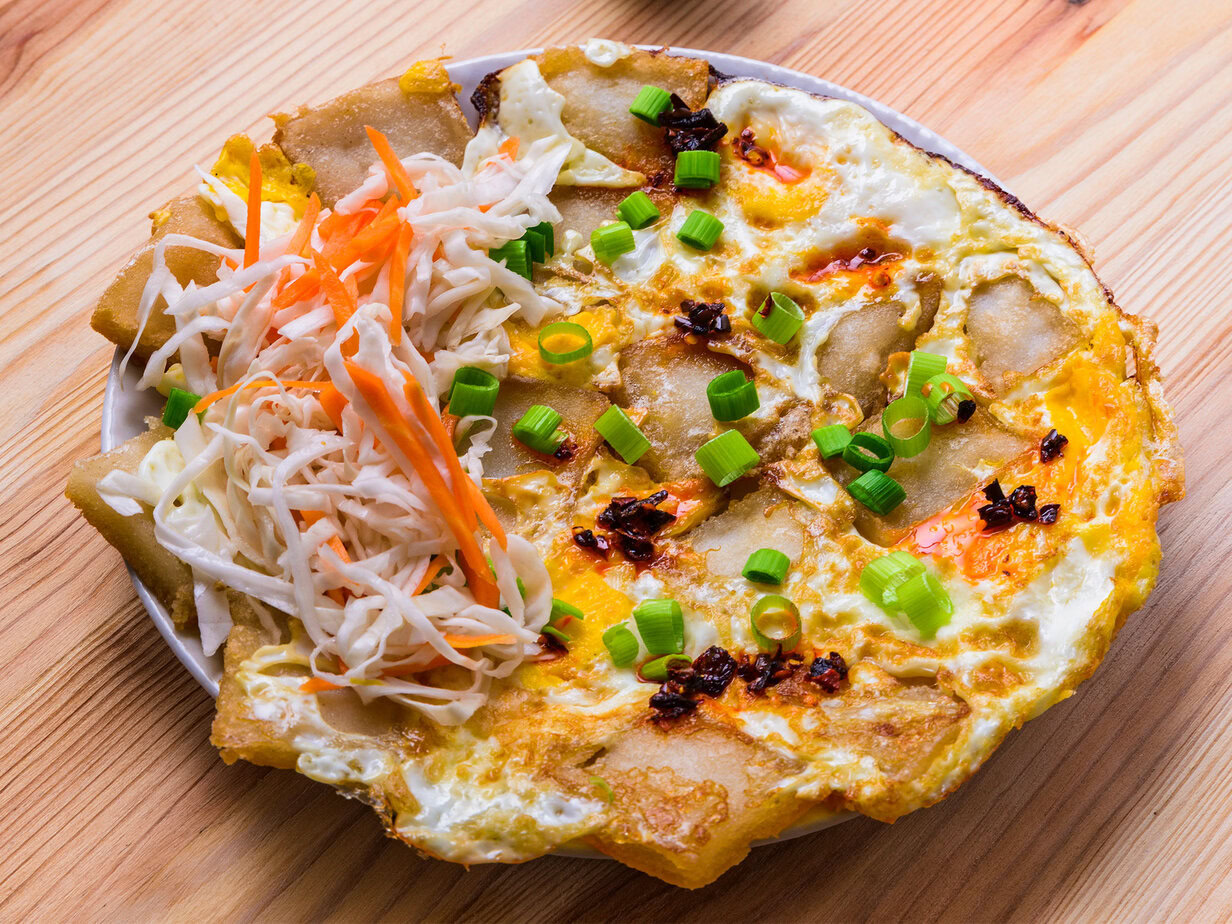
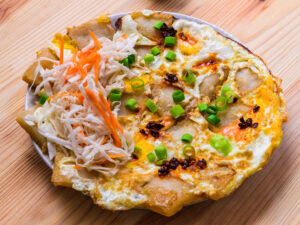
Savor these irresistible squares of fried rice cake, served with crisp pickles and a sweet-and-tangy sauce, Vietnamese street-food style.
On a large cast-iron griddle, blocks of rice starch sizzle and turn deep golden brown. The vendor often cracks a duck egg (or a chicken egg) on top: the yolk spreads, then sets, forming crispy edges around the cubes—golden outside and surprisingly soft within.
Scallions scent the dish, while a small bowl of soy–vinegar sauce is served alongside, with pickled green papaya (and sometimes a pinch of fried garlic). This balance of richness, acidity, and crunch is what makes bột chiên so irresistible in Saigon.
What is bột chiên?
“Bánh bột chiên” literally translates from Vietnamese as “fried flour cake”: bánh (cake), bột (flour, starch), chiên (to fry). In practical terms, these are rectangles of dough made from rice flour, often lightly blended with tapioca starch for extra tenderness. Depending on the stall, the batter is first thickened on the stovetop, then steamed (or steamed directly) until fully gelatinized, before being seared over high heat.
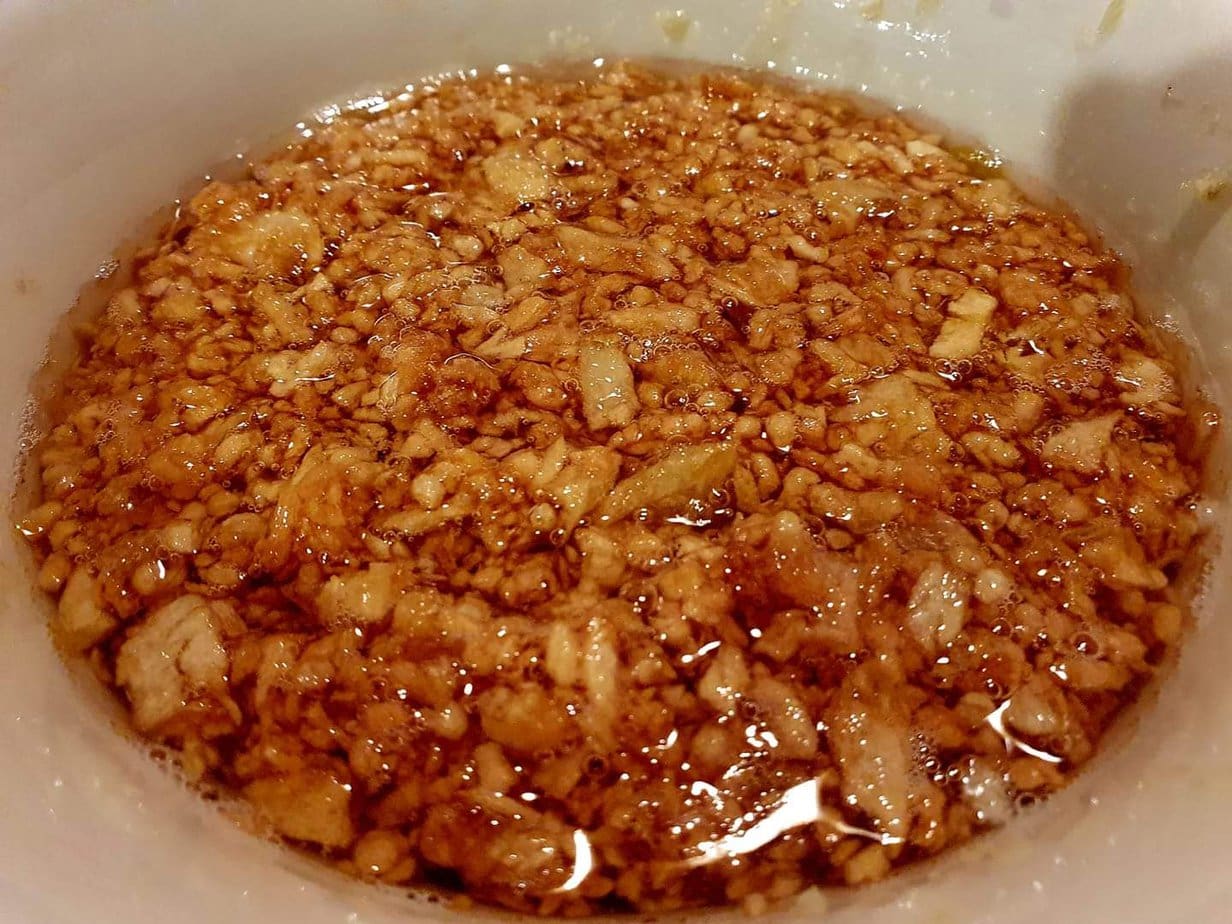
Toward the end of cooking, an egg binds everything into a craggy pancake—a kind of broken omelet—set in the pan and flecked with scallions. It’s eaten piping hot, with a light soy sauce thinned with water, sweetened and sharpened with vinegar (often Chinese rice vinegar), sometimes darkened with a dash of dark soy sauce.
It’s served on the side, with sweet-and-sour pickles. Here, this isn’t nước mắm sauce : without the sweet soy–vinegar dip, the dish loses much of its identity.
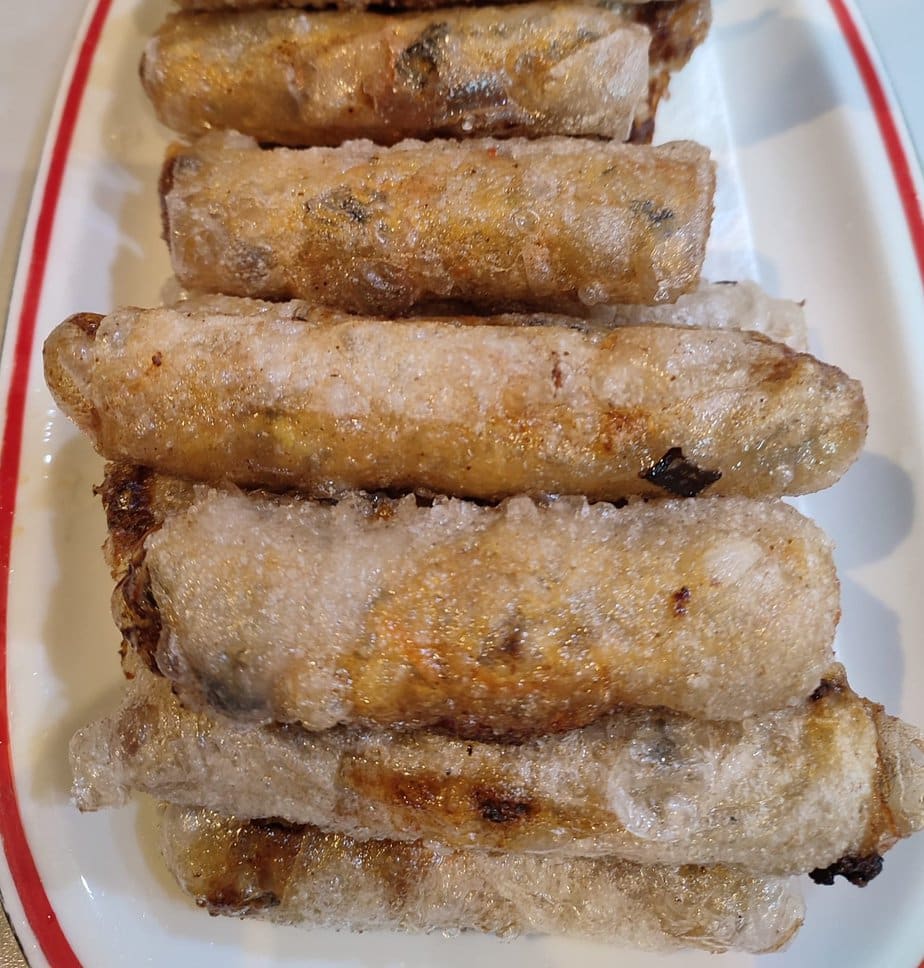
Nuoc cham is used for spring rolls
The Origins of Bánh Bột Chiên
Bột chiên, of Chinese origin, was introduced to Saigon by Teochew (Triều Châu) migrants in Chợ Lớn more than a century ago. It’s close to chai tow kway (radish rice cake) ; in Saigon, some versions omit radish depending on the vendor.
What defines it is cooking on a very hot pan, as in sheng jian bao (and, more broadly, certain pan-fried baozi). Brought by these communities, the dish blended into the city’s culinary landscape to the point of becoming an emblem. Even today, many stalls are run by Sino-Vietnamese families (see also the world of dim sum) who keep the craft alive: a large cast-iron pan, metal spatulas clacking, the scent of oil (often lard).
When school lets out, students crowd around the cart ; later, night owls return to tame a late‑night hunger. It speaks to a history of migration, transmission, and urban memory.
In the same vein, the city abounds with classics like phở, bún bò Huế, bún chả, bò bún, spring rolls, and chicken spring rolls. You’ll also come across lemongrass chicken and cà ri gà.
Main Ingredients of Bánh Bột Chiên
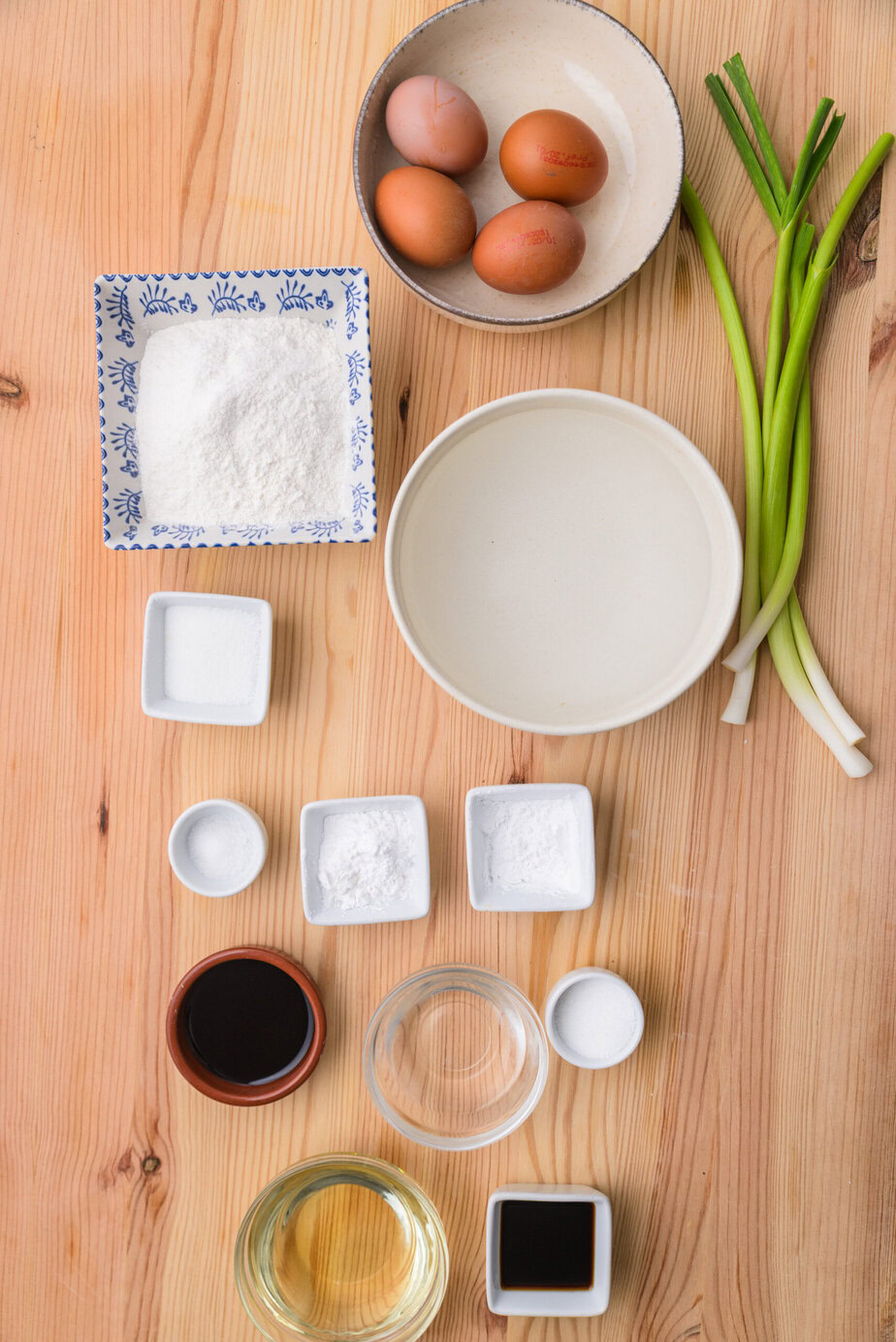
- Rice flour (bột gạo tẻ) : provides structure; neutral, and browns well
- Tapioca starch (about 5–10 % of the weight of the rice flour) : adds characteristic elasticity
- Water : hydrates the starches, which then gelatinize with steaming.
- Salt and a little oil in the batter : minimal seasoning and suppleness.
- Cooking fat : neutral oil, or lard (traditionally favored for a crisper result).
- Eggs (often duck eggs) : bind, add aroma, and richness
- Scallions : a fresh, herbal touch that brightens everything.
- Serving sauce (soy + vinegar + sugar, served on the side) : the typical salty–sweet–acidic balance, without nước mắm.
- Pickled green papaya (often with carrot or daikon) : crunchy freshness, an indispensable counterpoint
- Chili (fresh or in sauce) : optional, to add heat
Common Variations (and their limits)
Depending on families and neighborhoods, some versions (notably Teochew) incorporate daikon (white radish) into the cake and/or add, during cooking, bits of salted preserved radish (cải xá bấu).
Others use mashed taro, which gives a denser, almost creamy texture. There are also modern variations (melted cheese, cold cuts, etc.), but they stray far from the original spirit, whereas the traditional version is meatless—apart from the egg—and dairy‑free.
Ingredients
Marinated Vegetables
- 100 g green papaya or grated cabbage
- 1 carrot
- 250 ml rice vinegar
- 60 g sugar white
- 20 g salt
Dipping Sauce
- 25 ml rice vinegar
- 25 ml light soy sauce
- 15 g sugar
- 3 g tapioca starch
Batter
- 130 g rice flour
- 10 g tapioca starch
- 450 ml water cold
- 3 g salt
- 10 g sugar
Cooking and Serving
- 4 eggs
- 4 stalks scallions
- 100 ml oil vegetable oil or lard
- light soy sauce a little, to color the batter
- Chili sauce for serving
Instructions
The day before
- Prepare the marinated vegetables, dipping sauce, and batter, then refrigerate overnight.
Marinated Vegetables
- Rinse the papaya and carrot.100 g green papaya, 1 carrot
- Peel, cut into julienne strips, and soak for 15 min in lightly salted water.
- Drain, squeeze out excess water, and let dry well.
- Mix the vinegar, sugar, and salt until dissolved, then pour over the vegetables to cover; marinate 3–4 h.250 ml rice vinegar, 60 g sugar, 20 g salt
Dipping Sauce
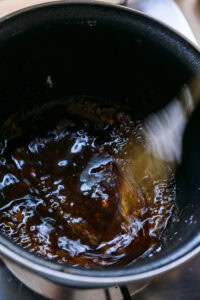
- Combine the vinegar, soy sauce, sugar, and tapioca starch. Heat, stirring, until thickened, then let cool.25 ml rice vinegar, 25 ml light soy sauce, 15 g sugar, 3 g tapioca starch
Batter
- Whisk together the rice flour, tapioca starch, water, salt, and sugar until smooth.130 g rice flour, 10 g tapioca starch, 450 ml water, 3 g salt, 10 g sugar
- Pour into a dish, cover, and steam for 30 min; let cool, then refrigerate for 24 h.
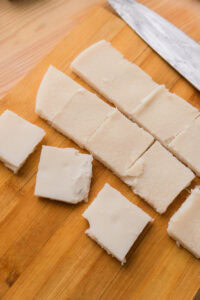
- Unmold, cut into rectangles 0.5–0.75 cm thick, and brush with a little light soy sauce for color.light soy sauce
Fry and Serve
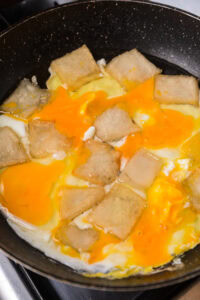
- Heat the oil in a skillet and fry the batter rectangles over medium heat until golden.100 ml oil
- Raise the heat to high, crack the eggs over the batter, sprinkle with scallions, and flip to finish cooking.4 eggs, 4 stalks scallions
- Drain on paper towels, then serve hot with marinated vegetables, dipping sauce, and a drizzle of chili sauce.Chili sauce
Notes
- Lard yields a crisper texture and browns faster.
Culinary Sources
• Bánh bột chiên – Wikipedia (English)
• Crispy rice cakes recipe – Viet World Kitchen (English)
• Saigon: the bột chiên era that had everyone hooked – Sài Gòn thập cẩm (Vietnamese)
• Bánh bột chiên – Wikipedia (Vietnamese)
• Guide to making bánh bột chiên – Dieutri.vn (Vietnamese)
• How to make tasty bột chiên at home – Netspace (Vietnamese)
• Rich and aromatic bánh bột chiên – Kingfoodmart (Vietnamese)
• What is this Vietnamese appetizer? – Reddit (English)
• Guide to making crispy egg bột chiên – Nan N Kabab Vietnam (Vietnamese)
• Bánh bột chiên – bepnhabeo (Vietnamese)
• Where can I find bánh bột chiên in San Diego? – Reddit (English)
• Homemade bánh bột chiên: stir-fried Vietnamese rice cakes – Reddit (English)
• Week 19, Vietnamese cuisine: bánh bột chiên with smoked sausage – Reddit (English)
• Bot Chien Restaurant, 1818 Tully Rd, San Jose, California – Yelp (English)


Crispy, tangy, and so satisfying. 😋
Absolutely delicious, crispy edges and that tangy sauce is perfection! 😋
Absolutely addictive, crispy edges and that tangy dip is perfection! 😋
Didn’t think I could pull this off, but the rice cakes actually got crispy and golden and the egg/scallion part made it feel like real street food! The sweet tangy dipping sauce and pickles were so good together, kind of proud of myself 😅