Chiang Mai rewards preparation more than most Thai destinations. Planning a trip to Chiang Mai comes down to settling two questions, both months in advance. First, dates: between February and April, the air ranges from tolerable to downright dangerous depending on the year you visit. Then, paperwork: Thailand’s visa exemption is changing, and the length of stay you think you have is not necessarily the one that will apply on the day you fly.
This article covers logistics. What the city is really like, and how to turn that into an itinerary, is the subject of our complete guide to visiting Chiang Mai. Here, you will find the practical details: how to get there from France and Bangkok, when to go and what the smoky season really means, getting around, entry requirements for French passport holders, money, health, internet access and three daily budgets.
A caveat about the figures. These are the amounts sources were quoting in mid-2026, in baht (THB) for local transactions. Euro equivalents are calculated at roughly 38 THB to 1 EUR, as in the rest of this guide. Thai prices are creeping up and the baht has strengthened against the euro, so older budgets you find elsewhere will underestimate costs.
Getting there: from France to Chiang Mai, then the Bangkok leg
No airline flies nonstop from Paris to Chiang Mai. All routes involve one or two stops, most often via Bangkok, Doha, Kuala Lumpur or Istanbul, with Qatar Airways, Thai Airways, Emirates, Etihad, Cathay Pacific, British Airways and Austrian serving the route. Return tickets range from around 398 to 810 EUR, averaging about 646 EUR, and the cheapest route on average goes through Kuala Lumpur, at around 620 EUR. Comparison sites put the ideal booking window at roughly 40 days before departure. Journey times are variously quoted as around 16 hours with a tight connection or nearly 26 hours on averages that include long layovers: check the layover before checking the price.
The Bangkok-Chiang Mai night train
Long-distance trains now depart from Krung Thep Aphiwat Central Terminal, rather than Hua Lamphong, which no longer handles northern services. Train 9/10 leaves at 18:40 and arrives at 07:15, a journey of about 12 hours 35 minutes. Train 13/14 leaves at 20:05 and arrives at 08:45, taking about 12 hours 40 minutes. There is also a daytime express railcar, train 7/8, running from 07:30 to 17:50, with air-conditioned second-class seats only, at 558 THB.
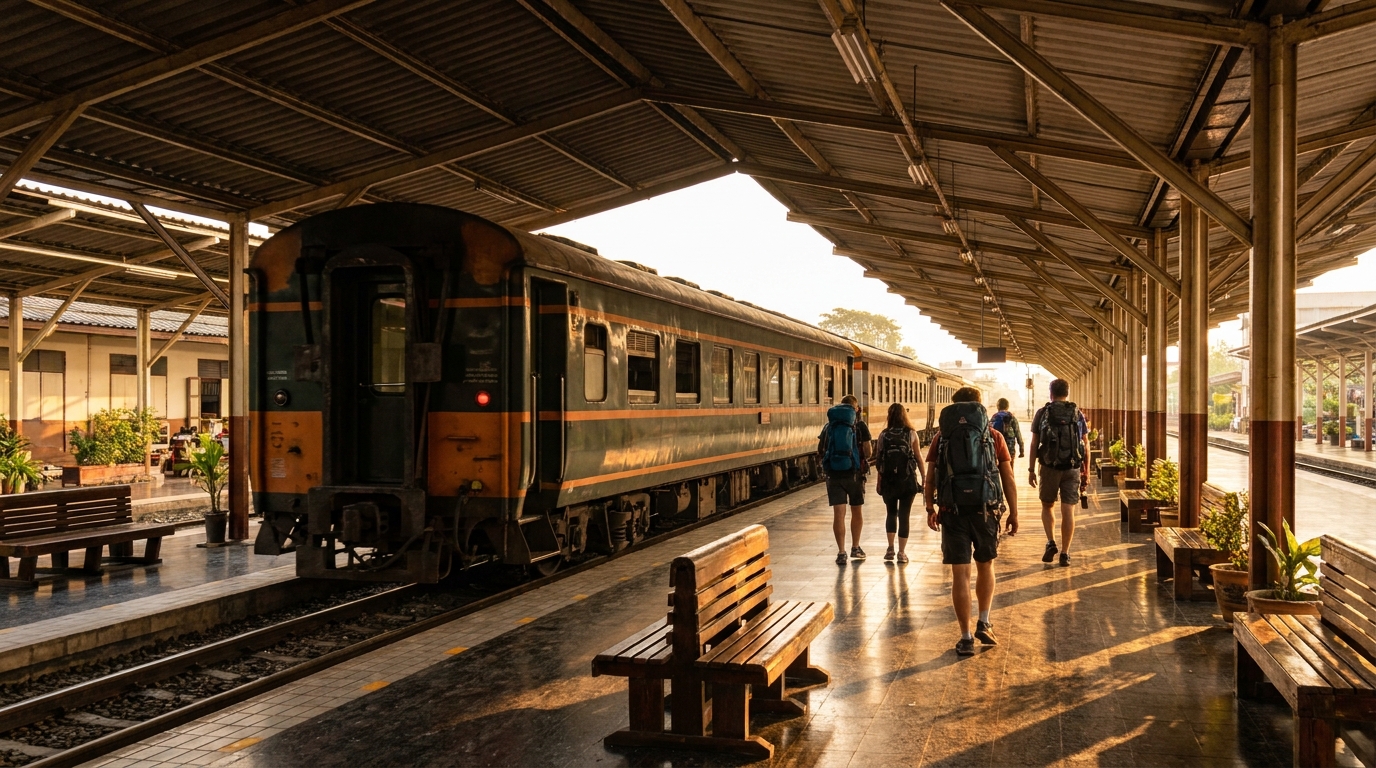
On train 9/10, first-class berths cost 1,446 THB for an upper berth and 1,646 THB for a lower one, or 2,446 THB for single occupancy; air-conditioned second-class berths cost 938 THB for an upper berth and 1,038 THB for a lower one. Train 13/14 is cheaper across the board, starting at 768 THB. Another source puts second-class lower berths closer to 1,050 to 1,100 THB and the journey nearer 13 hours, so budget a little above the published fare table. Second class means a berth closed off by a curtain in an open carriage, and it is perfectly comfortable. First class buys you a private cabin for two, for around 500 THB more. Upper berths are reached by a ladder.
Bookings open six months ahead, and the official website is dticket.railway.co.th, available in English. Lower berths sell out several weeks before departure, and the real trap is the booking process itself: travelers regularly see every date listed as sold out by resellers, card payments fail on the official website after bank verification, and the seats then remain blocked as reserved until the following day. There is no dining car: buy food at the station.
Take the night train because it saves you a hotel night and a day of travel, not because it is cheap. Generally, it is not: a traveler who compared the two in late 2024 paid 28 USD for the flight versus 30 USD for the train. Be realistic about sleep too, because plenty of passengers spend twelve hours lying down without getting a wink.
Flights and buses
The short nonstop hop from Bangkok to Chiang Mai takes about 1 hour 20 minutes. AirAsia, Nok Air and Thai Lion Air depart from Don Mueang (DMK), while full-service airlines use Suvarnabhumi (BKK): that detail determines whether your international connection works. One-way fares on low-cost airlines are advertised from roughly 25 to 38 USD. Economy fares on full-service airlines range anywhere from 30 to 110 USD depending on the season and how far ahead you book, with another 12 to 15 USD for the first 20 kilos of checked baggage. You can also board the night train at Don Mueang station, another reason to favor DMK if you plan to combine the two.
A VIP night bus was advertised at around 690 THB in mid-2026, departing Bangkok in the evening and arriving at Arcade Bus Terminal in the early morning. The VIP option costs about 4 USD more than a standard coach and adds a toilet, a blanket and snacks. Bus prices fluctuate more than train fares: check rather than building your budget around this figure.
When to visit Chiang Mai, month by month
The year divides into three seasons: cool and dry from November to February, hot in March and April, and wet from roughly May to September, with the heaviest rain from July onward. January is the coolest month, around 30 °C by day and 15 °C at night. Heat peaks in April: 38 °C during the day, and still 25 °C at night. Rainfall is just as uneven: February averages around 4.8 mm versus 260 mm in August, out of an annual total close to 1,197 mm.
Thai travelers favor a narrower window than the standard November-to-February advice: the last two weeks of December plus the first two weeks of January, for the coldest, clearest air of the year. Their second choice is mid-October through November, when the rains ease and the countryside is still green. Two festivals skew the calendar. Yi Peng, the Lanna lantern festival, falls in November. Songkran, the Thai New Year in mid-April, is the busiest week of the year.
The smoky season, without sugarcoating
From roughly February to April, northern Thailand burns and Chiang Mai sits under a blanket of smoke. The worst period generally runs from late February through March, peaking from late March into early April. Do not plan your trip around a clear-cut start date, because nobody agrees on when it is: some residents say nothing really begins before mid- or late February, others describe thick smog as early as late January, the Thai press tracks rising particulate levels from around October, and longtime residents stretch the phenomenon from December to May. The province enforces a seasonal burning ban, the ham phao, but the announced dates change from year to year.
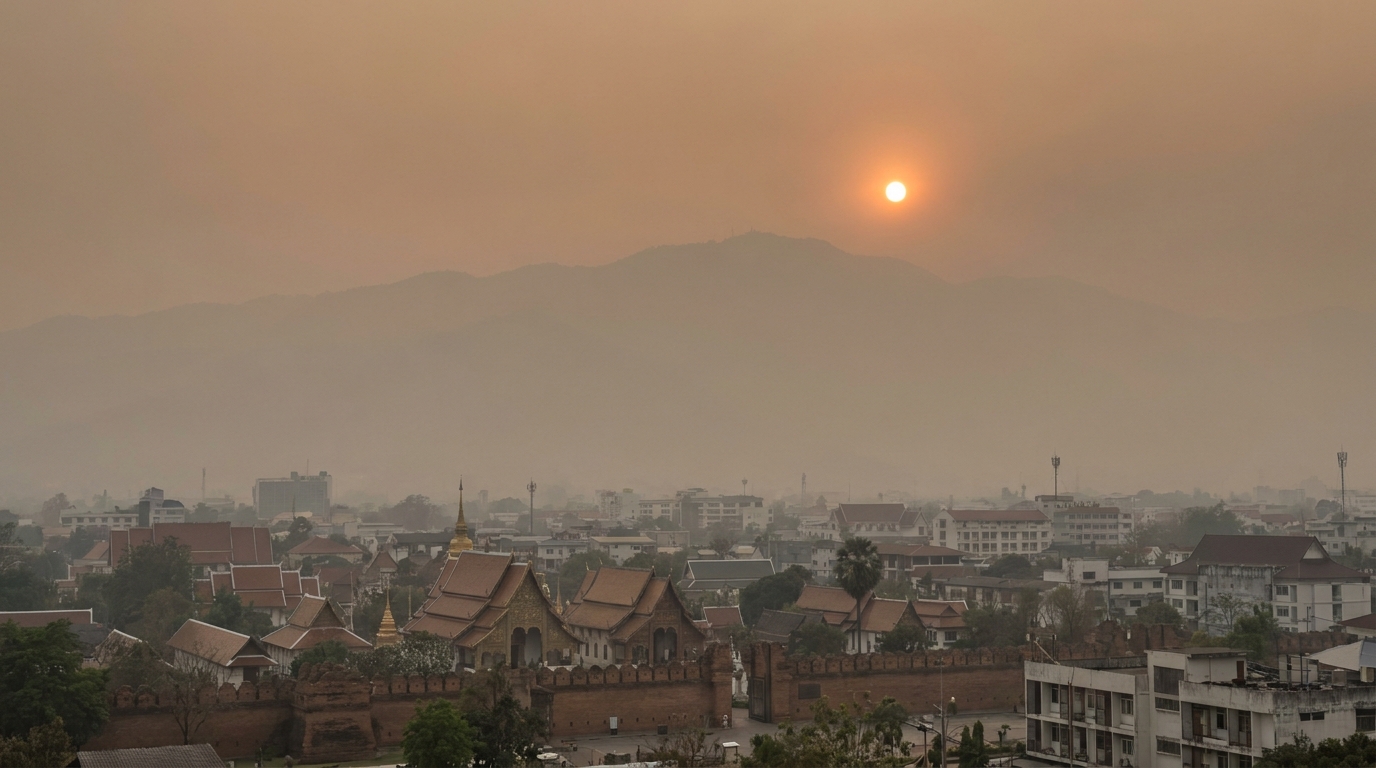
The cause is a mixture: agricultural residue burning across the north, mainly rice, corn and sugarcane stubble, compounded by forest fires and smoke drifting in from Myanmar and Laos. A 2024 study attributed about one-third of Thailand’s PM2.5 to agricultural burning, a share rising to 51 % of PM2.5 in Chiang Mai province in March and April. Some locals dispute this interpretation, with some using hotspot counts to argue that the overwhelming majority of fires are forest fires set in the mountains. Both claims can be true at once, since one measures a share of pollution and the other counts fire outbreaks. What is not disputed is why successive zero-burning policies have failed: farmers facing falling yields and debt have no affordable alternative.
2026 was a severe year, and it is worth knowing what a severe year looks like. PM2.5 exceeded 300 µg/m³ in some districts, nearly ten times Thailand’s national standard. The AQI reached 231 on April 2, firmly within the purple “very unhealthy” band. Chiang Mai ranked as the world’s most polluted city on March 31 and again on April 7, holding that ranking for four consecutive days. Hospital patient numbers roughly doubled, bookings fell ahead of Songkran, and on April 4 the Interior Ministry declared Chiang Mai, Lamphun and Phayao provinces disaster zones.
Now for the important qualification, because planning around 2026 figures alone could make you write off a year that turns out entirely differently. Severity varies enormously. One Chiang Mai resident described the 2025 season as unusual and one of the best of the decade, while judging 2023 and 2024 bad enough to wake up with a sore throat on the worst mornings. Across the full year, the picture is milder than the peak: the city’s average PM2.5 level in 2025 was 18.2 µg/m³, equivalent to an AQI of 63, classified as moderate, but still 3.6 times the WHO annual guideline. So do not take anyone’s verdict at face value, including this one. Open the historical air-quality archives on aqicn.org, check your dates across several past years, and decide based on the variation you see.
What those figures feel like on the ground is the other half of the answer. A young, athletic couple spent four days here in March 2024, with an AQI between 150 and 220 throughout. They brought masks and never wore them. The effects were limited to a dry nose and throat at night and wanting to blow their noses more often, even though one of them has mild asthma. They were glad they came, while saying they would not have wanted to endure more than seven to ten days of it while going out every day. A resident who cycles 300 km a week puts his threshold at an AQI of around 300: below that, he reckons you can function outdoors if you start early. On bad days, readings climb to 300 to 400 and purifiers struggle. Some people should avoid this window altogether: those with asthma or any other respiratory condition, heart patients, pregnant travelers, young children and older travelers. The Thai press documents nosebleeds in children attributed to the smoke.
If you come anyway, copy what locals do. Close all windows and glass doors and run the air conditioning, a fan and a purifier together in one tightly closed room, and buy N95 masks rather than surgical masks, along with saline solution for nasal rinses. Before booking, check that your accommodation actually runs purifiers rather than assuming it does: one traveler in March 2024 discovered their hotel had none and was given a strange look for asking. This question goes hand in hand with choosing a neighborhood, which we cover in our guide to the best areas to stay in Chiang Mai. The local response, for those who can afford it, is to head south to Koh Phangan or Phuket. The haze is regional enough that Chiang Rai and Pai offer no refuge, and one resident’s rule fits into a single line: in March, go south of Hua Hin. Do not count on a date when the air will clear, either. Thai internet users describe it as a matter of waiting for the first rains, while longtime foreign residents leave for March and say things improve quickly after Songkran.
The rainy season
The rainy season is the one most French travelers rule out automatically, and they are probably wrong. It runs from roughly May to September, with rain concentrated in July, August and September, August being the wettest month. What it offers is the exact opposite of the smoke: freshly washed air and green mountains, without the high-season crowds. What it costs you is the reliability of a full day outdoors, plus a risk of mosquito-borne diseases that peaks precisely during this window.
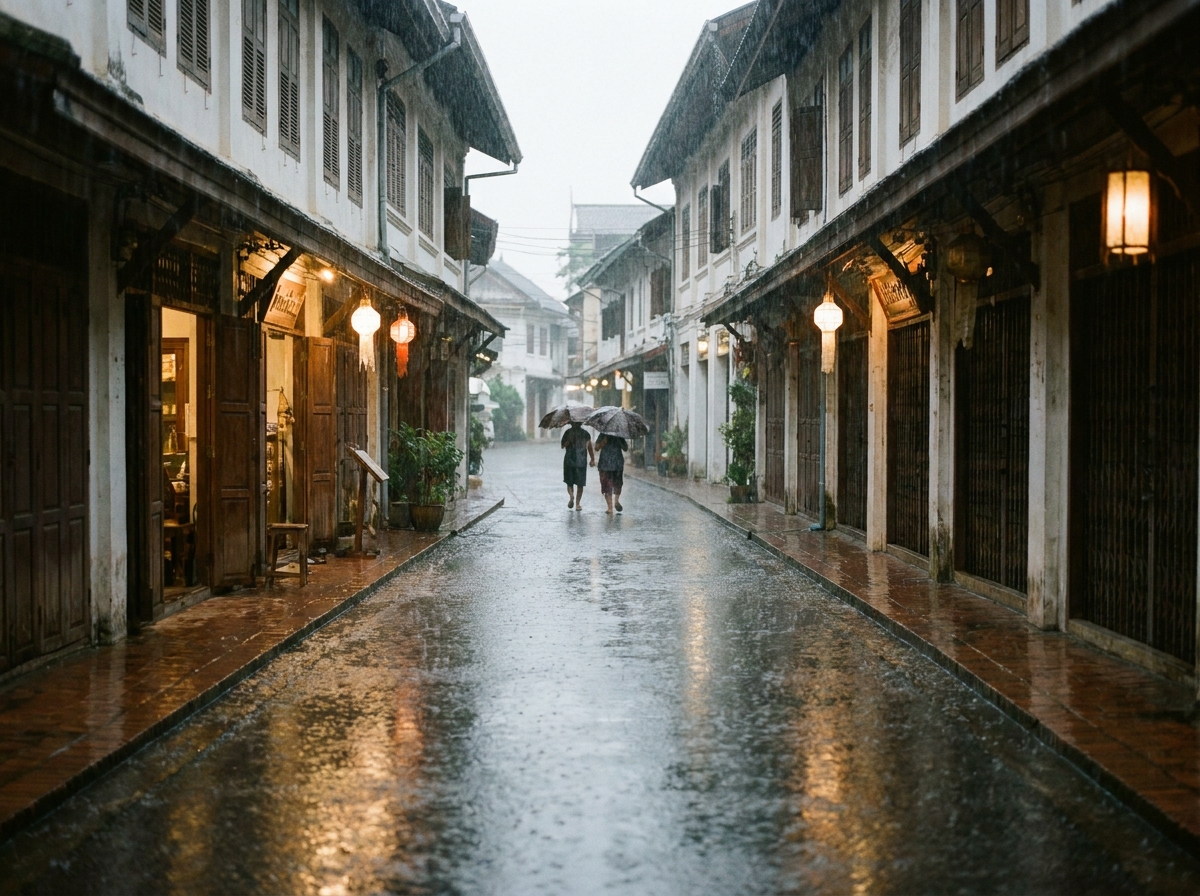
The best balance comes at either end, in the shoulder seasons. Mid-October through November, once the heavy rains have ended but before the cool-season crowds arrive, is the second window Thai travelers recommend, slotting neatly between the damp and the smoke. If you are choosing between March and October, it is no contest.
Getting around Chiang Mai
Public transport in Chiang Mai is limited. The network is designed for locals, and most tourists end up using ride-hailing apps or riding in the back of a red pickup. In the old city, walking covers most of what you will want to see.
Red songthaews, the rot daeng
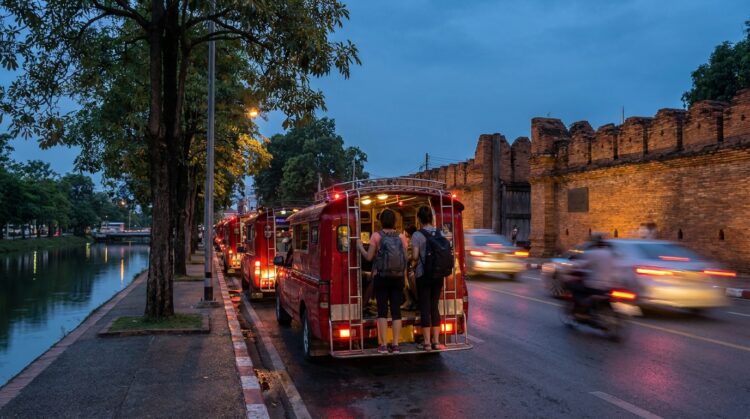
These shared red pickups are the local transport system. You flag one down, state your destination, agree on a price, then climb into the back and ring the bell when you want to get off. The fare scale quoted by Thai sources, which English-language guides flatten into a single figure, starts at 30 THB per person for hops of up to about 4 km and rises to 40 or 50 THB for longer journeys. From the railway station or Arcade terminal to the center, expect 50 to 100 THB depending on how many passengers share the ride, while trips toward the airport cost more, often around 100 THB from Nimmanhaemin. Hiring a songthaew for a day of sightseeing starts at around 300 THB. Some English-language guides now quote a minimum of 40 THB in town, probably a sign of a genuine upward drift.
The way the price escalates is almost always the same. Drivers charge locals a modest fixed fare per passenger and leave when they have enough people to make it worthwhile, but the laminated fare sheets they carry work out at around 30 THB per kilometer, and that is the rate applied once the ride becomes a private hire. This switch from shared ride to personal taxi is the trap, and nobody announces it. Agree on the price before boarding and say out loud whether it is per person or for the group. If a quote seems high, let it go and flag down the next pickup: a Thai passenger who stopped twelve red songthaews for the same journey was quoted between 80 and 150 THB. Booking a songthaew through Grab bypasses the negotiation and often works out cheaper.
Grab and Bolt
Both ride-hailing apps work here and, between them, handle most tourist trips. Travelers consistently rate Grab as more reliable and Bolt as cheaper: installing both costs nothing. What they really give you is a price known in advance. Hailing a vehicle on the street has always involved negotiation, drivers often did not understand the destination, and foreign passengers regularly paid more than locals.
From the airport, a GrabCar to the old city costs 80 to 180 THB, typically around 150, for a 15- to 20-minute journey, with surge pricing of 1.2 to 1.5 times the fare after 23:00 on weekends. The airport’s official taxi counter charges a fixed 150 THB to any address in town, or 200 THB for a vehicle seating up to six: the counter wins when you have luggage and a dead phone. The locals’ trick is to take a red songthaew to Central Airport Plaza for 30 THB and walk the final 800 meters. Two situational notes: during Songkran, take a Grab or Bolt car rather than a motorbike or an open songthaew if you want to arrive dry; and remember that the apps are excellent at taking you out of town and poor at bringing you back. Travelers report getting stranded at waterfalls, waiting for a songthaew willing to come past, with one walking 90 minutes to find a vehicle. If your day takes you to the outskirts, hire a vehicle rather than trusting you will find a ride back.
The city bus, for the record
The RTC network exists, and its R3 loop, the yellow line, serves visitors fairly well: it stops at the airport, Nimmanhaemin, the Three Kings Monument, Tha Phae Gate, Warorot Market, the Night Bazaar and Chiang Mai Gate. From the airport to the old-city stop, allow around 30 THB and roughly 40 minutes, including the loop. The fare is the unresolved part: sources quote a fixed 30 THB, a range of 20 to 30, and a promotional fare of 15 THB. Above all, bear in mind that practically no traveler mentions having taken these buses.
Renting a scooter
Rentals start at 200 or 250 THB per day, helmets included; a Honda Click 125i runs around 300 THB and a Honda PCX 150 around 500 THB. Residents quote the same 300 THB per day for a 125 cc bike and about 1,500 THB for a car. A scooter turns outlying temples and countryside trips into an easy, spontaneous afternoon rather than a booked excursion.
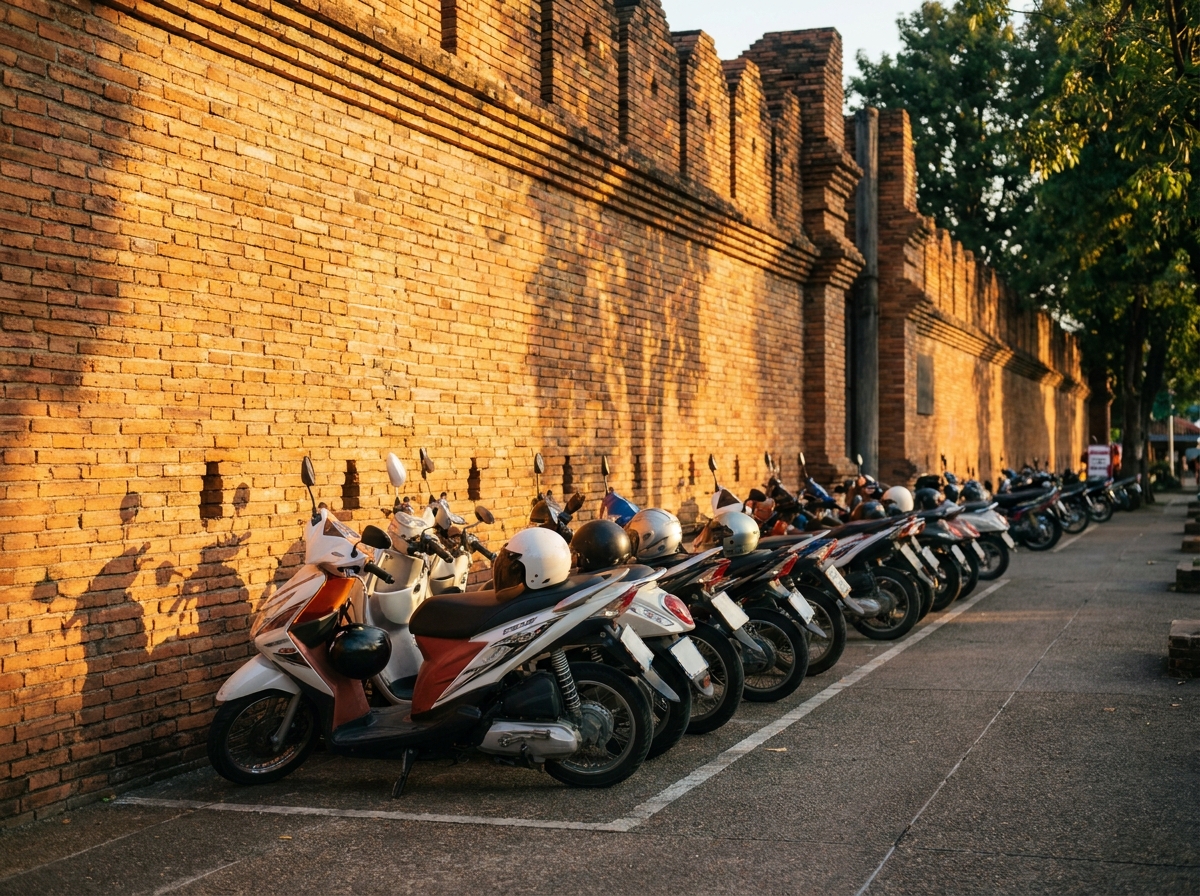
Pay for the optional damage insurance, generally around 150 THB per day. Without it, the rental company decides what your scratches are worth when you return the bike, and some operators treat damage charges as a revenue stream in their own right. For the same reason, refuse to leave your passport as a deposit and offer a cash deposit instead. Whoever holds your passport holds the leverage.
The license question is where travelers get it wrong. Rental companies ask for a passport or Thai ID card, plus a motorcycle license. Without an international or Thai license, some refuse outright, others demand a higher deposit, and others rent you a bike anyway, which does not mean you are riding legally. Police checkpoints around the old city are routine: one visitor reported in early 2025 that they had been stopped three times a day in previous years, and one resident puts the fine for riding without a license at 400 THB. The real risk is not the fine. Travel insurance generally does not cover an accident if you lack the required license, turning a scraped knee into a bill you pay yourself.
Entry requirements for French travelers
Read this section as a snapshot rather than a fixed rule, because it contains a moving part. As things stand, French nationals do not need a visa for stays of up to 60 days, and that is what border officials currently apply. But the Thai Cabinet approved the end of the 60-day scheme on May 19, 2026, then approved the detailed measures on July 16, 2026, reducing the exemption to 30 days for a list explicitly including all 27 European Union member states. France appears on the 30-day list in every version of the published information. The new rules take effect 15 days after publication in Thailand’s Royal Gazette, and that publication had still not taken place by mid-2026, so there is no effective date yet. Official French travel advice says exactly that: 60 days today, reduced to 30 once the measure takes effect, which is expected within a few weeks. Anyone entering before the effective date keeps the full length of stay granted on entry. Check France Diplomatie or the Thai embassy in the days before your flight, and if your trip lasts more than 30 days, plan it so that a shorter exemption does not derail it.
The second requirement is not optional and catches many people off guard. Since May 1, 2025, every non-Thai national arriving by air, land or sea must complete the Thailand Digital Arrival Card, or TDAC, including visa-exempt travelers. It replaced the old paper TM6 form. It is free, the only official website is tdac.immigration.go.th, and it must be submitted within the three days (72 hours) before arrival. You need your passport details exactly as they appear in the machine-readable zone, your arrival date, flight number, purpose of travel, accommodation address in Thailand and an email address; a single session covers up to ten people. A QR code arrives by email for you to show at immigration. Lookalike domains charge for what the authorities provide free: type the address rather than clicking a search result.
The rest is standard. Your passport must be valid for at least six months after your arrival date and contain a blank page, and you may be asked for proof of onward travel. Immigration may also request proof of funds, generally quoted as 20,000 THB per person or 40,000 THB per family, although that figure comes from commercial visa guides rather than a verified official page. A 300 THB arrival tax for entry by air was approved in February 2023 and then postponed repeatedly, with the latest announced deadline being mid-2026; no source confirms that it has been implemented.
- Check the current visa-exemption period on France Diplomatie or with the Thai embassy during the week of your departure, and do not assume it will be 60 days.
- Submit the TDAC at tdac.immigration.go.th within the 72 hours before arrival, and pay nothing for it.
- Check that your passport has six months of validity and a blank page.
- Have a ticket out of the country dated within your permitted stay.
- Take out travel insurance with at least 50,000 USD in emergency medical coverage.
- Bring your motorcycle license or an international driving permit if there is any chance you will drive.
- Pull up historical air-quality data for your exact dates before committing to a trip between February and April.
If you end up extending your stay, Chiang Mai’s immigration office is at Central Festival, and regulars arrive around 07:00 to queue outside. You can obtain a 30-day extension there; confirm the fee on site, as the amounts circulating are dated. The French consular agency in Chiang Mai reopened to the public on March 4, 2026. A warning for anyone planning a wider loop around Thailand: France advises against all travel within a 50 km strip along the Cambodian border, because of the aftermath of the armed conflict and unexploded ordnance.
Money and payments
Cash still rules the streets here, and ATMs are where foreign cards quietly get hit with charges. The standard fee is 220 THB per withdrawal, and in 2026 some machines display higher charges: 250 THB for Visa and up to 350 THB for some foreign Mastercard cards. AEON Bank ATMs charge 150 THB per transaction, among the lowest rates in the country. Withdraw larger amounts less often and those fees become less of a burden.
Always decline when the machine offers to charge you in euros. This is the ATM’s own currency conversion, DCC, and it hides a 5 to 7 % markup on top of the withdrawal fee: the option that looks convenient is always the more expensive one. The QR codes on every counter are PromptPay, the national payment system Thais use for everything from bowls of noodles to government transfers, but foreign visitors generally cannot register without a Thai bank account, so your two payment methods will remain cash and cards.
Staying connected
A tourist SIM card is cheap enough that going without makes no sense, especially since apps will be how you get around. AIS sells tourist plans lasting 3 to 30 days for roughly 299 to 1,250 THB, including an 8-day, 15 GB package at 299 THB. TrueMove H, now merged with dtac, sells an 8-day Thailand Tourist Infinite plan with unlimited 5G for 499 THB, around 13.50 USD, and offers the same product as an eSIM at the same price. Entry-level plans start at just 150 THB, and unlimited internet for a full month can be found for under roughly 40 USD.
Health and safety
There is no malaria risk in Chiang Mai city, just as in Bangkok, Chiang Rai, Koh Phangan, Koh Samui and Pattaya. The real risk is dengue, found throughout the country and peaking during the rainy season from May to October, with Chiang Mai among the areas reporting outbreaks. The Aedes mosquitoes that transmit it bite during the day, reversing the usual advice: apply repellent in the morning, not at dusk. Chikungunya is also increasing, with 1,379 cases reported in Thailand in 2025, roughly double the previous year, and the north recording the highest numbers. After any dog or monkey bite, wash the wound with soap and running water for at least 15 minutes and get post-exposure treatment; Maharaj Nakorn Chiang Mai Hospital is listed as a treatment center.
Understand how Thai private hospitals work before you need one: they require upfront payment and do not accept foreign public health coverage, so your card pays the bill and your insurer reimburses you afterward. The standard recommendation is at least 50,000 USD in emergency medical coverage, and it is worth rereading the exclusions if you plan to ride a motorbike. Save three numbers before landing: tourist police on 1155, available 24 hours a day with English-speaking operators, medical emergencies and ambulances on 1669, and general police on 191.
The scams that actually happen here
Start with a sense of proportion. Travelers repeatedly scammed in Bangkok regularly describe Chiang Mai as the easy part of the same trip, and many accounts of several-week visits include the city without a single incident. Sticking to apps eliminates most of your exposure. The classic daytime setup is the commission-based tuk-tuk tour: a driver quotes a suspiciously low price, then takes you to a tailor, souvenir shop or gem dealer, where he earns a cut of anything you buy. The low price is the bait, not the bargain. Guides describe a variation targeting Wat Phra Singh and Wat Chedi Luang: a friendly stranger, often on a motorbike, tells you the temple is closed today for a ceremony and helpfully redirects you. Chiang Mai residents are not reporting this version at the moment; the excuse they actually hear here is more often an exceptional holiday weekend. Either way, walk up to the ticket counter: the temples are not closed. The gemstone version involves a government promotion on stones you can supposedly resell at a profit back home, and the stones are poor quality or fake.
The most expensive scam, and the one missing from most scam lists, happens after midnight. The pattern: your ride-hailing app is not working, you accept a tuk-tuk on the street, and instead of taking you to your hotel, the driver drops you outside a karaoke bar and ushers you in for just one drink. One traveler on Songkran night in 2024 remembers a single beer and a bill of 8,500 THB. An even worse account describes a friend held inside the karaoke room while the group was pressured over a bill of around 10,000 THB, with staff repeatedly trying to charge 8,000 THB to a card until it was declined. Establishments change names, so warnings about a specific bar quickly become outdated. The defense does not: late at night, never let the driver choose the destination, and if your app is down, wait for it to come back.
The rest is small fry. Street approaches do happen in Chiang Mai, including a lost-wallet story near the Three Kings Monument and sellers claiming to represent charities who start at 2,000 THB, drop to 1,000 and then to 500. A blunt rule from regular visitors: if a stranger starts talking to you in the street, they want something, and ten pleasant minutes of chatting are part of the setup. Bring something to cover your shoulders at temples instead of buying it at the entrance, and photograph any rented motorbike before getting on it.
Three daily budgets for Chiang Mai, disagreements included
Chiang Mai is cheap, but published budget figures for Chiang Mai vary fourfold, and the reason comes down to definitions rather than geography. As one long-term traveler summed it up, for every backpacker spending 500 THB a day, there is another spending 3,000.
At backpacker level, 700 to 1,200 THB per day, roughly 18 to 32 EUR, covers a dorm bed in the old city at 200 or 350 THB a night, three street-food meals, a scooter and temple admission fees. Travelers who keep their receipts fall at the bottom of this range: lunch for 70 THB outside the center, a motorbike for 250 THB a day, a good dinner with a beer for 130 THB. Thai benchmarks point the same way, with the national tourism authority pricing a three-day, two-night itinerary at 5,000 THB for two people, and Thai travelers publishing breakdowns such as four days for 6,191 THB per person, including flights, accommodation, food and souvenirs.
The midrange is where sources disagree. One puts it at 800 or 1,300 THB per day (21 to 34 EUR) for a private guesthouse room, three street-food meals and local transport. Another sets it at around 3,867 THB, or nearly 102 EUR. Both describe something real; they simply draw the line in different places. The useful benchmark lies between them: actual 2024 bookings in genuinely pleasant hotels at 700 or 800 THB a night, with the advice to book just outside the old city, where the same money buys more space, and private guesthouse rooms starting at around 15 USD. Call this upper tier comfort rather than luxury. The 3,867 THB figure then describes it fairly well: a hotel instead of a guesthouse, restaurants instead of stalls, a private car instead of a red pickup, a booked excursion instead of a rental scooter.
The food price scale underlying these three tiers is consistent across Thai and foreign sources: 30 to 80 THB (0.80 to 2.10 EUR) for a street-food meal, 50 to 120 THB (1.30 to 3.15 EUR) at an ordinary stall or market, and 120 to 250 THB (3.15 to 6.55 EUR) at a well-regarded café or restaurant, with a trendy brunch in Nimman topping out at around 250 THB. The places behind those figures are in our guide to the best places to eat in Chiang Mai. If you are considering a longer stay, the monthly figures are what persuade people to extend: a modest studio in a university neighborhood at 5,000 THB a month, with a long-term scooter rental at 3,000 THB, and around 15,000 THB for an attractive studio geared toward digital nomads.
Planning a trip to Chiang Mai starts with settling your dates, and everything else follows: choose a window outside the smoky season or go with historical air-quality data in front of you, book your night-train berth or low-cost flight early, submit the TDAC three days beforehand, then let the city take over. Once the logistics are sorted, the enjoyable part begins, and it starts with our overview of what to see and do there.