Bangkok’s temples are the reason most travelers book a flight to the city
Bangkok is home to more than 400 active Buddhist temples, but you don’t need to see even a fraction of them to understand why the city draws more than 20 million visitors a year. A handful rank among the most remarkable religious buildings in Southeast Asia, and you can cover the must-sees in a single morning if you plan well.
But here’s the bottom line: Bangkok’s temples are not just about ticking a tourist checklist. The Grand Palace houses Thailand’s most sacred Buddha image. Wat Pho holds a 46-metre reclining Buddha covered in gold leaf.
A five-and-a-half-ton solid-gold Buddha sits in Chinatown, hidden under plaster for centuries until someone accidentally dropped it. These are places where Thai people genuinely come to pray, and the stories behind each temple are as compelling as the architecture.
This guide covers the temples that are truly worth your time, drawing on feedback from real travelers. I’ll walk you through the major sights, the hidden gems most tourists miss, dress-code rules, scams to avoid, and how to stitch everything together in an itinerary that won’t leave you templed-out by noon. For a broader overview of planning your trip to Bangkok, see our complete Bangkok travel guide.
The Grand Palace and Wat Phra Kaew: Thailand’s holiest site
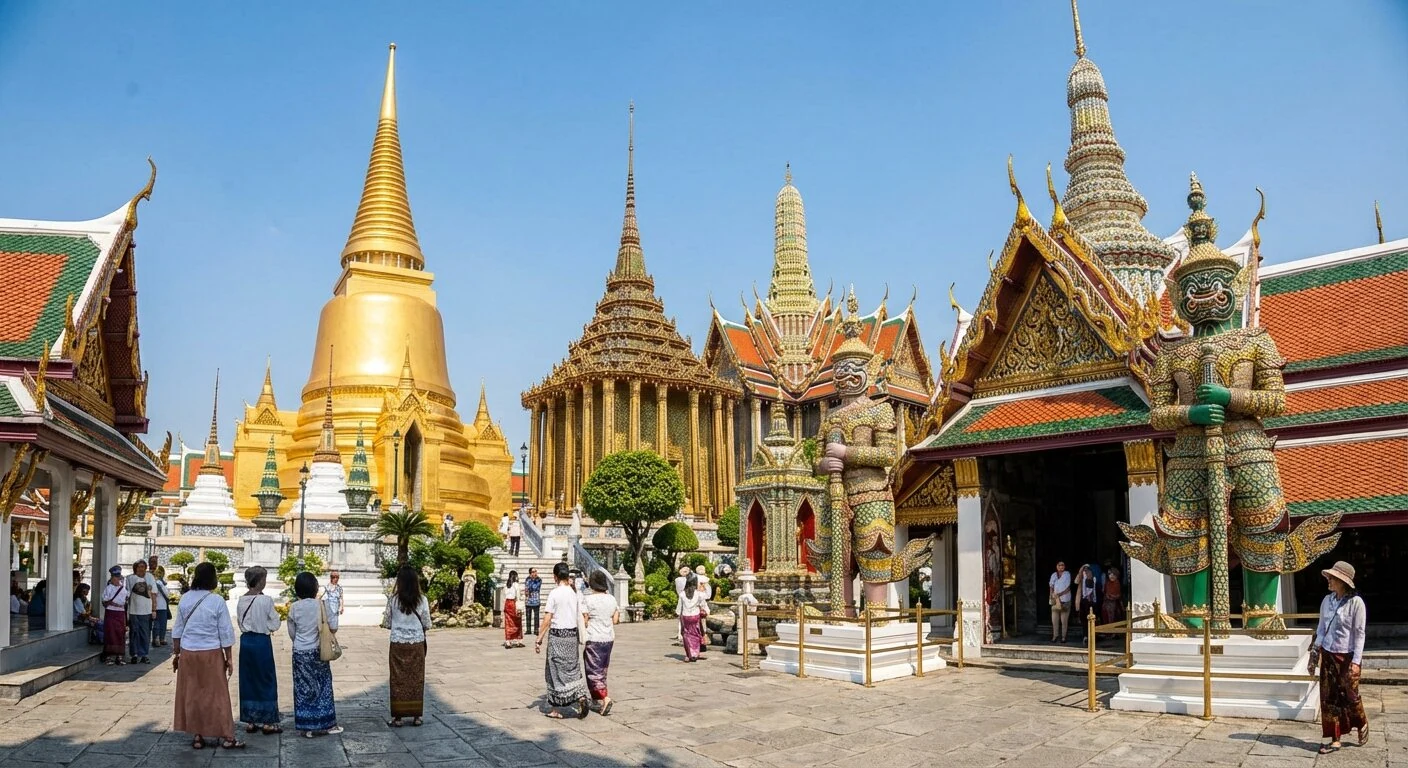
The Grand Palace is Bangkok’s most famous landmark, and Wat Phra Kaew (the Temple of the Emerald Buddha) sits within its walls. The Emerald Buddha is Thailand’s most revered Buddha image. It’s small—only 66 centimetres tall—carved from a single block of jade, and the King of Thailand changes its gold robes three times a year to mark the seasons. You can’t get close to it, and photography inside the chamber is forbidden.
The complex’s architecture is breathtaking. Every surface seems clad in gold leaf, coloured glass mosaics, and hand-painted murals. The Ramakien murals running along the corridor walls portray the Thai version of the Ramayana over 178 panels.
The craftsmanship is hard to take in on a single visit, a bit like walking into the Hall of Mirrors at Versailles for the first time. No other temple in Bangkok comes close to this level of detail.
That said, the Grand Palace clearly divides opinion among travellers. The case for it: it’s Thailand’s most important historical site, the architecture is outstanding, and skipping it is like going to Paris and not seeing the Eiffel Tower.
The case against: the 500 THB entrance fee (about €13) is the highest of any Bangkok temple, the crowds are genuinely unbearable (especially after 10 a.m. when tour buses roll in), there’s almost no shade, and you can’t enter most buildings. You walk around the exteriors in full sun.
My recommendation: go if it’s your first time in Bangkok, and show up at 8:30 a.m. when the gates open. By 9:30 the tour groups arrive and the experience deteriorates fast. Allow 1.5–2 hours. The ticket office closes at 3:30 p.m.
A detail almost everyone misses: your 500 THB ticket includes entry to a Khon masked dance performance in a nearby theatre. Ask at the ticket counter for show times. It’s genuinely worth seeing, and you’ve already paid for it.
The strictest dress code in Bangkok
The Grand Palace enforces its dress code strictly, and guards will turn you away if you don’t meet the requirements.
Men must wear long trousers (no knee-length shorts or capris) and a sleeved top. No tank tops, no ripped jeans.
Women must have shoulders and knees covered with a real sleeved top. Leggings are rejected as too form-fitting. Throwing a scarf over a tank top is also refused. Guards want to see a proper sleeved shirt.
Flip-flops and sandals are perfectly acceptable, since you remove your shoes before entering any building anyway. Wear shoes that are easy to slip on and off. You’ll be doing it many times.
If you arrive improperly dressed, vendors outside sell “elephant pants” (loose printed trousers) for 100–200 THB (€2.50–5). The quality is poor, but they’ll get you through the gate. It’s easier to just wear appropriate clothes from your hotel.
The “palace closed” scam
This one is so common it deserves its own section. Here’s how it works: you’re walking toward the Grand Palace and a friendly local approaches, usually near the outer walls or a side gate. He tells you the palace is closed today for a ceremony, cleaning, or a holiday. He kindly offers to redirect you to a tuk-tuk driver who will take you to see a “Lucky Buddha,” a jewellery shop, or a tailor.
The Grand Palace is almost never closed during opening hours. It’s a scam, every time.
The “friendly local” gets a commission from the jewellery shop or tailor for delivering tourists. Don’t get sucked in. Walk straight to the main entrance on the north wall. Ignore anyone who approaches you outside the walls, no matter how convincing they seem. The only people you should listen to are the uniformed guards at the official entrance.
Wat Pho: most travelers’ favourite temple
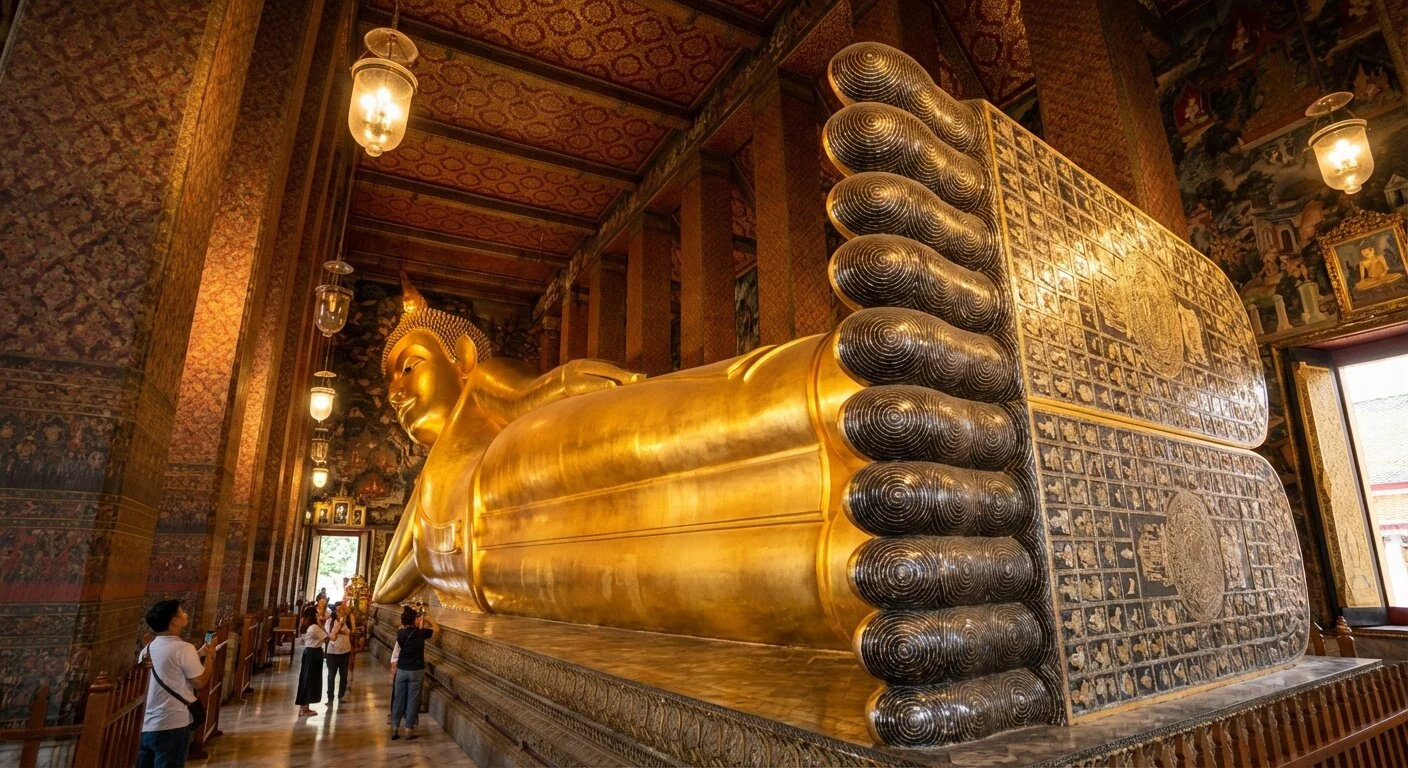
If you can visit only one temple in Bangkok, pick Wat Pho. It’s the unanimous choice among Bangkok regulars, and it’s easy to see why. The temple houses the famous 46-metre Reclining Buddha, completely covered in gold leaf, lying on its side in a hall that barely contains it. The feet alone are more than five metres long, inlaid with 108 mother-of-pearl panels depicting auspicious symbols from Buddhist mythology.
But Wat Pho is more than a single statue. It’s one of Bangkok’s largest and oldest temple complexes, with more than 1,000 Buddha images scattered around the grounds. The atmosphere is notably more relaxed than at the Grand Palace: more shade, fewer pushy vendors, and a calmer pace. The dress code is also looser (knee-length shorts are generally tolerated, though covering shoulders is still required).
Entrance is 200–300 THB (€5–8), about half or a third of the Grand Palace price. You don’t need a guide; the complex is easy to explore on foot.
Getting a massage at Wat Pho
Wat Pho houses Thailand’s oldest traditional massage school, and you can get a massage right on site in an open-air pavilion. The technique here is true traditional Thai massage: vigorous, therapeutic, and sometimes painful. This is not a spa experience. Expect stretches, pressure-point work, and firm manipulation. The massage takes place in an open pavilion with fans, no air-conditioning.
Wait times are 1–2 hours. Here’s a tip: book your slot as soon as you enter the complex, then use the wait time to tour the temple. By the time you’ve seen the Reclining Buddha and wandered the gardens, your massage should be ready.
Getting to Wat Arun from Wat Pho
Wat Pho is a 5–10-minute walk from the Grand Palace, so visiting both in the same morning makes perfect sense. And from Wat Pho, reaching Wat Arun on the opposite bank of the river is child’s play: walk to the Tha Tien pier (right next to Wat Pho), hop on the ferry for 4–5 THB (just a few cents), and you’re at Wat Arun in about two minutes. The ferry runs frequently all day.
Wat Arun: the temple people photograph more than they visit
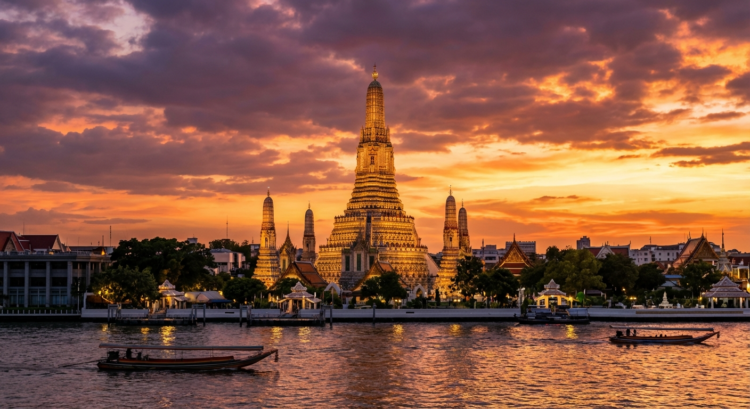
Wat Arun (the Temple of Dawn) is Bangkok’s most iconic image. You’ve seen it on every guidebook cover and on Instagram: a tall Khmer-style prang (tower) rising from the west bank of the Chao Phraya, covered in thousands of shards of colourful Chinese porcelain and seashells. The design is unique among Bangkok temples. Nothing else looks like it.
Here’s what seasoned travellers will tell you: the best thing about Wat Arun is the view from the opposite bank, not the experience of visiting up close. Bangkok’s most famous view is Wat Arun at sunset, bathed in golden orange against the evening sky, seen from the east bank of the river. After dark, the temple lights up and puts on a completely different show.
That said, visiting the temple itself is still worth it, especially early in the morning. You can climb the very steep central prang to admire the porcelain mosaic work up close and enjoy the surrounding views from on high.
Just go early: the white porcelain reflects sunlight intensely, and by midday the heat and glare become unpleasant fast. The entrance fee is only 100 THB (€2.50, the cheapest of the three big riverside temples), and the whole visit takes about 45 minutes.
Where to watch sunset over Wat Arun
If there’s one thing to book in advance for Bangkok, it’s a sunset dinner with a view of Wat Arun. The most coveted spots on the east bank are Sala Rattanakosin (the clearest view, fairly upscale), Chom Arun (good food and great view), The Deck by Arun Residence (the classic), and Eagle Nest Bar (perfect for a terrace drink). These restaurants fill up for golden-hour tables (5:30–6:30 p.m.) weeks or even months ahead in high season. Reserve well in advance.
If you don’t want to splurge on a terrace dinner, there’s a free option: ride the ferry around sunset. The view from the water is excellent, and the ride costs less than 5 THB.
Wat Saket: Bangkok’s best panoramic view
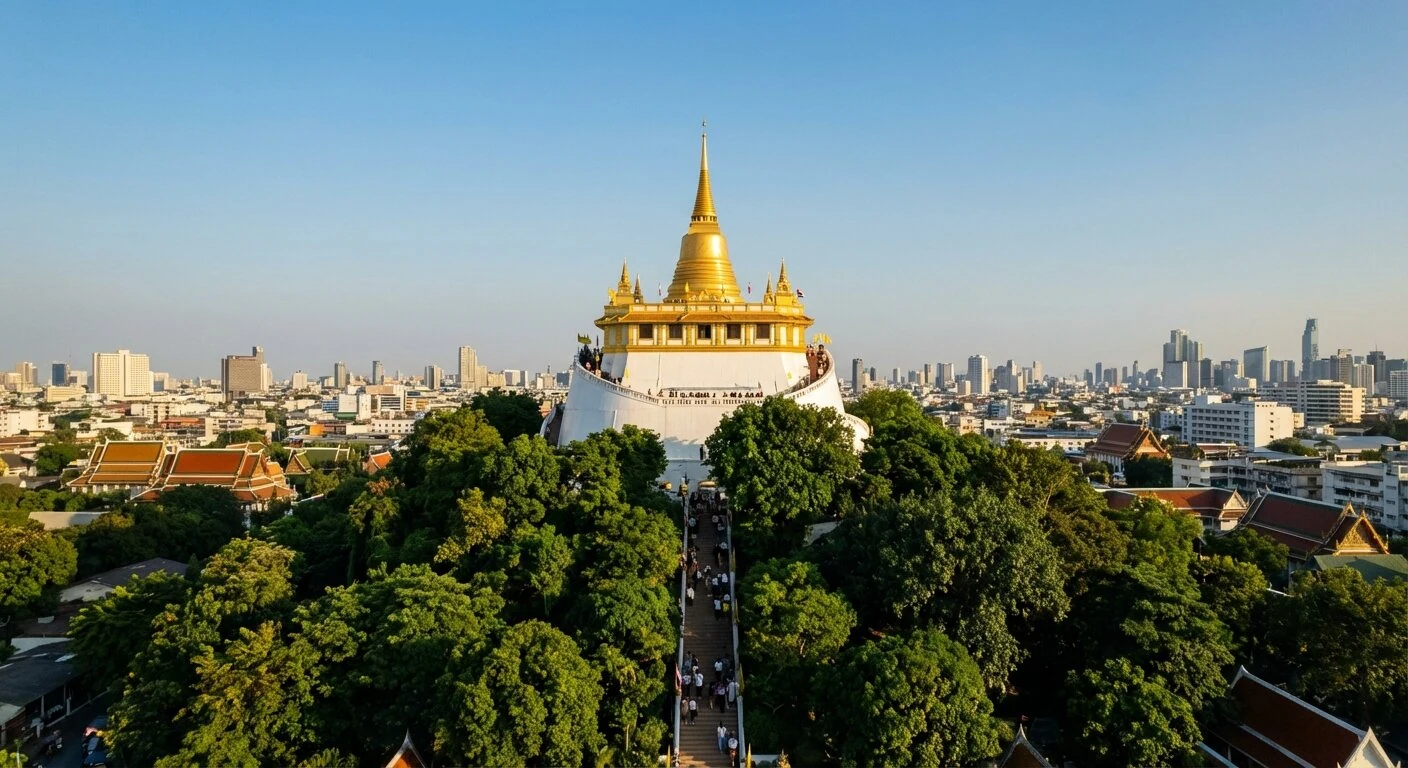
Wat Saket, better known as the Golden Mount, is the temple that travellers who’ve visited Bangkok more than once tend to recommend first. It doesn’t have the fame of the three riverside giants, but it offers something none of them do: a 360-degree panoramic view over the entire city from a hill that rises well above the flat surroundings.
To reach the summit you climb more than 300 steps, but the path is shaded and fitted with mist fans and water features that cool you far more than you’d expect.
The ascent is pleasant rather than taxing. At the top, a golden chedi (stupa) containing a Buddha relic is ringed by open-air viewing platforms where you can look out over Bangkok in every direction. The atmosphere up here is breezy and peaceful, a sharp contrast to the crowded, stuffy temples at street level.
Entrance is about 50 THB (€1.30), a fraction of what the Grand Palace charges. Crowds are light. In November, during the Loy Krathong festival, the temple hosts an annual fair with a candlelit procession up the mount, regarded as one of Bangkok’s most memorable events.
Wat Saket pairs well as an afternoon follow-up after a morning at the riverside temples. Take a taxi or tuk-tuk from the Wat Pho area (15–20 minutes), and you’ll arrive ready for a completely different experience.
Loha Prasat: the only temple of its kind in the world
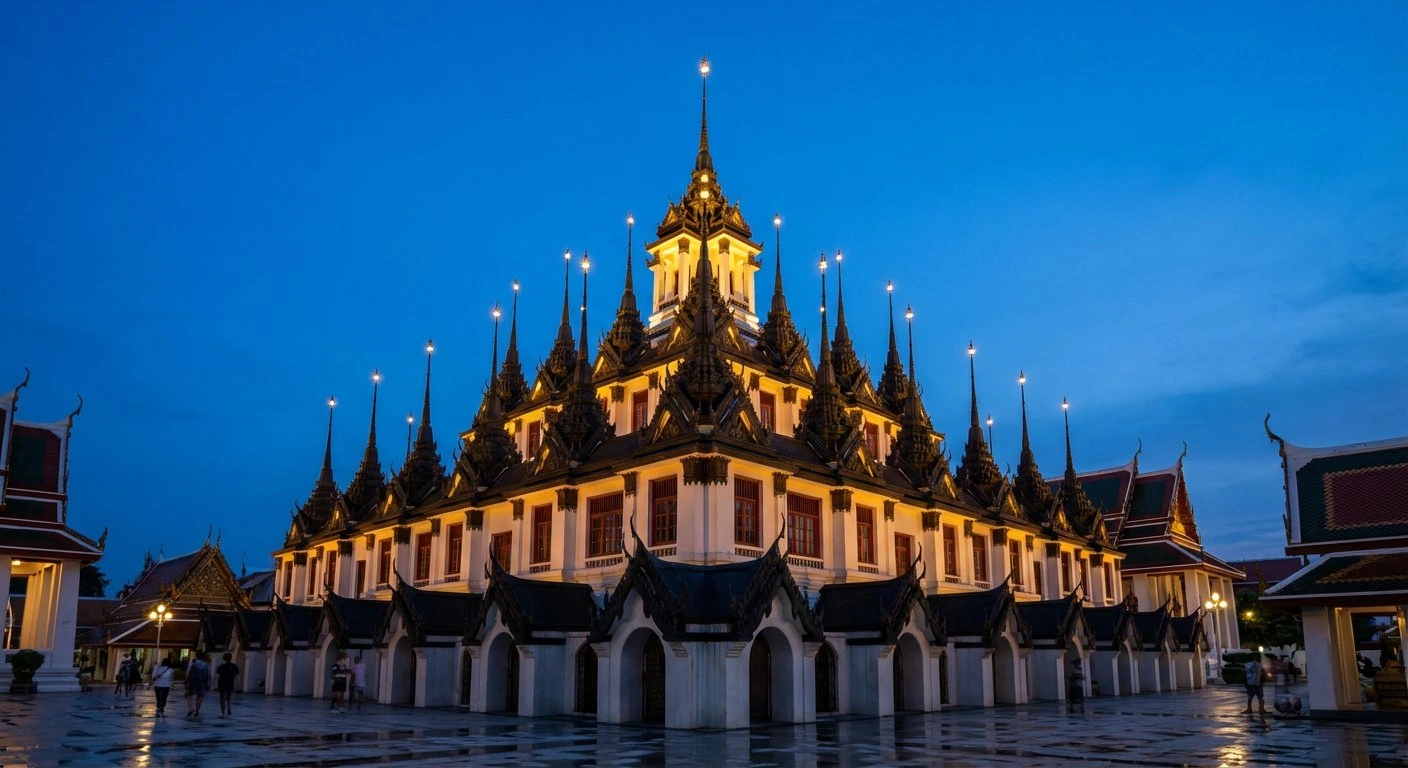
Loha Prasat, literally “Metal Castle,” sits right next to Wat Saket, making the two an obvious pairing. This temple at Wat Ratchanatdaram features 37 black iron spires arranged in a geometric pattern unlike anything else in Buddhist architecture. It is the only metal prasat (castle-like structure) still standing in the world; the other two that once existed in India and Sri Lanka have long disappeared.
The architecture draws photographers more than any other Bangkok temple. The geometric repetition of the spires against the sky is especially photogenic in late afternoon. Inside, you can climb through the prasat’s levels, though the interior is plain compared with the exterior.
Entry is free or about 20 THB (€0.50). The temple is near Khao San Road. Almost no tourists visit it, despite its uniqueness. Combine it with Wat Saket; you can walk between them in under five minutes.
Wat Traimit: a five-ton golden secret hidden in Chinatown
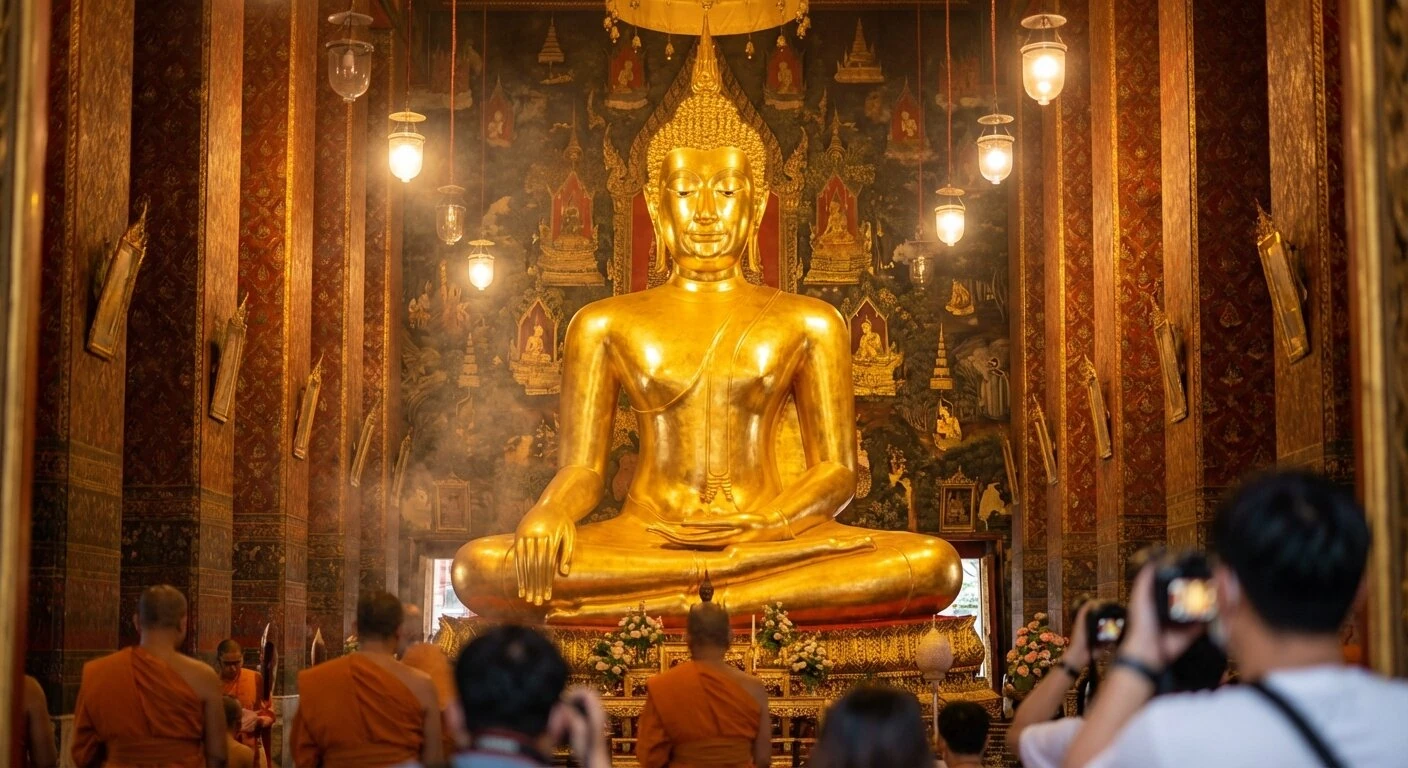
Wat Traimit houses the world’s largest seated solid-gold Buddha: 5.5 tons of pure gold, worth an estimated US$250 million today (over €230 million). But the story behind it is more interesting than the statue itself.
For centuries, this Buddha sat in a temple coated with a thick layer of plaster, and no one suspected what lay beneath. In 1955, while moving the statue to a new building, the crane cables snapped under the unexpected weight and the statue fell, cracking the plaster shell. Workers returned the next day to find gleaming solid gold shining through the cracks.
The plaster had been applied hundreds of years earlier, probably to hide the gold from Burmese invaders, and knowledge of what lay underneath was lost over time. A small museum inside the temple tells the full story.
Wat Traimit sits at the entrance to Chinatown (Yaowarat), making it a natural starting or finishing point for a food crawl in Chinatown. The closest MRT stations are Hua Lamphong and Wat Mangkon.
Entrance costs 40–100 THB (€1–2.50), and you’ll spend about 20–30 minutes there. The trip isn’t worth it if it’s your only reason to come to the area, but if you’re in the middle of exploring Bangkok’s street-food scene in Chinatown, the detour takes almost no extra time.
Wat Benchamabophit: European marble in a Thai temple
The Marble Temple gets its English nickname from its building material: Carrara marble imported from Italy, the same used for Europe’s great cathedrals. That makes it unique among Bangkok temples, which are usually built of brick, stucco, and wood. The symmetrical design and clean white surfaces are highly photogenic, and the site is far less chaotic than the riverside temples.
The downside is the location. Wat Benchamabophit is farther from the riverside cluster, and you’ll need a taxi or Grab to reach it (plan your Bangkok transport options in advance). If you’re short on time and can devote only one day to temples, this one should probably be skipped. If you have two full temple days, add it to your second day. Entrance is 20–50 THB (€0.50–1.30). The temple is open 8 a.m.–5:30 p.m.
Wat Suthat and the Giant Swing
Wat Suthat is one of Bangkok’s oldest and most important royal temples, with monumental murals and a massive Buddha image inside the main hall. The interior painting is considered some of the finest in Thailand, and the temple sees far fewer tourists than the Grand Palace or Wat Pho.
The Giant Swing (Sao Ching Cha) stands right in front of the temple. This 21-metre-tall red teak structure was used in a Brahmin ceremony in which participants swung very high to grab bags of gold coins suspended from a pole. The ceremony was banned in the 1930s after several fatal accidents. Today the swing is a photogenic landmark and the surrounding neighbourhood offers good street-food options. Entrance to Wat Suthat is 100 THB (€2.50).
Hidden gems: temples most tourists never find
Once you’ve covered the famous temples, the next question is where to go after that. Bangkok has several lesser-known temples that repeat visitors rate above the big crowded sites.
Wat Ratchabophit: the one everyone should see
If there’s one hidden temple to see in Bangkok, it’s Wat Ratchabophit, according to the city’s old hands. The temple is within walking distance of the Grand Palace and Wat Suthat, yet it’s almost completely deserted. The exterior tiling is very detailed, with patterns that reward close inspection. The interior is unusual for a Thai temple: it shows strong European architectural influence, looking more like a Gothic chapel than a Buddhist prayer hall.
A royal cemetery on the grounds adds another layer of interest.
Entrance is free. The temple may attract more visitors soon (rumour has it it was a filming location for White Lotus season 3), but for now you might well be the only foreign visitor. See it between the Grand Palace and Wat Saket, since it lies on the route between the two.
Wat Paknam: the green-glass ceiling
Wat Paknam Bhasicharoen has drawn attention thanks to its green-glass ceiling inside a large white stupa. The inner dome features a glowing emerald-glass tree surrounded by painted celestial scenes. It’s one of Bangkok’s most photographed temple interiors, and the images look almost unreal. The temple is on the Thonburi side, reachable by BTS to Wutthakat station.
Wat Pariwat: the David Beckham temple
This is the temple where monks have worked pop-culture figures into traditional Buddhist mosaic art. Look closely at the decorations and you’ll spot David Beckham, Pikachu, Captain America, Popeye, and various superheroes hidden among traditional Buddhist motifs. It’s a modern, quirky touch that makes you scan every surface twice. Very few tourists know it exists.
Wat Mahabut: the haunted temple
Wat Mahabut houses the sanctuary of Mae Nak Phra Khanong, a famous ghost from Thai folklore. The legend of Mae Nak is one of the best-known stories in Thai culture, adapted into dozens of films and TV series.
Thais regularly visit the shrine to make offerings and ask for blessings (especially in matters of love and fidelity). As a foreign visitor, this stop gives you insight into Thai supernatural beliefs that you won’t find at any tourist temple. Entrance is free. Almost no Western tourists go there.
Wat Pathum Wanaram: the temple between the malls
Located between Siam Paragon and CentralWorld, two of Bangkok’s biggest shopping malls, Wat Pathum Wanaram is a quiet space tucked amid concrete and commerce. It’s a welcome midday break if you’re shopping in the Siam area: step out of the air-conditioned skywalk, through the gates, and you’re in a shaded, peaceful temple garden. Free entry.
How to dress and behave in Bangkok temples
The basic rule for all temples: cover your shoulders and knees. This applies to both men and women. Beyond that, enforcement varies by temple.
The Grand Palace is the strictest (details above). At Wat Pho, Wat Arun, and most other temples, rules are applied more loosely. Knee-length shorts usually pass, but tank tops and very short skirts will get you turned away at some temples.
The ideal all-purpose outfit for a day of temple visits: lightweight linen or cotton long trousers (breathable in the heat, accepted everywhere) and a T-shirt that covers the shoulders. Women should slip a large scarf or pareo into their bag, since it can serve as an improvised skirt if needed.
For footwear, flip-flops or sandals are by far the best choice. You’ll remove your shoes before entering each temple building, and with five or more temples in a day that means taking them off and on dozens of times.
Slip-on sandals or Birkenstocks make it painless. Lace-up trainers quickly become a chore. Keeping your socks on inside temples is perfectly acceptable if you prefer not to walk barefoot.
Behaviour inside temples
Remove your shoes before entering any temple building. Step over the threshold (the raised wooden bar in the doorway); never step on it. When seated on the floor, tuck your legs behind you so your feet don’t point at the Buddha or at monks. Never touch a monk (especially important for women). Don’t point at sacred objects; if you need to indicate something, gesture with your whole hand, palm up.
Keep your voice low in prayer halls. Bring small bills (20–100 THB, €0.50–2.50) for donation boxes if you wish to contribute. And don’t worry too much about making a faux pas: Thais are generally forgiving toward foreigners who make an effort to be respectful, and it’s rare for anyone to call you out on a cultural slip.
Best temple itineraries: half-day, full day, and two days
Temple fatigue is real. After two or three temples in Bangkok’s heat, the gold, mosaics, and Buddha statues start to blur together. The key to enjoying the visits is pacing: alternate temples with food breaks, air-conditioned restaurants, and varied experiences. Here are three field-tested itineraries, which you can also weave into your broader Bangkok activity schedule.
Morning half-day itinerary (4–5 hours)
This route covers the three big riverside temples in one efficient morning.
Start at the Grand Palace at 8:30 a.m. sharp. Spend 1.5 hours before the tour buses arrive. Walk ten minutes south to Wat Pho and spend an hour with the Reclining Buddha (book a massage slot immediately if you want one). Then walk to the Tha Tien pier and take the ferry (5 THB, 2 minutes) to Wat Arun. Spend 45 minutes there. You’ll finish around 12:30 p.m. and be ready for a riverside lunch.
Total entrance-fee cost for this itinerary: about 800 THB (€21).
Alternative half-day: start with Wat Arun
This variant suits photographers better. Start at Wat Arun at 8 a.m. sharp, when the morning light is soft on the porcelain mosaics and crowds are minimal. Take the ferry back to the east bank around 9 a.m. Walk to Wat Pho, tour the complex, and get a massage. Then continue either to the Grand Palace or skip it and head to lunch. This itinerary puts you at the best temples during their best hours.
Full-day itinerary (8–9 hours)
Start with the morning half-day route above. After Wat Arun, have lunch in an air-conditioned restaurant (you’ll need the break to escape the heat). In the afternoon, take a taxi to Wat Saket and Loha Prasat (allow 1.5 hours for both). Then taxi to Wat Traimit in Chinatown (30 minutes to see the Golden Buddha) and follow with Chinatown street food for dinner on Yaowarat Road.
If you still have energy, head back to the river around 6 p.m. to see Wat Arun lit up after dark.
Total entrance-fee cost for this itinerary: about 950 THB (€25).
Budget itinerary (skipping the Grand Palace)
If you’d rather spend 500 THB on food than on an entrance fee, skip the Grand Palace and follow this route: Wat Pho (200 THB), ferry to Wat Arun (100 THB), walk to Wat Ratchabophit (free), lunch, then Wat Saket (50 THB) and Loha Prasat (free), ending at Wat Traimit and Chinatown. Total entrance fees: about 400 THB (€10.50), versus 500 THB for the Grand Palace alone. Many Bangkok regulars find this route more enjoyable than one that includes the Grand Palace.
Two-day temple programme
Day 1: the big three (Grand Palace, Wat Pho, Wat Arun) plus Wat Saket and Loha Prasat. Day 2: Wat Benchamabophit (the Marble Temple) in the morning, Wat Suthat and the Giant Swing, Wat Ratchabophit, and Wat Traimit with a Chinatown dinner. Spreading the temples over two days lets you see more without the burnout that comes from cramming everything into one exhausting march.
Each day, cap yourself at three or four temples max and take long breaks between each.
Getting to the temples: transport that actually works
The riverside temples (Grand Palace, Wat Pho, Wat Arun) cluster along the Chao Phraya, and the best way to reach them is by water. Take the BTS Skytrain to Saphan Taksin station, walk to the Sathorn pier beneath the station, and board the Chao Phraya Express Boat (look for the orange flag). The fare is 16 THB (€0.40), and the ride upriver is scenic and avoids Bangkok’s notorious traffic entirely.
The express boat stops at piers close to all the major riverside temples.
An alternative is the MRT (subway) to Sanam Chai station, which drops you within steps of Wat Pho and the Museum of Siam. The Sanam Chai station itself is worth a look; it’s one of Bangkok’s most architecturally elaborate metro stations.
To move between temple clusters away from the river, use the Grab app (Southeast Asia’s Uber equivalent). Metered taxis work too, but insist on the meter before you get in, or just use Grab to avoid negotiation.
Tuk-tuks near tourist temples consistently overcharge; a ride they quote at 300–500 THB can cost 50–80 THB by walking a block away and using Grab.
For more details on Bangkok transport options, including BTS, MRT, and river boats, see our practical guide and tips for getting around Bangkok.
Temples and the neighbourhoods around them
Each temple cluster sits in a distinct part of Bangkok, and the neighbourhood around a temple is often as interesting as the temple itself.
The Grand Palace, Wat Pho, and Wat Arun area is Rattanakosin, the historic old city. The streets are narrow and lined with food vendors, and the area around the Tha Tien pier has good lunch options.
Khao San Road is about a 15-minute walk north. Across the river, the Thonburi area around Wat Arun is quieter and more residential.
Wat Saket and Loha Prasat sit on the edge of Rattanakosin, near Khao San Road and the Banglamphu district, one of Bangkok’s best areas for budget accommodation and street food.
Wat Traimit stands at the gateway to Chinatown (Yaowarat), which comes alive in the evening with one of Asia’s best street-food scenes.
Wat Benchamabophit is in the Dusit district, near government buildings and wide European-style boulevards built during King Rama V’s reign. The vibe is very different from the dense old city.
Choosing a hotel near the temples you want to visit can save you considerable time and taxi fares. For recommendations on the best Bangkok neighbourhoods to stay in, see our accommodation guide.
Bangkok temples compared with other temple experiences in Southeast Asia
If you’re travelling around Southeast Asia and wondering how Bangkok’s temples compare with others in the region, here’s the short answer: Bangkok’s major temples are more ornate and more laden with gold than almost anything else you’ll find in the region. The decorative detail at the Grand Palace surpasses anything elsewhere.
Temple culture in Thailand extends far beyond Bangkok. If you head south toward the islands, Phuket has its own temple scene with sights like the Big Buddha and Wat Chalong, though on a smaller scale. And if you compare Thai temples with Balinese temples, the difference is striking: Bali’s temples are Hindu rather than Buddhist, with carved stone and jungle backdrops totally unlike Bangkok’s gold and glass mosaics. Both experiences are worth seeking out if your itinerary allows.
Practical information at a glance
Here are the opening hours and entrance fees for every temple covered in this guide, so you can plan your itinerary without looking each one up separately.
The Grand Palace and Wat Phra Kaew open at 8:30 a.m., ticket office closes at 3:30 p.m. Entry: 500 THB (€13). Allow 1.5–2 hours. Wat Pho opens at 8 a.m. and closes at 6:30 p.m. Entry: 200–300 THB (€5–8). Allow 1–2 hours. Wat Arun opens at 8 a.m. and closes at 6 p.m. Entry: 100 THB (€2.50). Allow about 45 minutes.
Wat Saket opens at 7:30 a.m. and closes at 7 p.m. Entry: 50 THB (€1.30). Allow 45 minutes to 1 hour. Loha Prasat opens at 8 a.m. and closes at 5 p.m. Entry free or 20 THB (€0.50). Allow 30–45 minutes. Wat Traimit opens at 8 a.m. and closes at 5 p.m. Entry: 40–100 THB (€1–2.50). Allow 20–30 minutes.
Wat Benchamabophit opens at 8 a.m. and closes at 5:30 p.m. Entry: 20–50 THB (€0.50–1.30). Allow 30–45 minutes.
Wat Suthat opens at 8:30 a.m. and closes at 9 p.m. Entry: 100 THB (€2.50). Allow 30–45 minutes. Wat Ratchabophit opens at 8 a.m. and closes at 5 p.m. Entry free. Allow 30–45 minutes.
Bring plenty of water and sunscreen. Bangkok’s heat is relentless, especially between 11 a.m. and 2 p.m. when shade is scarce in most temple complexes.
Budget at least 700–1,000 THB (€18–26) per person per day if you plan to visit multiple temples, including entrance fees, transport, and water. Travellers from France should bring their EHIC card even though it doesn’t cover Thailand: instead take out travel insurance like Chapka Cap Aventure or ACS Globe Trotters, which cover Southeast Asia for a few euros a day.
For more on budgeting, transport, and other practical questions, see our complete practical tips for Bangkok. And for a full overview of everything Bangkok offers beyond temples, check out our comprehensive Bangkok travel guide.
For a different cultural experience, discover what to see in Hanoi between the Old Quarter and millennia-old temples