

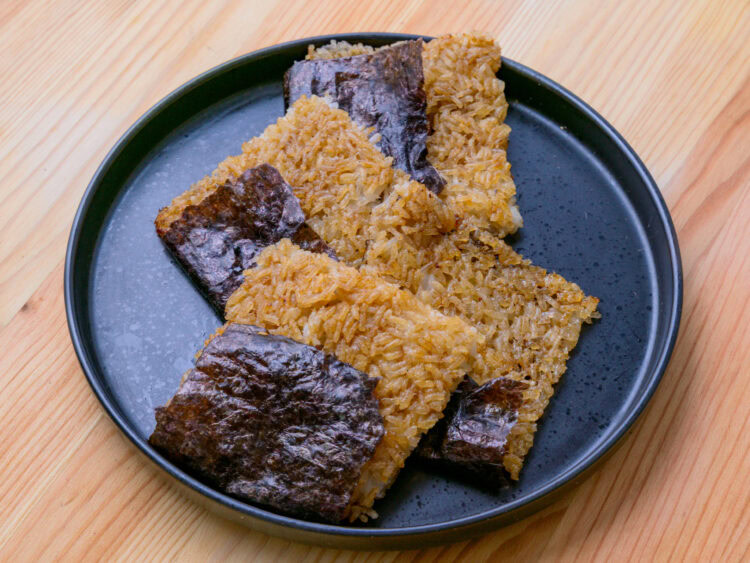
Discover Nurungji, crispy Korean rice pan-toasted and glazed with soy sauce and sugar for an irresistible snack.
In a pot set over the fire, the rice swells and then stops boiling. At the bottom, a thin layer keeps sizzling, turns golden, and fills the kitchen with aromas of corn and hazelnut. Koreans call this delicate crust, which snaps cleanly, nurungji.
This crust was born from a cooking “accident”—the slightly stuck rice that no one dared throw away. Over time, it became a delicious Korean snack.
What is nurungji?
In Korean, “nurungji” (누룽지) literally means “scorched rice.” Other regional names like nurunggaengi, nuleungji, nuleunbap, or gamachi in North Korea all refer to the same thing: the rice crust that forms at the bottom of the pot.
It’s not a dish with toppings, but a special state of bap, everyday white rice. Packed tightly together, the grains fuse into a compact sheet during cooking, then break apart into uneven shards.
A good nurungji looks like a thin, slightly uneven rice sheet, evenly golden to light brown, never burnt. The edges are dry and crunchy, while the center is a bit thicker and slightly chewy. Even without seasoning, the flavor is surprisingly complex: toasted grain, hazelnut, popcorn.
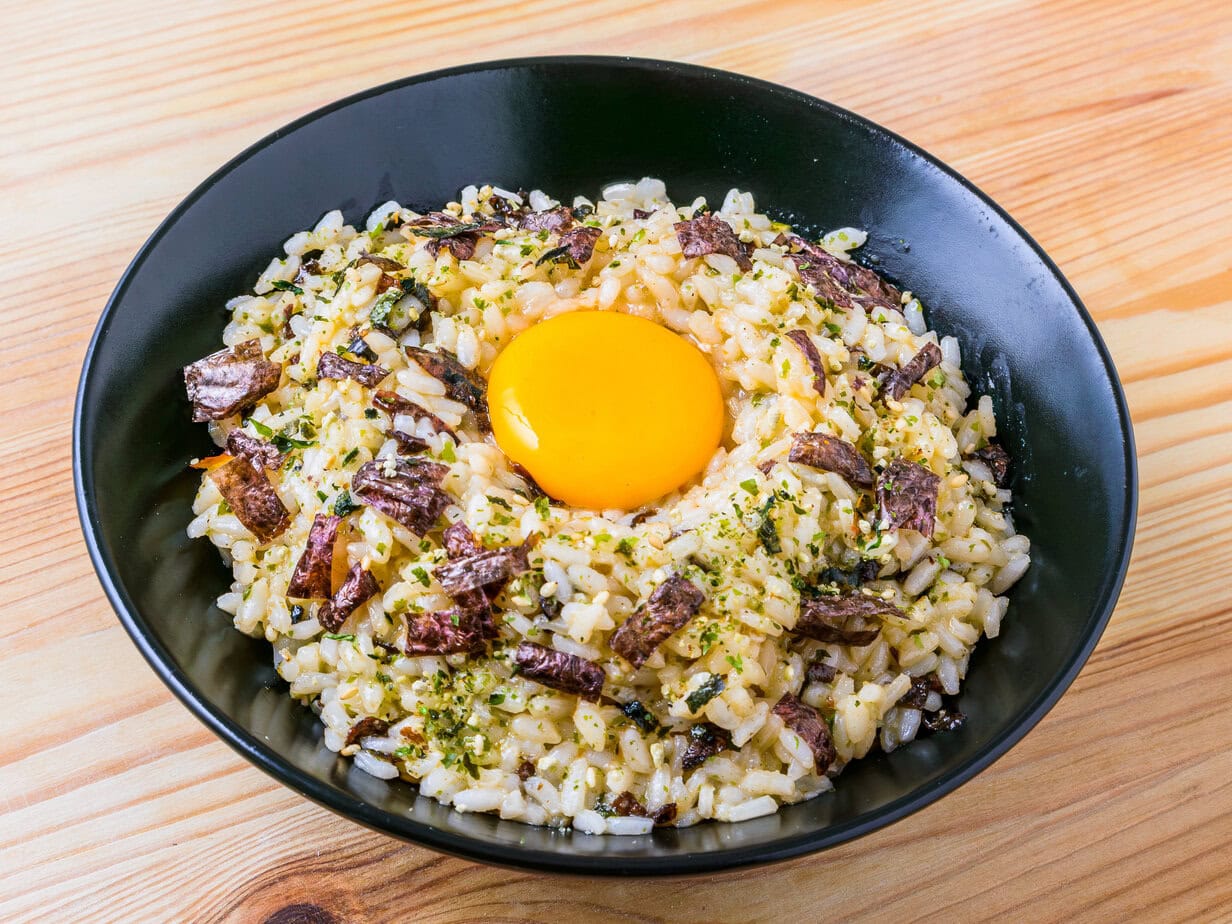
These notes come from the Maillard reaction between the rice’s starch and amino acids. You can eat it plain, as crispy rice shards, or steep it in hot water to make sungnyung, a comforting scorched rice infusion served at the end of a meal.
The origins of nurungji
Sources trace nurungji as a formal dish back at least to the Goryeo era. A 12th-century Chinese account describes suksu, “cooked water” poured over scorched rice, a direct ancestor of sungnyung. During the Joseon dynasty, this crust was no longer just a peasant leftover: at court, hot water was poured into the bottom of the pot to end the meal with a gentle drink made from scorched rice.
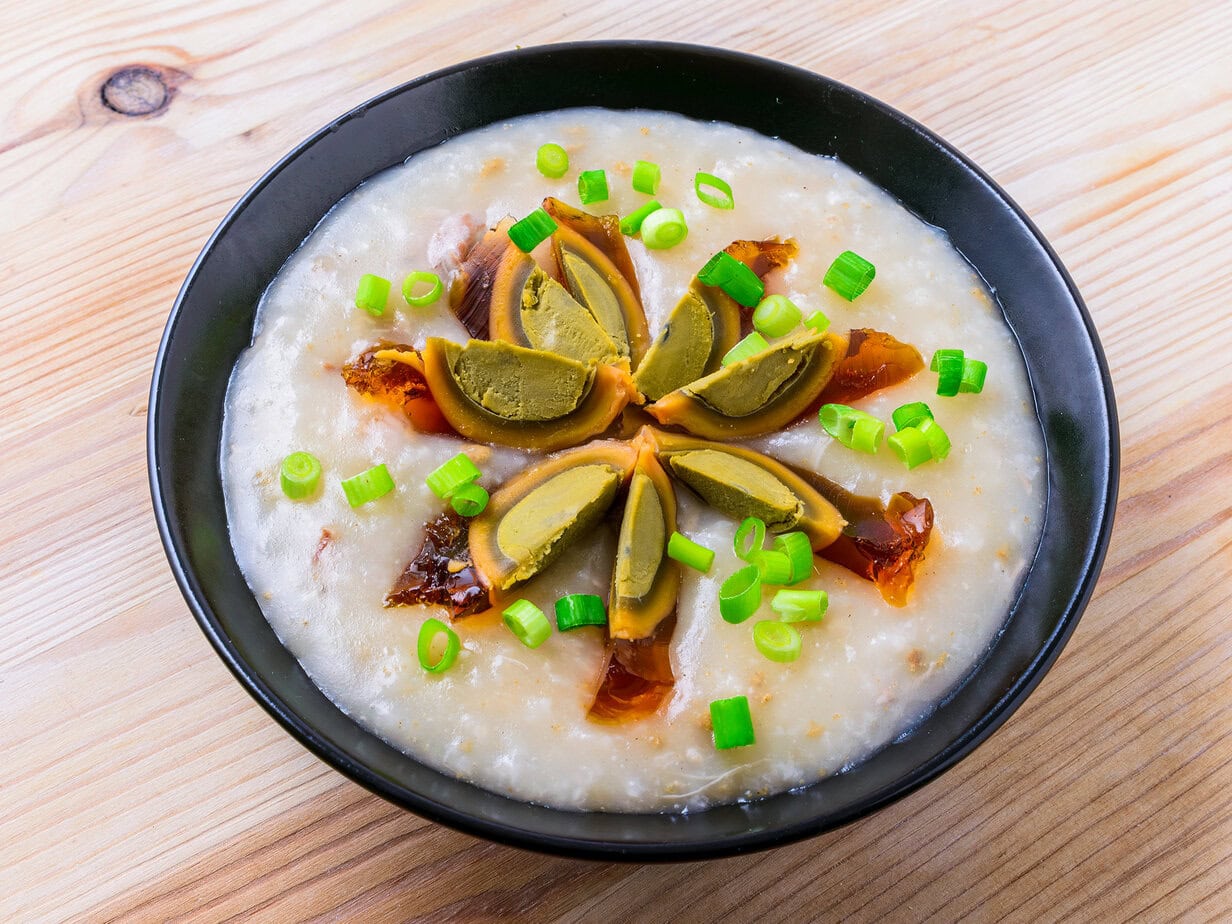
The medical treatise Dongui Bogam (1613) mentions this scorched rice, calling it chwigeonban, as a remedy to soothe the stomach. In Korea, where rice was precious, nothing went to waste: the crust was scraped up for a nourishing snack, and some even let the rice stick more to get extra, sometimes even frying the shards.
This practice is tied to cooking in a gamasot, a heavy cast-iron cauldron set over a wood fire: the water evaporates, heat concentrates at the bottom, the rice browns, and a crust forms. Unlike Chinese steaming, which separates rice from water, this direct contact makes the crust almost inevitable. Later, nurungji is used in nurungji baeksuk.
Key ingredients: making a lot with almost nothing
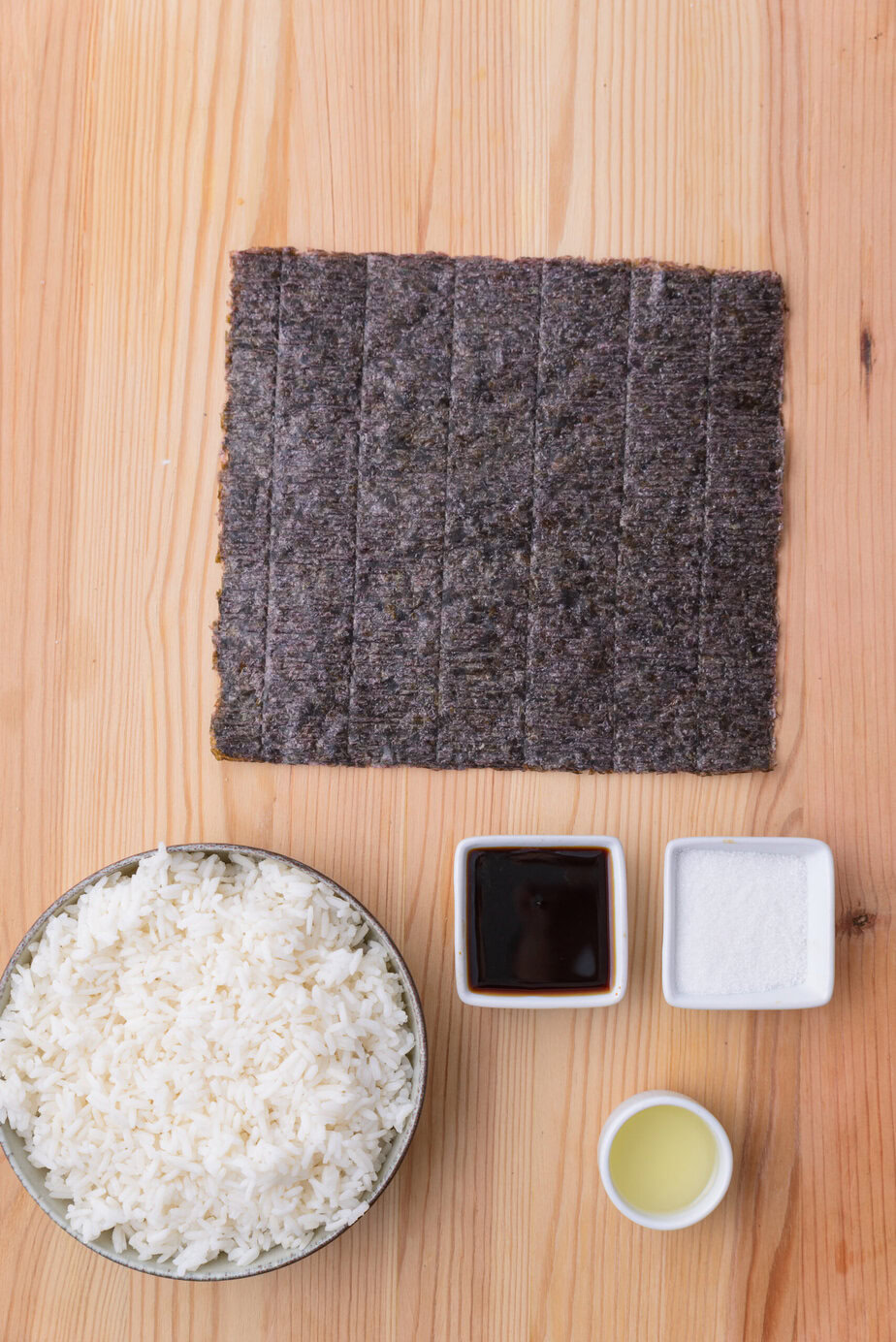
Traditional nurungji is made with the same short-grain white rice (sushi rice) eaten every day: round, polished, and rich in starch, it sticks just enough to form a layer at the bottom of the pot, then hardens into a crust as it browns. Nothing special is added: just rice and water, no salt or other seasoning. As the water evaporates, the rice at the base dries and browns where it touches the metal.
Mixes with brown rice, barley, or millet make a heartier crust, but polished white rice is still the standard. For a richer treat, you can add soy sauce, sugar, and more.
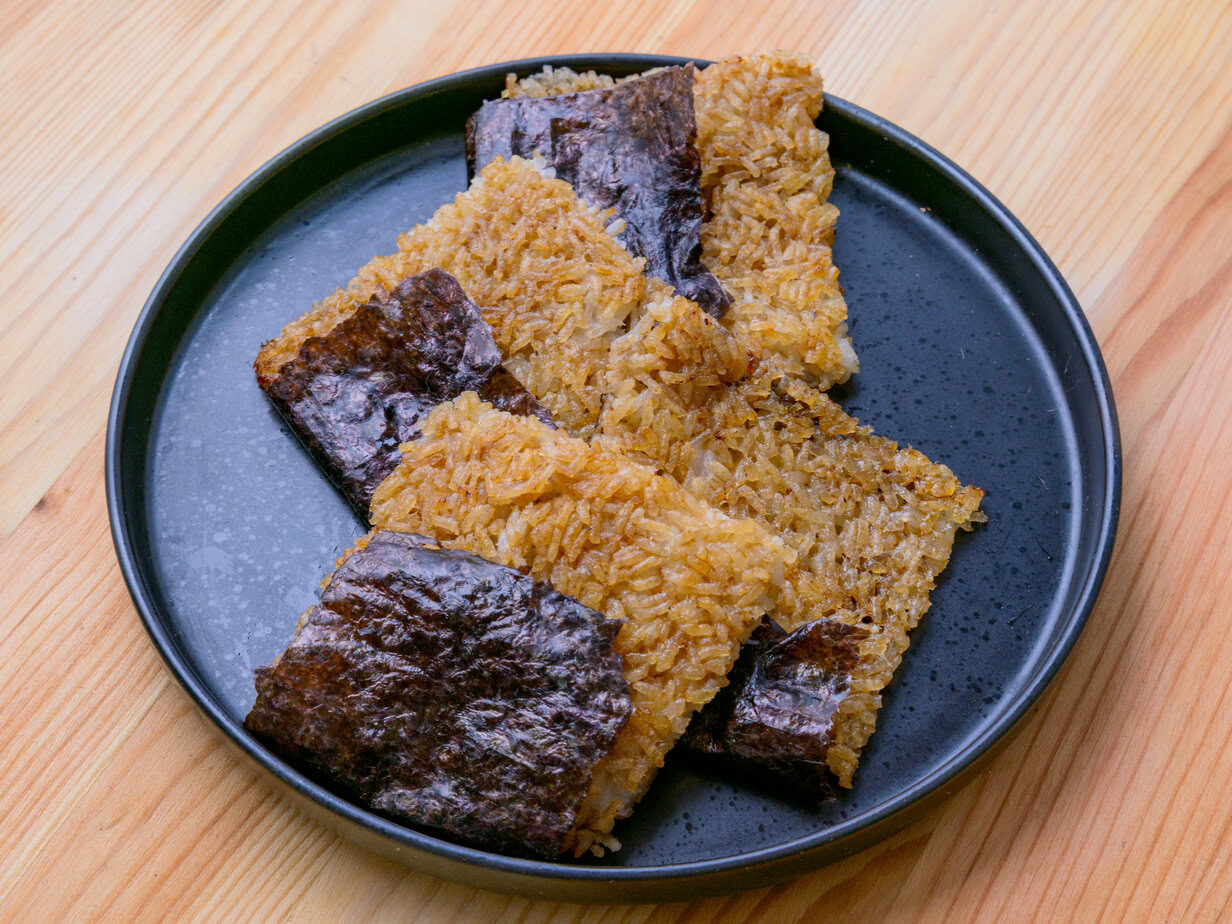
Ingredients
- 400 g cooked rice day-old or cooled (≈200 g dry weight)
- 2 sheets nori
- neutral oil for frying
Glaze
- 3 tablespoons light soy sauce
- 3 tablespoons sugar
Instructions
Preparation
- Heat a nonstick skillet over medium. Add a drizzle of neutral oil and swirl to coat.neutral oil
- When hot, add the cooked rice and press it into a thin, even layer with a spatula.400 g cooked rice
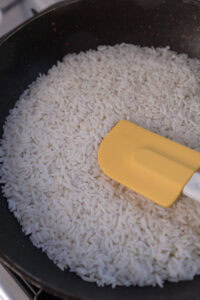
- Cook until golden and crisp, about 5 minutes. Carefully flip and cook another 5 minutes, pressing to enhance the crunch.
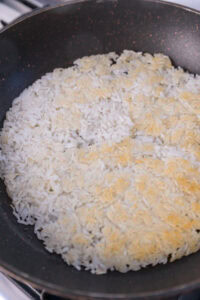
- Meanwhile, stir the light soy sauce and sugar until the sugar dissolves to make a glaze.3 tablespoons light soy sauce, 3 tablespoons sugar
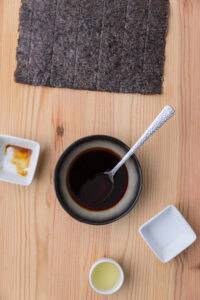
- Brush the top of the rice with glaze, flip, then brush the other side.
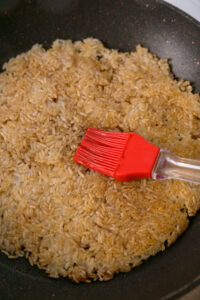
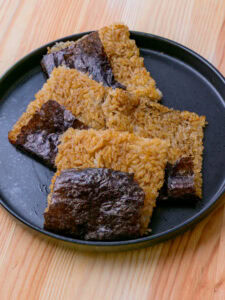
- When deeply crisp, transfer to a board and cut into 4 pieces. Cut the nori sheet into rectangles and wrap one around the base of each piece.2 sheets nori
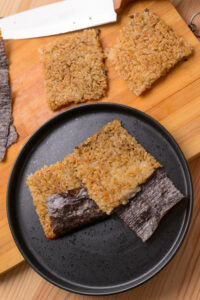
- Serve right away while still crispy.
Notes
- Use day-old cooked rice for the crispiest texture.
- Watch the pan—the rice should brown, not burn.
- For a spicy, nutty kick, add a little sesame oil or gochugaru to the glaze.
Nutrition
Culinary sources
• Korean Nurungji: history, benefits, ingredients, and recipe – Tistory (Korean)
• Scorched rice crust – Wikipedia (English)
• Sungnyung (숭늉), Korean scorched rice infusion – Encyclopedia of Korean National Culture (Korean)
• Nurungji (누룽지), Korean scorched rice crust – Encyclopedia of Korean National Culture (Korean)
• Nurungji, also known as scorched rice crust – Uwajimaya – Uwajipedia (English)
• Who loves nurungji? How do you like to make and eat it? – Reddit – r/KoreanFood (English)
• What’s the best way to make crispy rice (nurungji)? – Reddit – r/KoreanFood (English)
• Korea–China–Japan: who is the nurungji champion? – K-Food Times (Korean)


So crisp and addictive, the glaze is perfect! 😋
Made this nurungji last night and loved how balanced it felt, light and crisp yet still satisfying thanks to the simple rice and nori combo. The soy glaze adds just enough flavor without making it heavy, so it feels like a more nutritious snack than most crunchy treats 🙂
Made this nurungji last night and the soy-sugar glaze turned out perfectly crisp and addictive; honestly it’s as good as (maybe better than) the version I’ve paid for at Korean restaurants. Love how the edges stay crunchy while the middle has that slight chew 😋
This nurungji is the ultimate comfort food, so crisp and toasty with that sweet soy glaze, it instantly brings cozy vibes. Perfect rainy-day snack with tea when you just want something warm and comforting 😊