
Kuta has a reputation problem. Ask the question on any travel forum and the responses split cleanly: first-time visitors curious about its beachfront location and low prices, and returning travelers who advise everyone to skip it entirely. The truth, as usual, sits somewhere in between. Kuta is loud, commercial, and unapologetically touristy. It’s also ten minutes from the airport, with the best beginner surf beach in Bali, and hotel rooms at prices the rest of the island stopped offering years ago.
This guide breaks down Kuta’s neighborhoods, the hotels worth booking, and the traveler profiles who will actually enjoy staying here. If you’re planning a broader Bali trip, our https://marcwiner.com/guide-complet-visiter-bali/ covers the entire island, and our https://marcwiner.com/ou-loger-bali/ compares all the main areas side by side. But if you’ve already decided Kuta fits your trip, or you’re still weighing it against other areas, here’s the in-depth guide.
Why Choose Kuta for Your Bali Stay
Kuta exists because of its location. Ngurah Rai International Airport sits at the southern tip of the area, and most hotels in central Kuta are 10-15 minutes by car from the arrivals hall. For travelers landing late at night or departing early in the morning, this proximity alone justifies a night or two here. No other beach area in Bali is this close to the airport.
The second reason is price. Kuta and its immediate surroundings form the cheapest coastal accommodation zone on the island. Dorm beds start around 8 to 10 euros per night. Clean double rooms with air conditioning and a pool run between 20 and 40 euros. Even the five-star resorts here cost less than their equivalents in Seminyak or Uluwatu. If you’re traveling on a tight budget and want to be near a beach rather than inland, Kuta is where the numbers work out.
Third: surfing. Kuta Beach is a long sandy bottom break with consistent rolling waves, no reef underneath, and warm water year-round. It’s unanimously considered Bali’s best spot for learning to surf. The sandy bottom means wipeouts are forgiving. Surf schools line the beach, and a two-hour lesson with board rental costs around 15 to 25 euros. If you came to Bali specifically to try surfing for the first time, staying in Kuta puts you 200 meters from your classroom.
Fourth: nightlife. Kuta’s nightlife is cheap, loud, and unpretentious. Sky Garden is the main club. Paddy’s Pub is the classic bar. A night out here costs two to three times less than the same night in Canggu or Seminyak. The dress code is flip-flops and Bintang singlets. If that appeals to you, you’ll have a good time. If it puts you off, you now know to stay elsewhere.
And finally, walkability. Unlike Canggu or Uluwatu, where a scooter is practically mandatory, central Kuta and Legian are walkable. The main strip along Jalan Legian connects shops, restaurants, bars and the beach within walking distance. For families who don’t want to rent a scooter, or solo travelers who prefer to avoid riding in traffic, this changes everything. You’ll find the best local eating spots in our https://marcwiner.com/ou-manger-bali/.
The real downsides, to be honest: Kuta is noisy 24 hours a day. Street vendors and touts will approach you constantly. The beach accumulates trash during the rainy season (December to March). The area has no cultural atmosphere. If your image of Bali involves terraced rice fields, temple ceremonies and quiet mornings, Kuta will disappoint you within an hour of arrival. It’s a beach town built for tourism, and it doesn’t pretend to be anything else.
Kuta’s Neighborhoods: Which to Choose?
People say “Kuta” as if it’s one place, but greater Kuta includes four distinct zones with different price levels, noise and atmosphere. Choosing the right neighborhood is more important than choosing the right hotel.
Central Kuta
Central Kuta is the strip between the beach and Jalan Legian, roughly from Kuta Beach to the Beachwalk Mall area. This is ground zero: the highest concentration of cheap hotels, souvenir shops, massage parlors, bars and fast food. It’s also the noisiest part. Bar music carries until 2 or 3 AM. Touts call out from every doorway. The streets are narrow and clogged with motorbikes.
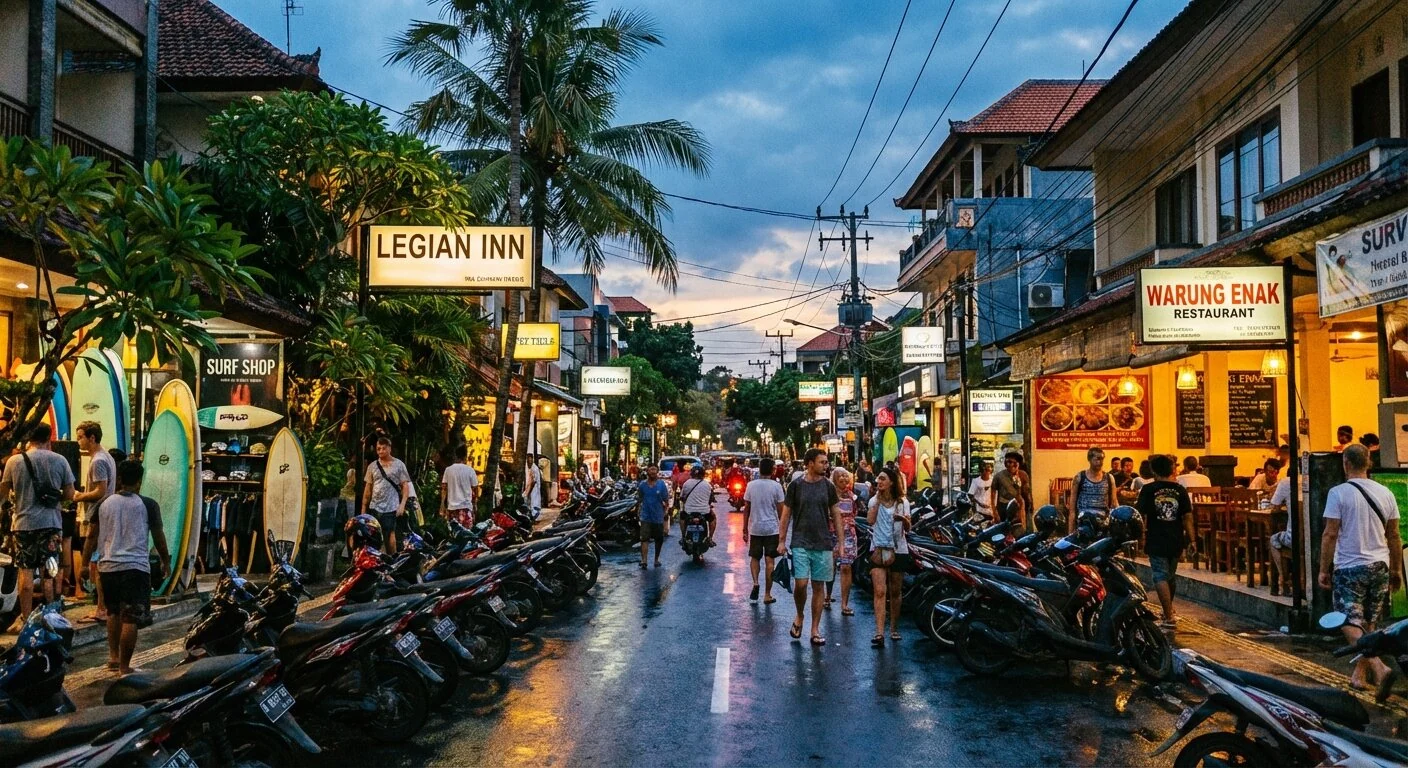
The upside of central Kuta is convenience. Everything is five minutes on foot. The beach is right there. Beachwalk Mall has air-conditioned shopping, a supermarket, restaurants and a cinema. The Sheraton and Aloft hotels connect directly to the mall, which is a real advantage if you want to eat or shop without crossing the chaotic streets. Waterbom Bali, one of Asia’s best water parks, is a ten-minute walk south.
Stay in central Kuta if: you want the cheapest rooms near the beach, you plan to surf every morning, or you’re only spending one night near the airport before moving on. Avoid if you’re a light sleeper or aggressive sales tactics annoy you.
Legian
Legian starts where Kuta calms down, roughly from Jalan Melasti heading north along the beach toward Seminyak. This is the zone experienced travelers call the “sweet spot”: cheaper than Seminyak, less frenetic than central Kuta, and walkable to both. The beach here is essentially the same strip of sand, but the crowd thins out and the atmosphere shifts from party strip to something that feels more like an actual vacation.
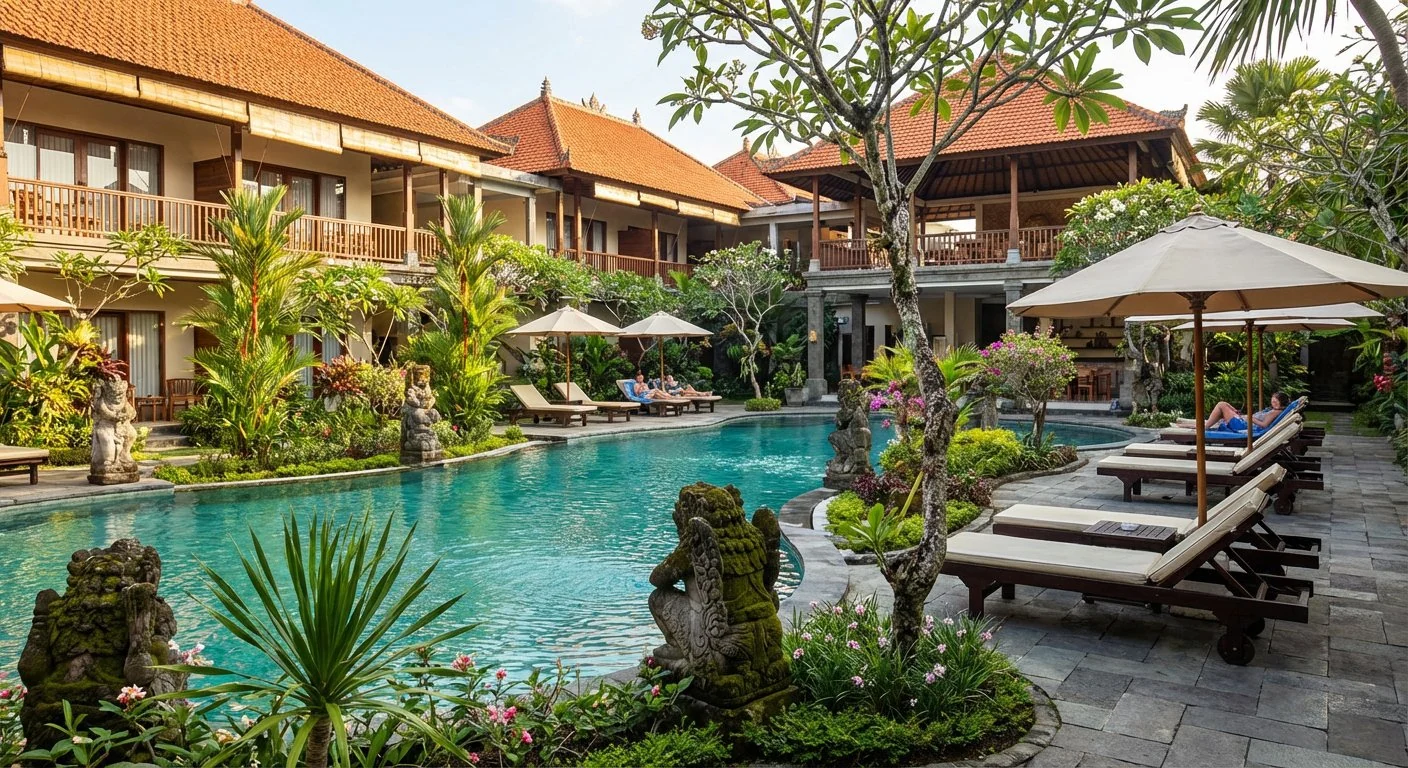
Jalan Padma and Jalan Melasti are the key streets. They connect Jalan Legian (the main inland road) to the beach and have a good mix of restaurants, small shops and hotels. Garlic Lane, a side alley off Jalan Legian in the Legian sector, is known for cheaper shopping without the aggressive sales tactics that plague central Kuta. The beach path along the sand connects Legian to Kuta and Seminyak, making it easy to walk in both directions.
Legian is home to the area’s best resort: Padma Resort Legian. We’ll discuss it more below. But beyond the big names, the mid-range options here consistently get better reviews than their equivalents in central Kuta. Three Brothers Bungalows has a “jungle in the city” feel with dense gardens and traditional Balinese architecture. Bali Mandira Beach Resort has an artificial sand beach integrated into its pool area, a clever solution for families who want the beach vibe without unpredictable ocean currents.
Legian is the right choice for most travelers staying in the Kuta area. You have access to Kuta’s nightlife and surf without living in the middle of it.
Tuban (South Kuta)
Tuban sits between central Kuta and the airport, south of the main tourist strip. The streets are wider. Traffic is lighter. Touts are fewer. It feels like a different town, even though it’s technically a ten-minute walk from central Kuta’s chaos.
Tuban is where the family resorts are. Bali Dynasty Resort is the most recommended family hotel in all of greater Kuta. It has a kids’ water park, teen club, family rooms with bunk beds, and an Irish pub on-site called Gracie Kelly’s (convenient when the kids are asleep and you want a drink without leaving the property). Holiday Inn Baruna is the quieter alternative: large gardens, beachfront location and affordable spa. Bintang Bali Resort is another solid option with more classic Balinese character.
Tuban also has easier airport access than central Kuta. When traffic hits (and it will), the journey from Tuban to the airport remains manageable while roads from central Kuta or Legian can be stuck for an hour. Lippo Mall, just south of the main area, has a cinema, food court and supermarket that are less crowded than the Beachwalk.
Tuban is the best choice for families with young children, travelers who want quiet nights near the airport, and anyone who finds central Kuta too oppressive but still wants to stay in the area.
North Kuta / Seminyak Border
The northern end of Legian blends into Seminyak, and the border is more gradient than line. This transition zone is home to some of the area’s newer boutique hotels and trendier restaurants. Prices climb here compared to central Kuta, but they stay below Seminyak proper. You have cleaner streets, a notch-up food scene, and the ability to walk south to Legian’s bars or north to Seminyak’s beach clubs.
The Stones Hotel sits right on this border. It’s a modern property with a large pool, and it suits travelers who want Kuta prices with quality closer to Seminyak. Pullman Legian is another option in this zone: family-friendly, beachfront, and positioned as a compromise between the two neighborhoods.
This border zone suits couples and travelers who want to dip a toe into Kuta without being surrounded by the atmosphere. If your budget can stretch a bit beyond central Kuta prices, this sector gives you more comfort per euro spent.
Best Hotels and Accommodation by Budget
Kuta accommodation ranges from 8-euro dorm beds to 350-euro resort suites. Here’s what each price bracket actually gets you.

Budget: Under 30 Euros per Night
At this price level, Kuta really delivers. Cara Cara Inn is a clean, central budget hotel that backpackers regularly recommend. Rooms are small but functional, and the location puts you walking distance from both the beach and Beachwalk Mall. Puri Rama functions as a social hostel if you want to meet other travelers.
In this range, expect air conditioning, hot water, and usually a small shared pool. Don’t expect soundproofing. The cheaper the room, the closer you are to Jalan Legian noise. A useful trick: book an upper floor room on the side opposite the main road. It makes a noticeable difference.
Budget rooms in Legian offer better value than the same price in central Kuta. You pay the same price but get a quieter location. Three Brothers Bungalows in Legian, for example, has traditional Balinese cottages in a garden setting from around 25 to 35 euros, which is a completely different experience from a concrete box in a noisy alley.
Mid-Range: 30 to 100 Euros per Night
This is where Kuta’s value proposition is strongest. For 50 to 80 euros per night, you get rooms that would cost double or triple in Seminyak or Uluwatu.
Poppies Bali is the gem in this range. The place has a “secret garden” feel, with cottage-style rooms arranged around a natural pool, hidden behind walls that block out central Kuta noise. The property has character, which most Kuta hotels lack. Kuta Seaview Boutique Resort and Grand Barong Resort are solid, no-surprise mid-range hotels, well-located with decent pools. Le Baleka has pool access rooms and sits in a slightly quieter corner while staying central.
In Legian, Kumala Pantai is an older hotel with beautiful gardens and two beachfront pools. It’s not flashy, but beachfront location at mid-range prices is hard to beat. Ossotel has a more modern boutique style. Bali Mandira Beach Resort, mentioned earlier for its sand beach pool, sits at the top of this range and remains one of the best mid-range family hotels in the area.
At this budget level, prioritize location over amenities. A 50-euro room in Legian on the beach side of Jalan Legian will be a better experience than a 50-euro room in central Kuta with nicer finishes but noise everywhere.
High-End and Luxury: 100 to 400+ Euros per Night
If you’re spending luxury money in the Kuta area, the question arises: why not Seminyak or Uluwatu? The answer usually comes down to airport proximity, access to Waterbom Park, or the Padma Resort Legian.
Padma Resort Legian is consensus best hotel in greater Kuta-Legian. It runs around 250 to 350 euros per night and is worth the price. The gardens are immaculate. The infinity pool has an adults-only section. The breakfast buffet is regularly ranked among Bali’s best. The “Club” room upgrade gives access to evening cocktails and snacks in a private lounge. If you want to splurge once during a Bali trip and prefer a resort over a villa, the Padma is where travelers say to do it.
Sheraton Bali Kuta Resort is the only true five-star beachfront in central Kuta. It connects directly to Beachwalk Mall, has a pool with sunset views and family suites. The mall connection alone sets it apart from other luxury options: you can shop, eat or browse without stepping into the chaotic street. Aloft Bali Kuta, also connected to the Beachwalk, is a notch down in room size but newer and well-located.
Hard Rock Hotel Bali suits families with older kids and teens. The pool scene is lively, the location is central, and the hotel plays up the rock’n’roll theme with enough energy to entertain teenagers. Discovery Kartika Plaza is a beachfront property with large spaces and connecting rooms, designed for families who want more space.
Kuta Beach Heritage Hotel sits at the epicenter of Kuta action, with a rooftop pool and sunset views. Warning: the location is extremely noisy. If you’re a light sleeper, choose something else.
In Tuban, Bali Dynasty Resort (100 to 180 euros) and Holiday Inn Baruna (80 to 150 euros) are the family-oriented luxury choices. It’s not traditional luxury in the marble-and-champagne sense, but they’re well-run resorts designed around families, and they deliver on their promise.
Last Night Before Airport Hotels
If you just need somewhere to sleep before an early morning flight, skip the Kuta strip. Hilton Garden Inn and Novotel, both located near the airport, exist precisely for this. It’s clean, quiet, and minutes from the terminal. Better than navigating alcohol-soaked streets at 4 AM to catch a taxi.
Kuta for Families, Couples and Solo Travelers
Families
Kuta works surprisingly well for families, but the right sub-neighborhood matters more here than anywhere else in Bali.
Tuban is the best zone for families with young children. Wider streets mean strollers actually work. The kids’ facilities at Bali Dynasty Resort ensure children stay busy without parents constantly improvising. Waterbom Bali is a ten-minute walk or short taxi ride, and it really is one of Asia’s best water parks. Older kids cite it as a trip highlight.
Legian suits families with older children who can handle busy streets better. The beach walking path, Beachwalk Mall dining options and generally calmer atmosphere than central Kuta make things manageable. Bali Mandira’s pool concept is particularly kid-friendly for children who want to play “at the beach” without parents worrying about currents.
Central Kuta is not ideal for families with young children. Streets are chaotic, noise runs late, and constant vendor approaches become exhausting when you’re managing a toddler. Families with teens who want some autonomy may find it works, since everything is walkable and the area is safe enough during daytime.
One real advantage Kuta has over Canggu for families: no scooter needed. In Canggu, scooters are nearly essential for daily life, which is dangerous with young children. In Kuta and Legian, feet and short taxi rides handle everything.
Couples
Central Kuta is a poor choice for couples seeking romance. The noise, crowds and general atmosphere work against you. However, Legian and the Seminyak border have reasonable options.
Padma Resort Legian, with its adults-only pool section and resort gardens, suits couples who want a beach resort without Seminyak prices. Beachfront sunsets in Legian are identical to Seminyak’s (it’s the same coastline), but you pay less for the hotel room.
For couples on a tight budget, Legian guesthouses have private rooms with character. Poppies Bali’s cottage-garden setting has a romantic quality that’s totally absent from most Kuta hotels. But let’s be honest: if romance is your trip’s main goal, Ubud’s jungle villas or Uluwatu’s cliff resorts will suit you better. Kuta is practical, not romantic.
Solo Travelers
Kuta is one of Bali’s easiest places to travel solo. The backpacker infrastructure is well-established. Hostels are cheap and social. Surf schools are organized for individuals. And the nightlife is the kind where strangers end up at the same table before midnight.
For budget solo travelers, the hostels and cheap hotels in central Kuta work. Cara Cara Inn and Puri Rama both function. The beach is free, surf lessons are affordable, and a night out doesn’t require much money.
Safety note for solo travelers: Kuta isn’t dangerous, but it has the most petty crime in Bali. Phone snatching by motorbike riders exists. Don’t walk with your phone in hand near the road, especially at night. Use Grab or Gojek rather than walking alone when drunk or carrying valuables. Avoid the beach after dark. Street dealers (“mushroom” sellers) are aggressive and sometimes linked to police traps or scams. Never talk to them. Indonesia has extremely strict drug laws and consequences are severe.
Beaches and Surfing in Kuta

Kuta Beach stretches in one unbroken arc from Tuban in the south, through central Kuta and up to Legian. The sand is light brown, sunsets face directly west over the Indian Ocean, and waves are consistent year-round. It’s not a pretty beach by Southeast Asian standards. The water is murky compared to the Bukit Peninsula coves, and during the rainy season (December to March), currents bring plastic waste and debris onto the sand. But it’s a functional beach, flat, wide and suitable for walking, running and learning to surf.
Surfing is Kuta’s main asset. The sandy bottom means there’s no reef to hit when you fall off the board. The whitewater is consistent and forgiving. Hundreds of people learn to surf here every week, and the success rate is high. Pro Surf School and Odysseys Surf School are the two most frequently recommended operators on the beach. Both have good reputations for safety and teaching quality. A group lesson costs around 15 to 25 euros for two hours, board included. Private lessons run between 30 and 50 euros.
Legian Beach, the northern continuation, has similar conditions: sandy bottom, suitable for bodyboarding and beginner surfing. The crowd is slightly sparser. Tuban Beach, to the south, can have rocks and reef patches, making it less ideal for beginners but slightly quieter.
For strong swimmers and snorkeling enthusiasts, Kuta beaches are not the right place. Water quality varies and waves make snorkeling impractical. For that, you need the Bukit Peninsula or the east coast. Our https://marcwiner.com/plus-belles-plages-bali/ covers the full range of options across the island.
During the rainy season, beach quality drops noticeably. Trash accumulates, water turns brown after storms and currents strengthen. If you’re visiting between December and March, book a hotel with a good pool and consider the beach a bonus rather than the main attraction. The Sheraton’s pool, Padma’s infinity pool and Bali Dynasty’s water park hold up regardless of what the ocean is doing.
Getting Around from Kuta
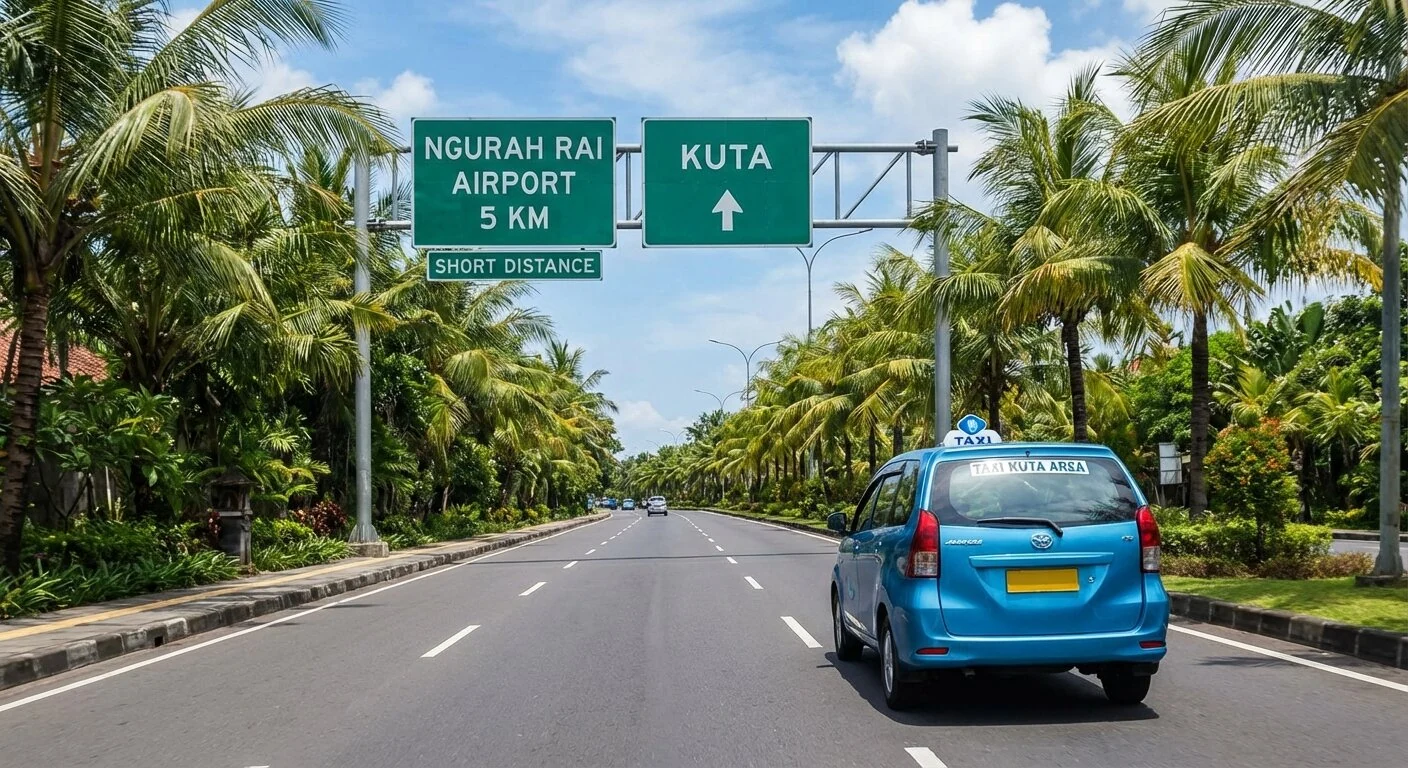
Kuta’s central location in southern Bali makes it a logical base for day trips, but traffic is the island’s worst. Distances that look short on the map take much longer in practice. The main road north from Kuta toward Seminyak and Canggu can be stuck for hours during rush hours. Knowing real travel times prevents plenty of frustration.
To the airport: 10 to 20 minutes from central Kuta, 5 to 15 minutes from Tuban. This is Kuta’s biggest practical advantage. No other beach area gets you to the terminal this quickly.
To Seminyak: 15 to 30 minutes depending on traffic. Walkable from north Legian via the beach path (about 30 to 40 minutes walk). The beach walk is often faster and more pleasant than a taxi in traffic jams.
To Uluwatu and the Bukit Peninsula: 30 to 50 minutes by car or scooter. Southbound traffic is generally smoother than northbound. Uluwatu Temple and the Kecak dance at sunset make a good half-day trip from Kuta.
To Ubud: 1 to 2 hours depending on traffic. This is the day trip most Kuta visitors attempt, and the travel time surprises everyone. Google Maps says 45 minutes; reality says 90 minutes or more during busy hours. A private driver for the day costs around 35 to 50 euros and is the most comfortable option. If you want to spend serious time in Ubud, consider booking a few nights there rather than making the round trip. Our https://marcwiner.com/ou-loger-ubud-bali/ covers the best neighborhoods and hotels if you decide to split your stay.
To Canggu: 30 to 60 minutes. Despite apparent proximity on the map, traffic between Kuta and Canggu is consistently bad. This surprises first-time visitors.
To Sanur: 20 to 40 minutes. Sanur is the departure point for boats to the Nusa Islands. If you plan to visit Nusa Penida or Nusa Lembongan, the morning journey from Kuta to Sanur port is doable but tight if your boat leaves early.
Transport options: Grab and Gojek work well in the Kuta area for ride-hailing. Taxis are plentiful but agree on a price or insist on the meter. Scooter rental costs around 5 to 7 euros per day if you’re comfortable riding in Balinese traffic. For day trips to Ubud, Uluwatu or the east coast, a private driver is worth the cost. Check out our https://marcwiner.com/activites-excursions-bali/ for ideas of things to do once you’re there.
Our Practical Tips for Kuta
Scams and Hassles to Watch For
Kuta concentrates more petty scams and street harassment than any other tourist area in Bali. Nothing dangerous, but it eventually wears you down.
Phone snatching is the main real risk. Motorbike riders grab phones from pedestrians, especially people walking near the road looking at a map or taking a photo. Walk on the inside of the sidewalk and keep your phone in a zipped pocket when you’re near traffic.
Street dealers approach tourists, especially at night around bars. They offer mushrooms, weed or other substances. Some are police traps set up to extract bribes. Others are pure scams. Indonesia has extremely strict drug laws. Engaging with these people has no upside and serious downsides. Walk past without responding.
Taxi scams are less common since Grab and Gojek exist, but unmetered taxis still try to overcharge, especially from the airport. Use ride-hailing apps or negotiate the price before getting in.
Money changers on Jalan Legian sometimes use rigged calculators or sleight-of-hand when counting bills. Use ATMs or reputable exchange offices (BMC and Central Kuta Money Exchange have decent reputations). Recount your money carefully before leaving.
Surfboard rental scams on the beach involve agreeing on an hourly price, then claiming you stayed longer than you actually did. Take a photo of the time when you take the board, and clearly confirm price and duration before starting. Better yet: book through a real surf school.
Best Time to Visit
The dry season (April to October) is the best time for Kuta. The beach is cleaner, surf is consistent and weather is sunny without extreme humidity. July and August are peak season with higher prices and more crowds.
The rainy season (November to March) brings late afternoon showers, higher humidity and beach trash. December and January are the worst months for beach cleanliness. Hotels are cheaper during this period, and if you prioritize pools and nightlife over beach time, the reduced prices might be worth it.
For surfing, Kuta works year-round. Waves are consistent in both seasons. The rainy season can even have slightly bigger swells.
Booking Tips
Agoda consistently shows better prices than Booking.com for hotels in the Kuta area. Check both before booking (Booking.com is the default in France, but Agoda usually wins in Southeast Asia).
For stays of three nights or more, contact hotels directly via WhatsApp or email and ask for a direct booking rate. Many properties give 10 to 15% discount from platform prices to avoid commissions.
Hotels connected to Beachwalk Mall (Sheraton, Aloft) have a practical advantage beyond the rooms themselves. The mall connection gives you air-conditioned access to restaurants, a supermarket and shops without stepping outside. This matters more than you’d think, especially during rainy season or if you have young children. On the insurance side, remember to request your EHIC (European Health Insurance Card) before departure, even though Indonesia isn’t covered. It will be useful for any European stopovers. Also get travel insurance with medical evacuation: decent hospitals are concentrated in Denpasar, and medical evacuation from Bali is expensive. For more planning advice, our https://marcwiner.com/preparer-voyage-bali/ covers budgets, transport and logistics across the island.
If you’re choosing between a fancy room in central Kuta and a simpler room in Legian, choose Legian. Location quality matters more than room quality in the Kuta area. A hotel that’s not on the main strip guarantees radically better sleep.
Kuta vs Other Bali Neighborhoods
Kuta makes the most sense when you understand what it is compared to the alternatives. Here’s how it stacks up.
Kuta vs Seminyak
Seminyak is the “adult” version of Kuta. Cleaner streets, better restaurants, real sidewalks and a more polished vibe. Beach clubs like Potato Head and Ku De Ta attract the crowd that finds Kuta too rough. Prices are higher across the board: hotels, meals, drinks and shopping all cost more. If budget isn’t your main concern and you want a walkable beach area, most experienced travelers recommend Seminyak over Kuta.
Kuta’s advantages over Seminyak: lower prices (30 to 50% cheaper for equivalent accommodation), closer to the airport, better beginner surfing, cheaper nightlife and Waterbom Park.
Kuta vs Canggu
Canggu is Kuta’s philosophical opposite: smoothie bowls instead of Bintang beers, coworking spaces instead of souvenir shops, digital nomads instead of tour groups. Canggu has better food, a more interesting social scene for young travelers and a more “curated” atmosphere. But you need a scooter to get around (dangerous for families), beaches are gray sand, and prices have skyrocketed. Some regulars now say Canggu has become “as bad” as Kuta, but with more expensive coffee. The two areas are 30-60 minutes drive apart despite their apparent proximity on the map.
Kuta wins on: walkability, budget, beginner surfing and airport proximity. Canggu wins on: food, coworking, social scene and nightlife variety.
Kuta vs Ubud
These are two completely different experiences. Ubud is inland, surrounded by terraced rice fields and jungle, with temples, art galleries, yoga studios, and everything closes at 10 PM. Kuta is a beach town with nightlife and surfing. Most travelers spending a week or more in Bali visit both, starting with Ubud’s cultural sites when energy is at maximum, then moving to the coast for the second half. A two-stop itinerary (three to four nights in each) is most common for first-time visitors. Our https://marcwiner.com/ou-loger-ubud-bali/ covers Ubud’s neighborhoods and accommodation in detail.
Kuta vs Uluwatu
Uluwatu, on the Bukit Peninsula, has white sand beaches at the base of cliffs, clearer water and a more upscale atmosphere. It’s the best choice for experienced surfers (the reef breaks are fast and powerful), couples who want cliff villas, and anyone prioritizing beach quality. The trade-off is that Uluwatu requires a scooter, has fewer dining options and is farther from the airport. Kuta is the practical, cheap option; Uluwatu is the scenic, pricier option.
How Kuta Compares to Other Southeast Asian Beach Towns
If you’ve traveled the region, the closest equivalents to Kuta are Patong in Phuket and the beach cousin of Khao San Road. The same combination of cheap accommodation, loud nightlife, aggressive vendors and proximity to the main airport. Travelers who know Phuket can compare neighborhoods in https://marcwiner.com/ou-loger-phuket-quartiers/ and beaches in https://marcwiner.com/plus-belles-plages-phuket/. The accommodation strategy is similar: stay in the tourist hub for budget and convenience, or pay a bit more for a quieter nearby area.
For travelers choosing between Bali and other Southeast Asian destinations, the accommodation question deserves city-by-city research. Our guides for https://marcwiner.com/ou-loger-bangkok/ and https://marcwiner.com/ou-loger-hanoi/ follow the same neighborhood-by-neighborhood format, and the general guides for https://marcwiner.com/guide-complet-visiter-bangkok/ and https://marcwiner.com/guide-complet-visiter-hanoi/ help with overall planning.
The Verdict
Stay in Kuta if you’re a first-time visitor who wants the simplest possible base near the airport. Stay in Kuta if you want to learn to surf. Stay in Kuta if your budget is tight and you want a beach. Stay in Tuban if you’re a family with young children who wants water parks and wide streets. Stay in Legian if you want a compromise between Kuta prices and Seminyak comfort.
Don’t stay in Kuta more than a few nights. The consensus among travelers who know Bali is clear: two or three nights are enough to surf, enjoy the nightlife and use it as a launch pad. After that, move on. Ubud, Uluwatu, Canggu, Sanur, or even just moving up to Seminyak will give you a completely different side of the island. Kuta is a starting point, not a destination.