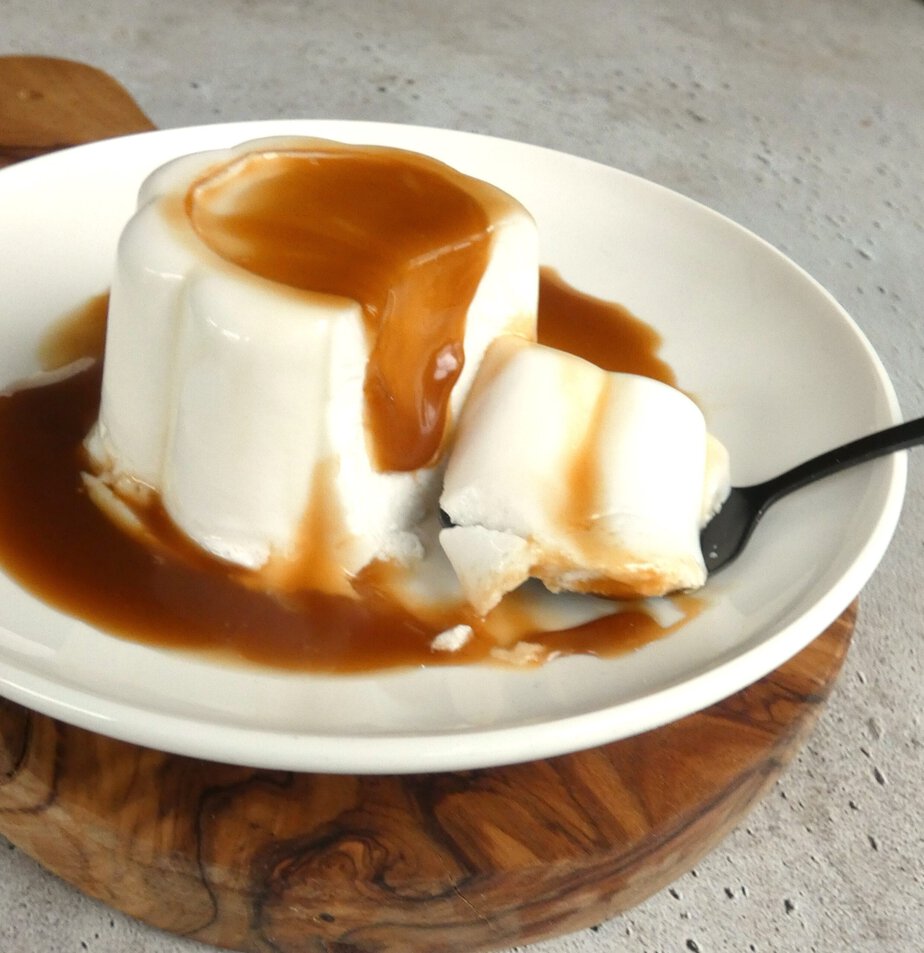
Sugar-Free Coconut Milk Panna Cotta
This sugar-free panna cotta combines coconut milk with a firm yet melt-in-the-mouth texture, enhanced by a caramel topping.
Print Recipe
Pin the recipe
Servings: 4 servings
Ingredients
- 400 ml coconut milk from a carton or can; I used 17% fat coconut milk (which is fairly standard)
- 5 g gelatin approximately 3 sheets of 1.75 g or 3.5 sheets of 1.5 g, or 1 g of agar-agar
- 30 g stevia white powder
- 1 pinch salt
Optional
- 1 teaspoon Bourbon vanilla powder or one vanilla pod
Topping
- 4 tablespoons sweetener caramel-flavored liquid
Procédé
Preparation
- If using gelatin sheets: soak the gelatin in cold water for at least 10 minutes. You can leave it longer. Make sure the sheets do not stick together. If using powdered gelatin or agar-agar, skip this step.5 g gelatin
Boil the milk
- Bring the coconut milk to a boil with the white stevia, vanilla (if using) and salt. Let it boil briefly, stirring with a whisk. Be careful: it behaves just like heavy cream or milk. At first, it seems to take a long time. But once the mixture starts boiling, it can boil over very quickly. If this happens, briefly remove it from the heat or turn the heat down.400 ml coconut milk, 30 g stevia, 1 teaspoon Bourbon vanilla powder, 1 pinch salt
- Turn off the heat. Squeeze the water out of the sheets. Then let them dissolve in the milk one at a time, whisking thoroughly. If using powdered gelatin, keep the heat on low and give the powder a little time to dissolve. With agar-agar, however, let it boil thoroughly with the milk. The milk will already start to thicken slightly.
- Let the mixture cool briefly in the saucepan. The cooler the mixture, the less the vanilla will sink straight to the bottom (and end up entirely on top after unmolding). However, the mixture should still pour easily when you fill the molds. If using agar-agar, also leave the milk in the saucepan for a little while. The thickened mixture settles slightly as it cools. If you pour it straight away, the panna cotta will sink a little in the middle.
- Divide the mixture among the molds. If they are still very hot, let them cool a little longer outside the refrigerator. Then refrigerate for at least 3 hours. The longer they chill, the firmer the panna cotta will become. With agar-agar, setting is quicker and, if necessary, it can also set at room temperature.
Unmold just before serving
- Loosen the panna cotta from the edges of the molds as much as possible without damaging it. A small, flat knife with a rounded tip works very well.
- If using slightly flexible molds, gently squeeze them on all sides. If using molds with a vacuum release, invert them directly onto the serving plate.
- If the panna cotta does not release easily, fill a cup or small bowl with hot tap water. Hold a mold by the top and dip it into the water for a few seconds. Take it out, dry it lightly and try unmolding again.
- Spoon the topping over the panna cotta. Enjoy!4 tablespoons sweetener
Notes
The quantity is based on a large carton or a can of coconut milk. It is enough for 4 molds of about 120 to 150 ml each. If using smaller molds, it is best to make more portions, otherwise you will have a lot of mixture left over. For example, you could fill 5 molds of 100 ml each, leaving a little space below the rim.
Equipment: small molds, small saucepan (with a handle), whisk, small bowl of cold water, small precision scale, cup of hot water.
Did you make this recipe?Tag @marcwiner on Instagram!