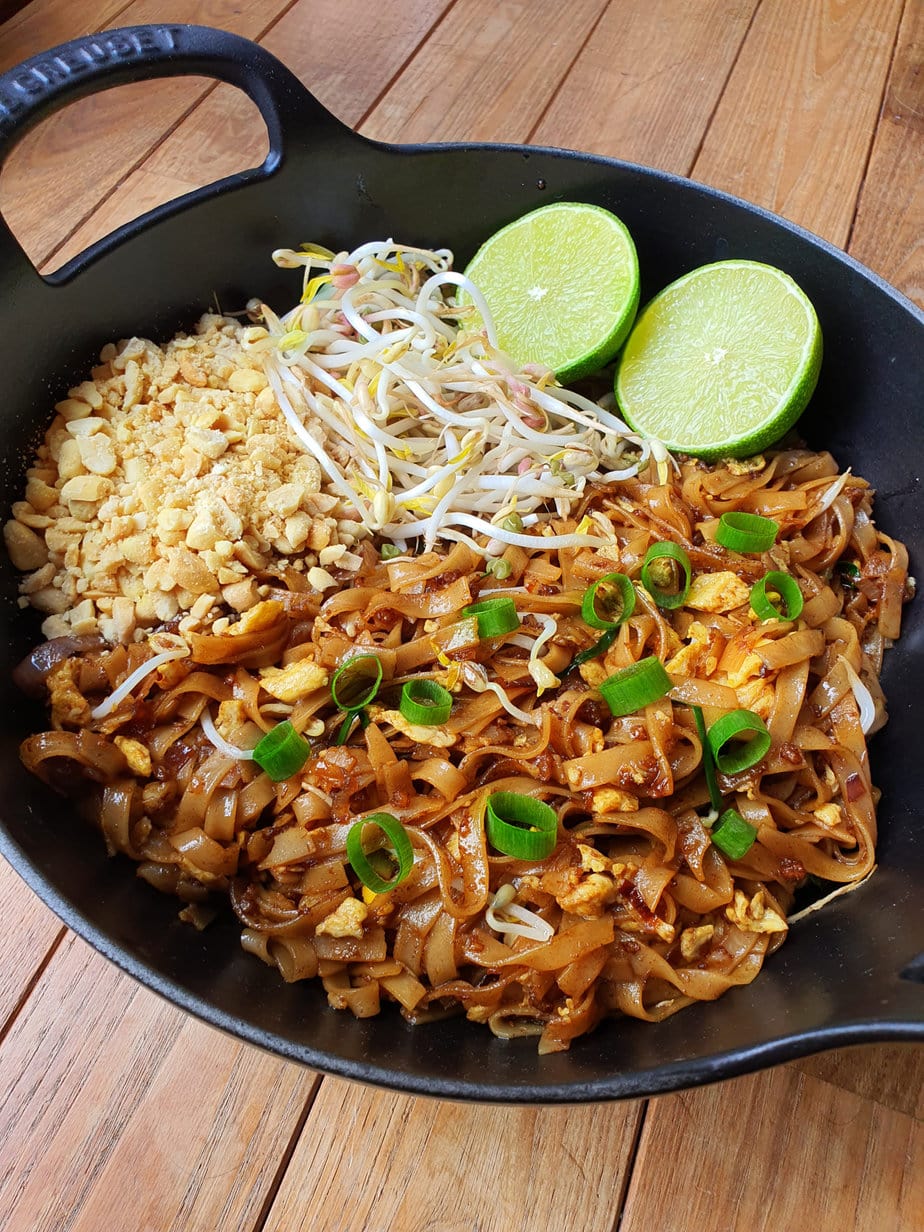
Servings: 2 servings
Calories: 844kcal
Equipment
- 1 Wok
Ingredients
Pad Thai Sauce
- 6 tablespoons brown sugar
- 4 tablespoons fish sauce
- 40 g tamarind pulp softened; if using tamarind concentrate, use twice the amount (in ml)
- 120 ml boiling water for the tamarind pulp
- 2 tablespoons dark soy sauce ideally, use Thai "black" soy sauce from the brand "Healthy Boy"
Other
- 75 ml water
- 250 g rice noodles dry weight; pre-cooked according to the instructions in the recipe
- 1 pinch salt to taste
- 1 teaspoon white pepper
- 25 g dried shrimp ground to a powder
- 4 garlic cloves sliced
- 2 shallots thinly sliced
- 3 large eggs beaten
- 1 handful bean sprouts
- 1 handful Thai chives cut into 1 cm slices
- 4 tablespoons peanuts roughly chopped
- 2 limes, for serving
Procédé
Sauce
- If using tamarind pulp, mix it with the boiling water. If using concentrate, skip to step 4.120 ml boiling water, 40 g tamarind pulp
- Break up the pulp and mix well, removing any seeds as needed.
- Strain the mixture through cheesecloth.
- Prepare the sauce by mixing all the ingredients thoroughly in a bowl.6 tablespoons brown sugar, 4 tablespoons fish sauce, 40 g tamarind pulp, 2 tablespoons dark soy sauce
Cooking the Noodles
- Submerge the noodles in hot water (not boiling, just hot) and soak for 5–10 min.250 g rice noodles
- The noodles should be pliable but not fully soft. It may seem counterintuitive, but you’ll see. Drain and set aside.
Stir-Fry
- Blend the dried shrimp (or mince very finely) to a powder.25 g dried shrimp
- Heat a saucepan or wok over medium-high with a thin layer of oil. Let it get very hot.
- Add the powdered dried shrimp and stir constantly for 2 minutes.25 g dried shrimp
- Add the shallots and stir-fry for 2–3 minutes.2 shallots
- Add the garlic and stir-fry for 2–3 minutes.4 garlic cloves
- Increase to high heat, add the noodles and sauce, and toss well.250 g rice noodles
- Add the water, mix well, and let it almost completely evaporate. A tip I learned from a chef in Thailand—it gives the noodles the perfect final texture.75 ml water
- Reduce heat to medium-high, push the noodles to one side, and add the eggs to the other. Cook for 30 seconds to 1 minute, then scramble. Fold into the noodles.3 large eggs
- Add the chives, white pepper, and bean sprouts; toss for 1–2 min.1 teaspoon white pepper, 1 handful bean sprouts, 1 handful Thai chives, 1 pinch salt
- Serve with chopped peanuts and limes.4 tablespoons peanuts, 2 limes, for serving
Notes
For pad thai rice noodles, there’s a simple trick for perfect results (and that signature, authentic texture). If you prefer, you can cook the noodles according to the package, but I highly recommend trying this method.
In short, the noodle cooking happens in two stages:
- Submerge the noodles in hot water (not boiling, just hot) and soak for 5–10 min. They should be pliable but not fully soft—it may seem counterintuitive, but you’ll see. Drain and set aside.
- The second stage happens in the pan, as the recipe describes. Because the noodles are only partially cooked, they finish cooking in the sauce and oil, which gives them a unique texture that’s truly inimitable.
Nutrition
Serving: 200g | Calories: 844kcal | Féculents: 152g | Protein: 37g | Fat: 9g | Saturated Fat: 3g | Polyunsaturated Fat: 2g | Monounsaturated Fat: 3g | Graisses trans: 0.03g | Cholesterol: 407mg | Sodium: 1099mg | Potassium: 722mg | Fiber: 5g | Sugar: 15g | Vitamin A: 388IU | Vitamin C: 5mg | Calcium: 177mg | Iron: 4mg
Did you make this recipe?Tag @marcwiner on Instagram!