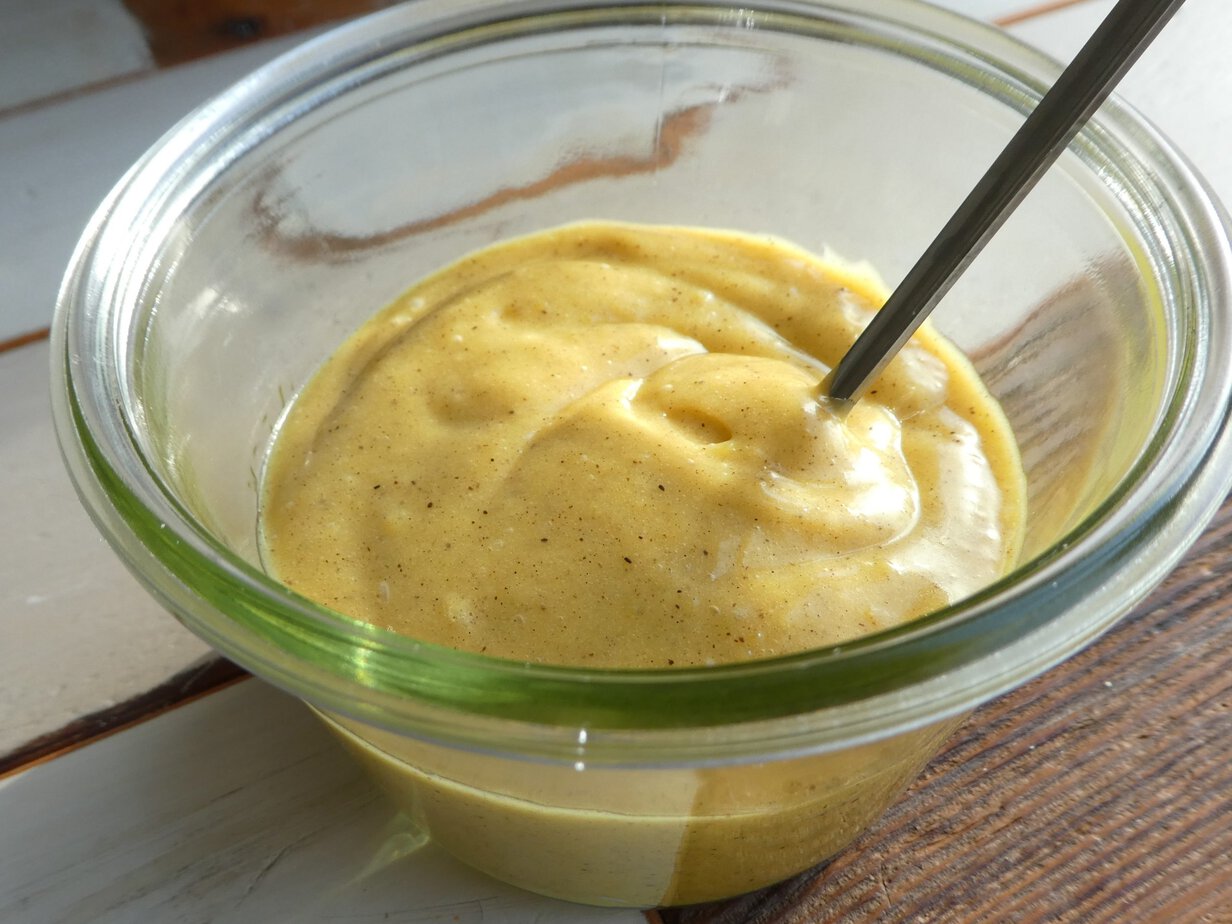
Servings: 6 servings
Ingredients
- 4 egg yolks at room temperature
- 2 lemons
- 100 g butter (from grass-fed cows), substitute lactose-free butter or goat's milk butter
- 30 g powdered sugar (or powdered erythritol for a sugar-free version)
- 2 teaspoons Bourbon vanilla powdered, or 2 vanilla beans
Procédé
- Melt the butter with the powdered sugar (or erythritol) and vanilla in the small saucepan. The butter may foam a little as it heats, but do not let it brown. Let it cool if it is too hot: when you use it, you should still just be able to dip a finger into it.100 g butter, 30 g powdered sugar, 2 teaspoons Bourbon vanilla
- Separate the eggs and place the yolks in the bowl that will later sit over the saucepan to form a double boiler. Do not use the whites.4 egg yolks
- Add the juice of two lemons to the yolks. Use room-temperature eggs and lemons. Whisk together until smooth.2 lemons
- Set the bowl containing the egg and lemon mixture over the saucepan of simmering water and keep whisking until the mixture becomes a little creamier. The egg yolks will gradually thicken. Do not let them curdle (this will happen around the edges first). If this happens, immediately lift the bowl off the steam, or remove the entire saucepan from the heat.
- Then lower the heat a little and continue. Even if the mixture has curdled slightly, you can still save the curd by stirring it thoroughly. Keep stirring. You should also just be able to dip a finger into the egg yolks without the mixture feeling too hot.
- The egg yolk mixture and the butter mixture should be at roughly the same temperature. This is essential, otherwise the curd will separate when you combine them (the fat and water will not mix). Both the eggs and the butter should therefore be hot, but not too hot. Pour the butter into the egg yolks a little at a time, stirring continuously.
- After about 10 minutes (often as little as 5), the curd should be ready. It will be creamy at this point, but will thicken a little more as it cools.
Notes
A basic lemon curd recipe consists of whole eggs or egg yolks, lemon juice, sugar, and butter. Lemon zest is often added as well. It is a little like a pudding or a custard, but made without milk or cream. Eggs are the only thickener used.
Curd is usually eaten cold. It can be spread like a thick jam on pancakes, for example, and is used in pastries and served with scones. You can dip cookies into it or use it as one of the layers in a trifle.
The proportions of the ingredients can vary from recipe to recipe, as can the preparation method. You can even simply heat everything together in a small saucepan. However, there is a slightly greater risk that the mixture will not come together properly or that the eggs will curdle too quickly.
For a low-carb version, I replace the sugar with powdered erythritol. Erythritol has a slightly sharp taste at the front of the mouth, which heightens the lemon's acidity. So I don't use too much lemon, and I add vanilla to round out the flavor. You can also make the curd with coconut sugar instead of powdered sugar or erythritol.
Equipment: a bowl set over a saucepan to form a double boiler, a small saucepan, small containers, a whisk.
Did you make this recipe?Tag @marcwiner on Instagram!