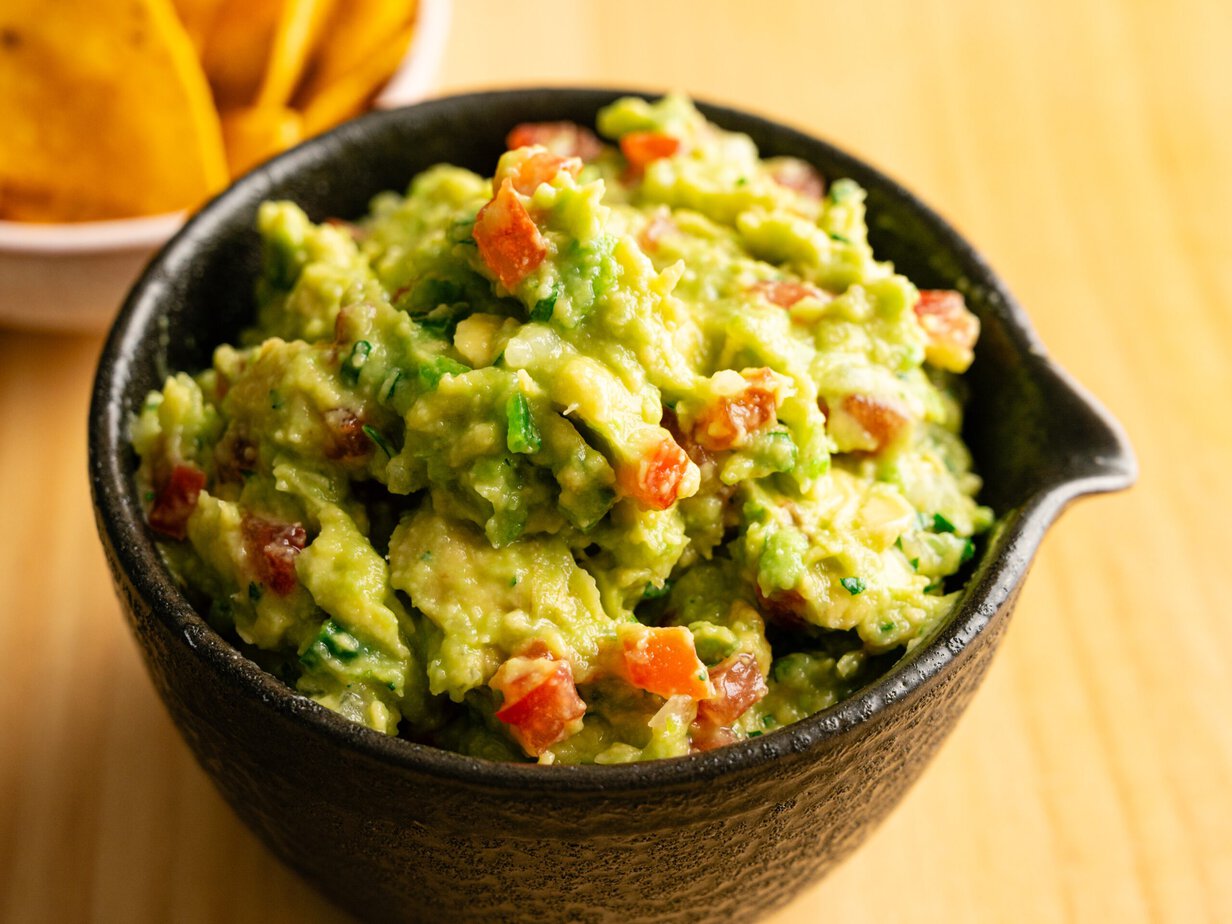
Servings: 6 servings
Ingredients
Chile Paste
- 1 teaspoon coarse salt
- 2 serrano chiles, very finely chopped
- 0.33 white onion, very finely chopped (1 tablespoon for the paste, the rest for finishing)
Avocados
- 3 large avocados, ripe, preferably Hass
Finishing and Serving
- 1 lime
- 0.33 bunch cilantro, chopped
- 1 tomato, seeded and cut into small dice (optional)
- Totopos (corn chips)
Procédé
Chile Paste
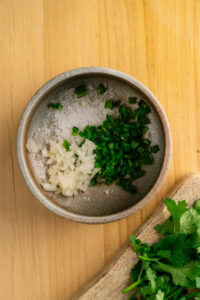
- Put the coarse salt, chopped chiles and one tablespoon of the chopped onion in the molcajete.1 teaspoon coarse salt, 2 serrano chiles,, 0.33 white onion,
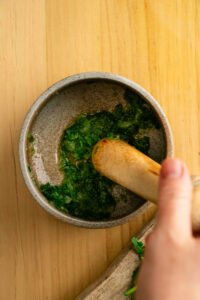
- Grind with the tejolote until you have a fragrant green paste: the coarse salt breaks down the chile's walls and releases its oil.
Avocados
- Cut the avocados in half lengthwise.3 large avocados,
- Twist the two halves in opposite directions to separate them.
- Remove the pit by striking it with the knife blade so the blade lodges in it, then twisting to free it.
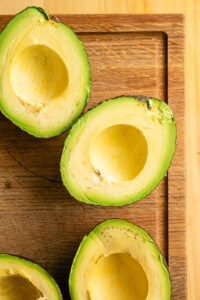
- Scoop out the flesh in one piece with a spoon.
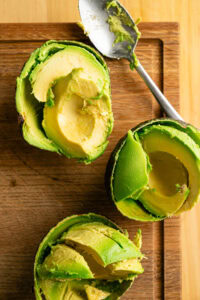
- Put the flesh in the molcajete, on top of the chile paste.
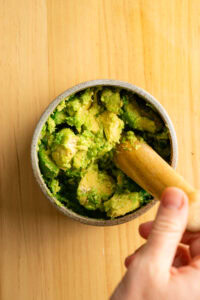
- Mash with the tejolote only three or four times: you want fingernail-sized pieces surrounded by creamy flesh, not a puree.
Finishing and Serving
- Squeeze the lime over the avocado.1 lime
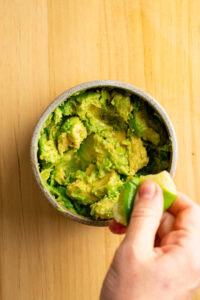
- Stir with a spoon, without mashing any further: from this point on, the tejolote is no longer needed.
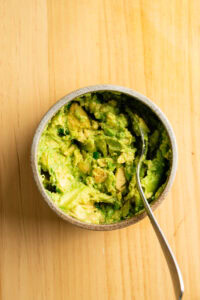
- Add the rest of the onion, the cilantro and the tomato, if using.0.33 bunch cilantro,, 1 tomato,
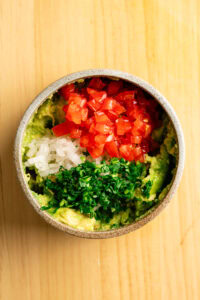
- Stir gently, lifting the mixture from the bottom up, to distribute the ingredients without crushing the pieces of avocado.
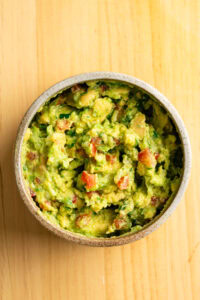
- Taste and adjust the salt: avocado is rich and often needs more than you'd think.
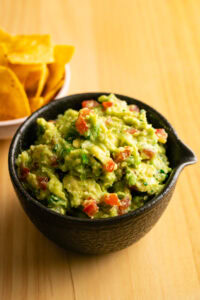
- Serve immediately, in the molcajete, with totopos: guacamole is at its best two minutes after it's finished.Totopos
Notes
The initial paste is the step almost nobody bothers with, and it's the one that adds the most flavor. The oil from the chile spreads through the whole guacamole instead of staying concentrated in the pieces. Every spoonful tastes of chile, rather than just a few bites being spicy.
If you mash for more than three or four strokes, you end up with a smooth puree and lose the contrast between creamy and firm, which is what guacamole's texture is all about.
The molcajete is the Mexican mortar made of volcanic stone, and the tejolote is its pestle. A blender or food processor will work, but the result is no longer guacamole: it's avocado cream. They also whip in air and speed up browning.
For the avocado, choose Hass whenever you can: it's richer and has a more buttery texture than smooth-skinned varieties. Check ripeness by pressing with your palm, not your fingertip, which bruises the flesh and leaves a mark that shows up later. The second check is the stem: if it comes off easily and the spot underneath is light green, the avocado is ready; if it's dark brown underneath, it's overripe inside.
Tomato is optional and divides opinion. If you use it, remove the seeds and the jelly-like pulp: that's water, and water turns guacamole into soup in twenty minutes. Keep only the flesh, cut into small cubes, and fold it in at the end.
In central Mexico, lime is traditionally added in small amounts, or not at all; in the north and abroad, much more. It provides the acidity that balances the richness of the avocado and slows oxidation. One lime for three avocados strikes a balance that doesn't mask the flavor of the avocado.
The most common mistakes. Runny guacamole: an unseeded tomato, or too much lime. Bland guacamole: it needs more salt. A puree: it was mashed for too long.
Quick browning: too little lime, or a container left uncovered. A bitter taste: an overripe or bruised avocado.
Guacamole doesn't get any better by sitting. If there's any left over, transfer it to a small container, smooth the surface, press plastic wrap directly against the guacamole and refrigerate. One day at most, and you'll probably need to remove the top layer.
Did you make this recipe?Tag @marcwiner on Instagram!