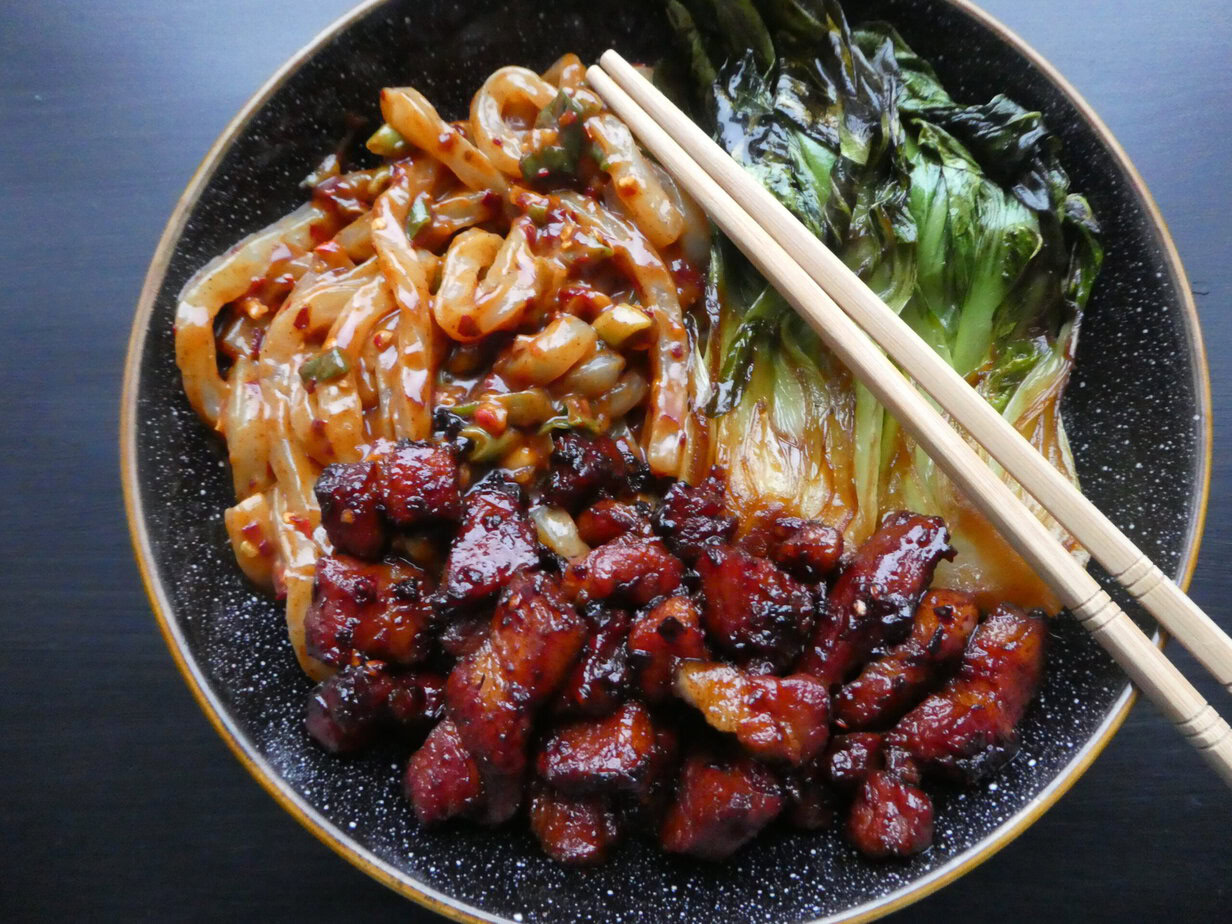
Konjac Noodles with Crispy Pork (Keto)
Konjac noodles coated in a garlic caramel sauce, served with crispy, chili-spiced pork.
Print Recipe
Pin the recipe
Servings: 1 serving
Ingredients
Pork belly
- 2 slices of pork belly (free-range)
- 0.5 teaspoon baking soda
- 2 teaspoons white vinegar or apple cider vinegar
- 1 teaspoon fish sauce (sugar-free)
- 3 tablespoons soy sauce or tamari
- 1 tablespoon chili flakes
- 2 tablespoons brown erythritol or white erythritol
- a generous splash avocado oil mild olive oil or high-oleic sunflower oil
Optional
- 0.5 teaspoon Sichuan pepper ground
Konjac noodles
- 1 serving konjac noodles or kelp noodles
- 3 tablespoons avocado oil, mild olive oil or high-oleic sunflower oil
- 3 cloves garlic
- 1 spring onion
- 1 tablespoon tahini or 1 tablespoon of almond butter
- 1 tablespoon soy sauce or tamari
- 1 tablespoon caramel-flavored liquid sweetener
- 1 tablespoon sesame oil
Procédé
- Cut the pork belly slices into strips or cubes. Marinate the pork belly pieces with the baking soda, vinegar, chili flakes, fish sauce and 2 tablespoons of soy sauce. Let rest for about an hour at least.2 slices of pork belly (free-range), 0.5 teaspoon baking soda, 2 teaspoons white vinegar or apple cider vinegar, 1 tablespoon chili flakes, 1 teaspoon fish sauce (sugar-free), 3 tablespoons soy sauce or tamari
- Rinse the noodles under running water in a colander. Let drain and pat dry.1 serving konjac noodles
- Heat the mild olive oil in a small saucepan. Do not let it get too hot. Crush the garlic with a garlic press and add it to the oil. This allows the garlic flavor to slowly infuse into the oil.3 tablespoons avocado oil, mild olive oil or high-oleic sunflower oil, 3 cloves garlic
- Heat the wok or frying pan and pour in a generous splash of oil. In Chinese cooking, you don't skimp on the oil... Stir-fry the pork belly over high heat.a generous splash avocado oil
- Once the pork belly is golden around the edges, lower the heat a little. Add the erythritol and the remaining tablespoon of soy sauce. Add more to taste if desired. Stir occasionally. Cook for about a quarter of an hour in total.2 tablespoons brown erythritol
- If using Sichuan pepper, grind it and add it to the meat.0.5 teaspoon Sichuan pepper
- Add the noodles, caramel syrup and soy sauce to the oil and garlic in the small saucepan. Let simmer together, keeping the heat gentle.1 tablespoon caramel-flavored liquid sweetener, 1 tablespoon soy sauce or tamari
- During the last few minutes of heating/simmering, add the sliced spring onion to the noodles. Also add the nut or seed butter. Let it melt briefly and mix well.1 spring onion, 1 tablespoon tahini
- Just before serving, add the sesame oil to the noodles.1 tablespoon sesame oil
Notes
Konjac noodles work well in many recipes: with chicken, shrimp or as a side dish.
Equipment: large PFAS-free frying pan (or wok), small PFAS-free frying pan (or saucepan), spatulas, garlic press, mixing bowl.
Did you make this recipe?Tag @marcwiner on Instagram!